Musings, Verse perverse

Tumble-Wash Epiphany

Of late I’ve been experiencing a strange mental turmoil.

Days and nights have been passing in a timeless, rather pleasant blur—nothing unusual about that, as the passing of days and nights in a blur has pretty much been part of my philosophy and lifestyle since 1963, when my Class 2 teacher recognized and highlighted it with a vitriolic comment or three. But in the past few months, the blur has been interspersed with short but incredibly vivid interludes of fantasy that are as engrossing and disturbing as they are impossible to wipe off the cerebral slate.

Last night, I actually experienced intense déjà vu within dream. The weird thing is (or was), in my dream I was not myself—meaning, I was not this dusty old bandicoot who even now sits in a dusty corner of East Delhi on a sultry mid-August night writing this crap. Instead, in my dream I was a dusty old historian from South Delhi in body, mind and soul, a part-time heritage walk mentor specializing in ancient Sultanate and Mughal monuments. I was walking through the Mehrauli Archaeological Park area on a grey, misty, bitterly cold January day with a small group of men, women, children, and a few other creatures including a squirrel wearing bifocals and the crafty look of an avaricious advocate. The walk was going quite well in my dream, though I was mildly irritated by the squirrel which kept asking me searching and intelligent questions about squinches, domes, arches and other such architectural things that I knew very little about, and  that chuckled and chittered loudly and derisively whenever I fumbled for answers.

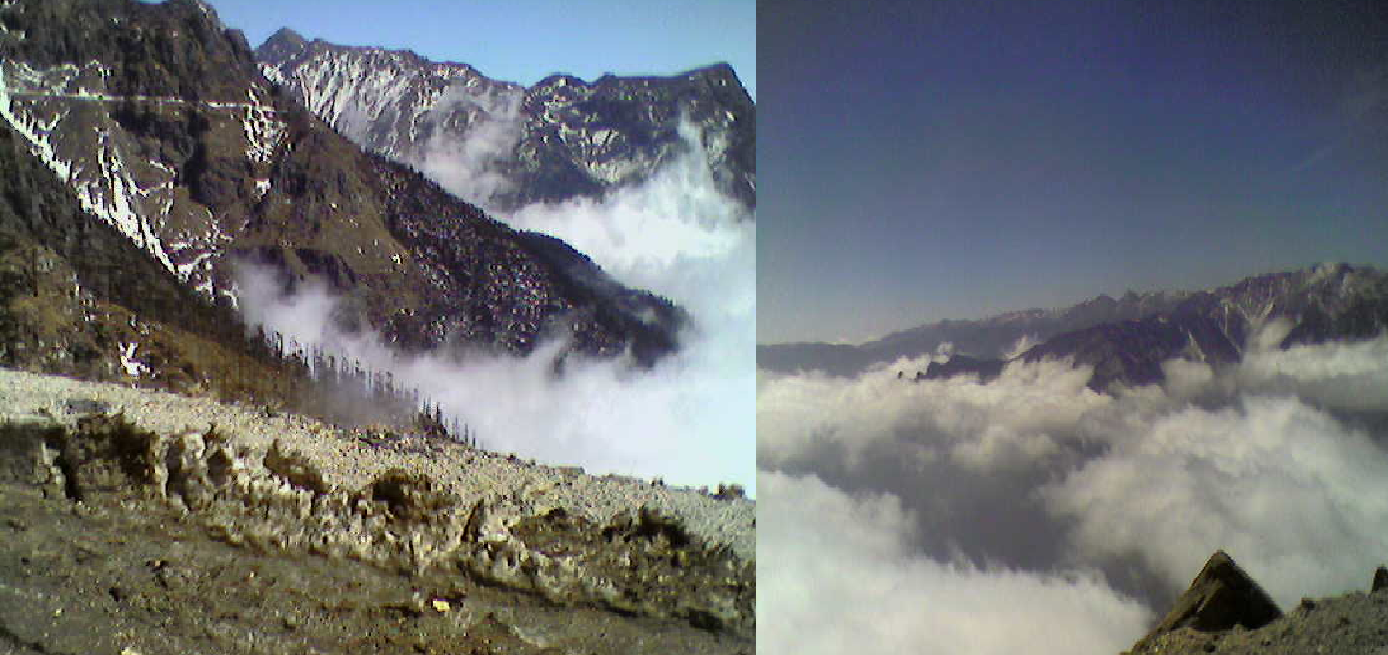
All at once, without warning, the swirling mist intensified into a white-out fog. Alarmed, I froze in mid-step and called to the others to stop …even in dream I remember noting how flat and muffled my voice sounded. And then, like the clouds of moisture-laden air that wander amidst the deep gorges of Sohra and Pynursla, the dense fog magically thinned into great billowing columns that parted like pearly curtains and evaporated into blue nothingness, and I found myself bathed in brilliant sunshine, and that’s when I realized two things:

One: I was no longer with my group in Mehrauli but standing alone, utterly alone on a vast, treeless sweeping slope strewn with scree, surrounded by incredibly tall snow-streaked mountains;

Two: I knew for sure I had never stood on that slope or ever seen those mountains in my life, yet I knew I had been there before, experienced that experience before…just as I knew exactly and fully what I would think and see and  hear and smell and taste and feel at the very next moment and at every moment from then onward, for ever and ever…
…And that’s when, even as I clutched on to that timeless déjà vu, it slipped away and vanished with the growing awareness that I must be in the coils of dream, because there was no way in which I, a heritage walk mentor, could have transported myself from Mehrauli in south Delhi to what appeared to be a steep mountain-side amidst the high Himalayas…leave alone experience déjà vu in that desolate place. And with that awareness that I was dreaming came a tidal wave of terror that I might awaken to find myself not the historian/heritage walk mentor that I actually was, but as someone else…perhaps even as a decrepit old writer lying in bed in east Delhi. And at that thought a great abyss of dread opened up deep within my mind as the tidal wave tossed and turned me hither and thither and eventually flung me, battered and bruised, on to the shores of consciousness where I lay trembling, awake at last.

How could I possibly have dreamed such a dream, in which I was not only someone else but had actually experienced déjà vu as that someone else?

I have no answers; only questions, that sound so demented I am almost too scared to voice them.

Yet I must.

Have the global clouds of angst and anxiety, spawned by Covid-19, finally overcome my cerebral defences? Do they now wait, like monsoon clouds in their brooding and silent enormity, to pour forth their giga-tonnes of fluid insanity and wash away what remains of my cognition in a raging neural flood?  

Have I waded for too long in the limpid pool of Mann Ki Baat, to now be flushed away and drowned in the foaming toilet of Monsoon ki Bath? 

Have I finally achieved the position grimly foretold for me by my class 2 teacher, and become quietly yet indubitably insane?

In the sacred name of Bakasura the Ravenous, will I ever be able to escape from this realm of Guiche into which I have wandered wonderingly and now wonder wanderingly?

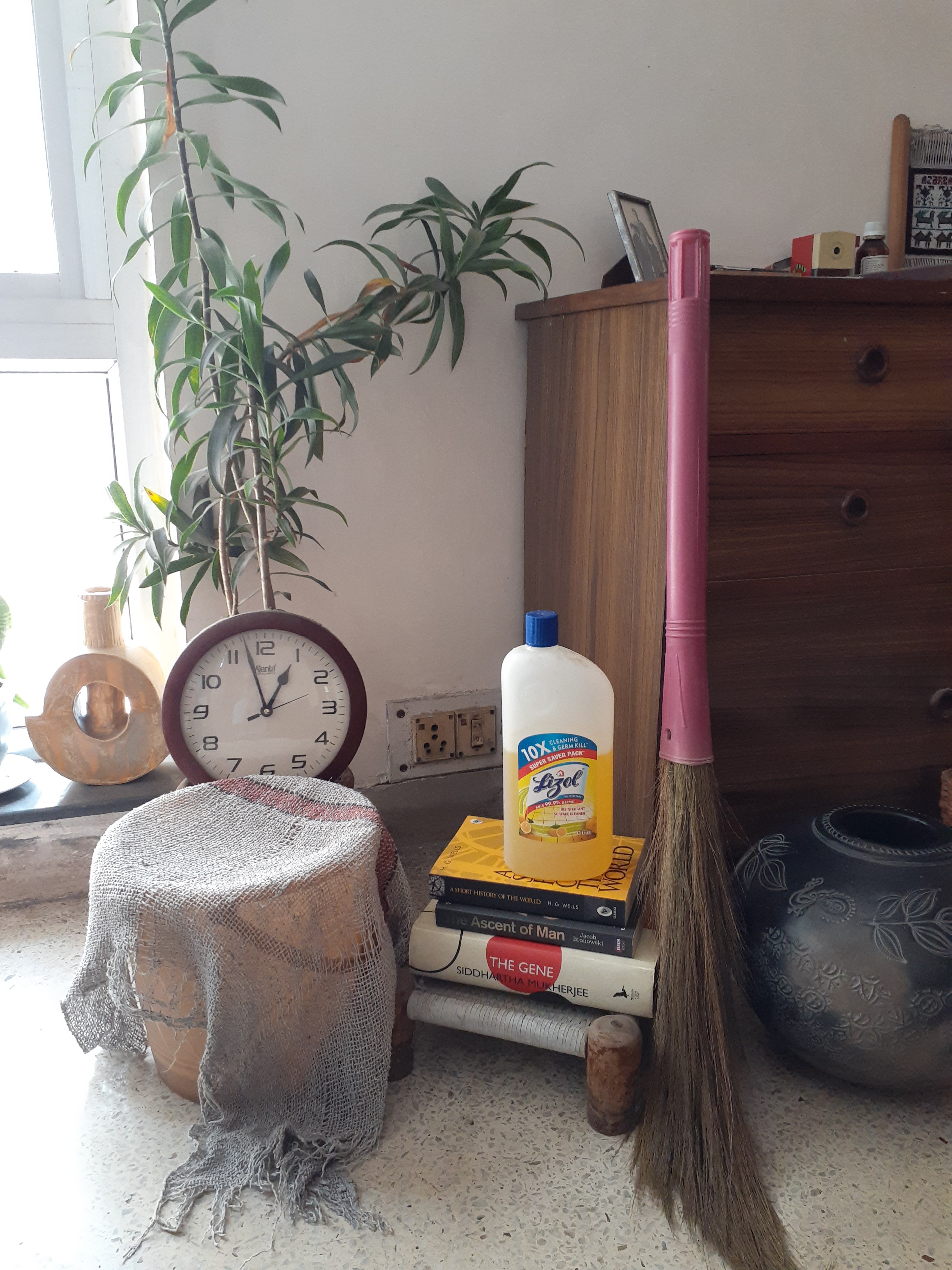
These and other troubled musings kept me tossing and turning till dawn; whereupon, after a few cups of healing tannin and caffeine solutions, I went up to the terrace and put a load of clothes to wash.  Watching the sheets and pillow cases tossing and turning in the washing machine just as I had tossed and turned half the night, I began to feel better. Slowly but surely, that familiar old timeless and rather pleasant blur of being returned to soothe my frayed neurons, dendrons and rhododendrons. The washing machine hummed contentedly; the birds chirped happily as they hunted bugs in the foliage; a squirrel streaked across the tiles, sat on its haunches a few feet away, chirruped a series of questions and stared at me through shrewd eyes, waiting for a response.  I stared back at it, wondering why its accent seemed so familiar…but the moment passed, as did the squirrel.

My questions may have no answers; I realize that now, as I write these words.  

Indeed, my answers may have no questions.

Yet I find some blurry comfort in the immortal lyrics of that great and little-known Tamil bard of yore, Konal Kuttilingam (c. 644–596 BCE) whose octrain ‘Ode to Calavai-Pen‘ was translated and soulfully rendered by Irish blues singer Anne O’Nimus at the New Orleans Jazz Festival, 1963 shortly before her tragic demise due to an accidental overdose of pandemonium nitrate.

Wash’d like a garment might thou feel, O beloved, in this Kaveri of Life

Beaten and scrubb’d by Great Calavai-Pen* on Her adamant stone

Yet despair not! Only by this Bath of Anguish, this Path of Strife

May’st thou for many Muttal-Thanams@ of the Past atone

Be joyful, then, as She cleanses thee, wrings thee

Spreads thee to dry: do not moan and groan

Behold! the Vapours of Illusion leave thee, pure and free

To ask: “Dog without bone, or bone without dog…who is more alone?

[(Tamil) *Calavai-Pen = washerwoman; @Muttal-Thanam = idiocies; boo-boos. Translation by the late lamented & lamentable Periachandu Dorai II of Mayiladuthurai (1946 – 1997)]
General ravings, Musings

Jhadoo-Pocha reflections

Jhadoo-Pocha Reflections

The Moving Finger writes; and, having writ,
Moves on: nor all thy Piety nor Wit
Shall lure it back to cancel half a Line,
Nor all thy Tears wash out a Word of it.

[Omar Khayyam]

I’ve always enjoyed doing jhadoo-pocha ; for the same reason I enjoy washing dishes, and scrubbing the bathrooms, and watering plants, and chopping vegetables and cooking and so on.

Jhadoo pocha helps me relax; reflect on things. Today, it helped me remember Omar’s lines.

Sure, jhadoo-pocha can be tough; especially when doing the two flights of stairs, 15 steps each (I live in a duplex). But even as the cervical and lumbar vertebrae perform painful calisthenics in counter-rhythm with the swishing jhadoo, even as the knees buckle and thigh muscles catch fire with every swipe of the pocha-cloth, I remind myself that during ‘normal’ (pre-lockdown) times, my help the incredible Meera does this task cheerfully and uncomplainingly seven days a week. Not just that: Meera dusts the entire flat, and sweeps and washes the terrace too thrice a week, and then she goes and does daily jhadoo- pocha and dusting in a friend’s flat as well, before returning to her own home where she, with her eldest daughter’s help, does jhadoo-pocha and dusting and also cooks and washes dishes and clothes and goes out shopping for supplies and generally does all that it takes to take care of a family of five including two school-going children.

Jhadoo-pocha teaches me humility. Like Covid-19 does.

It reminds me to count my blessings. It reminds me to look on the brighter side of things, and I do believe there’s always a brighter side to things. Even to this Covid-19 pandemic that’s keeping half the world indoors, 24/7, for a month and more.

Like: Covid-19 has at one stroke (or two coughs if you like) solved the climate change crisis. It has achieved what hasn’t been achieved by thirty years of global bickering and conferencing on how to combat climate change by cutting down on CO2 emissions from burning fossil fuels like petrol, diesel, furnace oil and gas. Thanks to Covid-19, almost all transport and industry throughout the world has come to a standstill for a month or more. So, across the world, we’re burning much less fossil fuels than usual (as the IEA graphic shows).

IEA impact of Covid19

And so, even while contemplating the possible extinction of a sizeable proportion of humanity because of Covid-19, I offer a respectful namaskaaram to the little virus for saving all Life on Earth from the devastation that might have been caused by human-induced climate change.

Of course, solving the climate change crisis will bring its own consequences. Like possible job losses to all those whose careers depend on the climate change crisis continuing to remain a crisis because of human stupidity and arrogance, so that they can research and reason and advise and argue and advocate and ideate and implement innovative ideas to avert the energy and climate change and resources crises on an ongoing basis.

People like me!

horror

I write part-time for a research institute that’s working on things like technologies to improve energy efficiency in industry, reduce greenhouse gas emissions, and conserve natural resources. This writing earns me enough so that I can spend time writing what I really like most to write—crap like this—which earns me nothing at all.

So what does the future hold for me, and others like me, if climate change is suddenly no longer a big issue?

What will wildlife conservationists do if threatened species suddenly emerge from where they’ve been hiding fearfully all these decades, and frolic and cavort and thrive as they’ve started to do, thanks to Covid-19 locking up humans indoors and thereby cleansing the air and the land and forests and lakes and rivers and seas of noise and foul emissions and toxic effluents?

What will economists do if there are no discernible economies left to misdirect? What will teachers do if all kids learn what they want to learn online? How will advertisers and marketers avert starvation when no-one’s buying anything anymore because no-one’s making anything anymore and no-one’s got the money anyway?

What will become of the politicians, the religious kooks, the war-mongers, the committed journalists, and all the countless others who survive and prosper by turning human against fellow human by sowing seeds of deceit and suspicion and envy and hatred, watch the ensuing chaos, carnage and mayhem… and then, when the bloodlust is temporarily sated and the mobs vanish into guilt-ridden silence and the raging fires settle, move out cautiously to peck over the remains like buzzards over battlefield carrion, seeking glowing embers of anger and grief that they can use as seed for future anarchy? How will all these men and women survive when the common people realize – as they already are – that we are all united and equally frail, equally vulnerable before Covid-19 the Great Leveller?

Thoughts like these fill me with foreboding…and also a mad exultation.

For 5000 years, we humans in our vanity have believed that the Great Universal Creator (peace be upon the many piece-meal names we have given It) created humans to rule Earth.

Well…Covid-19 reminds us we’ve been a tad arrogant. Viruses don’t have grandiose pretensions like we do. From a virus’ point of view, the Great Universal Creator created humans only to enable the virus to make more little viruses.

That’s all that the virus wants to do. Procreate.

From our myopic viewpoint, the virus’ way of procreating may not seem anywhere close to as much fun as our way of procreating can be for us. But then, who are WE to judge? For all we know, those little viruses are in realms of absolute ecstasy as they take control of our cells and multiply.

And what of the future?

As far as we can tell, viruses don’t think too much about the future. Indeed, the only goal of a virus seems to be to simply BE.

Curiously, learning to simply BE is also the ultimate goal of spiritual seekers among humankind.

Perhaps there’s a lesson hiding in there…

General ravings, Potshots

Lamps of Thanksgiving

Last night I had a terrible dream.

I dreamed that India was facing a pandemic from the Covid-19 virus—which was bad enough—but instead of the Modi-led NDA government, India was governed by the Congress/Communist-led UPA government.

In my dream I was at a press briefing by Mr Shashi Tharoor, Union Minister for Health, Information & Broadcasting.  Mr Tharoor was replying, in his characteristic cultured and mellifluous tones, to a question on the role of Tabhligi Jamaat in increasing the spread of the virus across India:

“May I, in the simplest possible words, categorically defenestrate the diabolical diatribes of disinformation, the extraordinarily elliptical propositions, indeed the abominable and abhorrent agglomeration of synchronized ad hominem assaults by a regrettably vociferous section of our public who hilariously profess that they alone represent the descendants of those doubtful ancestors who built the great cities of Harappa and Lothal on the Western Plains, that a certain esoteric ecumenical congregation in the Nizamuddin area of the Capital known as Tabhligi Jamaat have, in furtherance of what is after all only their honest and benign desideration to practice and observe their faith, sown and spread far the seed of the pestilence that we know as Covid-19; I say fie on these craven, communal and cavilling critics, these illiberal worthies of inchoate intellect; to them do I murmur: Factum fieri infectum non potest”.

It took a large pot of strong, haldi-laced tea and a filter-load of black coffee to replace the feverish trembling of my limbs with calming, caffeine-induced tremors of my whole body.

I don’t know about you, O most worthy Reader, but tonight I shall respond to Prime Minister Modi’s call and light two lamps on my balcony at precisely 9 p.m. I’m a little flexible on letting them blaze for precisely 9 minutes; because my lamps are LED lamps made in China, so by leaving them on for an hour I’m neither going to cause any problems to the power grid not add any additional environmental impact to that already caused by the manufacture of these lamps.

I bought my Chinese lamps from a kid at a traffic signal; his smile was a blessing that no amount of fervent prayers at any shrine, religious or political, can bring.

I’m lighting these lamps as a Pratinandana or ‘Thanksgiving’.  Like on the evening of March 22nd , when I stood – well, strode up and down – on the balcony beating away at a metal pan and a Turkish drum.

Like on that day, tonight my Pratinandana will be for nurses, doctors, ward boys, municipal sweepers, drain cleaners, garbage collectors, micro vendors of fruit and vegetables, rickshaw-wallahs, thela-wallahs, head-load workers, truck drivers, police constables, watchmen…. for little kids forced to sell Chinese lamps at traffic signals…for all the countless, forgotten millions whom we see but do not recognize, encounter but do not meet, who live their invisible lives and slave at endless, thankless jobs that ensure that you and I are healthy and secure and  well-fed and sheltered and strong enough so that we can all make careers out of criticizing the Politicians, the Government, the System, the Establishment, the Bureaucracy,  and a thousand other ‘Others’ and ‘Thems’ for not making our beloved India a better place to live in for these very countless millions.

But I shall also offer a fervent thanksgiving prayer to all Gods and Prophets  –  secular, communal and communist – for saving us from  what I believe would have been a fate even worse than a Covid-19 pneumonia: namely, if instead of the Modi-led NDA, India had been governed by the Congress/Communist-led UPA government.

Oh, just to clarify:  I’m not making any political statement by lighting made-in-China lamps. Unlike a large section of our populace (unhappily, most of them highly-educated urban illiterates), I neither believe that China has created Covid-19 to murder off most of the world’s people, nor do I believe that Covid-19 and other viruses are created wearing little molecular-sized kufi caps or vibhuti marks on their heads, or for that matter waving tiny nano-sized red flags and yelling revolutionary slogans.

Sure, lighting these lamps is symbolic. I think symbolism is good.

I believe symbolism is one of the things that distinguish the human from the bacteria and the virus.

Jai Hind.


Musings

Coronas – Stellar and Earthly

This was meant to be about the significance of corona viruses in our scheme of things and the insignificance of us in the Universe’s scheme of things.

Well, maybe the next time…

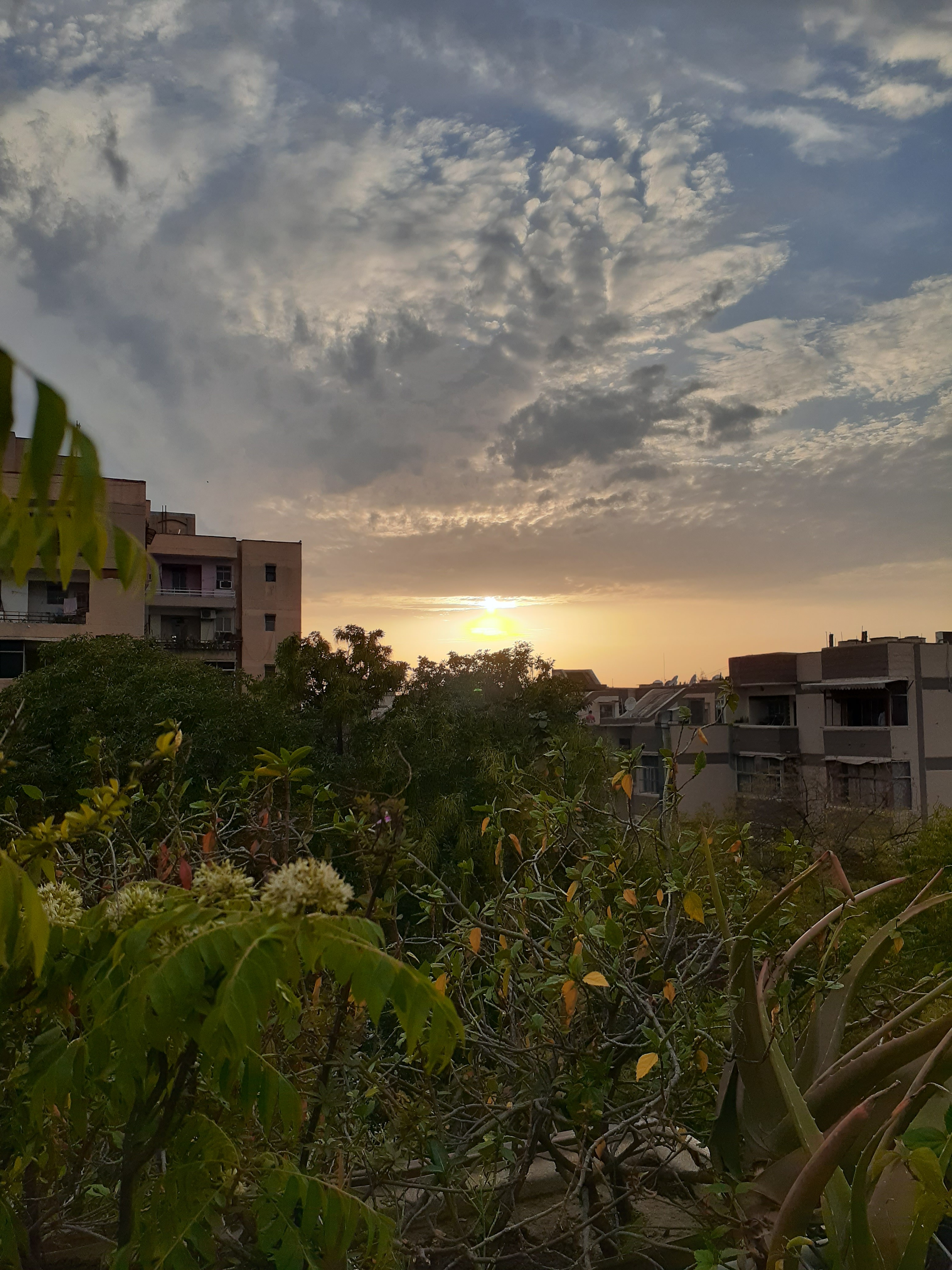
Right now I’m still a little high from viewing the skies at sunset three evenings in a row from my terrace. Here are a few photos: all I can think of now are the words of Georges Lemaitre (1894–1966): Catholic priest, mathematician, physicist, the cosmologist who first proposed the theory of an expanding Universe which has come to be called ‘Big Bang’ …

The evolution of the world can be compared to a display of fireworks that has just ended: some few red wisps, ashes and smoke. Standing on a wellchilled cinder, we see the slow fading of the suns, and we try to recall the vanished brilliance of the origin of worlds…

1a23a546

General ravings, Potshots

Courting Contempt

[Disclaimer: This has been written on the 9th day of the author’s self-isolation due to persistent cough and sore throat, and amid recurring episodes of catatonia, mild hallucination, and hysterical cackling at the sight of TV news anchors and onions. Any disrespect shown or hurt caused to any lawyer, advocate, journalist, politician or any other person connected with or disconnected to the judiciary is entirely intentional.]

Despite the title, this isn’t about the ethics (assuming the existence of any) of ex-Chief Justice of India Ranjan Gogoi accepting the NDA government’s offer of a Rajya Sabha seat. Nor is it about the ethics (assuming they have any) of these myriad lawyers, journalists, politicians and affiliated scoundrels who today are questioning Gogoi’s ethics, when just two years ago –  on January 12, 2018 to be precise – the same bunch had extolled Gogoi as some kind of judicial hero for having been one of the four Supreme Court judges who  held a press conference to publicly accuse then Chief Justice of India Deepak Mishra of improprieties.

Ethics in India is like the radioactive element Polonium-214: it has a rather short half-life.

This is about the 3.3 crore cases that are pending before courts in India.

Now, numbers numb the brain—especially, large numbers. We usually regard anything more than six as a blurry ‘many’.  So, how in the name of Bakasura the Ravenous does one comprehend a number like 3.3 crores?  How can we visualize it, get a feel of what it is?

It’s important that we can do this. Because India is all about very large numbers; especially in the synergistic realms of political swindling, business theft and general loot of the public exchequer by public and private individuals and institutions.  For example, there’s Rana Kapoor, Founder of YES Bank, whose maxim seems to have been “Founders Keepers” as he scammed us of at least Rs 3000 crores (they’re still counting).  Vijay Mallya, that ethylated and spirited Kingfisher entrepreneur, made off to Britain with Rs 9000 crores of public money kindly gifted to him by nine banks.  Nirav Modi the Hira Chor (I just love the way our journalists call him ‘Diamantaire’ ) robbed Rs 28,000 crores from just one bank (Punjab National Bank).

And so, ignoring your howls of protest and with a murmured Guru Stotram  to the great  Isaac Asimov who had a way of making the most complex things simple to understand, we shall try and explain this number of pending court cases—3.3 crores— in a manner that even Rahul Gandhi might comprehend (if he concentrates really hard).

In sallying forth, we shall try our best to retain our footing on the treacherously narrow and slippery path that runs high above the dreadful chasm of Contempt of Court.

Here goes…

Preamble

Any business involving Indian courts generates colossal quantities of paper – in the form of indemnities, oaths, bonds, undertakings, agreements, powers of attorney, declarations, affidavits, deeds, and a plethora of other documents. Each document is invariably photocopied in triplicate at the very least.

Why so many copies? No-one knows.

Maybe it’s prescribed in the Shastras and Puranas.  Maybe it’s just that no one dares ask why.

I personally believe all the kabaadiwallahs, channawallahs, peanut vendors, et al. are running this multiple-photocopies system in cahoots with lawyers and advocates to ensure that they receive a vast, steady and sustainable  supply of waste paper for packaging their wares—a fine example of the Sustainable Circular Economy.

Anyway: to return to the topic from which we were rudely distracted by ourselves…

Bird’s-eye view

Let’s assume, very conservatively, that each court case involves 2000 sheets of A-4 sized paper located in various files. Then, 3.3 crore court cases give us a total of 66 billion A4 sheets (that’s 66000000000). Since we know that an A4 sheet measures 21 cm × 29.7 cm, it’s easy to work out the total area that can be covered by the paper that makes up 3.3. crore case files:

Area of paper  = [66000000000 × 21 × 29.7] square cm =  4116 square kilometres (km2).

To visualize this better:  with the paper from our pending court cases, we could completely paper over  India’s six largest metropolises—National Capital Territory of Delhi  (1484 km2),  Bengaluru (709 km2), Hyderabad (650 km2), Mumbai  (623.7 km2),  Chennai (426 km2) and Kolkata (205 km2)— and still have enough paper left over (i.e. 289 million A4 sheets, with a total area of 18 km2) to cover 2812 football fields.

Not impressed?

Astronomical view

Well…we could instead paste our 66 billion A4 sheets together, lengthwise, and make a paper bridge that’s 19.6 million kilometres long—enough to stretch to the Moon and back 20 times,  still leaving us 4.2 million km of paper with which to wrap Earth around the Equator 105 times.

If that’s not inspiring enough:

Green view

A good working estimate is that one large tree has to be felled to make about 10,000 sheets of A4 paper. This means that our 66 billion pending court cases represent the long-neglected and cruelly fragmented remains of  6.6 million trees!  

One wonders how many of these pending cases pertain to our ecology and environment? To tree felling?

Economic development view

There’s also a bright side to the issue: a silver lining in the judicial cloud. Consider the fact that these 3.3 crore pending cases have for decades provided livelihoods to lakhs of advocates, legal interns, office assistants, stamp vendors, typists, photocopiers, notaries public, stamp and seal makers, oath commissioners, and other hard-working men and women. By ensuring that these court cases have remained pending, these heroes and heroines of our judiciary have in fact contributed significantly to India’s GDP.

May they continue to do so! 

Way forward

The Indian judiciary is doing its best to reduce the number of pending cases. For instance, in 2016, the subordinate courts disposed of a whopping 1.9 crore cases…but the problem is, over 2 crore fresh cases were filed in subordinate courts during that year. [see here for details].

Clearly, like the Red Queen, our judiciary is sprinting to stay in the same place…and steadily falling back. The number of pending cases just grows and grows.

Little wonder that out of the 3.3 crore currently pending cases, 86 lakh cases have been pending for five years and more in subordinate courts and High Courts.

How we can reduce this colossal backlog?

A friend suggests that we periodically line up and shoot all advocates who ask for adjournments. An attractive idea: but we fear it might be a violation of their fundamental rights to procrastinate.

We must instead look for a Constitutional solution.

Let’s focus only on these 86 lakh (8600000) cases pending for five years and more. Let’s suppose the government and judiciary set up 100 brand-new super-efficient Special Courts exclusively to dispose of these 86 lakh old cases, with each Court working 10 hours daily for 300 days a year. Furthermore, let’s suppose each Special Court completes hearing and disposal of a case every hour (i.e. it finishes off 10 cases daily, or 3000 cases a year).

How long will it take for these Special Courts to get through all 86 lakh old cases?

It would take 8600000 ÷ 100 × 3000 = 28.66 years.

 So, if we set up the 100 Special Courts today, they could get the job done by November 2048!

Of course, that’s provided the litigants and their lawyers don’t appeal to higher courts against the verdicts in the Special Courts…

[Adjourned]


General ravings, Musings, Potshots

Corona Virus, Evolution and Revolution

However much we dread the Corona Virus, we cannot mask ourselves against the truth that the virus reflects the spirit of true Indian Secularism in the way it infects all people irrespective of their race, religious belief, caste or class.

Covid-19 might not be good for one’s constitution, but in its own humble way it respects the Indian Constitution. It shows us that we are all truly One.

Which, for no apparent reason, brings us to the question: how can one teach Evolution to Indian schoolchildren?

Now, you might think the answer’s simple. You might answer as follows:

“Just write up – or better still and in true Indian tradition, plagiarize—a simple summary of Darwin’s ‘On the Origin of Species’; enrich Darwin’s ideas with Gregor Mendel’s insights into inheritance of characteristics; lead on to Erwin Schrodinger’s insights into the molecules that must make up life, and explain how his ideas and the work of Oswald Avery, Linus Pauling and others inspired the discovery of DNA’s structure by Rosalind Franklin, Francis Crick and James Watson…sparking off a vast amount of research and expansion in our knowledge of how all life on Earth is linked, so that we know today that all humans are descended from the same ancestral mother who lived somewhere in the African continent.”

Of course your answer is correct, O learned reader. Alas, translating your answer into action is not simple, because nothing’s simple in India. It’s especially hard to introduce the flavours of Truth and Rationality, seasoned with Scientific Temper and Honesty and laced with a few dashes of Fun and Adventure, into the horrifying tasteless khichdi that masquerades as our Education Policy.

Consider, gentle reader, two of the simple statements just made up there somewhere:

  1. All life on Earth is linked.
  2. All humans are descended from the same ancestral mother who lived somewhere in the African continent.

Now, imagine that we propose to set out these statements as the Learning Outcomes of the chapter on ‘Evolution’ in the NCERT textbook for, say, Class 10. Assuming further that we are not lynched on the spot by an all-party delegation of MPs and MLAs, these are the kinds of responses we might expect from two of our political parties, the BJP and the CPI(M):

BJP: It is quite correct to state that all life on Earth is linked. But our textbooks must also emphasize that these so-called discoveries of Evolution by these Darwins and Sharwins, Watsons and Whatnots, were actually made 11000 years ago by our Vedic ancestors who summarized their insights into the concept of ‘vasudaiva kutumbakam’ – One Great Family. We must also mention that Indians ruled the entire Earth in ancient times, for which evidence is everywhere to see, in our ancient epics as well as in today’s world. For example, Argentina derives its name from Arjun-Sthaan, clearly evidencing that Arjuna, the great warrior of Mahabharata, had visited this South American region in his search for divine weapons…

CPI(M): In very simple words, we see this attempt to introduce Evolution into our school curriculum as nothing but another manifestation of Brahmanical Hegemony masquerading as pseudo-rationalism to preserve and strengthen the existing class-hierarchical model of social exploitation ; a diabolic and communal attempt by bigoted Hindutva-worshipping self-styled scholars to saffronize our school curriculum and brainwash young and innocent minds into believing the despicable lie that all Indians are equal—thereby denying the hundreds of millions of underprivileged Backward Castes, Minorities, Dalits, Scheduled Castes, Scheduled Tribes, women and other oppressed communities their just rights for reservation of jobs, educational quotas, subsidies and other forms of affirmative action under the various reservation policies. We will oppose this Hindutva proposal tooth and nail; we shall leave no stone unturned or Molotov cocktail unflung in our peaceful street marches calling for Revolution against Evolution…

General ravings, Musings, Remembering

Drumming away the Blues

Right from childhood days in Shillong I’ve loved music. Around 1967/68, when I was around 11 and also a round 11 (I was fat and short), I taught myself how to play the drums.  A battered old leather suitcase made a nice snare drum; a brass table top with a couple of nails on it made for an excellent cymbal;  and for sticks I ‘borrowed’  a couple of Mom’s knitting needles (sizes 7 to 9 worked best, as they allowed a good rebound for rolls).   My musical heroes in those early days were Brian Bennett (The Shadows), Mel Taylor (The Ventures),  Ringo Starr (The Beatles), and Ginger Baker (Cream).   In 1969 I bought a pair of teak drumsticks for the princely sum of Rs 1.50.  I still have them; every scar on them brings fond and noisy memories. They worked well on my suitcase too, though I kept borrowing Mom’s knitting needles…

But the story of my musical eccentricities must wait for another time.  Why I mention music now is, music has always been my refuge, it’s brought me solace and comfort and delight. And playing the drums elevates my spirits even in the darkest of moments.

Which is why, last week, after a gap of over five years, I picked up my drumsticks and went to a jam room in South Extension where there’s a nice drum set, and I practiced playing the drums for an hour.

There were no listeners to tell me how hideous it sounded, because I was all alone and the jam room was (mercifully) sound-proofed.  I was rusty, stiff in bone and muscle and brain, I panted and gasped at the exertion, I missed a beat every nine beats on average.

But I loved it!

I emerged from the jam-room, exhausted but healed of angst, the words of Omar Khayyam  blending weirdly yet sublimely with the words of Adi Sankaracharya in my haze-filled mind:

Alike for those who for TODAY prepare,

And those that after a TOMORROW stare,

A Muezzin from the Tower of Darkness cries

Fools! Your Reward is neither Here nor There!

Bhaja Govindam, Bhaja Govindam

Govindam Bhaja, Moodamathe!

I managed to record part of my solo cacophony, and place three short sections below – missed beats and all – for your torment, ferment and comment, O patient and long-suffering reader!


Don’t worry, I promise you I won’t post any more of my solo practice sessions.

Oh…and tomorrow I’m going again to the jam room.  Do join in…it’ll be great!