Potshots

A Letter of Appreciation for Shri Arvind Kejriwal re. “Chief Minister Advocates’ Welfare Scheme”

Dear Kejriwal-bhai,

I trust you will allow me the liberty of addressing you in this rather affectionate but respectful manner, being as I am a die-hard, hardly-alive 67-year-old senior citizen and supporter of your AAP government in Dilli.

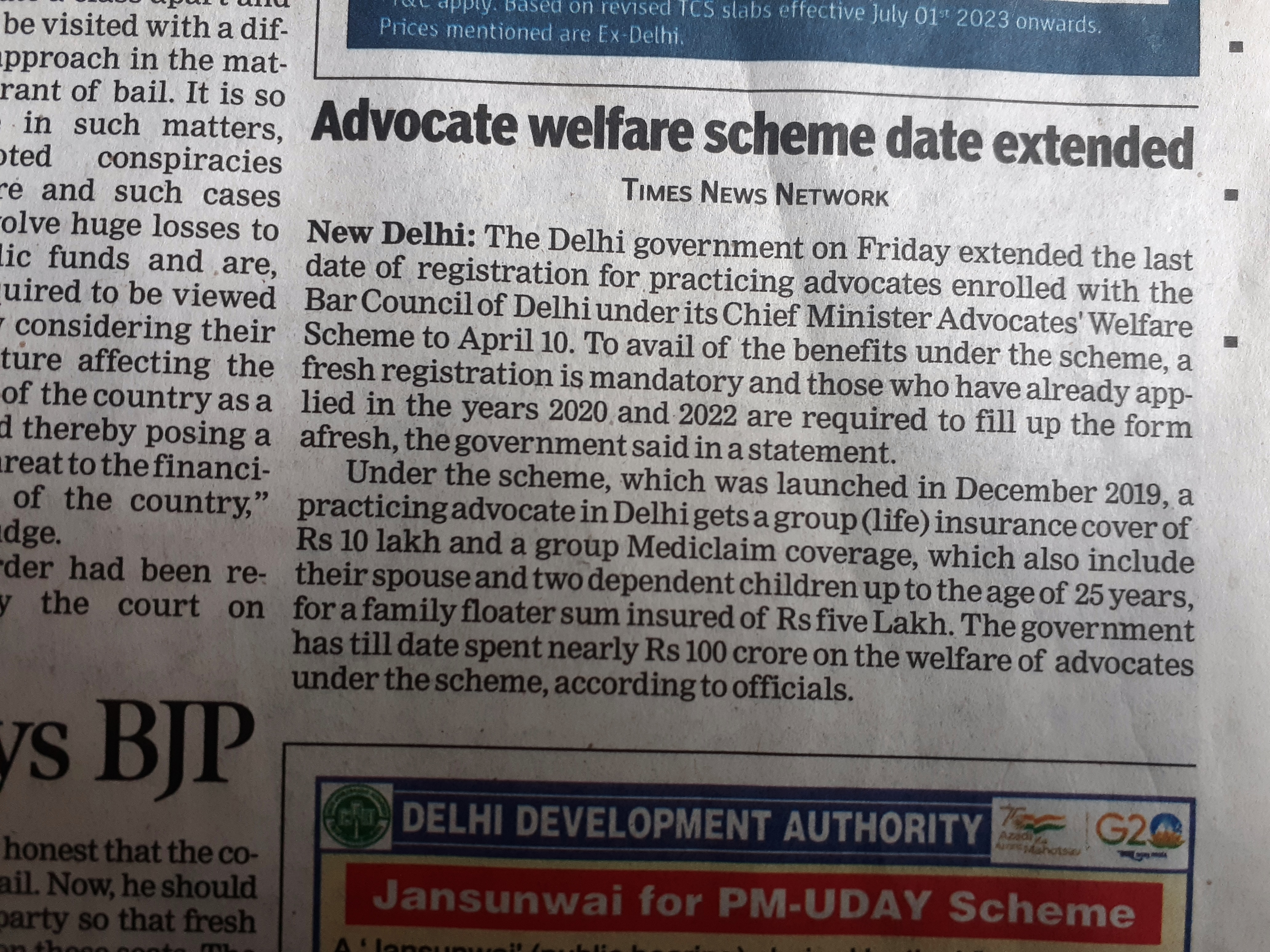
I am writing to compliment you for launching the ‘Chief Minister Advocates’ Welfare Scheme’ (CMAWS). Surely, this must rank as the world’s most wonderful Group Life-cum-Health Insurance scheme launched by the government for the benefit of one of the most  vulnerable, impoverished  and persecuted sections of the common citizenry—in this case, the community of Advocates registered with the Bar Council of Delhi.

I first came to know of CMAWS barely two weeks ago— on April 1st, from a report in my Times of India paper. By a curious and perhaps unfortunate coincidence the report on C-MAWS was next to an article informing me that our poor AAP leader Manish Sisodia-bhai had been denied bail despite the best efforts of his Advocates.

And because of this coincidence, Kejriwal-bhai,  I did not believe what I read about CMAWS that day.

It was April 1st, no?  

Hah,  I told myself, this CMAWS sounds so good it is too good to be true!  Sab bakwaas, I told myself, these saale badmaash Times of India patrakaars are making one nice April Fool joke just to keep us readers cheerful while Modi and Shah and all their nasty BJP-wallahs are doing zulum and chillum on all of us with CBI and ED and all, and and persecuting and prosecuting and jailing our dear Sisodia-bhai and Jain-bhai and other AAP- bhais just because they are doing so much welfare for the Dilli public.

And so, I laughed scornfully at the CMAWS report that day.  Hohoho. Hahahaha. 

O Kejriwal-bhai,  a thousand times I apologize, from the heart of my bottom to bottom of my heart I apologize, but I laughed heartily at CMAWS that day.

But then two days ago I again saw a report on CMAWS in my paper—this time, a full-page colour advertisement! It has your smiling photo in it!

It not only confirms that CMAWS is true and real and not some horrible BJP feku news , but it describes the many benefits of this thoughtful welfare scheme created by you for Dilli’s long-suffering Advocates!  

I have since then visited the CMAWS website and am delighted to learn many thrilling facts like the following:

  • CMAWS gives every Advocate registered with Bar Council of Delhi a group Life Insurance Cover of Rs 10 lakhs
  • CMAWS also gives group Mediclaim Insurance floating cover of Rs 5 lakhs for the Advocate and his/her family members
  • As many as 22,467 advocates and their family members are beneficiaries of CMAWS based on the ‘First List’ of the scheme. 
  • Another 29,612 advocates and their family members arebeneficiaries of CMAWS based on the ‘Second List’ of the scheme.

Most excitingly, the advertisement announces that you have extended the last date for registration and application under CMAWS  to April 17th 2023!!

I am overjoyed to inform you, dear Kejriwal-bhai, that I have accepted your kind invitation and have separately applied for registration and inclusion of my own name under CMAWS.

Of course, prima facie  my application is liable for rejection because I am not an Advocate.

However, as I have explained in the Introduction and Annexures 2 (d) and 6(a) of my CMAWS application:

  • I am an obscure, struggling, ageing self-employed writer, and as such I too am among the vulnerable, neglected, impoverished  and persecuted sections of society.  
  • My annual income has never exceeded and will never exceed Rs 6 lakhs, which is well below the Rs 8 Lakhs ceiling imposed by Government of India for determining ‘Creamy Layer’ status of OBC.
  • Also, as evidenced by attested copy of receipt in Appendix 2 of my application, I have in March 2023 paid the sum of Rs 53,673 as annual renewal premium for a health insurance policy of face value of a piddly little Rs 2 lakhs.  As a consequence, I am currently surviving on various permutations and combinations of aloevera sabzis, grass-flavoured daals (no, not the smoking kind, that I gave up), and the occasional banana.
  • Hence, I would deeply welcome any support by way of getting a health insurance cover of Rs 5 lakhs or more…especially if it is at taxpayers’ expense, as under CMAWS.

In conclusion, dear Kejriwal-bhai, I once again congratulate and thank you for creating an excellent and innovative affirmative action scheme like CMAWS!  I am confident that with the launch of CMAWS, any and all legal problems that any and all AAP members may face any time at all in the future will be eagerly and ably taken up and resolved by the tens of thousands of joyous Advocates who have already joined and will continue to join and reap the benefits of this brilliantly schemed scheme.

Please do convey my best wishes to Sisodia-bhai when you meet him next.

Namaskaar! Jai Hind!!

Mani

(R P Subramanian)

General ravings, Potshots

Courting Contempt

[Disclaimer: This has been written on the 9th day of the author’s self-isolation due to persistent cough and sore throat, and amid recurring episodes of catatonia, mild hallucination, and hysterical cackling at the sight of TV news anchors and onions. Any disrespect shown or hurt caused to any lawyer, advocate, journalist, politician or any other person connected with or disconnected to the judiciary is entirely intentional.]

Despite the title, this isn’t about the ethics (assuming the existence of any) of ex-Chief Justice of India Ranjan Gogoi accepting the NDA government’s offer of a Rajya Sabha seat. Nor is it about the ethics (assuming they have any) of these myriad lawyers, journalists, politicians and affiliated scoundrels who today are questioning Gogoi’s ethics, when just two years ago –  on January 12, 2018 to be precise – the same bunch had extolled Gogoi as some kind of judicial hero for having been one of the four Supreme Court judges who  held a press conference to publicly accuse then Chief Justice of India Deepak Mishra of improprieties.

Ethics in India is like the radioactive element Polonium-214: it has a rather short half-life.

This is about the 3.3 crore cases that are pending before courts in India.

Now, numbers numb the brain—especially, large numbers. We usually regard anything more than six as a blurry ‘many’.  So, how in the name of Bakasura the Ravenous does one comprehend a number like 3.3 crores?  How can we visualize it, get a feel of what it is?

It’s important that we can do this. Because India is all about very large numbers; especially in the synergistic realms of political swindling, business theft and general loot of the public exchequer by public and private individuals and institutions.  For example, there’s Rana Kapoor, Founder of YES Bank, whose maxim seems to have been “Founders Keepers” as he scammed us of at least Rs 3000 crores (they’re still counting).  Vijay Mallya, that ethylated and spirited Kingfisher entrepreneur, made off to Britain with Rs 9000 crores of public money kindly gifted to him by nine banks.  Nirav Modi the Hira Chor (I just love the way our journalists call him ‘Diamantaire’ ) robbed Rs 28,000 crores from just one bank (Punjab National Bank).

And so, ignoring your howls of protest and with a murmured Guru Stotram  to the great  Isaac Asimov who had a way of making the most complex things simple to understand, we shall try and explain this number of pending court cases—3.3 crores— in a manner that even Rahul Gandhi might comprehend (if he concentrates really hard).

In sallying forth, we shall try our best to retain our footing on the treacherously narrow and slippery path that runs high above the dreadful chasm of Contempt of Court.

Here goes…

Preamble

Any business involving Indian courts generates colossal quantities of paper – in the form of indemnities, oaths, bonds, undertakings, agreements, powers of attorney, declarations, affidavits, deeds, and a plethora of other documents. Each document is invariably photocopied in triplicate at the very least.

Why so many copies? No-one knows.

Maybe it’s prescribed in the Shastras and Puranas.  Maybe it’s just that no one dares ask why.

I personally believe all the kabaadiwallahs, channawallahs, peanut vendors, et al. are running this multiple-photocopies system in cahoots with lawyers and advocates to ensure that they receive a vast, steady and sustainable  supply of waste paper for packaging their wares—a fine example of the Sustainable Circular Economy.

Anyway: to return to the topic from which we were rudely distracted by ourselves…

Bird’s-eye view

Let’s assume, very conservatively, that each court case involves 2000 sheets of A-4 sized paper located in various files. Then, 3.3 crore court cases give us a total of 66 billion A4 sheets (that’s 66000000000). Since we know that an A4 sheet measures 21 cm × 29.7 cm, it’s easy to work out the total area that can be covered by the paper that makes up 3.3. crore case files:

Area of paper  = [66000000000 × 21 × 29.7] square cm =  4116 square kilometres (km2).

To visualize this better:  with the paper from our pending court cases, we could completely paper over  India’s six largest metropolises—National Capital Territory of Delhi  (1484 km2),  Bengaluru (709 km2), Hyderabad (650 km2), Mumbai  (623.7 km2),  Chennai (426 km2) and Kolkata (205 km2)— and still have enough paper left over (i.e. 289 million A4 sheets, with a total area of 18 km2) to cover 2812 football fields.

Not impressed?

Astronomical view

Well…we could instead paste our 66 billion A4 sheets together, lengthwise, and make a paper bridge that’s 19.6 million kilometres long—enough to stretch to the Moon and back 20 times,  still leaving us 4.2 million km of paper with which to wrap Earth around the Equator 105 times.

If that’s not inspiring enough:

Green view

A good working estimate is that one large tree has to be felled to make about 10,000 sheets of A4 paper. This means that our 66 billion pending court cases represent the long-neglected and cruelly fragmented remains of  6.6 million trees!  

One wonders how many of these pending cases pertain to our ecology and environment? To tree felling?

Economic development view

There’s also a bright side to the issue: a silver lining in the judicial cloud. Consider the fact that these 3.3 crore pending cases have for decades provided livelihoods to lakhs of advocates, legal interns, office assistants, stamp vendors, typists, photocopiers, notaries public, stamp and seal makers, oath commissioners, and other hard-working men and women. By ensuring that these court cases have remained pending, these heroes and heroines of our judiciary have in fact contributed significantly to India’s GDP.

May they continue to do so! 

Way forward

The Indian judiciary is doing its best to reduce the number of pending cases. For instance, in 2016, the subordinate courts disposed of a whopping 1.9 crore cases…but the problem is, over 2 crore fresh cases were filed in subordinate courts during that year. [see here for details].

Clearly, like the Red Queen, our judiciary is sprinting to stay in the same place…and steadily falling back. The number of pending cases just grows and grows.

Little wonder that out of the 3.3 crore currently pending cases, 86 lakh cases have been pending for five years and more in subordinate courts and High Courts.

How we can reduce this colossal backlog?

A friend suggests that we periodically line up and shoot all advocates who ask for adjournments. An attractive idea: but we fear it might be a violation of their fundamental rights to procrastinate.

We must instead look for a Constitutional solution.

Let’s focus only on these 86 lakh (8600000) cases pending for five years and more. Let’s suppose the government and judiciary set up 100 brand-new super-efficient Special Courts exclusively to dispose of these 86 lakh old cases, with each Court working 10 hours daily for 300 days a year. Furthermore, let’s suppose each Special Court completes hearing and disposal of a case every hour (i.e. it finishes off 10 cases daily, or 3000 cases a year).

How long will it take for these Special Courts to get through all 86 lakh old cases?

It would take 8600000 ÷ 100 × 3000 = 28.66 years.

 So, if we set up the 100 Special Courts today, they could get the job done by November 2048!

Of course, that’s provided the litigants and their lawyers don’t appeal to higher courts against the verdicts in the Special Courts…

[Adjourned]