The other evening – 17th of November it was – I went with a couple of friends and heard T M Krishna sing at the Garden of Five Senses, Delhi.
It was great!
Krishna was in fine voice; a voice I’d heard only a couple of times earlier, rendering Thyagaraja krithis as smoothly as folk songs. Oh, and also singing in a short but powerful campaign video against Unilever for dumping toxic chemicals and endangering the people and ecology of Kodaikanal (click here to see it)
That’s all I knew of Krishna till around the 14th of November; that he was a great musician, innovative, that he sang for good causes.
And then this great big thing blew up in our faces, amplified to megaton levels by media: that Airports Authority of India and Spic-Macay had abruptly cancelled a scheduled concert on 17th November featuring Krishna, among other artistes. AAI gave no reasons for the cancellation; but I understood, from editorials print and online, that Krishna was regarded by BJP sympathizers – and therefore, the Central Government, and by inference, AAI too— as ‘anti-Hindu’ and ‘anti-Indian culture’, all because he, Krishna, conveyed pithy political and social messages through his songs. I also heard and read that Krishna had been cruelly trolled by ‘right-wing Hindutva’ nuts.
All this I found profoundly disheartening, disturbing, disgusting. I hoped, over those two days that followed, for some strong reaction from the Central Government, from AAI…but there was only stony silence.
And so, when Delhi’s AAP government announced that it would host a performance by Krishna on the 17th, I decided I must attend. Not to convey some glorious ‘secular message’ or make a ‘political statement’ or anything pretentious as that, but to simply hear Krishna, a musician who just wanted to sing from his heart about things he felt strongly about… and had been cruelly treated for wanting to do that.
Given the circumstances, I was a little worried about the event becoming more a political jamboree than a music concert. But credit to AAP leaders Kejriwal and Sisodia, not only did they arrive only about 20 minutes late, which is incredibly early by Delhi standards, but their bhashans were mercifully brief and non-incendiary. Krishna himself was all dignity: he murmured that he was there not to speak but to sing…and so he did: wonderfully, passionately, movingly.
Now, clacking out these words, I wonder: why must we taint everything in our lives that brings joy, with the corrosive acid of divisive politics?
My music or writing or theatre, my art, my rendering of what I think of as art, might not be to your liking, and vice versa; but surely we can each find the art we like and peacefully enjoy it without having to mock, disfigure, destroy others’ likes, others’ art? Without hurting others?
Just as you, gentle reader, might hold the view that I can’t write for nuts (doubtless with great justification). But that shouldn’t drive us – and our fans, our acolytes, assuming we have any – at each others’ throats?
Like: I never liked M F Hussain’s paintings. M F Hussain, in my view, couldn’t paint for nuts. I have said so to friends who like M F Hussain’s paintings. It hasn’t affected our friendship.
I remember even writing so once (in Indian Express, in a letter): in the late 1990s, a time when, weirdly, it had become the politically correct thing to like M F Hussain, and you risked being branded ‘Hindu communalist’ or ‘fascist’ if you said you didn’t like Hussain. Well, I wrote I didn’t like M F Hussain’s work, not because his work offended my religious or cultural sensibilities but because his work offended my artistic sensibilities. But (I added) that didn’t mean I had the right to burn his paintings or run the man out of the country.
You, I, anyone at all, can take on T M Krishna fair and square, one-on-one, for his political views, such as they are…just as Krishna has the right to take on any of us fair and square for our political views, such as ours are.
But when Krishna the musician is invited to present his music, we must welcome him and respect him as musician.
I have heard Krishna, I love his music, I admire his politics. But that’s my opinion; you can think differently, it’s okay.
But none of us, none of us can allow a government institution like AAI to judge an artiste, any artiste, by his or her perceived ‘politics’.
It is terrible, the way AAI has capitulated before a gang of nameless, faceless e-thugs whose claim to represent ‘Hinduism’ or ‘Indian culture’ is as well-founded as Lashkar e Toiba’s claim to represent ‘Islam’ or ‘Islamic culture’.
It is good that Delhi’s AAP government gave Krishna a chance to play at the Garden of Five Senses…and us the chance to hear him.
As of today, 19th November 2018, I am a votary of AAP.
But I shall watch AAP’s future activities with considerable interest before taking the call at the next polls. Knowing our politicians, be they from Left, Right or virtually non-existent Centre, chances are high that the AAP will commit some colossal balls-up ere long…
That’s why we need you, T M Krishna! Jai Vijaye Bhava! Jai Hind.
This is sentimental. Because music makes me sentimental.
I write this with the feeble authority of one who has taught himself to play percussion by ear. I must hastily add: I also play percussion by fingers, palms, and feet.
I write to say I was utterly swept away by the ocean of music created by the many ustaads who performed during the MTV India Music Summit, organized by Musiconcepts at the Fairmont, Jaipur from 12th to 14th October.
I dare not try and describe what they played or how they played or why their performances were so wonderful, so moving, so magical. That is best left to the countless others who are more qualified and knowledgeable than me in matters musical.
But this much I bravely declare: the music I heard during the Summit unshackled my mind (it is of no relevance whether the mind was already unhinged); it carried me off to float effortlessly into realms of utter harmony, where, on the waves of timeless rhythms and riffs and cadences and chords, I transcended – if only for a few days – the mechanical world of space-time that I think of, and usually dwell in, as Reality.
Some of the maestros who played at the Summit [I’ve shamelessly ‘borrowed’ and adapted this collage from Musiconcepts ]Among the maestros who performed at the Summit were Shujaat Khan on sitar, Ajay Prasanna on flute, Amit Choubey on tabla, Ambi and L. Subramanian on violin, Aruna Sairam and Suresh Wadkar on vocals, Prasanna on guitar…. to name just a few. We heard Indian and Western classical, jazz and rock and world music, pop and devotional…
And more than once, at the end of some performance when I opened my eyes to the sound of applause and cheering as the last ethereal notes faded, I remembered something that the great jazz drummer Max Roach once said: that a great musician makes music the way a lover makes love.
Many of the musicians at the Summit demonstrated (and how!) the truth of this maxim in their performances: blending boundless curiosity with childlike delight, self-control with confidence; tempering blazing passion with tenderness, raging desire with empathy; taking us soaring to celestial heights of ecstasy, utter abandon, and then gently, respectfully, bringing us back to earth…
They performed with love, pure and unselfish. The love resonated as much in the joyous, crystal-clear choruses of the Mizo Cardinal Choir as in Usha Uthup’s husky, throaty, sending-shivers-down-the-spine crooning; in the devotional songs of Mazhar and Javed Ali Khan and of Pandit Chhannulal Mishra; in the innocent, lilting violin-cello-piano melodies of the Ramakrishnan Trio comprising Aaliya, Naima and Nisha; in the divine flute duets with which Suchismita and Debopriya Chatterjee dispelled dawn’s chill and welcomed the rising sun.
And if the Summit was shaped and held together by these many delicious and diverse strands of music, their impact was hugely enhanced by the interludes during which the maestros shared their musical knowledge and insights with us, through relaxed baithaks and conversations filled with anecdotes and banter. It was amazing how, with seemingly no effort or intent, these little one-off sessions developed a dynamic and logic of their own, with the ideas and musings and music in one session reflecting and being built on in another, till they became threaded together into a single string of multi-faceted, many-hued gems of gyaan.
There was so much of value, so much to listen to and revel in, so much to learn. Here are just a few random strands drawn from rapidly fading memory, in no particular order (the interpretations and translations, and any inaccuracies in them, are entirely my own):
Shujaat Khan, fondly recalling his father Vilayat Khan, and also Bhimsen Joshi who would often visit their home:
“Once, while listening to me as I was doing my riyaz, Joshiji began to chant the refrain of what sounded like a bhajan. Of course the bhajan blended perfectly with the raga I was playing, but I was unfamiliar with the lyrics. They went something like this (sings):
Pachhhee-suhha
Lakshmi Maaaa Ryg Gyu – Poo
Ney-Mahaa
Raaaaasha-Trahah
“After we finished, I asked Joshiji what the bhajan was. He replied, with a chuckle, that having momentarily forgotten the actual lyrics, he had instead sung out the address of his residence in Pune: ‘25, Lakshmi Marg, Pune, Maharashtra’…
Shankar Mahadevan, talking about his work with Bollywood songs and explaining—through songs—why we must, and how we can, respect, preserve, build on, and popularize our incomparable musical heritage—Hindustani, Carnatic, and all their many regional streams—without compromising on the rigour and purity of their classical systems and structures.
Shujaat Khan on sitar, sliding almost mischievously from a lovely contemplative Hindustani classical piece to a Bollywood pop tune. And leading us, with his wizardry on the strings, on a voyage along a river of liquid notes during which we experience the closeness of music to nature, to life, to Creation.
Ambi Subramaniam with his violin bearing us smoothly, blissfully, across the realms of jazz, world music, Carnatic raga.
Chhannulal Mishra effortlessly switching from Hindustani raga to Carnatic raga, providing glimpses into the one deep ocean whence both great rivers of traditional Indian music originate…
Sufi Kathak dancer Manjari Chaturvedi, speaking passionately on her ‘Courtesan Project’ to erase the social stigmas attached to the tawaifs (courtesans) and give them the respect and credit they deserve as supreme exponents of dance, music, drama and literature:
“Today, it has become so convenient for us to depict the tawaifs as ‘victims of sexual exploitation’ because they were women who performed in the nawabs’ courts. This is wrong! By the same token, we ought to be depicting as ‘victims of sexual abuse’ the men who performed in the nawab’s courts! The truth is, the tawaifs were great artistes, they were ustaads. And ustaad is a gender-neutral word! We only denigrate the tawaifs, we diminish and devalue their achievements by looking at them through the narrow prism of gender. Their music, all music, should be judged by its intrinsic value and quality, not by the gender or social position of the performer…”
“NASA’s two Voyager spacecraft, launched in 1977, carry ‘golden records’ containing sounds and images intended to depict the diversity of life on Earth for any extraterrestrial intelligence that may come across them. The records contain music from many countries: the song selected from India is the raga ‘Jaat Kahan Ho’ sung by khayal singer ‘Surshri’ Kesarbai Kerkar. Today Kerkar is still remembered in NASA’s golden disc on distant Voyager…but she is forgotten by us…”
The memories of the conversations blur and coalesce; presently they will fade and disappear altogether.
The music and passion endure, enthrall.
High on music, captivated by this mighty war drum, I tried echoing the driving beat of the Fairmont Gatekeeper…and succeeded in driving away a number of guests
Wandering through some long-forgotten folders, I came across a few ancient F-class photos from late September 2008, when I travelled for a few days in eastern Uttar Pradesh, visiting villages in Allahabad and Pratapgarh districts. These villages were home to migrant brick kiln workers: primarily, kiln firemen and their families.
I’d taken these photos with my first and most favorite camera phone. How I miss its simple practicability: no frills, no fancy apps, just the large-sized alpha-numeric keyboard, left–right button navigation, and a 1-megapixel camera. The phone, alas, is long expired; as indeed are most of the memories of that trip. The sights, sounds, scents, emotions, the people I met, our conversations, the food we ate, the places I stayed in, the sequence of events, their vividness, the once-sharp outlines, are now smoothed and rounded off and merged into one amorphous, uniform, featureless, mass…like the distant hill you see from a speeding car or train, a blurry pile shimmering in mid-afternoon haze like a dream, seemingly moving along with you, keeping pace as you speed along across a vast plain, but ever-so-slowly lagging, slipping back, till it is left behind forever.
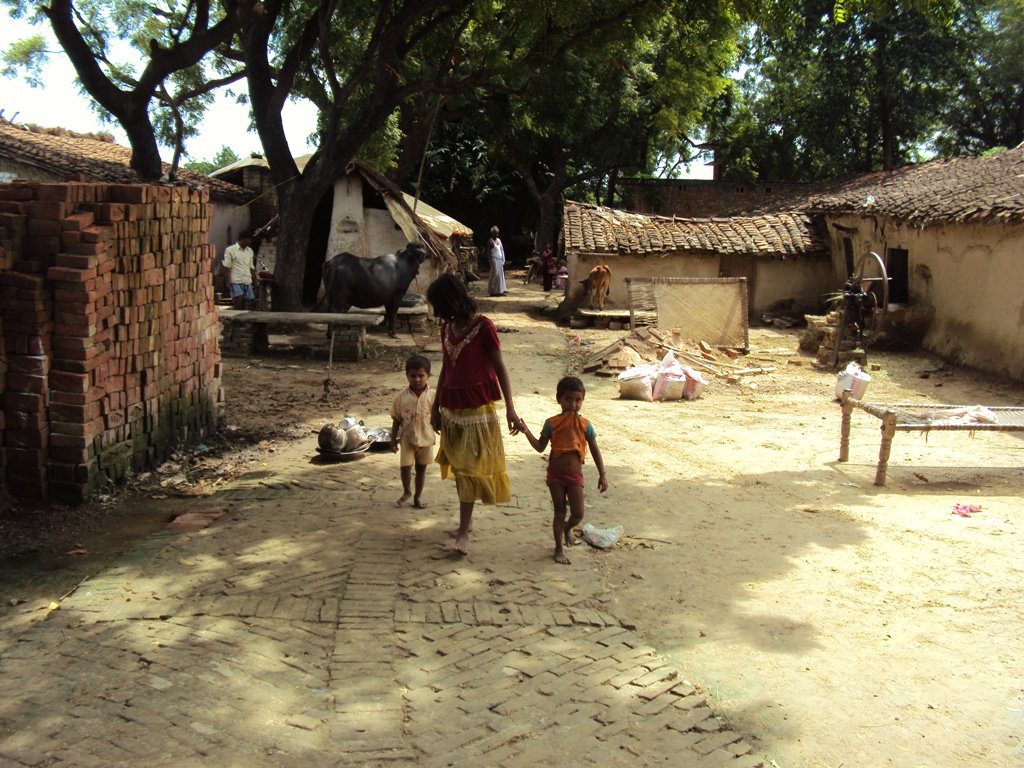
Yet the photos now bring back shards of memory; and even memory of memory. Broken memories they are, discontinuous, yet sharp and clear as glass splinters. A few village names come to mind: Ghuisarnath, Akhirajpur, Lakhram, Tharia. The drives to the villages, from Allahabad or Lalganj or Pratapgarh, were very hard on the bones and muscles, especially the stretches along rutted, pot-holed country roads. Yet I’d loved the experience. With the monsoon over and winter yet to set in, the streams and canals ran deep and wide, the exhilarating aromas of moist earth and damp vegetation hung over the rich green countryside, raucous birds rejoiced in the dense copses of mango, babool, neem, amla.
Amidst this richness, the firemen’s villages presented a sharply contrasting picture of poverty, endless toil, of quiet, timeless despair. Typically, each village was located on elevated ground; a few score huts scattered across the slopes, linked by mud-and-rubble-and-brick paths, with the inevitable tank at the base of the village, filled to the brim post the rains, some with flotillas of duck. Every village had a shrine, usually a temple of sorts, beneath some giant pipal or banyan, fronted by a large swept clearing that was the community meeting ground.
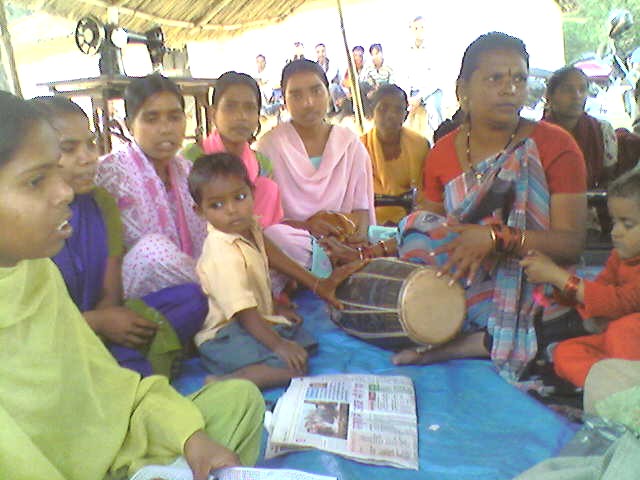
Sewing class taking a break – the newspapers are not for reading, but used instead of waste cloth (a costly and hard- to-get raw material) to train the young seamstressesTharia
Such was the little village of Mendara. Memories of trudging across broken land and halfway up a small hillock to where a great banyan stood, ringed at a respectful distance from its hanging roots by other smaller trees. Sitting in a circle with the villagers beneath the banyan, conversing about the lives they led—at the kilns, which were sometimes thousands of kilometers away, where the firemen worked ceaselessly for seven months or more each year in the most horrific conditions; and in the villages where, with the menfolk gone for most of the year, the women and children and the elderly faced extreme hardships. How deeply moving was their warmth, their innocence, their incredible generosity. Hogging large quantities of fresh gur, bananas, drinking sweet yet deliciously strong chai liberally laced with goat’s milk. Walking around the village; making comic faces at the little children who scampered around and giggled and guffawed and made faces right back at me. The small village shrine, exquisitely clean, utterly peaceful, with fresh flowers and a bunch of bananas placed in front of the tiny sanctum lit by a single lamp, redolent of goat’s butter.
Mendara
The village elder led the way up toward the crest of the hillock. The trees thinned, the ground levelled off, and suddenly, we were standing on the edge of a cliff that followed the contours of the hillock on either side: a broken, fifty-foot- high wall of angular rock faces and red, iron-rich earth, strewn with stone and rubble and the corpses of countless trees and bushes that had once dwelt on the slopes. Far across the shallow valley I saw a line of low hills; and running across their midriffs like a jagged knife wound, a road under construction—its course marked by the hideous, characteristic signs of road building in Indian hills: scarred slopes, littered with mounds of earth, blasted boulders, tree trunks scattered like matchsticks on the denuded expanses.
“That is the new road from Allahabad,” the elder murmured.
“The Allahabad Bypass Expressway,” a young fireman corrected him politely. “It will turn round that slope and pass close to Mendara, right below us. See? They are working quite close already.” He pointed toward the left and I saw in the distance a stretch of muddy track carved out from the hillside. A bright yellow earth-mover was gouging out great chunks of earth from the slope; the clattering roars of its engines faint but distinct.
“They say the Expressway will bring us jobs; that it will bring prosperity to us,” the young fireman went on. His voice was hesitant. “With jobs, maybe we can earn more, be closer to home through the year; we can take care of our women, our children. Maybe we won’t have to travel to work in faraway brick kilns any more…”
The elder sighed. “Yes…but with the coming of the road, our old ways are vanishing,” he went on softly, his eighty-five years carved into deep lines that divided his face into a thousand weathered segments. “So many trees have been felled; entire forests are gone. We have always grazed our goats, our buffalo, in the plains down there, but now the grasses are withered, the ground is hard, the streams are bitter, or have dried up. Where will we take our animals for grazing when the road is finished? When thousands of vehicles are moving up and down, day and night?”
His voice trailed away and we stood there in silence.
And that’s when, without warning, a memory flooded my mind like a river; a much older memory, from a time when I was much younger, maybe ten years old. It was during a drive in the mid-1960s, somewhere between Jorhat and Kaziranga in Assam; father was driving the car, mother seated next to him, brother and I were dozing in the back…till we were woken up with a start by the screeching of tyres as the car braked to a shuddering stop. Through bleary eyes I saw, in the dull red light of dusk, a dozen goats milling about on the road in front of the car, a young goatherd – a boy about my age – frantically darting about, crying out and wielding a bamboo stick expertly till he assembled the animals in a loose group and led them across the road and up a path leading to a cluster of huts on the slopes to the left.
“My God, I nearly hit them,” father murmured, his voice trembling, hands gripped tight on the wheel.
“It’s all right,” mother murmured. “I’ll drive for a bit…you take a break, you’ve driven the whole afternoon…”
As we set off again, mother at the wheel, I spoke up. “Stupid goats. Stupid villagers! Why do they have to live so close to the road?”
Father glanced around sharply but before he could speak mother replied. “Understand, always remember, they were here before us.” Her voice was soft but stern. “The villages, the villagers, were here long before this road came…before we came…”
On that hillock above Mendara, I heard and felt the impact of those words undiminished by the decades…as I do now, fifty years older but not much wiser.
The idea of a Congress Love Campaign fills us with delight.
Almost as much delight as Prime Minister Modi must have felt in the Lok Sabha that fateful July day, when, after Rahul delivered a passionate speech that blended incoherence, irrelevance and insolence in the proportion of 40:30:30, the youthful 49-year old Congress president suddenly and unexpectedly announced in ringing tones his boundless love for all humanity, including even Modi; declared his resolve to convert all Indians, including even the BJP members, to become loving Congress acolytes; galloped across the hall, stood over the bewildered Modi and commanded him to rise and receive his (Rahul’s) hug; and when Modi failed to oblige, bent down and clasped the PM, unasked, in a strong and presumably loving embrace.
We witnessed it live, gentle reader.
We choked; we nearly wept; so overcome were we with mirth.
We respectfully urge Rahul and the Congress to build on Rahul’s infantile performance, and to focus their electoral love campaign on mobilizing the young voters of tomorrow—the younger, the better!
With this principle in mind, we offer the following visual as our humble contribution to the Congress creative team’s ’ efforts. A small baby step that, we hope, will enable Rahul to assume charge of India and spread his message of Universal Love and Hugs.
Possible poster for Congress’ 2019 campaign: Catch ’em young!
Every day, I set out water for them – well, for the squirrels as well as for the pigeons, mynas, sparrows, crows, bulbuls, doves, sun-birds, babblers, wasps, chameleons, and all the other assorted creatures that have permanent citizenship and visiting rights to the terrace upstairs.
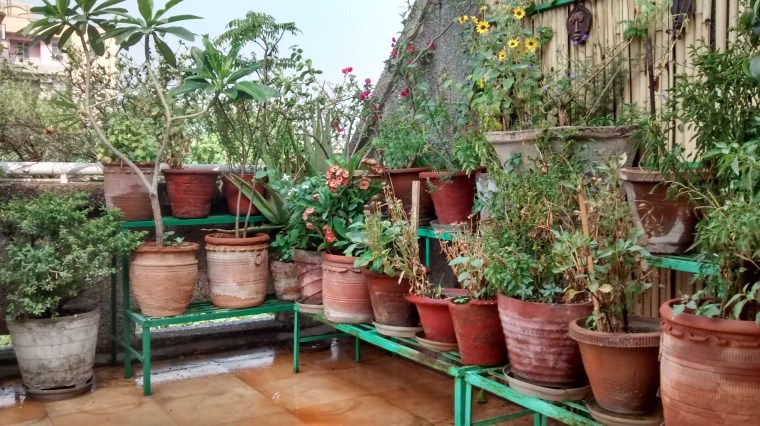
Terrace
Whenever I can, I toss the squirrels – and all the others – snacks to nibble on. Regular snacks include peanuts, cashew nuts, walnuts, raisins, bits of biscuits, pieces of buttered toast, and leftover rice. And in winter, when Delhi is at its best, with blue-and-gold mornings and clear, chill nights and the air crisp as the Marie biscuit that accompanies your hot cup of chai, I sit out on the terrace with the squirrels et al., and we bask in the sun for hours on end and chew assorted snacks and contemplate the beauty of the Universe, the subtleties of Creation, and the idiocies of Indian Polity.
Sometimes, the squirrels and I do yoga together.
“You’re sitting in my spot!”
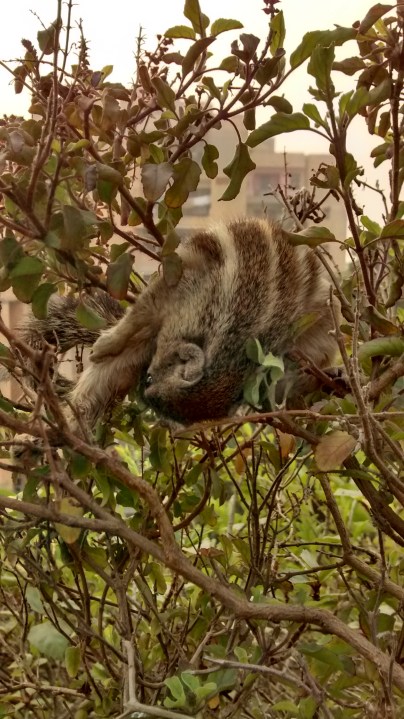
Aerial Uttan-asana
I’ve discovered squirrels eat all kinds of things we eat: potato wafers, murukku, samosa, paratha, slices of apple and mango (well, who wouldn’t eat that!), even gobs of ice-cream. I had always thought squirrels were vegetarian. And then, one winter’s day, I saw a scampering squirrel come to a screeching halt beside the tiny, desiccated remains of a long-deceased beetle. The squirrel peered at the hors de oeuvres; sniffed it thoroughly from end to end; and then grabbed it in two little paws and scrunched it down with thorough enjoyment before racing along on its interrupted errand.
Once, I offered a young squirrel a fish tikka in its foil wrapping, complete with a liberal daub of peppery green chutney. The squirrel unwrapped and ate the tikka with great delicacy, as though it were a gourmet dish, proceeded to lap up every last drop of the green chutney…and then sat on its haunches licking its chops and staring at me hungrily, hoping for more.
The squirrels are adapting to my ways, just as I am adapting to theirs. It is deeply comforting, this mutual bonhomie and peaceful coexistence.
Yet, the squirrels and I have our personal spaces; for do not strong fences make good neighbours? We too have our border; a Line of Actual Control (LAC), reasonably well demarcated, that both sides respect and do not breach, barring occasional, unarmed tests of strength that are as brief and non-violent as the scuffle between unarmed Chinese and Indian soldiers on the LAC in Sikkim, and as speedily and honorably settled with mutual withdrawals to our respective ground positions.
Thus, barring a few choice epithets hurled in their general direction, I do not bear the squirrels ill-will when I discover that they have vigorously uprooted and consumed all my carefully planted bulbs and seedlings in the terrace garden; nor do I run to the United Nations wailing for third-party mediation when a cheeky little squirrel-pup filches the buttered toast from the saucer that I had left unguarded for a minute while I went indoors for a coffee refill. Likewise, beyond tweeting a few derisive comments about me, the squirrels don’t complain when I chase them away from the chili plants whose slender twigs they love to use as toothpicks; or when I periodically clean up the window-sills that they use as community toilets (inspired, no doubt, by the Swacch Bharat Mission).
Recently, however, the spirit of Panchsheel that has hitherto governed our relationship was shaken by an unprecedented security breach on the LAC.
It started with a strange aroma in the kitchen: a scent that was neither pleasant nor unpleasant but quite distinctive: a cocktail of ancient pocha-kapda (mopping cloth), straw, damp leaves, grease and dog fur. For two days I hunted for the source of the smell. I checked every cupboard and shelf and drawer, every container and bottle; the fridge, toaster, the sink, the drain, the waste bin, even the water filter. No luck. The scent grew stronger, my appetite weaker, my mood fouler.
And then, returning home in the evening on the third perfumed day, I saw a squirrel taking a stroll on the kitchen counter-top. It executed a hop-skip-and-jump via the water filter up to the exhaust fan vent, within which it disappeared.
Theatre of action – LAC
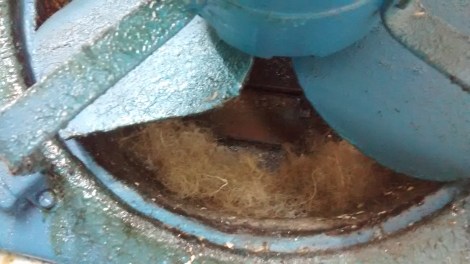
The exhaust fan vent…the one place I hadn’t thought to check! So I climbed on to a stool, stood on tiptoe and peered into the recesses of the vent. Voila! There it was, the source of the aroma—a pile of shredded cloth and rope and string and straw, carefully arranged layer upon layer to make it soft and springy, so tall that it completely obscured the hinged vanes on the far side of the vent. Of the squirrel, there was no sign.
The squirrels had built – or were still building – a nest.
But how on earth had they managed to get into the vent, that too with all this nest material, when the vanes on the far side normally remained shut and opened only when the fan was running? I soon discovered the answer: professionals that they were, the squirrels had wedged some kind of rag tightly between two vanes, so that the vanes remained half-open during the great construction project to allow smooth ingress and egress of squirrels and building materials.
Playpen in the making…
The discovery of the nest plunged me into a great moral dilemma, such as that which nearly undid the great warrior Arjuna on the battlefield of Kurukshetra before Krishna talked some sense into him.
I didn’t have the heart to demolish the nest. For the squirrels, the cool and dark tunnel of the exhaust fan vent provided the perfect refuge from the scorching summer heat. Besides, wasn’t it possible that Ma Squirrel was expecting to deliver a batch of little squirrel-pups, and was making this snug little nursery for her young-ones-to-come? How cruel it would be for me to undo all her hard work, her labour of love!
But countering this emotional response came the harsh yet compelling voice of reason. The nest was fragile, precariously located…in the exhaust fan vent of all places! Wouldn’t it be awful if I, or someone else, turned on the exhaust fan and hurled the feather-light nest – and possibly the pups – against the cruel vanes? Even worse, the fan blades might cause injury – or worse – to the squirrels. Surely that would be far crueller than removing the nest now, when it was empty?
And then, there was the little matter of mosquitoes. Every mosquito and her sister-in-law, from Noida to Gurgaon, must surely be making a beeline (or mosquito-line) for this inviting gap in the vanes, which, from a mosquito’s point of view, was like a blazing signboard over a fast-food joint; namely, me. Little wonder that of late, I was being eaten alive every night by the bloodthirsty members of the Family Culicidae…
What was I to do?
Like illustrious Arjuna, I chose the path of vacillation. Like brave Arjuna, I thought up seventy-six excellent reasons why I should not do anything. Let’s give it a day or three, I told myself: maybe Ma Squirrel will give up her nest project now, because she knows I’ve spotted her.
And so three days passed, with strict instructions given to one and all not to turn on the exhaust fan at any cost. The kitchen walls and ceiling grew grimier, the mosquito bites grew more numerous and painful, the nest grew thicker and wider. This made me feel worse: I had to do something fast, before it became too late for Ma Squirrel to change her plans…and before I was completely consumed by the mosquitoes.
On the fourth day I had a brainwave: I would simply remove the rag that held the vanes open! The vanes would snap shut; Ma Squirrel wouldn’t be able to get into the vent; she’d fret a bit, and then shake her furry head sadly and find another site for her nest.
So I fetched the stool, reached into the vent and tugged at the rag holding the vanes open till the rag suddenly came free and the vanes snapped shut. Leaving the nest intact, I descended and examined the rag: it turned out to be the frayed remnants of my face towel that had gone missing from the clothesline on the terrace the previous week; I had assumed the towel had been carried away on the gusts of a dust storm.
Problem solved…or so I thought.
Two days passed uneventfully. On the third day, while sipping my morning chai and scratching idly at a mosquito bite, I glanced up at the exhaust fan vent and noticed that the nest was distinctly thicker. What’s more, there was something blue resting on top of the nest. I climbed on to my trusty stool and peered into the vent. Not only was there a fresh layer of shredded pocha kapda on top of the nest, but carefully placed right in its middle was a blue clothes-clip – no doubt, Ma Squirrel had chosen it to decorate and liven up the little nursery.
Ma Squirrel was at it again! But how on earth had she got into the vent ?
I peered into the dark tunnel…and groaned. Once again, there was a piece of fabric carefully and tightly wedged between two vanes to hold them open. Muttering like an irate old squirrel, I tugged out the piece of fabric, descended to examine it closely…and nearly gave up my ghost there and then.
In my trembling hands was a pair of panties.
Slightly worn, slightly frayed, but definitively a pair of red panties. Size L, by the look of them; though I did not look closely.
Exhibit A
Well might you chortle, O dear reader. But picture my plight…and empathize! Leave alone Arjuna, even Bhimasena would have quailed at the dreadful situation in which I found myself.
Here I was, a single man, a senior citizen at that, holding a pair of panties. Whose panties they were, I knew not; nor did I want to know. I just had to get rid of them, fast. Imagine if someone walked in and found me in possession of lingerie!
How could I explain it? What could I say? Speak the truth?
“You see,I found these panties in my exhaust fan vent…The squirrels were building a nest in there…and they used these panties to prop the vanes open, so they could get in and out…”
It sounded a highly unlikely story, even to me.
I had to get rid of them! But carefully; I couldn’t risk anyone tracing the thingies back to me.
For a brief wild moment I considered burning the panties out on the terrace – but discarded the idea with a shudder. Imagine if the fire, and its source, drew the attention of neighbours…
And so, feeling like a murderer disposing of an inconvenient corpse, I wrapped the panties in three layers of newspaper; placed the paper package deep inside a black garbage bag; and then, deploying nest-layering skills and care that would have made Ma Squirrel shake her furry head in admiration, I buried the package beneath layer upon layer of vegetable peelings, tea leaves, coffee grounds, shredded paper, and finally and regretfully, the material of the nest.
A month has passed since that traumatic day. To my immense relief, there has been no discernible change in the neighbours’ attitudes, or in the attitudes of the squirrels. Clearly, the panties have been safely consigned to the landfill.
It’s now safe for me to reveal the truth, complete with photographic evidence – such as it is – in the interests of transparency.
Ma Squirrel has not resumed her nest-building. Still, I continue to check the exhaust fan vent, and especially the vanes, thrice daily…just in case.
You just can’t underestimate the squirrels. Or under-rate their underwear-filching skills.
Do bear with me, O suffering and patient reader, while I, at the risk of offending you, rant on many strange things—as always, without knowing why. On history, science, the nature of discovery, epics, epic stupidity…and most incoherently, on why I am always uncertain, always a little angry because I have no idea what’s truth or half-truth or untruth any more.
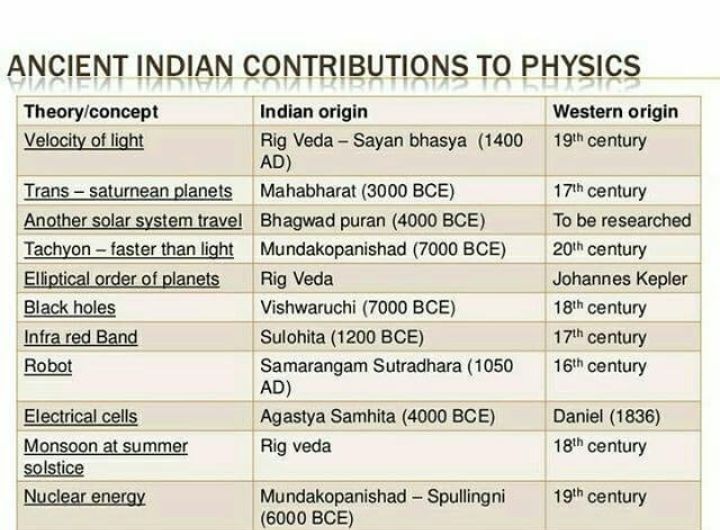
First, do take a look at this screenshot of a WhatsApp message I received from a friend whom I’ve always considered to be far more erudite and rational than me.
I read the message very carefully from start to finish and from top to bottom; I studied every row and column, I even turned the phone backward to discern any hidden meanings I might have missed (succeeding only in taking a selfie of my elbow and part of one ear, which I will post separately – the selfie, I mean, not the ear).
But I discerned no hidden meanings. There was only this brave, neatly tabulated edict shining forth on my phone screen; a declaration that physicists in ancient India had discovered the principles and laws and patterns that explain how the Universe works long before pretenders of the ‘West’.
Briefly, I felt the Worm of Incredulity stir and wriggle in my mind. Quickly, I reached for my mental Bata chappal and squished the foul creature. For, I am a proud Indian; I love my Veda and Upanishad; I wanted to believe!
Staring at the awesome proclamation, I felt my mind’s heart swell with pride at the thought that my glorious scientific Indian super-ancestors had discovered all there was to discover in the Universe, as long as 9000 years before any of those ‘Western physicists’. In my mind’s eye I could see them now—a multitude of goggle-eyed Western physicists tumbling at relativistic velocities, arse-over-elbow, into the great Latrine of History, to be swallowed by the eddying and foaming waters and flushed away into the Celestial Cesspits of Dissolution. In my mind’s ear (located just below my mind’s eye), the cerebral air resonated with the throbbing, universal sound of the sacred syllable “HOME”…
Hooommmmmeeeeee
I cackled in unholy glee as I beheld Anaxagoras, Galileo, Newton, Faraday, Maxwell, Planck, Rutherford, Bohr, Einstein, Dirac, Fermi, Feynman, Born, Schrodinger, Chadwick — heroes of my misbegotten and ignorant youth, now exposed as charlatans and pretenders, the bloody saala kuttas!— plunge headlong into that awesome and awful Thunderbox of Time…
Alas, my celestial reverie was rudely interrupted when, in that cerebral procession of academicians, I saw the familiar and beloved faces of Satyendra Nath Bose, C V Raman and Subhramanyan Chandrasekhar. Arre bhai, I thought to myself, these are deshvaasis! Enna daa, these are my very own Indian scientists! Pioneers they were, too, in their time; pathfinders in esoteric and diverse fields of knowledge, from nuclear physics to cosmology. Were they, too, cheats and frauds, usurpers of discoveries made in Vedic times?
The Worm of Incredulity wriggled frenziedly in my cortex; abruptly, the spell was broken. I regained my normal semi-sanity, and having fortified myself with strong kaapi, replied to my friend, expressing my doubts about the veracity of the tabulated data. I wrote:
“I sometimes suspect idiotic messages like these are being created by CPM and affiliated scoundrels just to make the public ridicule ancient Hindu texts – a purpose served when gullible people forward these messages without a thought!”
Rather unfair, of course, as pointed out by another dear friend. Why point a finger at CPM alone, she asked, when the real reason why such messages work is because there are any number of idiots (including, damn nearly, you) who will believe anything they are told; who cannot, or will not, tell truth from untruth?
But then, I reflected later, what in Allah’s and Krishna’s and Marx’s names is ‘truth’?
I wandered the campus alone through the night, pondering the question. I asked the night-watchman, and the night-watchman’s dog: to no avail.
Now, as I type these meaningless words, I wonder: maybe ‘truth’ is what I choose to believe to be the truth?
Because today I can choose what I want to believe is the truth, damn the rest of the world, empowered as I am by the mainstream media and Net which allows me to sift through like 367 startlingly different versions of the same news or event to find the version of ‘truth’ that makes me the most comfortable.
“TimesNow said so!”
“I saw it on The Wire…so there!”
“Indian Express carried it!”
“Ha! NDTV will never mention it because they’re in cahoots with You-Know-Who!”
Maybe truth is simply, conveniently, what my dear friends believe to be the truth as of today; and I believe that truth because I don’t want to be seen as silly or churlish or – most scarily – apart from the group by doubting, questioning, arguing, differing.
Maybe it’s all these reasons, and more. Maybe there’s no such thing as ‘absolute truth’ anymore; if ever such a thing held …er…true.
Maybe we are all equally at sea. Lost in a stormy, ever-swelling Universe-wide ocean of information: an electromagnetic, 5G ocean that swamps our senses, numbs our brains, distorts our thoughts, impairs our cognitive processes, alters even our dreams with its mega-blather of social media twitter and chatter, its tides of toxic subliminal multimedia messages and memes. We are tossed about on its terrifying Waves of Opinion, maddened by the shrieking Winds of Hates and Lusts that lash the waters into froth, hurled again and again toward the jagged, slippery Reefs of Judgment; our Sails of Resolve shredded, Compass of Confidence cracked, Lamp of Reason shattered, Moorings of Morality long forsaken…
And all the while, the ravenous Beasts of MAM wait impatiently for us to impale ourselves on the Reefs, or to release our despairing grips and slide into the seething waters …they, who have reduced our minds to a uniform, amoeba-like state of imbecility, the perfectly uniform baseline in which the only variants are the Truth-Feeds they manufacture and feed us with, 24/7…
I seek, and find brief solace, in the music of that wonderful rock opera of the last century, ‘Jesus Christ Superstar’: I shudder in the terrible words of Pontius Pilate in converse with Jesus:
Jesus: I look for Truth and find that I get damned.
Pilate: But what is Truth? Is Truth unchanging law?
Resolve Mandir/Masjid Mess – learn from secular mosquitoes
It’s that happy time yet again! When, inspired by a cerebellum that is as overflowing with originality and creativity as Rahul Gandhi’s is, I reach into the dusty shelves of decade-old works and re-inflict them upon my hapless and rapidly dwindling readership.
The reason for committing this latest atrocity on thee, O dear and innocent reader, is to defend the initiative taken by Sri Sri Ravishankar—the Indian spiritual leader, head of ‘Art of Living Foundation’, popular among Hindus, Muslims and other communities for his teachings, cosmetics and other rejuvenating products—to engage with Muslim community leaders in an effort to settle the gangrenous, 30-year-old Ram Mandir/Babri Masjid dispute out of court. Sri Sri’s initiative is being met with violent opposition from many rabid, self-styled leaders of Hindu and Muslim communities.
An important disclaimer: I am no ‘follower’ of Sri Sri. In fact, I have severely criticized him in speech and in writing (and still do) for hosting his ‘World Culture Festival’ on the Yamuna floodplains in March 2016; an event that led to the de-vegetation and flattening of a vast area on the floodplains. The repercussions of that ecological assault are still being directly and painfully felt by the undersigned and other residents of East Delhi in the shape of year-round attacks by assorted species of mosquitoes (all of them entirely secular in their choice of prey); because with the denudation of bushes and scrub on the floodplains, these bloodsuckers have lost their traditional breeding and brooding grounds on the said floodplains.
But I still believe Sri Sri and his associates, Hindu and Muslim, are doing the right thing, indeed a noble thing, by trying to solve this hideous mess over Mandir vs. Masjid; a mess that’s led to mass murder in the past – and threatens mass murder in times to come.
If Sri Sri succeeds in his mission, I am even willing to forgive him for the mosquito bites he has caused me, and countless others of every faith.
And so, in good faith, I present here an article I wrote for the edit page of Indian Express nearly 15 years ago, when the Kanchi Shankaracharya launched an identical ‘reconciliation’ initiative in 2003—and was met with the same violent opposition and ridicule by so-called leaders of Muslim and Hindu communities. In fact, the man was even charged with murder in 2004, arrested, jailed and tried…only to be absolved of all charges and released in 2016!
You’ve taken on formidable forces, Sri Sri! Victory be thine: Jai Vijaye Bhava!
It is heartening that the Muslims of Faizabad-Ayodhya see the Kanchi Shankaracharya’s initiative to resolve the Ayodhya tangle as a ‘‘good beginning’’ (‘Local Muslim leaders find some hope…’, IE, June 11). Ironically, the sincerity of the Kanchi seer’s efforts is proven conclusively by the heated opposition he has drawn from the lunatic fringes — both Hindu and Muslim! Organisations such as the Vishwa Hindu Parishad, Bajrang Dal, All India Babri Masjid Action Committee and Sunni Wakf Board will never solve the Ayodhya problem because they are the problem. While the common citizenry of both faiths only want peace and harmony, these bodies comprise bigoted, self-serving individuals who not only claim to represent their religions, but have obtained enormous fame and political power precisely by keeping the Ayodhya issue simmering. Any solution to the dispute would threaten their very existence. Quite naturally, then, they have resisted, and will resist, any attempted solution. Remember how the Kanchi seer’s initiatives for dialogue were rubbished by both the VHP and BMAC in 2002?
Let us face it: the Ayodhya issue will not be resolved by the much-bandied ‘‘court decision’’ (assuming it ever comes). It will be solved only by mutual understanding between the Hindu and Muslim communities at large. After all, any court decision will be interpreted in only one of two ways: as favouring the building of a temple, or of a mosque. If the verdict favours a mosque, the VHP et al. will shriek that Hindus have been ‘‘betrayed’’. On the other hand, Muslim bodies such as BMAC will become redundant at a stroke; their very raison d’etre would be gone! So the VHP and similar self-styled ‘‘Hindu’’ bodies will incite violence across the country; the members of BMAC and similar ‘‘Muslim’’ bodies, threatened by redundancy, will find fresh reasons to project themselves as ‘‘defenders of the faith’’; the outcome will be chaos and bloodshed.
And what if the verdict favours a temple? Alas, these dreadful organizations would merely switch roles. The BMAC would shriek that the Muslims have been betrayed, the VHP would assume the mantle of ‘‘defenders of Hinduism’’, and chaos and violence would follow.
The only way to unravel the Ayodhya tangle is to shun any political, executive or judicial involvement — precisely what is being advocated by the Kanchi seer and by the Muslims of Faizabad-Ayodhya. Let us not be misled by the rabble-rousers, Hindu and Muslim, who have no religious or intellectual authority whatsoever to represent the laity; who number no more than a few thousand; yet who have held a nation of one billion hostage to their narrow-minded agendas for decades. Let us leave it to learned men and women of both faiths to sit together and agree on a simple way by which the country can finally discard the communal baggage of the past.
 Mani
Mani






 Wanderings and Wonderings