General ravings, Musings

Holland: Remembering Eternity…

It’s 43° C in the shade here in Delhi, with a scalding hot wind ripping the  leaves off trees and propelling kilograms of nano-sized dust particles through the tiniest cracks and crevices in the doors and windows to fill the room where I sit, listening to the air cooler roaring in futile rage, eating juicy chunks of chilled watermelon in between keystrokes and cheering myself with visions of my not-so-favourite netas roaming the streets and campaigning for votes in this infernal weather.

Indeed, there is Dharma in this world.

Delhi’s incendiary summer is a good time to remember the crisp chill of Holland’s winter. I visited Holland in December-January; a dreamy, timeless three weeks during which I re-learned the sublime and long-forgotten art of simply being. Base camp was my friend Udai’s apartment in Delft –  it’s the prettiest little town I’ve ever been in. Delft is young by Indian standards (it’s only 600 years old) but its history is linked closely—oh so closely— to the history of India, indeed of the whole world.  There was so much to see, to experience, to learn…not only in Delft but in Leiden, Rotterdam, The Hague … no, it’s impossible to find words to describe it all, I don’t know where to start, so  I won’t even try – at least not now.

Right now I’m just going to place a few photos of Delft, from here and there. Like this…

I did miss two things, briefly but deeply, in Holland.

One was seeing tulips carpeting the earth out in the countryside like in the photos I’ve seen. Winter is off-season for tulips. So, I plan visiting Holland again, in April/May 2020.

Yayy.

The other thing I missed is actually a person: a friend, the first Dutchman I ever met, I’ll call him Helm, for it wouldn’t be fair for me to use his real name without asking him, and sadly I can’t do that now because Helm and I’ve lost touch since we last met in Shillong in the mid-1970s. I was then pursuing an elusive college degree in Shillong, invigorated in my chase by the healing vapours of garden-fresh cannabis and affiliated psychoactive substances. Helm was a visitor to Shillong from Calcutta, over three successive years, each time just for a fortnight or so. He was a Masters student (of Comparative Religions, if memory serves right) at the Viswa Bharati University, Santiniketan (Calcutta); a few years older than I, tall, broad, strong, golden-haired, ruddy-faced, always clad in white kurta-pajama and clogs. Helm was learned, earnest, serene, yet with a ready smile and a huge laugh that could shake the dust and woodlice off the  rafters. Helm lugged his classical guitar along wherever we wandered—exploring the hills and rills, meadows and forests, taverns and caverns—and when the heady ganja and mellow kyat had soothed the spirits sufficiently and the comfortable silences had settled, he would pull out the guitar and pluck and strum beautiful melodies and belt out folk  songs – Dutch, sometimes English – in a powerful baritone. He even taught me one Dutch song: I only remember the tune now, the lyrics are long forgotten.

I learned much from Helm: about the beauty of all religions and the horrors inflicted across the world in the names of gods and prophets, about humanism, tolerance, the need to remain curious as a child throughout life, how travel can open minds. Helm didn’t educate me on the tulips of Holland, but he taught me a far more valuable life-skill, one that is deeply rooted in India’s glorious heritage and culture—the refined art of making the purest charas (hashish) from the cannabis plants that grow in such profusion in the meadows of Meghalaya. It was a primary objective of his annual pilgrimage to Shillong, to manufacture sufficient stocks of charas to keep him going in Calcutta till the winter break when he went home to Holland.  Thanks to Helm, I and a few friends drastically cut down our ganja-smoking; we switched to charas.

Wherever you are, Helm of Holland, may peace be with you. It was wonderful visiting your beautiful, eternal country: I remembered you, briefly but deeply, when there.  Who knows, the One willing, perhaps we shall meet again someday, in this life or in another, in some timeless rolling meadow filled with music and laughter and companionship and comfortable silences and mounds of stroopwaffel and the divine fragrances of tulips and mellow wine and ripening ganja plants in the sunshine…


Musings, Potshots

Lessons in Economics – from Rahul Gandhi and from Suresh

I must share with you two really profound – and radically contrasting – lessons in Economics I learned today. One, from  Congress President and Prime Minister-aspirant Rahul Gandhi; the other, from my colleague-become-friend of some 24 years, Rickshaw and Thela (wheelbarrow) Operator Suresh.

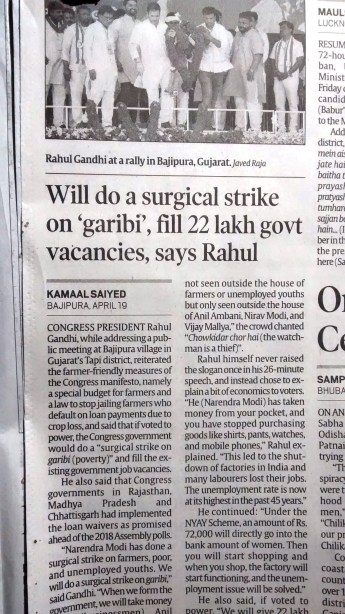
First, Rahul, who “chose to explain a bit of economics to voters” while addressing a public meeting on April 19th at Bajipura (Gujarat). To quote from today’s Indian Express article [click here to read]: Suresh and Rahul

He (Narendra Modi) has taken money from your pocket, and you have stopped purchasing goods like shirts, pants, watches, and mobile phones.’ Rahul explained. ‘This led to the shutdown of factories in India and many labourers lost their jobs. The unemployment rate is now at its highest in the past 45 years.’

He continued: ‘Under the NYAY scheme, an amount of Rs 72,000 will directly go into the bank account of women. Then you will start shopping, and when you shop, the factory will start functioning, and the unemployment issue will be solved.’

He also said, if voted to power, ‘We will give 22 lakh government jobs in one year, which are currently vacant, and 10 lakh youths will be given jobs in various panchayats.’

Rahul’s insight really made me think, O gracious reader. In a weird and woolly way, it kind of makes sense, no?

Only one thing about Rahul’s economics troubles me: Rahul’s plan to create 22 lakh government jobs (+ 10 lakh quasi-government jobs). Since the 7th Finance Commission, even the lowliest central government employee in India starts with salary of Rs 18,000 per month; that’s Rs 216,000 (2.16 lakhs) annually. Which means that, even assuming that every one of Rahul’s 22 lakh new government employees draw only this minimum salary, the annual salary bill for these worthies will be Rs 47520,00,00,000.

That’s Rs 47,520 crores every year! At minimum government wages…

To me it seems a hell of a lot of money, just for the sake of having 22,00,000 more leech-like sarkari babus making life miserable for you and me and all other honest, tax-paying citizens. Especially so, because that Rs 47,520 crores is going to be forked out every year by honest, long-suffering income tax payers like you and I!

But then, I console myself, Rahul Gandhi has been advised on his NYAY scheme by globally renowned economists like our very own P Chidambaram, Arvind Subramanian, Raghuram Rajan, and also British Nobel Laureate  Angus Deaton and French economist Thomas Piketty. Undoubtedly there’s something  I’m missing, ignoramus that I am…

Enter, Suresh.

At my request, Suresh brought his thela over around 11 a.m and was helping me clear out some old furniture and stuff. As usual, over a break for a banana and chilled glass we discussed the state of the world. “Who will you vote for?” he asked. “I know I will not vote for AAP this time,” I replied.  “I’m more and more inclined to vote for Modi’s BJP-NDA…”

“I too will vote for Modi,” he said firmly. “Of course, I suffered a lot when the note-bandhi [demonetization, 2016] happened. All my earnings are in cash even today;  nobody pays a rickshaw/thela-wallah any other way but cash. And of course with prices always rising, it is a very hard life for a daily labourer like me. Besides, as you know, for much of last year, I could not work…”

In mid-2018, Suresh’s five year-old son was diagnosed with cancer. Thanks to the chemotherapy and the excellent medical care he received and continues to receive at the Delhi Government’s Lok Nayak Hospital, the child is now recovering well…but for Suresh and his wife, it has been a year of indescribable anxiety, physical and mental trauma….with the financial pressures (to raise over Rs 2 lakhs for the treatment, when there was no time to even ply his rickshaw or thela) only adding to their stress.

“But still, I think I will vote for Modi,” he repeated. “I think because of Modi, nowadays the sarkari-log, the babus are more scared to bully and exploit people like me.  The babus and other people are also more scared to do do-numbaree (black marketing). People tell me, arre look at price rise under Modi; but I tell them, I don’t think Modi is to blame for price rise.  I think the real reason for price rise is because people, more and more people, are greedy. People nowadays buy much more than they need, or can use; that’s the reason.”

He then described how, two weeks ago, he was helping a couple in the neighbourhood pack their belongings to move out of the city. “They had two wall-cupboards filled with only chaddars (bed sheets and bed-covers),” he murmured in awe.  “They had more than three hundred chaddars in there, single and double! Most of them were new, untouched.  If one couple buys so many hundred chaddars, why won’t prices of chaddars go up, sir? It’s like that with everything…”

Suresh’s words, too, made me think.

Unlike Rahul, who has a team of illustrious economic advisors, Suresh has none.

But  Suresh has something that I think counts for much more: common sense, that comes from experience of hard ground realities.

I’ll go with Suresh’s insights into economics.

Jai hind.

General ravings, Potshots

Political A-SAT and SAT

ASAT
Stellar vision?

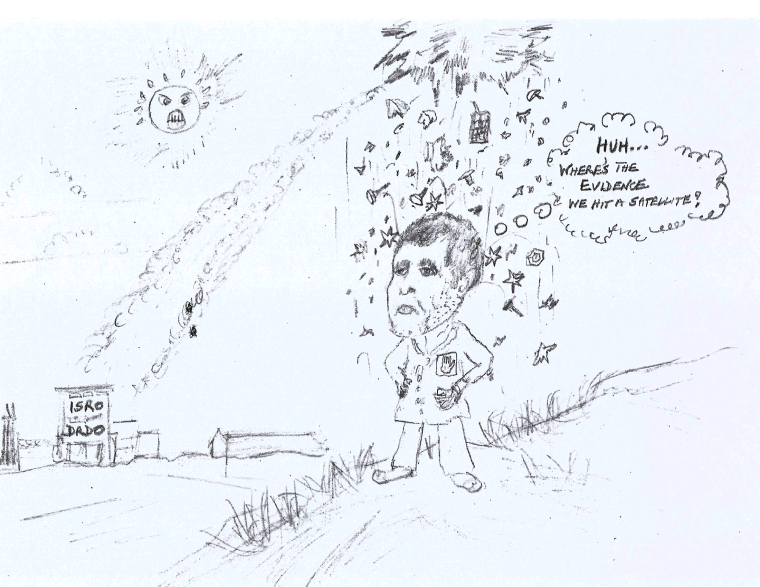
Ever since India successfully conducted its anti-satellite (A-SAT) missile test, our crass netas have given political twists to the event that would make a boa constrictor straighten in envy. Considering the kinds of comments that they and their acolytes are making, and with Lok Sabha polls looming over the horizon, we, the wee people, have good reasons to worry about whether our newly elected MPs will even understand, let alone be capable of handling, critical strategic issues such as space technologies, missile defense, nuclear deterrence and the like.

But there is hope! Unconfirmed and officially disavowed sources reveal that the Lok Sabha Secretariat is alive to the challenge, and is preparing a series of small booklets on science and technology for the enlightenment of our newly-elected MPs.

Here are a few sample definitions leaked from the draft Lok Sabha booklet on ‘Aerospace Science for MPs’:

 Satellite: This is simply another name for party follower or chamcha. Satellites can be of two common kinds:

  • ‘Polar’ or ‘Poll-ar’ satellites are rather unstable, and remain loyal only so long as their leader has a chance of winning in polls.
  • ‘Jio-synchronous’ satellites, also known as ‘Jio-stationary’ satellites, are more stable and loyal, because they are held securely to their leader/party by the attractive gravitational forces of G, 2G or even 4G.

Space Debris: The countless pieces of metal, plastic, composites and affiliated junk that are now orbiting the earth, and that have resulted from the break-up of old satellites launched by different countries during the last 50 years. About 97.9% of all the space debris is ‘clean’ debris, because it comes from NASA satellites sent up by USA. The remaining 2.1% of the debris is ‘dirty’ debris because it comes from Indian and Chinese satellites.

Escape velocity: The very high velocity with which politically connected fraudsters and affiliated crooks escape from India to other countries when a new government takes over in Delhi. ‘Relativistic’ velocity (also known as ‘Maxis’ or maximum velocity) is the highest attainable escape velocity, usually achieved only by crooks who are close relatives of political leaders.

Global positioning system (GPS): A wonderful technology that helps government to keep track of the escaped crooks, and guide them to safe havens when necessary.

Inertia: Describes the tendency of a government to remain forever in a state of supreme inactivity; or if roused into motion (usually by sting operation), to continue moving aimlessly along a fixed path to nowhere until halted by the ‘fictional’ force of Opposition.

Launch window: The auspicious interval of time for a new politician to launch her/his political career by filing nomination papers for Lok Sabha or assembly elections.  Launch window is determined by specialists in astral science called ‘astronauts’. The term astronaut itself is derived from the ancient Sanskrit: astra-nath—‘one who rules over stars’ (Ref: Goru Gauswamy et al., 4300 BCE. Space Explorations. Muttal Press: Takshashila).

Re-entry vehicle: Pathway for political deserters to return to their parent (or grandparent) party. As re-entry usually generates intense heat from party rivals, re-entering politicians require rings of protective coating. Hence, the re-entering politicians are popularly called ‘turncoats’.

Star wars:Spectacular electoral battles waged between stars affiliated to Bollywood, Mollywood, Tollywood and other non-Dawood studios. If firearms such as Shotguns are used by the star-candidates during poll campaigns, we call them ‘shooting stars’. Sometimes, the winning stars are given Cabinet portfolios, in which case we call them ‘acting ministers’ if they turn up for work; or else, ‘deadwood’.

Warhead: An especially strident jingoist, usually seen on TV talking-head shows calling for nuclear attack on neighbouring nations, political opponents, and occasionally, neighbouring panelists.

Jai hind!


Musings, Potshots

Balakote: A Post-Mortem for countless Jaish-e-Mohamed cadres


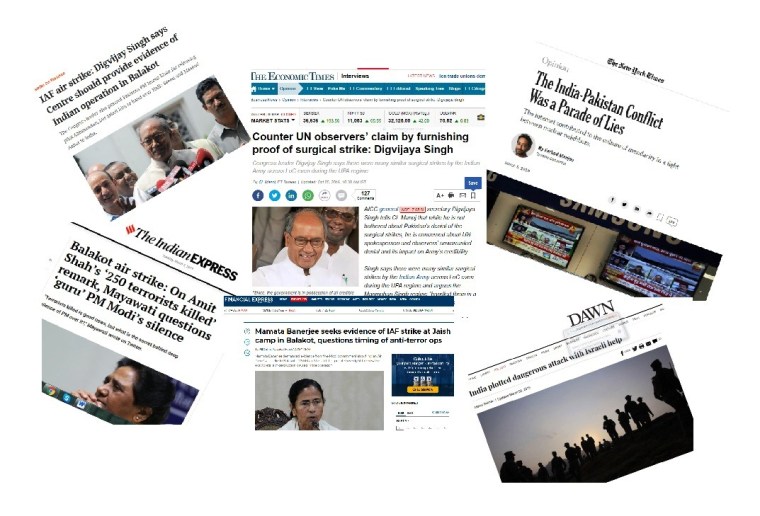
Balakote Post MortemAs Indian political leaders, and even some Indian journalists, question the veracity and impact of the Indian Air Force strikes on Jaish e Mohammed facilities at Balakote on February 26th, their questions resemble those of the smug lawyer who was questioning a pathologist in the Coroner’s Court:
Lawyer: Doctor, before you signed the death certificate, did you check the patient for pulse?

Doctor: No.

Lawyer: Did you check for blood pressure?

Doctor: No.

Lawyer: Did you check for breathing? For heartbeat?

Doctor: No.

Lawyer: (triumphantly)  So, doctor, do you admit it is possible that the patient was alive when you signed his death certificate?

Doctor: Well…let me put it this way. The patient’s brain was sitting in a jar on my desk when I signed his death certificate. But I guess it’s possible he was alive; indeed, he might even be practicing law somewhere.

I, dear reader, have no doubts at all about the IAF strikes on Balakote and their impact on the Jaish cadres sleeping in the targeted buildings. The several thousand kilos of penta-erythritol tetranitrate carried by those Spice missiles and thrust through the roofs of the buildings would have wreaked horrific destruction when they went off within – ripping apart metal, concrete, brick, wood, human flesh and bone.

I entirely empathized with the IAF Chief when he curtly told the media: “Our job is not to count bodies.”

Unlike the doubters as well as the gleeful war-mongers in their TV studios and editorial rooms, I do NOT want proof on how many JEM personnel were killed, or how many brooms and hoses were needed to clean up their remains.

Only the post-mortem of the deceased JEM cadres remains to be concluded.

The Coroner’s Court is noisy.

Two groups among those present—one Indian, the other Pakistani—are particularly strident. But strangely, both groups are screaming more or less the same things.

The Modi-led government is lying.”

“The Indian government is lying.”

“There was no Jaish camp in Balakote.”

“Where is the proof that there was a Jaish camp at Balakote?”

“Where’s the proof that the IAF hit their targets or killed any Jaish men?”

“The IAF hit nothing…only a few trees.”

How can Indians and Pakistanis be united in screaming against the Indian government?

Well…

The Pakistani group – comprising the Pak establishment, ISI, army and media – hates India in general and the Modi-led Indian government in particular. This is sad, yet understandable.

The Pakistani group’s hatred has been stoked by the IAF strikes on Balakote, which have gone down well among the Indian public in an election year.

The Indian group – comprising Congress, CPM, TMC and other Opposition parties, as well as large sections of Indian media –  hates the Modi-led government. This is sad, yet understandable.

The Indian group’s hatred too has been stoked by the IAF strikes on Balakote, which have gone down well among the Indian public in an election year.

Easy to understand…no?

I pay no attention to politicians because I do not trust politicians.  By definition, all politicians lie. Nikita Khrushchev put it succinctly:

Politicians are the same all over. They promise to build a bridge even where there is no river.

With a few noble exceptions, I pay no attention to journalists because I do not trust journalists. Try this out: take any event or issue, look at five different newspapers or TV news channels or websites, and you’ll get at least 19 different versions of ‘fact’, varying continuously and seamlessly with every passing hour. Breaking news is no longer distinguishable from breaking wind. As Thomas Jefferson put it:

The advertisements are the most truthful part of a newspaper.

Who, then, O long-suffering reader, can we trust to show us, tell us, the truth?

I don’t know about you…but I’ll stick with the Indian armed forces.

Be at peace, O deceased Jaish men.  Unlike your Pakistani army handlers,  I at least acknowledge that you once lived.

Jai hind.


Musings

Solidarity Day – II

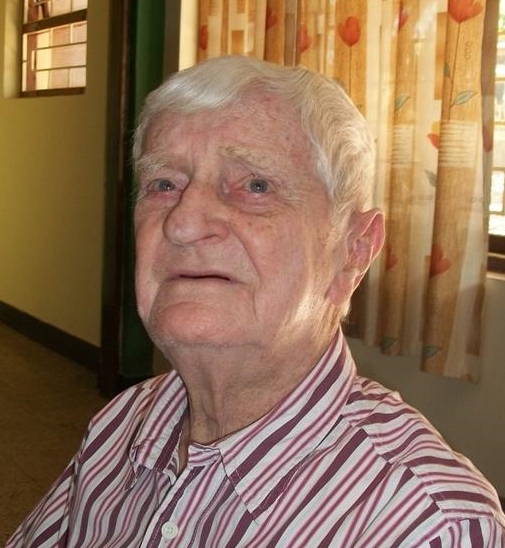
Rev. Br. R B Oman

I still remember that chill morning, early March, 1963.

It was opening day, St Edmund’s School, Shillong. Along with about two hundred other assembled students, I stood shivering in front of the flag staff on the sloping lawn at the main entrance of the school – in those days it was a magnificent, rambling old wooden building on a pine-forested hill. I was just under seven, nervous about entering class 2, about facing a new teacher…and most of all, about attracting the attention of that ruggedly built, auburn-haired, fierce-eyebrowed man in white robes who stood beneath the tricolour and glared at us all.

He was our Principal, the Rev. Brother R B Oman.

Gruffly, he asked us to stand at attention and observe three minute’s silence, in solidarity for those Indian soldiers who had died during the conflict with China in November 1962. He bowed his head: I stood silent in the thin drizzle, not aware of anything beyond my own physical discomfort and anxiety. And then the silence was broken: from the far left of the assembly where the senior boys stood, there rose a murmur and chuckle, quickly stifled. Br Oman glanced up sharply. ‘Silence’, he said softly, but with such intensity that the word sounded like a gunshot over the gentle hiss of the rain.

The minutes passed, an eternity, and then Br Oman looked up. He spoke for a while, then: on the meaning of solidarity, of valour, of duty and sacrifice, of patriotism, of the significance of the uniform to the soldier and to the student, on the transience of victory and defeat.  

I could barely comprehend his words, then, simple though they were: yet their power shook me, lifted my spirits as great music can move and inspire even the most uninitiated.  

It was again from Br. Oman that I had an early insight into the ephemeral nature, even foolish vanity, of ‘identity’.  It must have been 1964: a bunch of us were loitering in the corridors during the lunch break when he came swishing and clomping down the corridor toward us. He acknowledged our chorused ‘Good afternoon, sir’ with a slight smile and nod, and then asked us what we had learned in class that morning.

One of my friends eagerly piped up: “Sir, we learned history.”

“Oh? And what did you learn in history?”

“Sir, we learned that Vasco da Gama discovered India in 1497.” Indeed that’s what we had learned…our history was being taught verbatim from a textbook titled The March of Time, written and published in Britain.

Br. Oman looked solemn. “Well, well…and where were the Indians before Vasco da Gama discovered India in 1497?”

We gaped at him.

“Now, make sure you ask your teacher that question,” he added, with a twinkle in his eye and a wolfish smile.  Naturally, we did as he asked us with immense glee, much to our teacher’s discomfiture.

Over fifty years have passed since I last met Br Oman, but I’ve recalled him fondly from time to time over the years; more frequently in recent years, as the nation, indeed the world,  is being destroyed by selfishness and greed; as humans are being torn asunder, body and mind, by monstrous rabble-rousers who preach war, who teach their followers to pillage and maim and slay in the name of prophets and gods and ideologies and imagined identities.   

Br. Oman died on 17th February 2019, in Goa. He was 96.

The twinkle in his eye, his wolfish smile, his infinite humaneness, endure; they lighten the spirit in these troubled times.

Potshots, Verse perverse

Understanding the Budget: An A,B,C Primer for Rahul Gandhi-ji

Whether the ‘Interim Budget’ presented by acting Finance Minister Piyush Goyal was actually interim or not is immaterial – as immaterial as the benefits you and I will receive from the Budget.

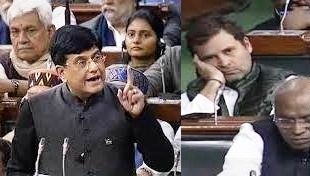
Far more tangible was the utter bewilderment on the face of Congress President Rahul Gandhi during Goyal’s speech. Clearly, the poor man was quite flummoxed by the barrage of economic spiel, financial terms and affiliated data Goyal dished out, tera-flop by tera-sop.

Long on speech, longer in face

Following the budget speech, we staggered up to the terrace and espied a piece of paper gently floating in from the general direction of Parliament Street. Grabbing it and smoothing it out, we discovered it to be a page torn from a standard-issue Lok Sabha jotting-pad. The page was filled with writing, starting with a four-line piece of doggerel!

We transcribe below, O faithful reader, the lines from this solitary page. We can only guess at the identity of the author – perhaps a cynical Congress or CPI(M) Member whose heart is yet in the Right, or even Left, place?

[QUOTE]

Rahul-ji’s angst and anguish doth grow and grow

With Goyal’s every buzz-word, every cackle and crow

Rahul-ji’s frown deepens; his face grows longer – little wonder

‘Tis clear he can’t follow a word, however hard he doth ponder

With general elections a couple of months away, and with strong indications that our Mahagathbandhan might well form the next government with Rahul-ji as prime minister, surely we must all try and help Rahul-ji understand some common terms used in connection with the budget?

Here is a small glossary to get Rahul-ji started:

 Appropriation Bill: This is a bill of receipt, or challan, given to you by team from Income Tax Department, Enforcement Directorate or CBI after they raid your home and/or office and appropriate assets disproportionate to your known sources of income. [Always remember: when raided,  insist on Appropriation Bill].

Balance of payments: Denotes the difference in total value between various payments into and out of India over a certain period of time on account of kickbacks on defense equipment, hawala transactions and so on, through legally disapproved channels such as Channel Island companies.

 Fiscal policy: Derives from the vision of  Congress fore-fathers, fore-mothers and fore-others, of an India where our youth – young and old alike – are strong and muscular, that is, fiscally fit. Fiscal fitness is especially important during election campaigning. Today BJP makes tall promises to set up infrastructure for fiscal fitness such as gyms, sports stadiums and so on. In practice, however, these promises are never kept and the money allocated disappears without trace in ghotalas and goshalas, leading to a weak fiscal condition in people known as fiscal deficit.

Gross Domestic Product (GDP): Although it might sound gross or unpleasant, GDP is a vital measure of the overall garbage output from the entire domestic or household sector in India.  As household prosperity increases, so too does household consumption of junk food and junk goods, and therefore of household garbage output. This is famous Garbage In = Garbage Out principle. Hence, high GDP growth is good because it means India’s economy is growing.

Inflation: Describes the tendency of the BJP government to make exaggerated claims about everything, including the size of Narendra Modi’s chest.  Affiliated terms are deflation and recession, manifest in shrinking chests of BJP members upon losing in successive state assembly elections.

Plan and Non-Plan Expenditure: Plan expenditure is what the government tells the public it wants to spend. Non-plan expenditure is what government has to spend, but doesn’t tell the public it has to spend, in order to spend what it tells the public it wants to spend as plan expenditure. [For more simple explanation, please consult Mani Shankar Aiyar-ji and/or Shashi Tharoor-ji]

 Public account: Refers to the public admission made by a high-level politician or government servant who is accused of swindling public money, during a court hearing that is open to public. When the hearing takes place in Supreme Court or Delhi High Court, the public admission is known as capital account.

[UNQUOTE…END OF PAGE]

P.S.:  We offer a reward of Rs 10,000 in non-demonetized notes to anybody who can trace the remaining pages of this invaluable document.


General ravings

Surviving the Indian Railways: perfecting the Pajama Hop

 Guidelines for Indian Railway travellers on how to change into pajamas at 130 kmph

Some years ago, O gentle and hapless reader, I’d drawn up a set of guidelines for the intrepid male Indian Railway traveller, on the fine art of shaving on express trains without performing involuntary self-circumcision or castration.  [Click here to view]

Now, bowing to widespread demands from orthopaedists, podiatrists and orthodontists who wish to remain anonymous, and ignoring thy vociferous protestations, I present a similar set of guidelines on how to change safely into pajamas during overnight train journeys…a process that is normally, and in the interests of public decency, undertaken in the toilet. For the sake of simplicity and brevity, these guidelines too are directed at male travellers: however, they can be adopted, with slight adaptations as needed, by travellers of all genders.

1 – Enter toilet with pajamas securely wrapped around neck, or tucked into waistband of trousers. Bolt door.

2- Carefully open up pajamas and tie them by the string (naada) to the clothes-hook behind the door. Use a good, strong knot like a square knot or clove hitch (you may click here to learn how to tie these knots and/or tie yourself in knots). Note: do not simply hang the pajamas from the hook, because the slightest jerk of the train will dislodge them on to the yucky floor.

3- Roll up both* trouser legs to at least 6 inches above the ankles (*if three-legged or more-legged,  roll up all trouser legs). This will protect your trousers from the swirling muck on the floor, and also make removal of the trousers easier.

4- Remove trousers, step by step and leg by leg as outlined in (a) to (d) below. [Warning: This entire process demands patience, extraordinary courage and lightning reflexes, to counter the violent lateral movements of the speeding train and to guard you against the perils of falling headlong into the W.C., and/or injuring various limbs, bones, joints and appendages]

(a) Lift right leg and use left hand to clutch on to clothes-hook or pajamas tied to hook, in the absence of any alternative dependable object to clutch. Note: do not attempt to clutch edge of washbasin, W.C. chain or pipes, for these may suddenly disengage from wall, plunging you into W.C. Also, do not clutch tap of washbasin, as the tap might open, soaking you head to foot in spray of water that adds to slush on floor and undoes all the gains of Swacch Bharat Mission.

(b) Balancing on left leg and lengthening the spine, take several deep breaths (depending on freshness of air) and then slowly and cautiously draw off trousers from right leg, using your right hand. Be alert against losing balance and lunging head-first into wash basin, wall or W.C.

(c) Clamp your teeth firmly around the rolled-up bottom of removed (right) trouser leg. Lower right leg to floor. Carefully replace the left-handed grip on clothes-hook with right-handed grip. Then, breathing shallowly through the trouser-leg clenched in teeth, lift your left leg and draw off the trousers from that leg, using your left hand.

(d) Open jaws and grab at the falling (right) trouser leg with left hand. Ensure that you have not inadvertently pulled off underwear along with the trousers (a chill draft in the nether regions is a sure indicator of this unfortunate situation – in which case, you may retrace earlier steps and start afresh).

5- Sling trousers over the right shoulder, taking care that you do not sling them into W.C. or allow any dangling portion of trousers or self to touch the inundated floor. Regain balance and composure by taking several deep breaths (if possible).

6- Untie pajamas from clothes-hook. The process of undoing the good knot(s) you tied earlier requires you to use both hands and possibly your teeth as well; hence, extreme care is advised.

7- Sling pajamas over left shoulder (taking same precautions as you did with trousers on right shoulder). Now, remove trousers from right shoulder and secure trousers to the clothes-hook by belt-loops, or fly zipper if loops are not strong enough.

8- Roll up both pajama legs to half their lengths. Then, lean against door for support, and with pajamas pressed against the left hip, execute a series of small, kangaroo-like hops till you succeed in slipping your right foot into right pajama leg. Note: All too often, the hasty traveller inadvertently slips right foot into left pajama leg, setting off a catastrophic sequence of agonized leaps that invariably ends in strained muscles, sprained joints and worst of all, ruined pajamas. [Tip: use fluorescent marker pen to mark right and left legs of pajamas before-hand (rather, before-leg)]

9- In similar fashion, slip your left foot into left pajama leg.

10- Lean away from door, and standing upright, use both hands to pull up pajamas and knot them around waist. This penultimate step is also the most dangerous, as with both your hands occupied in tying the pajama knot, chances of diving into the W.C at various angles are maximum.

11- Remove trousers from clothes-hook. Clutch hair in agony as you see your cellphone drop from the trouser pocket into the W.C. Pull chain, open door and exit.