General ravings, Musings

Jai Backwards! Jai Hind!

Jats in action
Jats fearlessly exposing themselves to injury during agitation

At last, the Jats of Haryana have triumphed in their heroic week-long struggle to be recognized as ‘Backward’. With the Government of India and the Government of Haryana declaring the Jats to be a Backward Community, the Jats have called off their agitation.

We, the people of India, are overjoyed. We congratulate the Jats for joining the swelling ranks of the Backward!

But the Jats have also suffered terribly during their heroic, Nationalistic struggle.

Thousands of young Jat men suffered cuts, bruises and sprains while lifting and dragging heavy stones, concrete blocks and tree-trunks to block all the highways and railway lines in Haryana, Punjab and Delhi, and while assaulting non-Jat passers-by with rocks, sticks and affiliated blunt weapons.

Many Jat men experienced severe dehydration and exhaustion as they wielded sledge-hammers, crowbars and other heavy tools to destroy the pumps, sluice gates, and affiliated equipment and concrete works used to supply water to New Delhi’s 15 million people via the Munak Canal.

Countless Jat men—and even a few Jat women (whose names have been noted by the Jat Khap Panchayats for future reference and action) — suffered lacerations, muscle pulls and back pains  as they broke shop windows and raided malls and supermarkets to loot mobile phones, refrigerators, cars, branded footwear and apparel, perfumes, lingerie, and other essential commodities.

Of particular concern is the fact that at least fifty Jat men are still under treatment for severe ailments such as neck and lower back injuries (from wielding heavy axes and swords), ‘shooter’s finger syndrome’ (from pulling stiff triggers of pistols and country guns) and burns (from setting fire to railway stations, buses, automobiles, shops, houses, truck tyres, and a few non-Jat passers-by).

Alas, the sufferings and sacrifices of the Jats in their heroic, Nationalistic struggle have gone unnoticed by our callous mainstream media, which has only been obsessed with the Anti-National protests of JNU students.

However, We, the Wee People of India, deeply sympathize with the poor Jats for the terrible hardships they faced and the sacrifices they made during their  struggle. We demand that they be compensated for their injuries and losses.

In ringing tones, We, the Wee People of India, assure the Jats that India shall forever recognize and celebrate their  Nationalistic struggle for what is, after all, the fundamental right of every true-blood, caste-ironed Indian – to be recognized by the world as Socially, Economically and Culturally Backward.

What a fine ideal the Jats have set of True Selfless Nationalism; an ideal  for the young Anti-National JNU-wallahs to emulate!

Inspired by the Jats, let  all Indians now unite, Forwards and Backwards, in our relentless hind-ward journey towards Backward Development.

Let our government demand a Reserved Seat for India in the UN Security Council under the Backward Quota.

Jai Backwards!

Jai Hind!


Musings, Verse perverse

Cosmic gurgle

Does your mind reel when endless ‘holy’ wars are fought

By believers in gods or prophets, against those who believe not?

When some deem cows ‘holy’, and so not fit to eat

And others deem pigs unholy, and pork a sinful meat?

Diminishing Divinity to what should or should not

Go into your cooking pot?


Surely, the One manifests, in love, compassion, joy, grace

In Nature’s harmony, awesome infinite Space

In children’s innocence, amour’s sublime passion

In the grandeur of cosmic balance, stasis in action

This Truth dwells within very being, in every place

In the baby’s delighted gurgle, the saint’s serene face


Behold! In that religious kook’s tooth – a calcium atom

That recently passed through an earthworm’s bottom…

‘Fore that, for eons this atom danced and ranged

Among a million bodies, across the planet – itself unchanged

A Truth as wondrous, as certain, as Spring’s softening to Autumn

A Secret, perhaps…yet one a child can easily fathom!


And look! There, in that crow’s eagle eye, sparkles a photon

That a decade ago sped past distant Procyon

Borne Earthwards a-straddle a cosmic ray

Crow blinks…and now the photon’s away

‘Twill streak by Neptune later today, heading to Orion

Tiny Space-Time voyager: Eternal, Unborn


In hills and rills, stones and bones, leaves and hide

In crystals and beings, inside and outside

Behold energy- turned-matter, bits of the Divine

Batter to bake the Cosmic Cake—and brew the Wine!

Ever changing yet eternal, rhythmic as the tide

Awakening the quark, the neutrino, the very Universe wide


In you today, in me tomorrow

Untouched by joy, passion, pain, sorrow

Ecstatic Players, in the Theatre of Great Allah

Dancing in abandon, Great Shiva’s Tandava

Star-Children, God’s children are we all, in Creation’s ebb and flow

Oh listen to the music and dance! Let’s lead, let’s follow


And  if the mind reels when, in the name of Divinity

Humans forsake humanity for murderous insanity

Despair not! With the Flame of Reason, lighten thy heart, thy ethos…

Rekindle the Spark; discern Order in the Sea of Chaos

And dance as your Oneness with the One illumines Infinity

And smile at the echo of the Cosmic Chuckle in the Halls of Eternity


Musings

Yoga Time-Out

Seeking Satori
Seeking Satori

Make a hook out of your left hand and reach out and grab your right shin. Reach up with your right hand towards the ceiling. Keep your left knee pressed firmly to the ground. Breathe…look towards your right hand …make sure the muscles in your neck and left shoulder are relaxed...”

Zubin’s voice is soft, calm; it seems to come from very far away as I follow the instructions.  I stare at the edge of my stretched right wrist, hearing the faint roar of my own blood pumping through my veins as I strive to breathe normally. It’s easier now to remember to breathe; much easier than even a month ago, when I would instinctively hold my breath each time I got into any new position. I feel a dull pain in the left side of the neck. It intensifies: I loosen the grip on my shin, the pain disappears and at once my left shoulder relaxes; I didn’t even know it was tense!

I return to contemplating my right wrist and the ceiling above.  Faintly, above the soft thunder of my blood, I hear Zubin murmuring: “It’s not about strength, it’s about becoming aware of yourself, about balance, harmony…

I hear the words without really absorbing their import; I let the mind drift through an incredibly diverse cerebral landscape…

I need to finish that %%^&*@! article.

I’m hungry, must go with the gang to Café Red…akoori on toast, yea! And that tall green gingery drink, whatever it’s called…

Green…must remember to call the gardener, fix the terrace plants…

Oh hell, forgot to go and get some bigger flower pots…

Do that on Monday, no, Tuesday…

I’ve got to call Bala.

The article…

Now, use your left elbow to keep your right knee pressed firmly towards the floor, and reach out with your right hand and see if you can grab the toes of your left foot…”

Hazily, I become aware that my limbs are arranged in an extraordinary pattern. I can feel a foot under my left hip; my left hand has, impossibly, coiled round my back and appears to be resting on my right thigh. But where is my right hand? Ah…that must be it, peeping out from beneath my left knee.  I can see the toes of another foot beneath what must be my bent right knee; I wiggle the toes…and to my astonishment I feel the toes on the foot beneath my right hip wiggle.

Is this a glimpse of true detachment? Nah! It’s just an inability to follow simple instructions.  As Zubin comes by and helps unknot and rearrange me into the required position by a series of deft twists, tugs, pulls and pushes, I slide off the banks of consciousness into the stream of  restless mundane thoughts once again…

Wonder where to get the fibre-glass roof for the terrace…

Hah! Forget it! Crazy idea. There’s no money, unless by some miracle my income-tax refund materializes.

Damn that article…

Besides, there’s the whitewash to do, and also fixing the broken windows…

Perish the thought. Maybe I’ll sell the damned windows…Hah!

There’s a jam on Friday. Must practice that Uriah Heep number…

My shoulder hurts…

Pay the electricity bill.

Jam means whole afternoon gone, so what about the article? I need to finish that %%%&&^*$# article! Must do it tonight, forget Café Red…

Or else maybe I’ll work late, yeah, work till 3 a.m…

Akoori on toast…

My shoulder hurts!

I realize I’m holding my breath again. I breathe deeply, easily; feel the shoulder pain vanish, feel energy surging through the body. It’s an extraordinary feeling, a kind of electric tingle that pulsates with every breath…it’s a feeling I knew in childhood but somehow lost over the decades…a feeling of being here and now, of – well, Being. Yea, of simply Being…

I allow myself to drift away in the embrace of the feeling; a feeling that’s actually a kind of knowing.  The knowledge that I AM, in this body yet able to contemplate it, in this mind yet aware that I have this mind and can channel it. I am here, now! I’ve always been here, now, amidst those whom I love and who love me…in this room, this world, beyond, infinitely. It is an incredibly exhilarating feeling, like it happens sometimes with déjà vu, knowing what’s going to happen, sensing the awesome truth that all that’s ever been and all that will ever be already IS…

I am that I am…

I am That I am

I am That I am

Tat tvam asi

Now slide yourself forward till you are in the child’s position. Relax, let go of everything, allow every muscle in your body to loosen up...

Slowly, I comprehend the words. Lazily, I float through the hazy, endless, weightless waters of satori back towards the banks of reality. I wonder briefly how much time’s elapsed, but let the thought drift away as the comfort of the child’s pose takes hold of my senses. My breathing is rapid but not ragged; the heartbeat is like a pounding bass drum in my ears…slowing down, softening…and presently, I return from the realms of infinite calm to the yoga room.

Musings

Communal Road to Calicut

Between Scylla and Charybdis

That Saturday, I left the bank as usual at about two o’clock and went straight down to Safina Restaurant, on the ground floor, where I wolfed down a half-plate of rice and chicken curry. Safina Restaurant was my regular eating place in Chemmad, primarily because it was the only restaurant in the whole town.  Not that I ever had cause to complain about its fare.  The Safina menu was limited but nutritious. Usually, I breakfasted on eggs and Malabar paratha; lunched on chicken biryani; and dined on chicken curry and rice. For variety, I sometimes lunched on chicken curry and rice and dined on chicken biryani.    When in extravagant mood, I sometimes had an omelet with my chicken curry and rice. Safina’s owner and head chef, Haji Mohamed, was a friendly and solicitous host, ever ready to sit with me and chat while I ate, and quite tolerant of my occasional forays into his kitchen to modify or experiment with some dish.  Thanks to Haji Mohamed’s fare, I gained three kilos during my five-month stay in Chemmad.

I was a Probationary Officer assigned to State Bank of Travancore‘s branch in this little town, located in Malappuram district of Kerala.  It took a while for me to adjust to Chemmad. Without doubt, it also took a while for Chemmad to adjust to me; for having lived all my life in Meghalaya and Assam, I knew little of the cultures of southern India.  I didn’t know a word of Malayalam; even my Tamil was awful.  Naturally, then, I dropped bricks of varying size and weight throughout my stay in Chemmad, much to the amusement of the townsfolk…

But all that is for another story, for another time.  This is about a bus journey I took that Saturday in early 1980; a routine weekend bus journey  from Chemmad to Calicut (now Kozhikode) to buy things and do things that I couldn’t buy or do in Chemmad—like pick up newspapers and magazines, medicines, toiletries, biscuits and namkeen, a carton of cigarettes.  Make ‘phone calls to my parents in Guwahati, perhaps to a friend or two in Delhi and Bangalore (Chemmad didn’t have a public telephone booth).  Drink a cup or three of good filter coffee; eat something other than chicken biriyani and chicken curry. As always, I had with me a large bag filled with linen to give for wash at a laundry on Beach Road in Calicut, and in which to bring back the earlier week’s consignment:  Chemmad didn’t have a dhobi, and its perennial water shortage made it difficult to wash anything larger than a shirt.   I looked forward to strolling along the Calicut beach, having a coffee somewhere, wandering aimlessly through the centuries-old lanes near the old harbor, the air redolent with spices and flowers and dried fish, the narrow pavements lit by oblong orange-yellow glows from a thousand shops selling a thousand different things as they probably had for a thousand years. I thought of the huge, smoke-filled tavern near the mofussil bus stand where, as always, I’d quaff a quarter bottle of rum, dine on rice and fish, and then board a bus back to Chemmad…

Presently, a Calicut-bound bus came rattling down the highway—like most of its kin, a private bus operated by ‘Vengara Roadways’ . I boarded the bus and found a seat.  Seated next to me, at the window, was an ageing maulvi with a deeply lined face and long, lustrous white beard. He had his eyes closed; his lips moved slightly in silent prayer. Most of the score or so other passengers were easily identifiable as Mohammedan by their kufi caps; hardly surprising, considering that Malappuram district’s population was predominantly Muslim.

We rattled along a two-lane winding road through low, thickly forested hills and valleys carpeted with green paddy and yellow mustard.  To the west, beyond and above the fronds of coconut palm and betel, banana and jackfruit, the glittering Arabian Sea stretched to an indistinct horizon, blue-green water merging and dissolving in blurry blue sky.  It was hot; the sun beat down from a shimmering cloudless sky; the maulvi dozed off, his wizened cheek resting against the edge of the window.

Calicut was only 30 kilometres away from Chemmad, but the journey usually took an hour or more. The driver slowed down the bus upon sighting any pedestrian or human habitation on or near the road, whereupon his assistant—a wiry, curly-haired youth wearing a red T-shirt and a lungi of incredibly bright pattern and hue—leaned out at a dangerous angle from the front door, banged the sheet-metal side of the bus and entreated prospective travellers, visible or otherwise, to board the bus with musical chanting of the names of all the villages and towns that lay en route.  “Aiieeee, Kozikode! Kozhikode! Tenhipalam! Feroke! Beypore! Kozhikode! Aiieeee, Kozikode!” The driver also obligingly stopped the bus wherever and whenever a passenger wanted— to disembark, to exchange pleasantries with passers-by, to buy fruit, or simply to relieve himself.

And so, in this wonderfully relaxed and friendly way, we trundled along. We stopped for over fifteen minutes at Tenhipalam, where the Calicut University is located. Many passengers disembarked here; a few boarded, and we moved on.  As we drew nearer to Calicut, the traffic on the road perceptibly increased, as did the noise levels.  We passed the industrial town of Feroke, crossed the long bridge across the Chaliyar river, and turned left to drive past the ancient port of Beypore with its thousand-year-old boat-building yards.

It must have been around 4 p.m when, with Calicut barely 10 kilometres away, the bus suddenly lurched to a halt. The maulvi started and opened his eyes.  I peered down the aisle and saw, through the windshield, a row of buses, trucks and other vehicles standing on the road ahead of us, extending as far as the eye could see.  The driver muttered imprecations and switched off the engine; the assistant hopped off the bus and walked off to converse with a small group of people standing next to the bus in front of us. He returned and exchanged a few quiet words with the driver, who stiffened visibly and then turned and announced something in Malayalam to all of us.  At once, all conversation ceased, and an electric tension filled the atmosphere inside the bus.

I didn’t understand much Malayalam then, but could gather the gist of what the driver had said.

There was trouble ahead.  And the trouble was drawing near, in the shape of an RSS procession.

It seemed that the RSS—Rashtriya Swayamsevak Sangh, self-proclaimed defenders of the Hindu community—were angry because earlier that day, an RSS activist had been hacked to death in a village up north, not far from Calicut. The assailants were Muslim men.  The assailants had been arrested—but the RSS was still in a rage over the incident.  And they were marching down this highway, in a ‘show of strength’.

I sat, silent as the other passengers were.  Next to me, the maulvi had again closed his eyes in silent prayer. The afternoon sun poured in through the windows on the left.  One by one, on both sides of the road, shopkeepers were pulling down their shutters. Only a few pedestrians hurried past on the pavement, heads down, urgency in their steps.  The wail of a distant police siren wafted through the oppressive quiet, grew fainter and then vanished.

After an interminable moment, the driver turned on his radio and fiddled with the knobs till he found a local Malayalam news channel. A woman newsreader mentioned communal tension in the Calicut area sparked off by the killing of an RSS man near Tellicherry, cheerfully adding that according to police, the situation was “tense but under control.” The news summary ended; abruptly Malayalam pop music blared forth from the speakers, shockingly loud.  A voice from across the aisle roared something, and the startled driver switched off the radio.

Silence returned. The pavements were now deserted. A few people leaned on the balconies overlooking the road.  Black ravens sat on the telephone wires high above the road, still and watchful.  And then I heard the drums, throbbing in the silent, still, humid air; soft at first, but growing louder and louder.

Ta-da-da-DUM. Dum. DUM-dum-dum. 

Ta-da-da-Dum. Dum. DUM-dum-dum.

Over and over again, on and on, the pulsating beat grew louder and louder till it was the only sound that filled the ears, the only thing that stirred the air, the only energy that filled the world.  Automatically, the Timekeeper in my mind took up the beat: Ta-da-da-DUM. Dum. DUM-dum-dum. Ta-da-da-DUM. Dum. DUM-dum-dum. It was a driving, maddening beat, a funeral beat; a beat I had learned to play from King Crimson’s ‘Devil’s Triangle’; a beat that resonated with grief and desolation, with Fear and her demented  brother, Rage.

Abruptly, the ravens took flight with a rush of wings and raucous cries. And presently, around the edge of the bus in front, the marchers appeared and streamed past along the road. Almost all of them were young men, some barely in their teens: black caps on their closely cropped heads, mostly clean-shaven, clad in starched white shirts and outsized khaki shorts over white socks and black shoes. At regular intervals along the fluid column were rows of drummers. They were clad like the others, but had drums slung about their waists: huge bass drums, beaten with ferocity to set the pace of the marchers, and smaller kettle drums on which slender sticks played the off-beat funeral march.  Ta-da-da-DUM. Dum. DUM-dum-dum.  Ta-da-da-DUM. Dum. DUM-dum-dum.

The marching column flowed past, seemingly endless; the marchers were silent, their muscles rippled as they swung their arms to the beat of the drums.  Their faces were expressionless but their eyes flickered now and again towards the bus windows as they moved past us. I caught the glance of one marcher as he moved past: his eyes bored into mine, hard as stone, blazing like a lizard’s eyes blaze in the instant before its tongue lashes out to capture and gobble up a frail-winged insect.  With an effort I looked away and stared at the back of the seat in front, frozen in body and mind.

The marcher’s eyes were filled with hate.

Hatred, for me. For us.

For the marchers, we were all Muslims— I, we, all of us in the bus.  We were identified as Muslims, if not by caps and beards, then by the name painted on the side of the bus.  We were Muslims…like the men who had murdered their RSS colleague in Tellicherry. We were Muslims, and therefore regarded as culpable in that murder.

Frantically, my mind wrestled with the sheer absurdity of the logic…even as icy fear grew like a wave and swamped the carefully constructed scaffolding of rational thought, self-control.   Conscious of the moving column just outside the window, at the corner of vision, I stared blankly at the seat in front, fists clenched in my lap, neck stiff, legs feeling like water.  Some of the passengers across the aisle had half-risen from their seats and were peering out the windows on our side, eyes wide, eager to catch a glimpse of the marchers yet anxious not to be seen.  The tension and fear in the bus was now palpable, a smothering blanket.

Sheeeenk.

The sharp sound cut through the silent, fevered air like a knife. It was the sound of metal sliding on metal; it had come from across the aisle. I turned and saw a young man half-risen from his aisle seat, about three rows ahead.  His eyes were on the marchers. His left hand gripped the top of the seat in front; in his right hand was a straight-bladed sword, about two feet long. Where he had pulled the sword from, I had no idea. To his left, at the window on the far side, crouched another young man; even as I stared at them both young men turned and looked at me. And their eyes were as hard, as blazing and pitiless, as reptilian as the eyes of that RSS marcher outside.

I tore my gaze away and looked out the window on my right, and then at the seat in front.

They are Muslims, a voice in my mind shrieked. They know I am not a Muslim. They see me as a Hindu; as one with the RSS marchers out there, whom they hate. To them, I am a Hindu…and therefore, equally to be hated.

Reason grappled with panic as I stared at the seat in front of me.  Incongruously, I felt laughter well up in my throat. I closed my eyes and swallowed, fought for breath as I felt myself caught, squeezed between two walls of hatred; walls that were closing in on me, closing in…

Chinta mat karo…”

The heavily accented Hindi words were soft, almost a whisper. The maulvi’s eyes were calm.

Chinta mat karo,” he murmured again.  “Hum sab ek hain. Hum sab Khuda ke saamne ek hain.”

Do not be afraid. We are all One. We are all One before the One.

Like mist before blazing sunshine, my fear vanished.  I drew a deep breath and looked out the window, where the last of the marchers were striding past.  I looked across the aisle; the young men were seated now, chuckling over something.  As the driver started the bus and turned on the music, I looked up at the maulvi. He nodded and smiled, and then closed his eyes, lips moving in silent prayer.

General ravings, Musings

Personal Space dynamics in a Bombay suburban train

From recent illuminating conversations with a few young sociologist friends, I’ve learned a new word; rather, a new meaning for an old and familiar word. The word is ‘space’. Hitherto, I’ve understood and used ‘space’ to mean ‘room’ (living space; space for one more; spacing between letters or tiles) or at times ‘realm’ (like in ‘outer space’), or even a state of mind (‘spaced out’ as in cannabis-induced euphoria).

Now, thanks to my sociologist gurus, I perceive that each one of us has a ‘personal space’ (p-space), and that we all live our lives in a complex, dynamic grid of p-spaces that overlap and interact with one another to form ‘public spaces’ and ‘social spaces’. Armed with my new-found understanding, I see all people – indeed, all creatures, from Brahminy ducks to Brahmins, cows to Congressmen, mosquitoes to musk deer, terrapins to terrorists – enveloped by pale, shimmering, p-spaces; surely these must be the ‘auras’ described and discerned by psychics. And even as our bodies corporeal inhabit and move and interact in the mundane material world, our individual p-spaces move with us and encounter and tryst with one another: whirling and swirling, coiling and recoiling, merging and submerging in larger spaces, often disappearing entirely only to emerge in different forms and dimensions…
Behold! A universe of Personal Spaces
Contemplating itself with a trillion ephemeral faces
Creation itself an interplay of Spaces unseen
From whose shadows Life springs into being

Eager to explore manifestations of p-space in the diverse and perverse environs of India that is Bharat, I trawl the foggy swamps of memory…and remember an incident in Bombay, where I spent a decade of decadence. Bombay! For that was the Great City’s name in the halcyon days before the Tides of Chauvinism rose and pounded its shores, leaving in their foul-smelling wake a battered and bent signpost bearing the name ‘Mumbai’ lying on the garbage-strewn sands of Chowpatty.

It was in Bombay that I first discerned the presence and value, if not the sociological meaning, of p-space. For the gentle reader unfamiliar with this greatest of cities, Bombay comprises a ragged row of rather narrow islands, joined to one another by causeways consisting primarily of the trash and rubble cast out by the City’s 20 million inhabitants and trampled down into concrete-like texture and strength over the centuries. Unlike the City’s cockroaches which are large and agile, a vast majority of the City’s dwellings are small and cramped. However, the lack of sufficient physical space at home has only strengthened the Bombay citizen’s awareness of her/his own p-space, and evolved over the decades into a remarkable ability to extend individual p-space into the public domain. Nowhere is this ability more vividly manifest than in the suburban trains, in which millions of Bombay citizens spend a substantial portion of their daily lives.

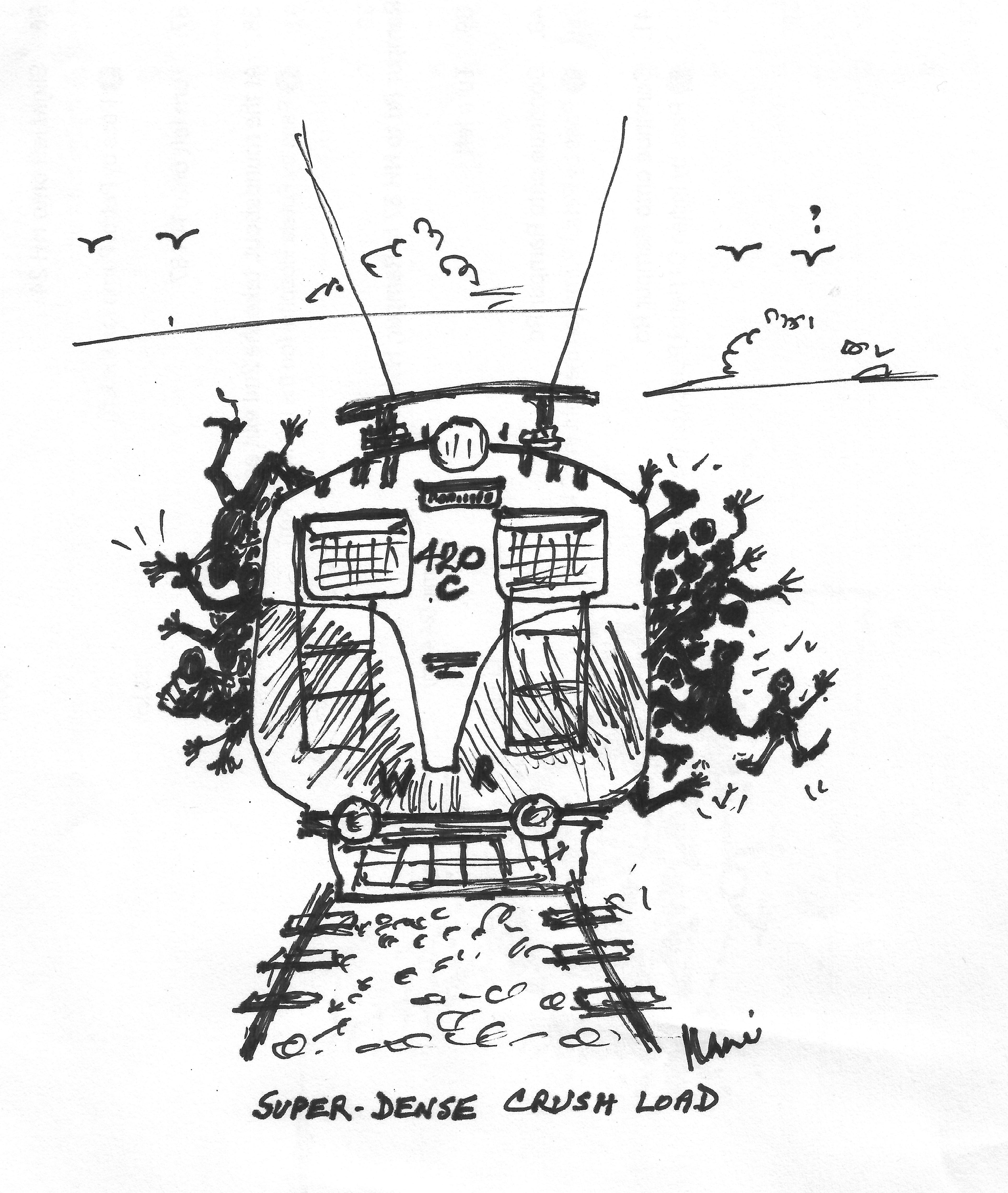
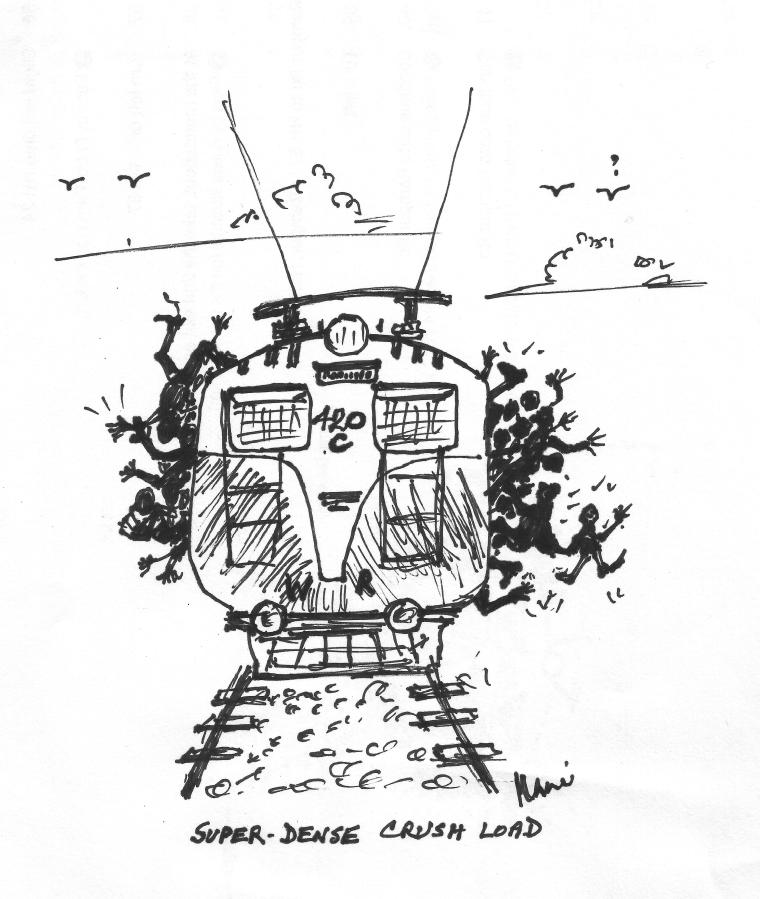
Like Death, Income Tax and Arnab Goswami, the Bombay suburban trains are great levelers. Within their hot and densely packed coaches all overt and covert symbols of social division – race, ethnicity, class, caste, language, religion, wealth, education – are melted down and compressed into a kind of thermonuclear plasma held together by the glue of sweat and common suffering. For the most part, the conditions in these trains are what the Western Railways define tersely and vividly as ‘super-dense crush load’; a state of being in which, as one hardened commuter put it, “When you try and scratch your nose you end up scratching someone else’s.” Paradoxically, though, even as this plasma-state twists and squeezes individual physical bodies to fusion point, it creates a strange and wonderful synergy among the various individual p-spaces inside the coach. It is almost as though the traveller attains an elevated plane of space-consciousness during the commute; a dual-consciousness that functions at two simultaneous levels:
(1) the individual p-space level, in which she/he indulges in individualistic or small-group activities ranging from bhajan singing, crossword solving and stitching to political discussions, munching snacks and scratching various parts of the anatomy;
(2) the collective social space level, in which the traveller is acutely conscious of creating and being part of a larger synergetic social space, and remains ever alert and ready to defend this synergetic social space against external disturbances.

Perhaps an anecdote might illustrate this synergetic space environment better. I recall one fine morning on a Churchgate-bound Slow Train; the 06:04 from Borivali, if memory serves right. I boarded at Malad and occupied my favourite position: standing beside the door, strap of shoulder bag firmly held between teeth, clutching on to a strap with a pinky finger and half-a-thumb as were about seven other commuters. Around me was the usual writhing, wriggling, rolling, swaying forest of tangled limbs, torsos and hair, from which rose the strange, feral noise known only to the Bombay commuter: the hoarse collective cry of two hundred and fifty humans squeezed into a space meant for twenty while hurtling through space at 60 kmph.
Superdense crush load 001
As the train sped along, the wriggling mass of humanity presently disaggregated into vaguely human forms: some clutching newspapers with pens poised over crosswords in Marathi, Hindi and English; others playing stand-up rummy, with one player collecting the discards under a rubber band stretched across his raised palm; a few crooners and hummers, a peanut vendor, a dozen peanut munchers, the many loners staring into space, at spots on walls or at one another; and the standard quota of loiterers, conmen and pickpockets scattered among the crowd. With each approaching halt – at Goregaon, Jogeshwari and so on – a score or so travellers would form a lump near the door on the far side and shoot out on to the platform like some giant hairy pea from a pea-shooter. At once, the space vacated by them would be occupied by a larger mass of humanity charging in through the door; the train would move again, things settled down a bit…and so it went.

Everything was normal, then, until we reached Andheri. About fifty people hurtled out of the coach; about eighty took their place; and suddenly, just as the train jerked into motion, a voice rose above the general din: a voice that brought instant silence into the coach, till the only audible sound was of rumbling wheels and the soprano hum of the pantographs gliding along the overhead traction lines.

“Tickets! Let’s see your tickets!”

The words were chanted in Hindi, then Marathi. The voice was not loud; but it cut through the silence like a bhelpuri-wallah’s knife through an onion. An instant later, I saw the Ticket Checker; white-trousered and black-coated, with black bag slung on his shoulders and pen and receipt book in hand, he had pushed his way from the vicinity of the far-side door into the middle of the crowd.

“Quickly now! Tickets…let’s see your tickets!”

The dynamic, invisible, synergetic social space inside the coach suddenly and soundlessly crystallized, revealing its six hundred glowing individual p-space shards. It was a dire socio-anthropological warning; but the TC was oblivious to it.

“Tickets, quickly now…” he chanted.

A young burly man, who might have been a football coach or perhaps a Matunga bar bouncer in his prime, responded. “Am I dreaming or do we have a TC with us?” He was standing right next to the TC; he spoke softly, courteously, a puzzled frown on his face as he scanned the faces all around him, including that of the TC.

The TC stiffened and opened his mouth to reply, but another voice came from his left; from a white-haired bespectacled man with the slightly distracted look and disheveled clothes of a long-retired Science Teacher. “I too heard a TC, son; but surely we are both mistaken. The last time I saw a TC enter a train during rush hour was in 1964…”

The TE found his voice. “What do you mean,” he sputtered. “I’m right here. Now show me your tickets…”

“Ah! There you are!” exclaimed the Bouncer, looking pleased. He patted the TC’s shoulder affectionately. “My ears are deceiving me, I’m afraid; I thought I heard you ask to see our tickets!” He laughed heartily, and was joined in his mirth by about sixty others. The TC did not laugh; instead he looked slightly grim as he rubbed his shoulder.

“Doubtless our TC is off-duty,” murmured a thin young man with frizzly hair. He was clad in kurta-pajamas and had a satchel slung across his scrawny chest; he looked every bit the Social Activist. “Doubtless he is heading home, after weeks of non-stop work in the service of the Railways and the nation.”

Many heads nodded, and all eyes turned to the TC. “Now look here,” the TC protested, “I am on duty, I must see your tickets…”

“You’re on duty!” cried the Social Activist, eyes wide in horror. “Do you realize what you have done? You have committed a grave injustice by boarding this coach…”

“What!” The TC’s eyes were round as saucers. “What injustice? What have I done?”

“You have snatched away food from the hungry when you boarded this coach,” went on the Social Activist, his voice gentle but persuasive. “Do you not see that by your very presence in this coach you have deprived another man, a poor man, from boarding this coach?”

“Because you have occupied a space that could have been better occupied by that poor man,” broke in the Science Teacher.

“That poor man now has to wait for the next train,” growled the Bouncer.

“He will be late for work…perhaps he will lose a day’s salary,” remarked a short, stocky man with a briefcase; doubtless a bank clerk.

A babble of voices broke out.

“Aye, yes, that poor fellow will pay the price for your thoughtlessness…”

“It’s a cruel day…”

“Are we all not honest travellers with tickets?”

“It’s a callous world…”

“Such is the lot of the common man…”

“What kind of government do we have, I ask you…”

The TC, who had been gaping all this while, found his voice. “Now wait a minute,” he protested, his voice thin and feeble.

“A single human adult male typically occupies a volume V in litres given by the equation V = 1.02W- 4.76,” went on the Science Teacher, his face glowing with eagerness, “where W is the weight in kilograms…”

“In fact, I remember seeing a poor man trying to get in at Andheri,” said the Bouncer thoughtfully. He looked at the faces around him. “Do you remember? He was weak and thin, had a faded shirt… torn pajamas…”

Several voices shouted agreement and added supplementary details.

“Of course, he looked starved…”

“He probably has seven children to feed…”

“And an ailing wife…”

“And a worthless good-for-nothing brother to support too…”

“Perhaps the brother too is a TC…”

“By my reckoning you weigh at least 80 kilos, so you occupy no less than 75 litres of space,” remarked the Science Teacher, eyeing the TC critically. “That’s enough to accommodate two normal-sized people…”

“What! So two poor people have been prevented from earning their daily wage!” came the general cry.

The TC now had a slightly hunted look. He began to edge backwards towards the doorway.

“Imagine if this injustice were to happen every day,” went on the Social Activist. “Why, not only would a family starve…

“Two families starve,” corrected the Science Teacher.

“Ah, yes sir, two families starve,” continued the Social Activist, “but over 1400 man-days would be lost because of this TC’s thoughtlessness…”

“Which, if you calculate even at minimum daily wage rate, works out to over 28,000 rupees…”

“And multiply that by the number of trains running each day…”

“Imagine the loss to the economy…”

“The GDP…”

“Little wonder India remains poor…”

“And all because this TC thinks we are so dishonest that we don’t have our passes or tickets!”

The crowd fell silent and two hundred pairs of eyes eyed the TC severely.

A small, meek-looking gentleman, who hadn’t spoken till then, suddenly piped up: “Does this TC himself have a ticket?”

The TC started, even as the cry was taken up. “Oye TC, do you have a ticket?”

“Do you? Do you?”

The TC wiped his brow. “No…I mean, I have a badge…” he mumbled.

“Oye, he doesn’t have a ticket!”

“Ah, the TC himself doesn’t have a ticket!”

“Chuck him out! He doesn’t have a ticket!”

The train slowed down and pulled into Matunga. Eager hands reached for the TC and helped him on his way to the doorway. The TC shot out on to the platform, rear-first, his velocity reduced and landing cushioned to some extent by about a hundred people who were waiting to enter. He was still running towards the exit when the train pulled out of the station. As the train pulled out and gathered speed, the travellers in the coach settled into their individual and small-group activities…and soon, the coach was filled with the dynamic, watchful peace of synergetic p-space again.

[P.S: I submitted this thesis to a sociologist friend, with the suggestion that it might be a useful case study to deepen knowledge and understanding of p-space. She has urged me to forget p-space, and instead take urgent measures to fill the discernibly voluminous space that, according to her, occupies the region between my cranium and mandible.]

Beastly encounters, Musings

Bondla Ramble

The silence is deafening.

Last night too there was silence, when we were sitting out on the verandah of our little cottage. It was quiet then too, but a different quiet – the dense forest around us was alive, filled with a sizzling, electric, watchful kind of silence, a silence strangely intensified  by the rhythmic breek-breeks of an orchestra of crickets, muffled bumps and thuds, sudden bird calls, a startled cry from some unknown animal (a fawn? a bear cub?), the excited chatter of a faraway monkey, the rustling of leaves, the steady drip-drip of raindrops from a billion leaves…

Our abode in Bondla
Our abode in Bondla

But now, at dawn, the silence is absolute. The air is clear, cool, still but for an occasional stray breeze; the sky is overcast, a great brooding grey presence that portends more heavy downpours. The creatures of the night are deep in slumber; the leopards and civets and owls and other nocturnal hunters doubtless dreaming of sweet meals had and yet to be had, while the deer and squirrel and countless other hunted ones are only now wakening wearily yet watchfully from the shadowy realms of half-sleep, thankful to have survived another dreadful night, already gearing themselves to brave a day filled with perils old and new…and the night to come.

I look to the right, up the road. About fifty metres away stands a small spotted deer, nibbling leaves off a bush. It looks up at me and then gets back to its repast; but its ears are cocked now, there’s a new tenseness to its limbs. I turn and hesitate…should I wake the others? Udai is in deep delta sleep; the door to the other room, where Rekha, Nisha and Tarini are, is shut. Quietly – or so I think – I step back into the room and open the side door, thinking to step down the path that leads to the road. The door swings open silently, but the deer is gone.

I walk down the slippery, mossy flagstone path and amble along the road, looking in vain for signs of animals among the mist-blurred thickets on either side. Giant carpenter ants march busily among the inch-thick avenues of dead leaves on both sides of the road. Countless black centipedes wander about like tourists lost in a metropolis; one runs headlong into a soldier ant, pauses and scratches its head thoughtfully with about seventeen limbs; doubtless it is asking for directions?  But the ant offers no assistance; instead it executes a remarkable backward spring of about three inches, capers around the centipede several times in an ever-widening circle, and then sprints away at about 60 kilometers an hour. Clearly put off by this discourteous behaviour, the centipede flexes its mandibles, shakes its head in disgust and moves on.

I wander into the gently sloping forest on the right, walking as silently as I can—the faded blue bathroom slippers make this task easier, but I am acutely conscious of how vulnerable my toes and ankles are to uninvited explorations by all manner of creatures, from leeches and spiders to centipedes and snakes. A slight flicker of movement in the corner of the eye…and I see them! A group of five, no, six spotted deer are standing about a hundred metres away, staring at me; their bodies are barely visible in the deep shadows , but the occasional twitch of an ear gives them away. After a long moment they decide I am harmless; with twitching tails they turn and walk away deeper into the woods, soon to be lost among the dark green caverns beneath the tall trees.

I move on towards a small hillock where the road ends in a flight of steps, leading up to a low, rectangular building with CI-sheet roof; this must be the canteen. The steps are covered in bright green moss and treacherously slippery. Emerging on to a large paved courtyard,  I stare at the sightless windows of the canteen; there is a large lock on the door. To the right of the door is a small shed—just a roofed enclosure with low walls, inside which are piled rusting table fans, broken chairs, a cracked plastic table, and similar junk. As I approach the shed there is a sudden scuttling noise from within; I freeze and hastily move the other way, towards the low wall around the courtyard. All of the Bondla Wildlife Sanctuary is visible from here. Beyond the wall, the forests fall away into a valley; above the tree-tops, and behind and all around, are high forested hills, their outlines blurred by the moisture-laden air.

A steady drizzle begins as I make my way down the steps. I see Nisha wandering through the woods where the deer were browsing. We meet on the road and walk slowly back towards the cottage.

“When does Krishna take his morning walk?” I ask, a tad anxiously.

“Around 9.30, I think,” Nisha replies. Krishna is the lone, slightly psychotic tusker who resides in magnificent isolation in the forested hills surrounding us; last evening we’d been told by Loveleen – the Veterinarian in charge of the Bondla Zoo and the Sanctuary – that Krishna enjoys taking a stroll down this very road every morning to inspect the lower reaches of his kingdom.

Nisha pauses and points towards an overgrown path leading off the grassy verge down into the wooded valley. “Here’s one of the nature trails.”

“Ah…so should we walk down it a bit?”

She nods. We move slowly and cautiously down the path, she leading the way, treading as silently as we can on the wet leaves. The slope is steep and slippery in parts; I stumble now and again, trying hard not to make so much noise as to scare away every living thing from Bondla to Kaziranga.  At one point the path curves sharply to the right, ducking behind thick undergrowth. I decide on a short-cut and plunge bravely into the thicket.  The earth seems alive beneath my feet…I look down and realize that it is, with large, fierce red ants. I execute an agonized leap that would have turned a spotted  deer green with envy, and narrowly  escape the ignominy of landing rear-first on the other side of the path.

As we descend, the forest closes in on us. It is like walking through a colossal green cathedral; a hall pillared and arched with countless trees of every imaginable size, shape and hue, tall and thickly leaved and so densely gathered in patches that the grey sky above is completely obscured. Many tree-trunks are festooned with creepers that swing lazily in the slightly chill breeze. The air is filled with a cocktail of scents, the primary ingredients comprising damp soil, crushed leaves and rotting wood. The earth is carpeted with a thick layer of sodden leaves. Bushes gather in fraternal clumps; some tall and thin with tendril-like leaves, others short and thickly leaved, with huge curved thorns;  still others sporting flowers blue, white, yellow and red. Mushrooms poke their yellow-white heads from rotting twigs and fallen boughs. There is water everywhere; myriad little trickles of rainwater flowing down the slopes, coalescing to form larger channels that eventually merge with the stream that bubbles and chuckles its way along the bottom of the valley.

Gallery of green
Gallery of green

Nisha pauses, holds up a warning hand, points to her left. I squint in the direction she’s pointing and see nothing but a large tree with thickly-leaved branches. And then, one of the branches shakes violently and I see two huge squirrels leap off it on to an adjacent branch, where they sit on their haunches and make derisive faces at me. They’re the largest squirrels I’ve ever seen in my life; each the size of a well-fed cat, and as agile too. “Malabar giant squirrels,” Nisha murmurs. The squirrels stare at us awhile, chattering their disapproval of the current political climate, and then turn in unison and leap out of view behind the foliage.

Spot the squirrel
Watching me watching you [photo: Nisha]
The drizzle is now a heavy rain; Nisha steps off the path to find shelter under a huge tree. I join her and we wait for the rain to subside. Incredibly, not a drop of rain falls where we stand; so thick is the canopy above us.  I am acutely conscious of the gaping hole in the tree-trunk right next to my shoulder. A perfect nesting place for a cobra, I think to myself gloomily; perhaps there’s an entire joint family of cobras in there, the young ones even now fighting over who among them gets to take the first nip at my scrawny neck…

Nisha touches my shoulder, startling me out of my serpentine reverie. She’s pointing towards a tall tree about a hundred metres away.  I stare hard at the tree, bringing into play all my powers of observation honed by two decades’ wanderings in the wilds of Meghalaya and Assam.  All I can see is the tree. Like a befuddled visitor at some gallery of modern installation art, I study the tree very carefully, closing one eye and then the other as I examine and appreciate its features. No doubt it is a fine tree, with a thick tapering trunk and many branches. The lowest branch is long and twisted, with a large oval-shaped knot halfway along its length…

“I don’t give a hoot” [photo: Nisha]
“It’s an owl…a tawny frogmouth owl,” Nisha murmurs helpfully. She’s now aiming her camera at the knot on the branch.

And then, at last, I see it. The knot is not a knot; it’s an owl. It’s huge, perched on the branch with its back to us, shoulders stiff and slightly hunched, its ruffled feathers clearly silhouetted against the slate-grey sky. “It’s sulking,” whispers Nisha. “Maybe because it’s wet…or maybe it doesn’t like being photographed by strangers.”

The rain thins; we leave the owl to its sulking and move on. Suddenly the sun breaks through a gap in the clouds, bathing the green hall in golden light from a billion glittering leaves. But only for a moment; like a curtain dropping, the thick grey veils of cloud conceal the sun again.

Now, slowly but surely, the creatures of the forest are waking up.  The air is filled with the hum of insects; dragonflies hover, butterflies flit about.  A sweet, fluting bird call wafts through the trees.   Nisha pauses, holds up a hand. “That’s a ruby throated yellow bulbul…the state bird of Goa,” she murmurs, scanning the tree-tops above us. After a moment or two she points; I see only a bewildering tangle of leafy branches.  She takes a few pictures, and then all of a sudden there is a flash of brilliant yellow amidst the green, and the bulbul does a fly-pass high above my head, a distinctly sardonic tone in its musical cheeping as it stares down at me. “Whee wit wit wheeNow do you see me?” it seems to chant.

The gurgling and murmuring of the stream grows louder and deeper, the light grows dimmer, as we near the base of the valley. Suddenly the stream is before us, about five metres wide, its dark but clear waters foaming among rounded rocks and pebbles and rushing between the bushy banks.  I step down to ford the water, and pause as a faint but pungent aroma reaches my nostrils. It’s a distinct odour, evocative…

“Elephant dung!” I whisper hoarsely. Nisha nods, eyes wide.

Silently, cautiously, I cross the stream, clamber up the bank on the other side, and emerge into a small clearing. On all sides the dense forested slopes press in; in the foreground on the left stands a light-grey rock formation; a monolith with an extraordinary shape…

It’s Krishna. He stands at least four metres high at the shoulders; his tusks are like giant yellow-white pincers; his legs as thick as tree-trunks. His eyes are open, but he is as still as rock from giant rear to pliant ears, from slender tail to stupendous trunk.

Nisha’s already crossed the stream and is climbing the bank. I point towards Krishna. For a moment we stand there, frozen, staring at our colossal slumbering colleague. And then, we turn and hasten back across the stream. Our ascent through the forest is far more rapid than our descent. I bravely lead all the way, happy that I’ve redeemed my reputation as a keen-eyed wildlife spotter.

After all, I’ve successfully spotted a three-tonne elephant at ten metres.