General ravings, Musings, Potshots

The redness of Sindhoor – 2

Believe it or not, O Dear Gentle Reader, I started to write this a few days after the Indian Director General of Military Operations (DGMO) granted  the Pakistan’s DGMO’s pleas for an end to hostilities; and that,  after the Indian military administered a much-deserved thrashing to the  Pakistan military during Operation Sindhoor, May 7–10, 2025. 

But I’ve kept adding to this rant, and subtracting from it, and amending it, all these weeks and months because so much has been happening so fast since then: between India and Pakistan, and between  India and the USA, and Pakistan and USA, and India and China, and Israel and Iran, and Pakistan and Iran, and Pakistan and Bangladesh, and India and Afghanistan, and Pakistan and Afghanistan, and Russia and Ukraine and the EU and the USA, and the USA and Israel and Iran and China and Myanmar and Russia and Bangladesh and …well…the USA and the rest of the world. And it’s been hard staying up to date and keeping tabs on all of these developments and events and discerning patterns in them.

Because they’re all closely, weirdly related, and not at all in a nice and friendly way for India and you and I and the Resident Lizard who, as usual, even now reads over my shoulder and chuckles derisively as I type this.  

That’s why, in the interim, I only posted a kind of foreword to this long rant titled “The redness of Sindhoor-1” in August : a kind of grim remembrance of the Indian civilian establishment’s collective cowardice following the Pakistan-sponsored terrorist attack on Mumbai in November 2008.

But now, driven by impatience and exhausted by Cacoethes Scribendi,  I scribble the last few words and post this rant before Dilli’s toxic air drives the last ergs of energy from body and last vestiges of rationality from mind.

First, in the warm and generous spirit of Deepavali, may I offer a (mercifully) short poem to Pakistan’s Field Marshal Asim Munir (though I suspect Munir-bhai may not like to be reminded of things like bright lights, flames and explosions after Operation Sindhoor):

I post this just over four months after Pakistan, led by the devout  Gen. Munir and the beatific Pak Prime Minister Shabaz Sharief, snatched  victory from India in Operation Sindhoor in May 2025; and barely a month after Pakistan snatched the Asia Cricket Cup from India in September 2025.

Let me hasten to explain, before I’m pilloried by my Adored Readers for being high on smooth whiskey and/or good ganja, or arrested by the Indian government or assassinated by Indian vigilantes for expressing ‘anti-Bharatiya sentiments’.

Consider Operation Sindhoor.

Sure, during Operation Sindhoor, India flattened terrorist training camps in Pakistan-Occupied Kashmir as well as the headquarters of Jaish e Mohammed and Lashkar e Tayyeba in Pakistan itself, killing a hundred or more terrorists of different degrees of murderousness and kookiness in the process.

Sure, the Indian Air Force (IAF) destroyed 12, possibly 13, Pakistani air force planes, including F16 and JF17 fighters and at least one AWACS and ELINT aircraft each—some of them shot out of the air, others incinerated in their hangars or on the tarmac in airbases across and deep within Pakistan by drones and rockets and long-range missiles. Sure, India attacked and destroyed assorted high-value infrastructure in at least 11 strategic (N-strike) Pak airbases including the runways, hangars with aircraft in them, air defence systems, and strategic command-and-control infrastructure, killing a hundred or more Pak military personnel in the process. Sure, evidence of all the havoc caused by the Indian military has been presented in public, not just by the Indian military but by defense/strategic analysts worldwide, and the evidence is still available to you and me and Pakistan and the world in public domain, in satellite imagery and on the Net and in print.

Sure, there is also clear evidence that in the course of its attack on Pakistan’s Nur Khan and Sargodha strategic air bases, the IAF severely damaged an undeclared (i.e., secret) underground N-reactor complex in  the nearby Kirana Hills along with an unknown number of dis-assembled N- warheads. Judging by reports, these N-warheads were plutonium-239  (Pu-239) devices. [This conclusion is based on a simple fact:  unlike uranium-235 warheads which are very stable once shaped and pre-assembled, plutonium-239 warheads constantly decay to non-fissile isotopes like Pu-240, Pu-241 etc. which ‘contaminate’ the Pu-239 over time, till the warheads become like soggy Deepavali crackers that go ‘Phuuussss’ instead of creating a hole the size of Delhi.  And so, Pu-239 warheads require a dedicated N-reactor to refine the plutonium in them back to fissile-grade, in a  complex never-ending cycle. ]

Most interestingly, there is also damning evidence that some or all the N-warheads in the underground N-facility in Kirana Hills—and indeed the entire Nur Khan air base— was under the direct command and control, if not full OWNERSHIP, of the US Air Force (USAF) and had been so for at least 15 years, perhaps ever since the so-called ‘War Against Terror’ launched by the USA under George Bush Jr.  And that the USA set up and controlled Nur Khan to keep a baleful N-watch on China, just as the USA had set up the Bagram base in Afghanistan to keep a strategic eye on China.

In effect, then, India not only delivered several painful kicks to Pakistan’s collective military butt during Operation Sindhoor; India also knowingly or unknowingly (I suspect the former) attacked and destroyed or severely damaged a secret and fully operational USA-run  N- strike air base located in Nur Khan, along with USA-built F-16 fighters and a secret, USA-owned ,underground N-complex including  N-warheads and  N-reactor in Kirana Hills.

But Pakistan declared – and continues to declare – that it defeated India in the battles of May 2025.

Pakistan’s Field Marshal described the inevitability of Pakistan’s victory over India as follows while addressing a Pakistani community event in Florida, USA in August 2025:

“India is like a shining Mercedes coming on a highway like Ferrari, but we (Pakistan) are a dump truck…If the truck hits the car, who is going to be the loser?”
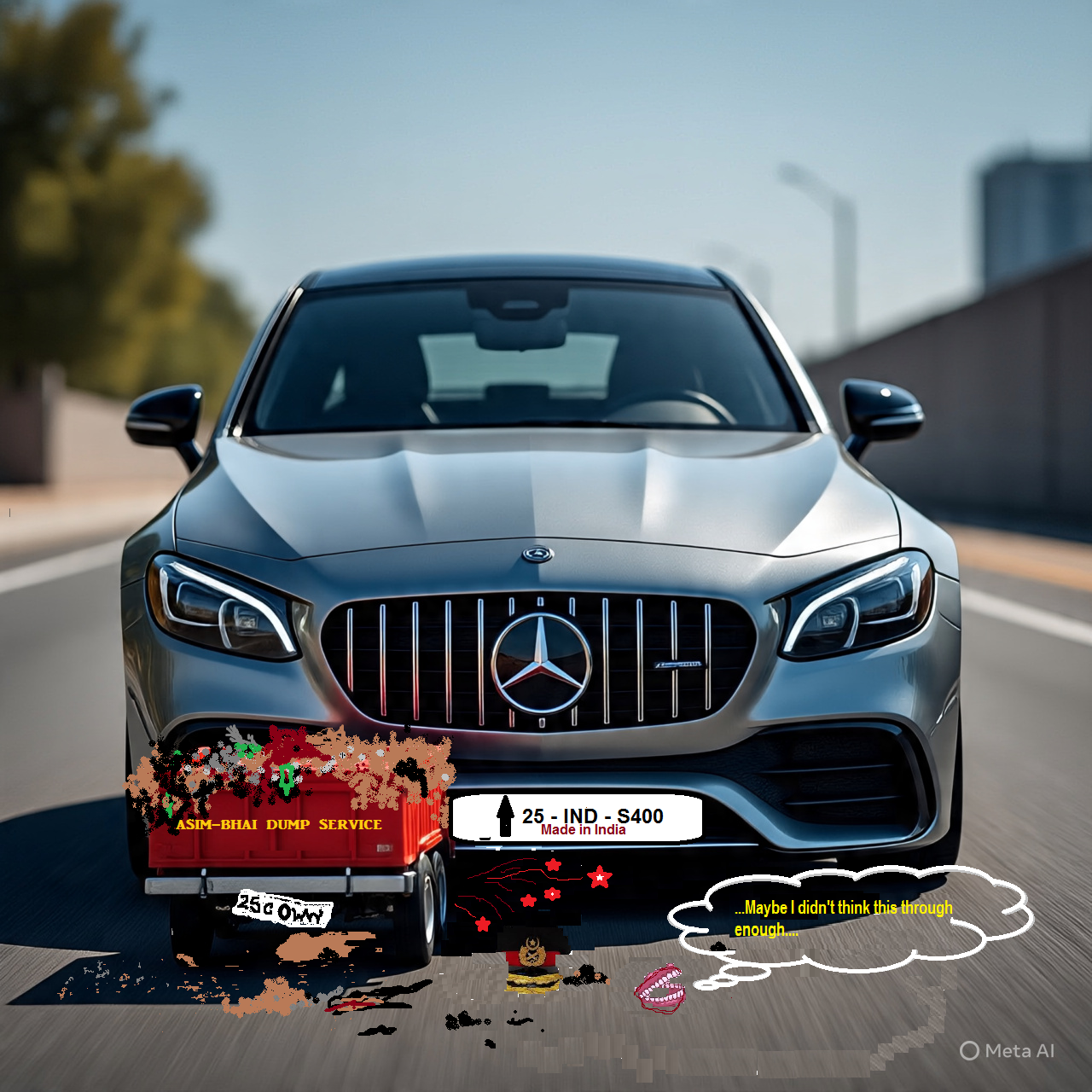
In destroying the USA-owned N-assets in Nur Khan and Kirana Hills in Pakistan, India has put not only Pakistan but Trump and the USA in a hell of a hot spot—militarily, diplomatically and politically.

There’s the money angle, of course…so important to Trump and his cronies. The USA set up the Nur Khan air base alone for over 550 million dollars—and that was only the capital cost.  The annual recurring costs would have been many times that figure. The Kirana Hills N-infrastructure would have cost billions of dollars.

That’s a lot of money, even for a do-numberi  builder-don like Donald Trump.

 Losing all that money to Indian strikes must be terribly painful to Trump and his Deep State cronies, especially when all those beautiful American assets have been reduced to piles of radioactive rubble underground.   

In fact, Trump et al. must be feeling the same pain as Iran did, when Trump’s USAF reduced Iran’s N-complexes in Fordow, Isfahan and Natanz to piles of radioactive rubble underground…

But it’s much more serious than that for Trump and the Americans.

On the one hand, the USA simply cannot ever admit that it owned and ran these N-weapon facilities in Kirana Hills or owned and managed Nur Khan N-strike airbase in Pakistan. Because, to do so would be to admit that the USA had installed N-weapons and N-delivery assets targeted at China  in a secret US base located right next to China—in Pakistan, ostensibly, a  ‘friendly’ neighbouring country of China!

And THAT would put the USA exactly where the Soviet Union had put itself when it started to establish Soviet N-missile bases very close to the USA, in Cuba, in 1962…bringing all humankind close to thermonuclear incineration before better sense prevailed thanks to John F Kennedy and Nikita Khrushchev…but that’s another story.

On the other hand, the USA cannot hide the evidence of its perfidious ownership and management of the Nur Khan air base or the Kirana Hills N-weapon facilities for long—because not only is all the evidence out there for the world to see, but N-radiation has an inexorable and horrible way of revealing itself in time…however deeply it might be buried

Most important, Pakistan is not going to let the USA escape responsibility and leave Pakistan to bear  the fallout—nuclear and figuratively—of the devastated underground N-facility and the remnants of N-warheads lying inside there, and its ruined air bases and related military losses. 

Yep folks, Pakistan has really got Trump and the USA by their short and curly N-hairs this time. For a while, at least.

And that’s why Trump toadies up to and ingratiates himself with Munir-bhai and Shabbaz-bhai of Pakistan  by the passing day, even as his rage against India intensifies by the passing second and by the midnight tweet.

The USA will never admit any of this:  they dare not, for their own reasons.

Pakistan will never admit any of this; they dare not either, for their own reasons.

A related question arises: why did Pak PM Shehbaz Sharif promote Pak military chief Asim Munir to Field Marshal and felicitate him for ‘defeating India ’ in  Operation Sindhoor?

Well…let’s empathize with Shabbaz Sharief on this one. Sharief had no choice but to promote Munir to Field Marshal; because to demote or court-martial Munir— as any other country in the world with a microgram of self-respect would have done after Munir led his military to such a humiliating defeat— would be to admit that Pakistan’s military had suffered defeat at the hands of India’s military.

And that admission simply cannot be made by any Pakistani PM.

As Pakistan’s brief but bloody history shows, such an admission, however truthful it might be, would lead to a speedy and unpleasant end for that Pak PM.

Whatever little poor Shabbaz Sharief understands about anything else in life, he certainly remembers what happened to erstwhile Pak PMs Zulfikar Bhutto and to Benazir Bhutto, even nearly to his own brother Nawaz Sharief….

Pakistan believes its supremacy over India, making ‘peace’ with India an absurd proposition. This belief is non-negotiable; it is, in Pakistan’s collective psyche, so deeply ingrained that it is the God-given Truth.

It is taught in Pakistani schools upwards. It is taught in religious seminaries. It is naturally, understandably, echoed in the Pakistani media, in the civilian and military streets of Pakistan.

That is why Pakistan declares that it won the conflict against India in May 2025; as it has won every earlier conflict with India since 1947.  

For Pakistan, eternal victory against India is the Holy Hallowed Truth.  However Holey and Hollow that ‘truth’ is.

This is Pakistan’s strength.  In a weird and wonderful way (though Munir might not like the analogy), Pakistan is in fact practising a fundamental tenet of Hindu philosophy: a tenet taught by Krishna to Arjuna in the Bhagavad Gita:

You cannot ever be defeated if you believe strongly enough that you haven’t ever been defeated and can’t ever be defeated.

“All that’s very well,” the Patient and Revered Reader might justifiably ask: “But why should this false, hole-ridden Pakistani version of the truth be published as the Truth in the Supreme Court of the World, also popularly known as Western English Media which includes BBC, New York Times, The Washington Post, The Guardian, and affiliated rags?”

The answer to this is best illustrated by the old joke about God and Devil.

And lastly (phew, at last), consider the Asia Cricket Cup, September 2025.

Sure, India and Pakistan played each other thrice during the tournament. Sure, India defeated Pakistan all three times, including in the Final.

But guess where the Asia Cup is?

The Asia Cup is NOT with the Indian cricket team. The Cup is not even in India.

The Asia Cricket Cup  is in fact in Pakistan, in the grubby hands of one Mohsin Naqvi who is the Chief of the Pakistani Cricket Board, and also works as Pakistan’s Interior Minister when he is not otherwise preoccupied stealing cups, awards and affiliated symbols of victory that belong to other nations.

How come Pakistan and this Mohsin Naqvi fellow snatched the Asia Cup from India after losing the Asia Cup tournament to India?

Well…now we know…

Because Pakistan can never be defeated by India. Pakistan always must win… one way or the other.

Jai Hind!

Ancient writings, Musings, Remembering

Choose

This is one of half a dozen short stories I wrote back in mid-1993: soon after I quit my job as a banker of 13 years’ vintage to don the lifelong disguise of writer… …and soon after Bombay, and India, plunged into a bloodfest organized by an unholy alliance of religious and temporal kooks, primarily Muslim and Hindu; a bloodfest that polarized India, lasted nearly 10 years and still erupts from time to time. The stories explored different manifestations of violence; the themes were all largely drawn from reality…and often, as in this case, built around personal experience.

I thought I’d wipe 30 years’ dust off this story and post it now…at a time when we feel pressurized to Choose every second of our lives in every aspect of our lives between This extreme and That extreme in a world that’s become Binary, a time when Russians and Ukrainians are slaughtering one another, when Hamas has achieved spectacular new depths of mass butchery of men, women and children in Israel and Israel is reducing Gaza and the bones of its residents to rubble…

I’d welcome your comments, Gentle Reader, as always.

I could see the highway as I descended the steep lane from my hill-top colony. It was awash with rain water, twin ribbons of glistening, rippling grey-black macadam stretching away in both directions, deserted at this early hour. The narrow mud-and-rubble divider that ran in between was as black as the ominous cloud-layer above. It was cold, and I shivered as the moisture-laden wind from the west tugged at my shawl.It was a good half-a-kilometre down to the 24/7 medical store on the road that led to the railway station. I had a terrible migraine, and needed to buy an inhaler and tablets.

I crossed the little bridge that gave on to the highway and waded across the flooded road till I reached the divider. Stepping on to it, I turned and began to walk along its length, picking my way carefully through the jumble of stones and clumps of rain-drenched grass. Walking along the divider would be slow and slippery, yet far preferable to wading along the verge where the water was deepest. And on the divider, at least I could be confident that no hidden brimming-over potholes waited, open-mouthed and hungry, to swallow me whole.

I saw movement to my left. In the darkness, two—no, three black shapes materialized on the verge and began to cross the road ahead of me. The men must have come up from the sprawling shanty-town that lay to the left, below the highway. I watched as they ascended the divider and walked towards me. One of them, I saw, carried a shapeless black bundle upon his shoulder.

They stopped, all of a sudden, about fifty feet ahead of me, and went into a huddle, heads close together. Something about their manner, some faint, inexplicable sense of uneasiness, made me slow down and come to a standstill. They hadn’t seen me yet. I watched as the tallest figure—the one with the bundle—brought his arms up and swung the bundle off his shoulder. It landed in the mud with a soggy thump.

The three figures stood, motionless, as though waiting for something.

I glanced at my watch. 05:20.

In another ten minutes, the great convoys of Bombay-bound trucks would be released from their shackles at the toll-tax gates a kilometre up the highway to the north, and soon the three lanes to the left would be filled with countless tonnes of hurtling metal and the air would reverberate with the triumphant roar of the trucks as they sped towards the wholesale markets and industrial belts of the great city.

As yet, though, the silence was disturbed only by the bubbling and chuckling of the flooded drains and sewage canals on either side of the highway. A light drizzle began, but I just stood there and watched the three figures as they hulked over the dark bundle at their feet. After a moment, the tall one—obviously the leader—squatted down and began to work at the top of the bundle. Curiosity overcame apprehension; I crept forward till I was barely twenty feet away from them, and now I could clearly see what was happening. The bundle was a jute sack, the kind used to pack grain or sugar in; the tall man was undoing the tight knots that bound the sack’s neck, with what seemed to be extraordinary caution.

He worked away silently, and his companions stood about him, watching his busy fingers as intently as I was. A pale, watery-grey light broke out over the dark hills to the east, just as the tall man undid the final knot and sprang back.

For a few seconds nothing happened. And then…the sack moved. One of the men laughed softly, but was shushed by the tall man. Their eyes were on the sack; if they’d seen me, they showed no signs of it.

Again, the sack moved…as though, deep within its rough, sodden folds, something was wriggling about, struggling to emerge.

A hum reached my ears, and deepened and grew steadily till it pulsed and throbbed in the thick atmosphere. The trucks were on the move, and approaching rapidly.

The three men had apparently been waiting for this; for, each one stepped back a pace and reached into his shawl. Their hands emerged, and now each hand bore a weapon. Strange weapons they were, too. The tall one held a long metal rod with a vicious hook at the end; one of his companions gently, almost lovingly, swung a bicycle chain; and the third man had a chipped cricket bat in his grip. Heart thudding, I watched and waited; not knowing what to expect beyond the conviction that, whatever it was, it was going to be violent.

The hum became a roar, and the first of the trucks passed by an instant later in a welter of noise, tyres hissing in the water and leaving a great filthy brown spray in its wake. It was followed a few seconds later by another, and then another, until the vehicles were thundering past in a continuous stream and the very earth trembled beneath their weight. The spray from the tyres rose ten feet into the air, and added its muddy weight to the drizzle; but I was oblivious to anything but the drama unfolding on the divider.

The tall man stared at the passing trucks for a moment, nodded to his companions as if satisfied, and then kicked the sack viciously. The sack shifted a foot, and from within it emerged shrill shrieks that made my skin crawl and my hair stand on end. It was the sound made by rodents in anger and in pain…

Now, something moved along the neck of the sack: a large lump, moving up slowly, followed by a smaller lump. The small lump suddenly shot forward until it collided with the large one; the neck of the sack twisted and turned, there came a squeal of agony from its interior; and then the larger lump disappeared and only the smaller lump moved, closer and closer to the mouth of the sack where it lay in the mud.

I held my breath as the lump reached the mouth of the sack. I darted a glance at the three men. They stood about the sack, tension in their stiff, motionless limbs, their silhouetted weapons infinitely threatening.

The mouth of the sack widened, and something emerged. At first, only a pair of long, dark whiskers; trembling, sniffing the air for threat and danger. The men stood like rocks while the whiskers twitched for an interminable period…and then, with shocking suddenness, a lithe, grey-black form leaped from the mouth of the sack and bounded straight across the divider—towards the deserted road on the right side.

The three men were faster. Like striking cobras, their arms rose and descended, again and again. One terrible shriek, quickly cut off…and the rat lay, broken and bloody, in the muck.

Even as my mind struggled to make sense out of what I’d just seen, the sack moved again. Horrified, yet fascinated, I watched as another pair of whiskers emerged from the mouth of the sack and tested the air. This time, one of the men expedited things by tapping the sack cloth behind the lump. The rat—it was a larger, rangier specimen than its unfortunate predecessor—shot out and headed straight down the divider. Towards me! I yelled involuntarily and leaped several feet into the air, but it was unnecessary; the bicycle chain cut the rat nearly in two, and for a horrible moment both segments quivered perceptibly in the mud.

Someone hissed. I looked up and saw all three men staring at me. Their faces were completely expressionless, but there was something about the glittering eyes in their dark sockets that sent a thrill of terror down my spine. I felt as though I were an intruder…yes, an intruder…at some dark, secret ritual being practiced there, in the middle of the highway.

This is ridiculous, I told myself. I’m in the suburbs of Mumbai, this is the twentieth century, neither the place nor time to imagine things…

The tall man took a single step towards me, and suddenly the impulse to run seized me. Run, the voice in my mind screamed. This is something you don’t understand, you can’t understand. Get away! Run!

But just then, a frenzied squealing from the sack diverted our attention. Turning my head, I saw no less than three rats fall out of the sack in a writhing lump.

A strange, feral cry rose from the men’s lips, the weapons rose even as the rats scrambled to their feet. Two scuttled to the right, and were butchered before they reached even halfway towards the deserted road. The third, however, headed for the road to the left. Towards the river of trucks, and their churning, grinding wheels.

And now a strange thing happened. The three men paused, weapons poised in mid-strike, and their eyes followed the rat as it crawled painfully towards the edge of the divider. One leg trailed behind it, apparently injured in the scuffles within the sack. The men made no move to hinder its progress.

The rat reached the edge of the divider, hesitated and made as if to turn about and crawl along the divider instead. The tall man reached out and flipped it around with the hooked rod in his hand. The rat staggered, fell over and landed on the road, whiskers twitching nervously as giant wheels passed within inches of its nose.

The tall man prodded it behind the tail…and the rat ran. With what little strength it had left, it ran across the road in an awful three-legged gait.

The three men hunkered down on their heels to watch its progress, and their eyes were wide and glittering, mouths half-open, eager…I couldn’t look, didn’t want to look, and yet I strained my eyes and peered beneath the passing wheels. I couldn’t see anything, but the three men obviously could. A simultaneous cry rose from them, savage triumph in its tone. The tall one raised his face to the sky and chanted aloud, almost as would a priest invoking celestial powers. His words cut through the rain; they were in rich rural dialect, they were weird…and they froze the blood in my veins.

Behold, the beast Chose its path through the Blaze

It Chose the Path of Pain; by its own Choice has been slain

So shall we treat Bearers of Misfortune in coming days

Faced with the Fire of our Wrath they will Choose…and be cut in twain


I felt my knees tremble. I willed myself to move, to leave that terrible scene, but I just couldn’t. The sack was full of frantic movement now, as if its occupants were aware of their doom; as if, somehow, they knew that an awful ritual of Choice awaited them outside the sack.

I stood there and watched while two more rats emerged from the sack, turned right and were promptly beaten to death. A third one emerged, a young one; small and thin, with a piercing high squeak. This one opted for the river of trucks, and was ground into the slush by a speeding sixteen-wheeler. The three men cheered.

But now, the sack did a little flip; and then a huge shape distended the neck of the sack, crept closer to its mouth, and the three men tensed and held their weapons at the ready.

A giant sigh went up from them as a large, grey-whiskered snout appeared at the mouth of the sack. Small, crafty eyes peered this way and that; pointed ears twitched; and then the rodent crawled out onto the mud and sat down on its haunches as if absolutely nothing untoward was going on.

Rajah, I heard one of the men whisper in awe.

Rajah. The King.

I saw what he meant. The Rajah was easily the biggest field-rat I’d ever seen. He must have been all of thirty inches from weathered snout to leathery tail, with a lean, muscular body and a certain look about him, a battle-scarred, war-veteran look. Cats would have had second thoughts about tangling with such an adversary.

The tall man raised his hand and the thin steel rod whistled as it scythed down. The Rajah was faster. He sat there till the very last moment…and then, in one fluid motion, he sprang into the air, slashed at the tall man’s bony ankle with long, yellowed teeth, landed in the mud with a thump and then ran straight for the divider’s edge. To the left, where the endless procession of trucks roared and churned the flooded waters of the road.

The tall man yelled in fury and pain, dropped his weapon and hopped about on one foot, holding his ankle. His companions, after one quick glance at him, turned and followed the Rajah’s progress. I saw the great rodent reach the edge of the divider, and suddenly madness took hold of me. I wanted this rat to cross safely, wanted it so badly that I yelled aloud. I wanted the Rajah to reach the other side and turn around and thumb his hoary nose at these murderers. I yelled encouragement as the Rajah stepped off the divider and scampered across the road. I squatted down on my heels and watched him go.

And how the Rajah went! Like a bullet he raced across the foaming surface; a huge set of wheels swished past, and for a few seconds all I could see was a sea of frothing brown water; but then I spotted him again, already halfway across, snout in air, tail waving about furiously. For a moment it seemed certain that he would be hit by an approaching petrol-tanker. The giant truck bore down upon the Rajah, the scene disappeared in a brown waterfall…and then the Rajah was scampering along on the other side, unscathed. He didn’t turn around to thumb his nose, he just vanished over the verge, but I was too elated to care. Hoarse, near-hysterical cheering reached my ears, and it was a while before I realized, with a start, that it came from my own throat.

I stopped short, then, and looked around at the three men. They stood there, staring back at me, and there was hatred, pure hatred, in their eyes. The tall one hissed something, and all three started to move towards me.

No, this can’t be happening to me, I remember thinking as I squatted there, paralysed by the look in their eyes. But then I saw the steel rod rise, and I leaped to my feet and I ran, dear God how I ran. I ran back towards home, and I kept seeing their faces as I ran, especially their cold, glittering eyes. I reached the point where I had crossed over from the bridge, and now the screaming torrent of trucks lay between the bridge and where I was, but I heard the pounding of feet behind me and I just ran out onto the road, screaming myself, and dodged and twisted and shut my eyes and kept going, and the screeching of brakes filled my ears and I fetched up with a great thump against something hard and waited for oblivion.

I opened my eyes and found myself in the grip of a policeman: a very large, very annoyed policeman. Even now I remember the smell of stale sweat from him, the crumpled uniform, the dark circles under his eyes from tiredness or lack of sleep; he must have been a night shift constable returning home from duty. He stared at me, breathing hard, as I gasped out my tale of violence and terror. From time to time I twisted my neck to peer towards the divider, to see if I could spot my pursuers between the passing trucks. But there was no sign of the men. A new fear grew in me as I babbled my incoherent tale: the policeman wouldn’t believe me; he would think I was stoned on drugs, or drunk, or insane.

At length, he released his iron grip on my shoulders. He stepped back a pace, surveyed me from head to toe, and then spat to one side.

“So these men scared you, did they?” He went on without waiting for a reply. `Ah…well, I understand your fear. What they did must have seemed a little strange to someone like you, an Angrezi-wallah city-dweller…especially someone who doesn’t understand our local culture, doesn’t even belong to our province…”

I gaped at him. “I was terrified,” I mumbled. “They were madmen, the way they killed those rats…they might well have killed me if I hadn’t fled!”

He waved a thick wrist and laughed indulgently. “Now, now, stay calm. Yes, what they did was certainly unusual, quite different from tradition, from the conventional ritual…”

“What! I don’t understand…”

He went on as if I hadn’t spoken. “…But then this is a big city, you see, things cannot be done the same way here as in our villages. And so naturally such things can’t be done in the traditional, proper ways…”

I couldn’t believe my ears. “What do you mean…”

“These men…they made do with what they had,” the policeman went on, his voice a little dreamy, “Back in our villages, we traditionally catch the rats and put them in a pot—a matka—rather than a sack. And we place the matka in a bamboo trap, and light a slow charcoal fire below it.” His eyes shone as he warmed to his theme. “This bamboo trap is just like a maze, you see, there’s only one winding way out of it. The rats have to find this way out – or they’ll burn. At every turn they have to make a choice. A choice! And even the rats that make the right choices, as they go, have to pass through a series of bamboo gates before they can get out. Each gate is delicately balanced, it is a gate of Death. If the rat so much as touches the gate it falls, and its finely sharpened bamboo splints impale…”

But I didn’t wait to hear anymore. I fled for home.

All this was last Tuesday. I haven’t been out since.

My neighbours, my friends and office colleagues, think I’m unwell. That’ll do for now. I can’t tell them the truth, can I? I can’t tell anybody the truth. No-one would believe me; they’d laugh at me, they’d think I’ve gone crazy.

There’s plenty of food and stuff; I have home delivery from the kirana store halfway down the hill, certainly I’m not going to starve to death. But for how long can I shut myself in here? How long can I keep up this pretense, how long can I go on like this?

I can’t sleep; I dare not sleep, the nightmares are so bad now, the migraine like a fire consuming my senses. I need to go see a doctor!

Hell, I’ve got to go to work! I’ve got to ‘phone people.

But to do all that, to do anything, I’ll have to go down to the highway. And I can’t do that.

But I’m not safe here, either.

They saw me flee across the road, they know now that I live here.

Maybe not today, maybe not tomorrow; but sooner or later, when bad luck, when some misfortune strikes them, they’ll think back and they’ll remember the Rajah. The One That Got Away.

And then they’ll remember me.

I, Bearer of their Misfortune. I, their enemy.

And the highway’s where they’ll be waiting for me, with their weapons. Or else, they’ll come for me, here, at home.

Sooner or later, I’ll have to choose. between going out and just cowering here in terror.

Like the rats, I have to choose…

Remembering

From Eternity to Eternity

I’ve never been embarrassed about wearing my sentiment on my sleeve – if only on occasion. And 26th July, 2001 was one occasion, the 2nd anniversary of Vijay Diwas – the Martyr’s Day in remembrance of the uniformed ones who gave their lives during the Kargil war, 1999…a war during which a few dear friends in Army and Air Force had played active roles. Today being 26th July, here it is: for all fauji friends, for all men and women of the fauj, past and present and future. With respect, with love.

On the night of 26th July last year we lit two little lamps out on the balcony and gazed at the lambent flames while, and on the still air we heard the whispers of names…Clifford Nongrum, Haneefuddin, Saravanan, Kalia, Ahuja…names of men we had never met yet seemed to have known so well.

Surely, they would have been no different from any other young men in the world?  In their love for laughter and revelry, for the scents of rain upon earth and flowers in a woman’s hair, for home-cooked food, the warmth of a family gathering, a boisterous game with children…they too must have yearned for leisure, for romancing, for peace. One of them had played the guitar, another had a voice like Rafi’s. Rich and varied were their tastes in music, as indeed their backgrounds and origins. Yet fierce were the bonds that had joined these men of diverse faiths, united them in their battle to preserve this very diversity, this richness and variety.

A strange, overwhelming sense of loss came upon us even as the flames rose steady and unwavering. We glanced up at the high-rise apartment blocks all around, at their dark balconies and terraces. A stray breeze brought a brief snatch of canned laughter from some TV set in some curtained lounge. And bitterness and anger welled up, sudden and surprising. How could they all be so callous, the inner voice raged, how could they forget the martyrs of Kargil so soon.

But the self-righteous and sentimental mind’s voice was abruptly quelled by a remembered voice from childhood: easy, self-assured, slightly mocking in tone, the voice of a young soldier, slain in battle long ago.

“Listen,” he had murmured, “in life, what others think or do doesn’t matter a damn. What YOU do is the only thing that counts. Before you, before each one of us, there’s a path; the path of duty. Seek that path, follow it, all else falls into place. It is so simple…”

The voice faded back into the caverns of memory; the flames flickered. And suddenly the twisted, tangled coils of sentiment and anger dissolved into a moment of deep understanding. Indeed the martyrs of Kargil had fought obdurate foes, in the harshest of conditions. They had endured terrible pain, died warriors’ deaths. But they were men who believed – nay, who knew – that beyond death there is no joy or sorrow, neither friendship nor enmity; there are no borders or lines of control, nor remembrance nor names.

There is only the peace of Eternity.

That is why our soldiers treated even the enemy’s slain with dignity, with honour. And that is why they were victorious.

We turned away, then. Fleetingly, sadness returned as we beheld the dark balconies all around. A flicker of yellow drew our attention to the right…and we gazed spellbound.

Down there, beyond the compound wall, set in the humble doorway of a tarpaulin-roofed dwelling, two candles had been lit. Their flames rose steady and unwavering. And again on the still air came the whisper of names…Vikram Batra, Neikezhakuo Kengurüse, Kanad Bhattacharya, Vijayant Thapar, Mohammad Hussain…

[‘Slain victors’: The Pioneer: 31 July 2001]

Ancient writings, Beastly encounters, Potshots

In the Plutonium Doghouse

Sixty thousand years ago, our dear ancestral cave-people snarled and hurled abuse and rocks and bones at their neighbouring cave-people, even as their respective supporters cheered and goaded them on while keeping themselves at a safe distance…

Today, Russia devastates Ukraine with missiles and other frightful weapons after being goaded beyond endurance by NATO and EU and USA, and Russia and the USA and NATO and EU snarl at one another even as the USA and NATO and EU cheer on and goad the Ukrainians to fight back and pour missiles and other frightful weapons into Ukraine while keeping themselves at a safe distance…

Everything changes. Nothing changes.

Thus it is in this dog-eats-dog world that we humans have in our wisdom created…because we love one another.

Cheered slightly by these thoughts, I inflict ‘pon thee, O long-suffering and precious Reader, a piece I wrote over 23 years ago – in fact, soon after India’s nuclear tests in 1998.

Disclaimer: Any resemblance in this article to any persons or nations on Earth, however slight, is entirely intentional.

____________________________________________

A mysterious defence document has come to light of all places, in the wrapping paper used by a peanut-vendor who operates his business near New Delhi’s India Gate. Inquiries reveal that the vendor purchased eighteen kilos of waste paper from Raksha Mantralaya early in May, and noticed this particular document only while wrapping five rupees’ worth of peanuts. “The masthead on the pages was different from the usual Defence Ministry stationery,” he explained, “so I thought it might be important, and called the authorities!”

Titled “In the Plutonium Doghouse”, the document is typed on the memo-pad of the Defence Ministry’s shadowy Department of Strategic Planning and Control (DSPC), and appears to be a sweeping account of global nuclear history. With Defence Ministry officials refusing to comment on it, the document is reproduced in its entirety below.

In the Plutonium Doghouse

Delhi, May-June 1998.

Once upon a time there was a kennel, in which lived dogs of assorted size, shape, faith and hue. Oldest among the dogs were Big Yellow and Big Brown. The two were neighbours, and like most senior citizens, pretty peaceful characters; in fact, Big Brown spent most of his time sleeping. Then came Big White, Big Red and a host of smaller dogs.

In the beginning things were just fine. Each dog had its very own space, with enough food supplies to last forever if managed well. But over the years some dogs got greedy and gobbled up their own supplies, and then they took to stealing other dogs’ food. Naturally, a stage came when they were all fighting like cats over the supplies that remained.

One day, Big White dug up an ancient bone from somewhere and discovered that by blowing on it he could make a fearful racket; enough to reduce all the other dogs to quivering, defenseless puppies! Naturally, he put on a lot of dog after that. He strutted about the kennel, brandishing his new pipe and helping himself liberally to the others’ provisions. But soon thereafter Big Red dug out a terrible bone-pipe of his own, and he was followed by two smaller white dogs; and barely had the echoes from their cacophonous pipes died down when Big Yellow nearly brought the roof down with a resounding trumpet-blast of his own.

Realizing that it was futile to aim their pipes at one another, the five dogs went into a huddle and came up with a brilliant idea: an exclusive pipe-wielder’s club, from which other dogs were debarred! For a while, then, the Plutonium Club (named after Pluto, the Almighty Celestial Dog) ruled the kennel; The five P-5 mongrels strutted about the kennel while the other dogs cowered in terror.

But Big Yellow was hungry for variety in his diet, and soon his crafty eyes turned towards the mountainous stores of Big Brown (who of course had slumbered while all this was happening).

Now, there was a little brown dog aptly called Li’l Brown who lived right next to Big Brown. Kennel folklore had it that once, very long ago, both Big Brown and Li’l Brown had belonged to the same family; but then a bitter quarrel had taken place over property, and Li’l Brown had thrown a tantrum and moved out to live by himself. Since then, Li’l Brown had developed a habit of filching food from Big Brown or nipping him while the old dog was asleep (which was almost always), and whenever the old dog protested Li’l Brown would roll over and yelp, “Help! He’s bullying me!” Baffled, Big Brown would go back to sleep, but soon Li’l Brown would be badgering him again, egged on by Big White who found it all very amusing.

Big White had other reasons too for befriending Li’l Brown. Right next to Li’l Brown lived a host of small dogs with vast supplies of delicious Afghan and Mughal food. Now, both Big White and Big Red were partial to Central Asian cuisine, but being much closer to these little dogs, Big Red had been hogging the lion’s share of these goodies.

So Big White made Li’l Brown his ally, promising him limitless supplies of hot dogs and cold fizzy drinks if only he harried Big Red and kept him away from the neighbourhood of the little dogs while he, Big White,instead carted off their provisions by tanker-loads and pipelines … oh, their oily pilafs were simply delicious, though the skewered meats did generate a lot of gas…

Well…such were the dog-eats-dog politics of the kennel.

But even while all this was happening, a day came when Big Yellow turned to Li’l Brown and growled, “Here’s a present for you… a little bone-pipe of your own! Now be a good fellow and wave it under Big Brown’s nose. It’ll distract him while I take a bite out of his Sikkimese pudding…I’ve been fancying it for years!”

But even as he spoke, a deafening roar shook the ticks off the kennel walls. Big Brown had sounded his very own bone-pipe; how he had dug it up while asleep, no one knew.

“Blast!” growled Big Yellow.

“Dog-gone it!” howled Big White.

As for poor Li’l Brown, he was inconsolable. “I can’t hound Big Brown any more, his bone-pipe’s bigger than mine,” he yelped and wailed. Finally Big White went over to him. “Aw, come on,” he rumbled soothingly, “tootle on that little bone-pipe of yours, chew on this nice piece of Afghan kebab, and you’ll feel better. As for Big Brown, just wait till the old duffer’s asleep and then take a nip out of his tail.”

Note from Special Directorate, Intelligence Bureau/DSPC, Raksha Mantralaya: Unfortunately the remainder of this secret document is untraceable at this point. Peanut vendors and their clients in Delhi are requested to keep an eye open, and to inform us at once in case any more pages are found.