General ravings, Musings, Potshots

The redness of Sindhoor – 2

Believe it or not, O Dear Gentle Reader, I started to write this a few days after the Indian Director General of Military Operations (DGMO) granted  the Pakistan’s DGMO’s pleas for an end to hostilities; and that,  after the Indian military administered a much-deserved thrashing to the  Pakistan military during Operation Sindhoor, May 7–10, 2025. 

But I’ve kept adding to this rant, and subtracting from it, and amending it, all these weeks and months because so much has been happening so fast since then: between India and Pakistan, and between  India and the USA, and Pakistan and USA, and India and China, and Israel and Iran, and Pakistan and Iran, and Pakistan and Bangladesh, and India and Afghanistan, and Pakistan and Afghanistan, and Russia and Ukraine and the EU and the USA, and the USA and Israel and Iran and China and Myanmar and Russia and Bangladesh and …well…the USA and the rest of the world. And it’s been hard staying up to date and keeping tabs on all of these developments and events and discerning patterns in them.

Because they’re all closely, weirdly related, and not at all in a nice and friendly way for India and you and I and the Resident Lizard who, as usual, even now reads over my shoulder and chuckles derisively as I type this.  

That’s why, in the interim, I only posted a kind of foreword to this long rant titled “The redness of Sindhoor-1” in August : a kind of grim remembrance of the Indian civilian establishment’s collective cowardice following the Pakistan-sponsored terrorist attack on Mumbai in November 2008.

But now, driven by impatience and exhausted by Cacoethes Scribendi,  I scribble the last few words and post this rant before Dilli’s toxic air drives the last ergs of energy from body and last vestiges of rationality from mind.

First, in the warm and generous spirit of Deepavali, may I offer a (mercifully) short poem to Pakistan’s Field Marshal Asim Munir (though I suspect Munir-bhai may not like to be reminded of things like bright lights, flames and explosions after Operation Sindhoor):

I post this just over four months after Pakistan, led by the devout  Gen. Munir and the beatific Pak Prime Minister Shabaz Sharief, snatched  victory from India in Operation Sindhoor in May 2025; and barely a month after Pakistan snatched the Asia Cricket Cup from India in September 2025.

Let me hasten to explain, before I’m pilloried by my Adored Readers for being high on smooth whiskey and/or good ganja, or arrested by the Indian government or assassinated by Indian vigilantes for expressing ‘anti-Bharatiya sentiments’.

Consider Operation Sindhoor.

Sure, during Operation Sindhoor, India flattened terrorist training camps in Pakistan-Occupied Kashmir as well as the headquarters of Jaish e Mohammed and Lashkar e Tayyeba in Pakistan itself, killing a hundred or more terrorists of different degrees of murderousness and kookiness in the process.

Sure, the Indian Air Force (IAF) destroyed 12, possibly 13, Pakistani air force planes, including F16 and JF17 fighters and at least one AWACS and ELINT aircraft each—some of them shot out of the air, others incinerated in their hangars or on the tarmac in airbases across and deep within Pakistan by drones and rockets and long-range missiles. Sure, India attacked and destroyed assorted high-value infrastructure in at least 11 strategic (N-strike) Pak airbases including the runways, hangars with aircraft in them, air defence systems, and strategic command-and-control infrastructure, killing a hundred or more Pak military personnel in the process. Sure, evidence of all the havoc caused by the Indian military has been presented in public, not just by the Indian military but by defense/strategic analysts worldwide, and the evidence is still available to you and me and Pakistan and the world in public domain, in satellite imagery and on the Net and in print.

Sure, there is also clear evidence that in the course of its attack on Pakistan’s Nur Khan and Sargodha strategic air bases, the IAF severely damaged an undeclared (i.e., secret) underground N-reactor complex in  the nearby Kirana Hills along with an unknown number of dis-assembled N- warheads. Judging by reports, these N-warheads were plutonium-239  (Pu-239) devices. [This conclusion is based on a simple fact:  unlike uranium-235 warheads which are very stable once shaped and pre-assembled, plutonium-239 warheads constantly decay to non-fissile isotopes like Pu-240, Pu-241 etc. which ‘contaminate’ the Pu-239 over time, till the warheads become like soggy Deepavali crackers that go ‘Phuuussss’ instead of creating a hole the size of Delhi.  And so, Pu-239 warheads require a dedicated N-reactor to refine the plutonium in them back to fissile-grade, in a  complex never-ending cycle. ]

Most interestingly, there is also damning evidence that some or all the N-warheads in the underground N-facility in Kirana Hills—and indeed the entire Nur Khan air base— was under the direct command and control, if not full OWNERSHIP, of the US Air Force (USAF) and had been so for at least 15 years, perhaps ever since the so-called ‘War Against Terror’ launched by the USA under George Bush Jr.  And that the USA set up and controlled Nur Khan to keep a baleful N-watch on China, just as the USA had set up the Bagram base in Afghanistan to keep a strategic eye on China.

In effect, then, India not only delivered several painful kicks to Pakistan’s collective military butt during Operation Sindhoor; India also knowingly or unknowingly (I suspect the former) attacked and destroyed or severely damaged a secret and fully operational USA-run  N- strike air base located in Nur Khan, along with USA-built F-16 fighters and a secret, USA-owned ,underground N-complex including  N-warheads and  N-reactor in Kirana Hills.

But Pakistan declared – and continues to declare – that it defeated India in the battles of May 2025.

Pakistan’s Field Marshal described the inevitability of Pakistan’s victory over India as follows while addressing a Pakistani community event in Florida, USA in August 2025:

“India is like a shining Mercedes coming on a highway like Ferrari, but we (Pakistan) are a dump truck…If the truck hits the car, who is going to be the loser?”

In destroying the USA-owned N-assets in Nur Khan and Kirana Hills in Pakistan, India has put not only Pakistan but Trump and the USA in a hell of a hot spot—militarily, diplomatically and politically.

There’s the money angle, of course…so important to Trump and his cronies. The USA set up the Nur Khan air base alone for over 550 million dollars—and that was only the capital cost.  The annual recurring costs would have been many times that figure. The Kirana Hills N-infrastructure would have cost billions of dollars.

That’s a lot of money, even for a do-numberi  builder-don like Donald Trump.

 Losing all that money to Indian strikes must be terribly painful to Trump and his Deep State cronies, especially when all those beautiful American assets have been reduced to piles of radioactive rubble underground.   

In fact, Trump et al. must be feeling the same pain as Iran did, when Trump’s USAF reduced Iran’s N-complexes in Fordow, Isfahan and Natanz to piles of radioactive rubble underground…

But it’s much more serious than that for Trump and the Americans.

On the one hand, the USA simply cannot ever admit that it owned and ran these N-weapon facilities in Kirana Hills or owned and managed Nur Khan N-strike airbase in Pakistan. Because, to do so would be to admit that the USA had installed N-weapons and N-delivery assets targeted at China  in a secret US base located right next to China—in Pakistan, ostensibly, a  ‘friendly’ neighbouring country of China!

And THAT would put the USA exactly where the Soviet Union had put itself when it started to establish Soviet N-missile bases very close to the USA, in Cuba, in 1962…bringing all humankind close to thermonuclear incineration before better sense prevailed thanks to John F Kennedy and Nikita Khrushchev…but that’s another story.

On the other hand, the USA cannot hide the evidence of its perfidious ownership and management of the Nur Khan air base or the Kirana Hills N-weapon facilities for long—because not only is all the evidence out there for the world to see, but N-radiation has an inexorable and horrible way of revealing itself in time…however deeply it might be buried

Most important, Pakistan is not going to let the USA escape responsibility and leave Pakistan to bear  the fallout—nuclear and figuratively—of the devastated underground N-facility and the remnants of N-warheads lying inside there, and its ruined air bases and related military losses. 

Yep folks, Pakistan has really got Trump and the USA by their short and curly N-hairs this time. For a while, at least.

And that’s why Trump toadies up to and ingratiates himself with Munir-bhai and Shabbaz-bhai of Pakistan  by the passing day, even as his rage against India intensifies by the passing second and by the midnight tweet.

The USA will never admit any of this:  they dare not, for their own reasons.

Pakistan will never admit any of this; they dare not either, for their own reasons.

A related question arises: why did Pak PM Shehbaz Sharif promote Pak military chief Asim Munir to Field Marshal and felicitate him for ‘defeating India ’ in  Operation Sindhoor?

Well…let’s empathize with Shabbaz Sharief on this one. Sharief had no choice but to promote Munir to Field Marshal; because to demote or court-martial Munir— as any other country in the world with a microgram of self-respect would have done after Munir led his military to such a humiliating defeat— would be to admit that Pakistan’s military had suffered defeat at the hands of India’s military.

And that admission simply cannot be made by any Pakistani PM.

As Pakistan’s brief but bloody history shows, such an admission, however truthful it might be, would lead to a speedy and unpleasant end for that Pak PM.

Whatever little poor Shabbaz Sharief understands about anything else in life, he certainly remembers what happened to erstwhile Pak PMs Zulfikar Bhutto and to Benazir Bhutto, even nearly to his own brother Nawaz Sharief….

Pakistan believes its supremacy over India, making ‘peace’ with India an absurd proposition. This belief is non-negotiable; it is, in Pakistan’s collective psyche, so deeply ingrained that it is the God-given Truth.

It is taught in Pakistani schools upwards. It is taught in religious seminaries. It is naturally, understandably, echoed in the Pakistani media, in the civilian and military streets of Pakistan.

That is why Pakistan declares that it won the conflict against India in May 2025; as it has won every earlier conflict with India since 1947.  

For Pakistan, eternal victory against India is the Holy Hallowed Truth.  However Holey and Hollow that ‘truth’ is.

This is Pakistan’s strength.  In a weird and wonderful way (though Munir might not like the analogy), Pakistan is in fact practising a fundamental tenet of Hindu philosophy: a tenet taught by Krishna to Arjuna in the Bhagavad Gita:

You cannot ever be defeated if you believe strongly enough that you haven’t ever been defeated and can’t ever be defeated.

“All that’s very well,” the Patient and Revered Reader might justifiably ask: “But why should this false, hole-ridden Pakistani version of the truth be published as the Truth in the Supreme Court of the World, also popularly known as Western English Media which includes BBC, New York Times, The Washington Post, The Guardian, and affiliated rags?”

The answer to this is best illustrated by the old joke about God and Devil.

And lastly (phew, at last), consider the Asia Cricket Cup, September 2025.

Sure, India and Pakistan played each other thrice during the tournament. Sure, India defeated Pakistan all three times, including in the Final.

But guess where the Asia Cup is?

The Asia Cup is NOT with the Indian cricket team. The Cup is not even in India.

The Asia Cricket Cup  is in fact in Pakistan, in the grubby hands of one Mohsin Naqvi who is the Chief of the Pakistani Cricket Board, and also works as Pakistan’s Interior Minister when he is not otherwise preoccupied stealing cups, awards and affiliated symbols of victory that belong to other nations.

How come Pakistan and this Mohsin Naqvi fellow snatched the Asia Cup from India after losing the Asia Cup tournament to India?

Well…now we know…

Because Pakistan can never be defeated by India. Pakistan always must win… one way or the other.

Jai Hind!

Ancient writings, Musings, Remembering, Verse perverse

The redness of Sindhoor – 1

O Gentle and Patient Reader,  I take the liberty of posting an article—a lament of sorts—written by my dear and departed friend Ghatotkacha in late 2008, soon after the terrible attack by Pakistani-trained terrorists on Mumbai on 26th November 2008. Ghatotkacha was my guide, my teacher, so close to my heart, in a very real sense my alter ego. I empathized with and endorsed every word in his article then. as I do now.

I post this the day after India’s Independence Day, 2025; a time when India and Pakistan still obsess over Operation Sindhoor, the name given to India’s short but devastatingly effective military campaign against Pakistan-based terrorist and military  infrastructure in  May 2025.

I post this article even though it is filled with anger and bitterness. I post this for the simple reason that I, like my fellow Indians, am conditioned to ignore and forget my own history…and worse, to eagerly seize upon and adopt, on continuous basis, others’ versions of my own history without a care.

I believe we must be brave enough to remember and come to terms with all that we ever really were, and really did, and really experienced: whether right or wrong, good or bad, sublime or horrific.

Because only then can we learn, only then can we act. With neither self-loathing nor hatred. But with Equanimity.

Only then can we heal ourselves, and move on

[That’s what another old and eternal friend Krishna counselled…]

[© Ghatotkacha Hidimbi Bhimasena (late): December, 2008]

First there was the rage.

Fury poured out on to the streets of Mumbai post 26th November 2008, fiery words spewed from the mouths of countless anchors on a hundred TV channels. There was much talk of retaliation, of revenge, of this latest atrocity by Pakistan-sponsored and Pakistan-supported and Pakistan-sheltered and Pakistan-trained terrorists being the last straw.

India has been restrained all these decades…but enough is enough!” These words about summed up the collective feeling of the Indian people after 200 innocent men, women and children were slaughtered by 10 murderers from Pakistan. Murderers helped overtly and covertly by the Pakistani military, the Pakistani establishment.

The evidence of Pakistan’s complicity was clear.

The world witnessed the massacre of innocents, on live TV.

The world awaited India’s response…as the Indian people did.

Two weeks passed, during which for the first time in memory the Indian political establishment actually appeared to have achieved the unimaginable – namely, to unite and speak as one in national interest.

“We are with the government in combating this evil force that has attacked our nation, that threatens the future of India,” said Opposition leader and BJP member (late) L K Advani on the floor of Parliament.

The Congress-led UPA leadership, in a symbolic move, sent the derelict Home Minister Shivraj Patil home and appointed the inflationary and inflated-ego Finance Minister P Chidambaram in his place.

In a rare and refreshing contrast to the Congress’ customary rodent-like squeak-speakers, External Affairs Minister Pranab Mukherjee fumed and fulminated against Pakistan and its deceitful references to the attackers as ‘non-state actors’, at one point memorably asking: “Do these non-state actors come from heaven?”

Equally remarkable was the fact that during these two weeks the Indian media collectively stayed with the Pakistan-sponsored terrorist attack story – that too sans the usual faffing in politically correct journo-speak, which requires that any atrocity by any kooks who claim to be ‘Muslim’ can only be reported as such when it can be ‘balanced out’ by reportage on a similar atrocity—real or imaginary— committed by kooks claiming to be ‘Hindu’. [This is, of course, the famous Balancing of the Kookery Equation Principle formulated by British sociologists in the 1850s, refined by the Congress and Communist Party of India (Marxist) post-Independence, and taught as a foundational course by mainstream Indian media houses to trainee reporters and journalists.]

Curiously, the English-language Indian media (seriously! That’s what they call themselves, and we call them) named the atrocity ‘26/11’—because ‘26/11’ resonates so well with the USA’s ‘9/11’—and so this name has stuck, even though it blithely ignores the fact that for the Americans, ‘9/11’ actually stands for September 11th (and not 9th November); by that logic we Indians should have called this Mumbai attack ‘11/26’. 

But then, what’s in a name, no?

At least for a change, there were no cut-and-paste editorials in the newspapers and magazines on how India must exercise ‘restraint’, no pious and ponderous platitudes on why India must follow the process of ‘dialogue’ and ‘negotiation’ with Pakistan rather than that of ‘confrontation’…

For the first time in history we were spared the logorrhea of human rights activists campaigning for the well-being of Ajmal Kasab, the sole Pakistani terrorist captured alive; spared, too, the hysterical outpourings of assorted pamphleteers drawing parallels between Mumbai 26/11 and Gujarat 2002 and Mumbai 1992/93.

By the time December 12th 2008 dawned, one actually dared wonder: had we, in India’s Civilian Street, finally discovered those rare qualities, Courage and Resolve?

Would the Indian political leadership, along with the bureaucrats and policy wonks and diplomats and strategic eggheads have the guts and the gumption to unshackle and unleash the calibrated might of our defense forces to strike and eliminate the sources of terrorist infection in our neighbour Pakistan’s ailing body? To strike not to destroy Pakistan, but rather to strengthen the Pakistani people in their silent, six-decade-old war against the Pakistani religious fanatics who rule them with fear; the monsters in clerical and military uniforms who have created schools of pain in the name of God, schools in which they have brutalized innocent young Pakistani boys and transformed them into the twisted, hate-filled murderers who call themselves Al Qaeda, Lashkar e Tayyeba, Harkat ul Jihad Islami, Jaish Mohammed?

We hoped so. The signs were good.

Alas, it was a futile hope.

In the two weeks since December 12th, 2008, the great show of bravado put up by our politicos and the media has all come unstuck faster than the dhoti of a certain senior Congress leader with a penchant for flashing.

As of 26th December, 2008 – exactly a month after the attack on Mumbai – India’s measures to avenge the Mumbai atrocity and cleanse Pakistan of terrorists comprise the following key elements:

  • Our nominal and notional PM, Manmohan Singh, has repeatedly appealed to the US, Britain, Australia, and any other country that might listen (and there haven’t been too many) to urge Pakistan not to send terrorists to India.
  • The PM and the Minister of External Affairs have repeatedly appealed to the United Nations to tell Pakistan not to send terrorists to India.
  • The PM and the Minister of External Affairs (as well as assorted Ministers of other Infernal Affairs) have repeatedly expressed disappointment that the international community is not telling Pakistan not to send terrorists to India.
  • The de facto PM Sonia Gandhi has repeatedly declared that India will give a ‘befitting reply’ to terrorists who think they can divide India on communal lines. (She is, apparently, even now drafting out the befitting reply on a standard-issue Congress party greeting card, which will doubtless be sent duly by Registered Post (with Acknowledgement Due) to Pakistan’s notional President Asif Zardari with copies for information and necessary action to Hafiz Muhammad Sayed of Lashkar e Tayyeba and Masood Azar of Jaish Mohammed..
  • The PM and the new Home Minster have announced the formulation of a new anti-terrorist law that will also include, in its ambit, heinous offences like smoking ganja and abusing politicians (might as well turn myself in).
  • The Hon’ble Union Minister A R Antulay has declared that the entire Mumbai atrocity was just a pre-planned strategy by Hindu fanatics to conceal the assassination of certain Mumbai police officers who were inquiring into bomb attacks targeting Muslims in Malegaon, Maharashtra by their brethren Hindu fanatics.
  •  The MEA has denied Pakistani media allegations that India had a hand in a car bomb attack in Lahore on 24thDecember – and continues to deny it even after the Pakistanis lost interest in the case after a Taliban splinter group claims responsibility for the Lahore car bomb attack.

Saddest of all, the print media editors, the TV talk-show hosts and their attendant analysts, the academia and intelligentsia and not-so-intelligentsia,  caution the Indian government with increasing shrillness and anxiety, about the dangers of any kind of strikes against a ‘nuclear-armed Pakistan’.

It makes one wonder:  why doesn’t Pakistan ever worry the same way about striking against a nuclear-armed India?

How the late and much-unlamented Paki dictator Zia-ul-Haque of the ‘boiled-frog’ strategy must be chuckling— even in his special cell in Shaitan’s Eternal Abode— at India’s self-imposed paralysis following the attacks of 26th November.

And so India’s leadership will wait—as always.

And so India will wait, as ever making a virtue out of inaction and passiveness; wait for the next attack by Pakistani terrorists…

http://creative.sulekha.com/boil-the-pakistani-frog_383941_blog

Ancient writings, General ravings

The Rain of Terror [or, Electricity Department Blues]

Please do forgive me for my long silence, O Most Loyal Reader…for Clouds of Angst have filled my deranged mind ever since the Lok Sabha polls, especially because the Aam Aadmi Party candidate for whom I voted—whose name I have forgotten, if at all I ever knew it—lost his/her/its deposit.

But now, as I struggle to cast aside Writer’s Block and emerge from the churning brown Monsoon waters that have turned Delhi into a mosquito-and-politician-infested swamp,  the Gates of Memory briefly open to reveal a dreadful yet inspiring tale I narrated 22 years ago; a tale that I inflict upon Thee now (with some slight modifications), in the hope that it might relieve Thee too of any depression with its moral message—that even within the deepest Pits of Darkness, we may find the Lights of Optimism and Good Cheer….    

Amid the fire and brimstone raised by the recent debates in Delhi and indeed across India over collapsing buildings, flooded streets, and rewriting our history books, an archaeological discovery of immense significance escaped public attention—much to the relief of an embattled government! Indeed, it was only with the greatest reluctance, and that too on conditions of strict anonymity, that a senior archaeologist attached to the Department of Ancient Monuments agreed to reveal details of their extraordinary find.

“The MTNL chaps unearthed it,” he began, “while digging a trench during a routine cable-laying operation in West Delhi. As soon as they alerted us, we rushed to the site to investigate what they’d found. Careful excavations at the site eventually revealed a large rectangular room with a single doorway. It was buried two metres below the surface, and built entirely of a sickly yellow material, that upon chemical analysis turned out to be a kind of inferior grade cement…”

“Cement?” we broke in, startled.  “How could that be…surely cement is a modern construction material…?”

“Exactly!” he cried. “We, too, were excited at the idea that we might have stumbled upon a facet of some hitherto unknown, technologically advanced civilization! At first the chamber we were in appeared to be an ancient necropolis, similar to those found in Egyptian and Mesopotamian sites of contiguous depth. Strange, sinister-looking objects stood here and there on the floor of the chamber, smothered in dirt and dust: some tall and vaguely cuboid, others squat and flat-topped, still others on spindly legs and clustered in little groups. There was something curiously familiar about them…a colleague remarked that they resembled the great dolmens of Stonehenge and Meghalaya. We also found hideous crimson streaks on all the walls, particularly near the corners. They suggested that the chamber might have been the site of ritual sacrifices in ages gone by!”

“It took us a month to survey the layout of the chamber and to record our findings on dictaphones and digital diaries, notebooks and camcorders. Even now I remember the moment when we finally commenced physical verification of the artefacts in the chamber, starting with a flattish mound near the doorway.” He shuddered slightly. “Ahh! Even now I recall the stillness all around, the eerie glow of our solar lanterns, the silence broken only by the hum of our scrapers and the hoarse breathing of my colleagues, the odours of decay and the heaviness of ancient memories in the air…” his voice trailed away.

“And…?” we prompted him gently.

“Oh ye Gods, give me strength!” he choked: the poor man was obviously still traumatized by his experience. He took a deep breath, lit a noxious cigarette with trembling fingers, and went on in a calmer tone: “As we worked away with scrapers and chisels, all of a sudden a great chunk of dirt fell away from the mound. We brushed away the last traces of earth and held aloft two lanterns to better illuminate the scene. Before us stood a crude wooden table, its legs still encased in muck. And on the table lay a monograph; a standard-issue Staff Attendance Register, open at a page marked ‘July 22, 1986..” and again he broke off into a spasm of choking and gasping.

“What!” we cried, aghast. “But what…but how…what did it mean!”

He held up a weary hand. “It meant,” he whispered hoarsely, “that after a month’s painstaking work, we had succeeded in unearthing a long-buried Area Office of the Delhi government’s sole electricity distribution company— the Delhi Electricity Supply Undertaking,DESU.” He paused to wipe his glistening brow.

We gaped at him, attempted to speak but could only make strange gargling noises.

“The other artefacts in the room,” he went on shakily, “revealed themselves to be cupboards, tables, chairs…little wonder they’d looked familiar to us despite being covered in muck! Our subsequent investigations revealed that on the afternoon of that fateful 22nd day of July, 1986, this particular DESU office had suddenly subsided beneath ground level. The cause for its subsidence was a nearby sewage canal, whose waters had progressively undermined the foundations of the DESU office building. Almost immediately thereafter, a violent monsoon storm had struck the city: whereupon a partly-constructed and wholly illegal building on an adjacent plot of land had collapsed onto the site where the DESU office had stood, burying it beneath tonnes of muddy waters, plaster, sand and assorted rubbish. It was fortunate indeed, that these events took place only at 3 p.m—two hours before official closing time, by which time of course all the staff had long left the office—or else the casualties might have been heavy.”

He wiped his brow again. “And so the DESU office remained concealed through the years, buried underground, till our arrival.”

“This is impossible to believe…it’s insane!” we yelled, having at last found our voice. “What about the employees, the DESU office staff? Surely they’d have turned up for work the following day and found their office missing? Surely they’d have tried to locate it, done something …?”

Our colleague emitted a hideous cackle. “Indeed they did!” he replied. “But all of them, from the Officer-in-Charge down to the lowliest assistant peon, were ‘Lessee Employees’: that is to say, each employee held his post in a purely unofficial capacity, on lease as it were, having paid a lump-sum for this privilege to the person whose name was actually on the official roles of DESU.”

We stared at him blankly.

“This system of Lessee Employment,” he explained patiently, “is still in vogue across India, particularly in government and public-sector undertakings . On the one hand, the official employee continues to draw his/her monthly salary but is unshackled of any duties, and thereby able to learn other skills and earn additional income elsewhere. On the other hand, the lessee employee rests content in the fact that under-the-table earnings more than compensate him/her for the absence of an official salary. Indeed, the overall effect of this system is to increase employment and national productivity!”

We made some more strange gargling noises. He ignored them and went on.

“Understandably, then, when these Lessee Employees of the DESU office could not locate their office the following day, there was no question of their lodging any kind of report or complaint—the poor fellows had no locus standi whatsoever! After searching awhile in vain, they therefore quietly dispersed. Our investigations have confirmed that in due course all of them found re-employment, on similar lessee terms, in other Delhi government and municipal bodies.”

A wave of unreality had come over us. “But…but what about the members of the public?” we quavered. “What about all the people in the neighbourhood who had electricity connections, who were served by this DESU office…what of their bills and applications, their files and records? Surely they at least would have complained when their DESU office disappeared?”

“Yes, yes!” our spokesman retorted impatiently. Clearly, he had had enough of the subject and wanted us to leave. “The more naïve and ignorant citizens did indeed lodge reports and complaints—naturally, to no avail whatsoever. One foolish person even filed a PIL before the Delhi High Court—we understand it is scheduled to come up for hearing in October 2029. The majority of people, however, regarded the disappearance of their DESU office—and with it, their files and records—as a supreme stroke of good fortune.”

“What! Why?”

“You see, at a stroke every electricity connection under this Area Office became unauthorized and illegal, because there were no documents left to prove that these connections had ever been sanctioned or even existed! This in turn freed the local citizens forever from power-related worries. Each grateful citizen—householder or shopkeeper, industrialist or businessman—simply made a suitable one-time lump-sum payment to designated DESU personnel who called on him/her at home…and lo! After that there were no more electricity bills to pay or files to chase, no faulty meters to complain about…”

He leaned back in his chair, glanced pointedly at the wall-clock and fed himself a large paan.

Outside the window, we could see the skies had turned a forbidding grey, and there was a heaviness in the air; a brooding stillness that mean only one thing: a great monsoon storm was brewing. Hastily we rose, thanked our spokesman for his enlightening discourse, but paused at the door as a sudden thought struck us: “One thing remains puzzling,” we ventured hesitantly. “What were those crimson stains you found on the walls of the buried chamber…?”

His reply was fluid if not eloquent. With accuracy born of years of practice, a jet of scarlet betel-juice shot out from his mouth straight out the window. We fled even as the lights suddenly flickered, heralding the usual evening power-cut…

[The Sunday Pioneer: January 20th, 2002]

General ravings, Potshots

ABC Primer on Artificial Intelligence for our new MPs

With the Lok Sabha elections 2024 well under way, we humbly offer selections from a small glossary of terms that, we hope, will help our newly elected Members of Parliament function effectively in a world that is increasingly being driven by Artifical Intelligence and related technologies.

Note: the glossary is still a work-in-progress; this selection of terms is inflicted on you merely by way of a ‘Beta Test’ (please see below for its definition).

Artificial Intelligence

Artificial Intelligence is a scientific term first used over 2000 years ago in ancient India, when the great philosopher-military strategist Kautilya composed his Arthashastra. Artificial Intelligence (or AI as it is popularly known) describe the simulation—or mimicry—of normal human capabilities such as communication, learning, and decision-making by a political leader of limited or even infantile intellectual abilities. The creation of an AI-endowed leader is a complex R&D process requiring sustained support in the form of mass subliminal advertising campaigns, saturation social/main-scream media coverage, marketing techniques, retrospective psychological and academic profiling, continuous rewritings of political and historical lineage, and other such elements. Such long-term and multi-faceted support requires colossal financial and other resources. Hence, AI-endowed leaders are usually found only in the richest and oldest Indian political parties such as the Indian National Congress.  

Generative AI is a related term, used to describe AI projects that have to be sustained over many generations in order to create and stabilize an AI-endowed political leader.

OpenAI is the short and informal term used by media professionals and marketing/advertising agencies to indicate that a political party has openings, i.e., vacancies, for training aspiring political candidates who have suitably open and vacant minds to become AI-endowed leaders.

Algorithm

An Algorithm is a fundamental sequence of rules that define the path of an AI-empowered politician’s career. However,  Algorithm can take many meanings in different parts of India, mirroring our nation’s disunity in perversity.

For instance, among the Hindi-speaking states of north India, Algorithm [pronounced ‘alag-rhythm’] is popularly used to praise an AI-empowered political leader who is seen as following a different or unique path to political power. Thus, a Congress supporter might be heard saying: “Hamara pyaara neta Rahuljee alag-rhythm ko naachta hai!” [Loose translation: ‘Rahuljee, our beloved leader, dances to a different rhythm.”]

In Tamil Nadu, algorithm [pronounced ‘Alagiri-r-dum’: ‘the power of Alagiri’] conveys a sense of wistfulness—even sadness—at the fate of DMK leader M K Alagiri, who was once seen as the heir and brilliant Rising Son of the late and great DMK supremo K Karunanidhi, but whose political career has rapidly waned and sunk beneath the horizon like the setting sun … even as brother Stalin sets the state ablaze in his dubious light. Thus, a Madurai citizen might shake her head sadly and murmur: “Paavam, Alagiri-r-dum pochu!’ [‘Poor Alagiri’s power is gone!’]

In West Bengal, Algorithm [pronounced ‘All-Agree-Team’, meaning self-explicit] is a popular and explicit term coined by Chief Minister and Trinamool Congress leader Mamata Bannerjee, to remind her Cabinet Ministers as well as party cadres that she expects unquestioning obedience from them of her every wish and command.

Important Algorithm-related terms include:

  • Classification—technique by which politician divides and target voters on the basis of class, caste, religion, language, sex, and economic status including various permutations and combinations of these criteria.
  • Regression(1) a portmanteau word [regrets + session = regression] that describes the common phenomenon of political leaders expressing profuse regrets on ongoing  basis for ‘inadvertent’ insults and abuses that they directed at rivals during earlier campaign speeches. (2) Regression is also used in the sense of ‘backward motion’ to describe the political strategy of promising more and more sections of people that they will be classified as ‘Backward Classes’ so that they can reap benefits of affirmative action policies such as reserved seats in educational institutions, quotas in government jobs, and so on.   

Beta test 

Beta Test [from beta = son, daughter or any other kind of offspring; test = pariksha, trial] describes the complex science-based process—or more accurately, scions-based process— by which an AI-endowed son or daughter of a senior politician is miraculously elevated to the position of party leader and then repeatedly fielded as Lok Sabha  candidate to test his/her/their/unka popularity. A Beta Test may extend for several decades because the Beta candidate’s popularity remains as elusive as a phantom; a result that is explained by some Left-leaning political science scholars as a manifestation of Phantom Uncertainty, first postulated by the great German political scientist Weiner Heisenhamburger.

Big data

Big Data refers to the huge sets of data that are painstakingly compiled by all Indian political parties on their political rivals, pertaining to corruption cases, violent crimes, scandals involving moral turpitude, and affiliated criminal misconduct. Big Data is gathered and analysed on ongoing basis to reveal the weak points and vulnerabilities of political rivals, so that they can then be amplified and exploited during election campaigns.

The analysis of Big Data is called Data Mining, whichderives its name from the infamous Coal Mine Allocation Scam of the early 2000s when this technique was first used effectively by (then) Opposition parties headed by BJP.  Since then, Data Mining is being used by all Indian political parties; not only to persecute their vulnerable political rivals but also to engineer defections by these  political rivals into their  own party or alliance. However, this defection process is subject to strict scrutiny under the Anti-Defecation Law, which forms an intrinsic part of the Swacch Bharat Abhiyan Mission that has been launched to flush out malpractices from India’s electoral system.

Important note:  Data Mining must not be confused with TADA Mining – which is a now-defunct legal provision under which criminal cases could be filed against political leaders for illegally awarding mining licences in their constituency to loyal crooks, thugs, goondas, scoundrels and other close family members.

Chatbot

A Chatbot [from chat = chat-show host; bot = bought] is a celebrity TV news anchor who is retained by one or more political parties to spread the party viewpoint(s) and increase the popularity of their leaders. Every Indian political party has at least two or three captive Chatbots, and every Chatbot serves at least two or three political parties.  

Chatbots are characterized by extremely high intuitive abilities (a skillset also known as cognitive computing), extremely low ethical standards, and unmatched swiftness in switching their allegiance from one political party to another as the occasion demands.

Emergent Behaviour

Emergent Behaviour [root: Emergency] describes an AI-endowed leader who has begun to show unpredictable or unintended capabilities, including authoritarian and/or totalitarian tendencies in political outlook.

Large language model

A large language model is simply the technology that allows teleprompters to display speech-text in large font and point-size, so that all but the most inept AI-endowed politicians can read the text without fumbling.

Pattern recognition

Pattern Recognition refers to the innovative system by which the Party Symbol is tattooed on to a newly elected MP/MLA’s hand by  the Lok Sabha Secretariat or concerned Assembly Secretariat. The tattoo helps the MP/MLA  remember to which Party he/she/they/it  presently belongs when the time comes to vote on a Bill  that is tabled in the House. This is of vital importance, as MPS and MLAs switch parties at the drop of a topi (or a dropped call from Enforcement Directorate).  Thus, Pattern Recognition helps MPs and MLAs avoid inadvertent cross-voting, and thereby saves them from painful disciplinary action in the form of whipping by their party Whip.

[to be continued…upon my release from Tihar Jail]

Beastly encounters, General ravings, Musings, Potshots

What’s in a Mane?

Once upon a time, not so long ago, while on a stroll in my neighbourhood, I met a girl, aged about 15, long-faced and short-haired, wearing that sulky, world-weary and prematurely cynical expression that’s so fashionable among today’s young urban elite activist-revolutionaries.

“Have you seen Bombshell?” she asked. Her tone was imperious, peremptory; her accent a pleasant blend of the USA’s North-East and India’s North-West.

I gaped at her. “Bombshell? Which…what…whose bombshell?”

She frowned. “Bombshell’s a cat,” she snapped.

“Oh..ah..yes, I see, your cat! You call it…er… Bombshell? “

“Bombshell’s a He or Him, not an It,” she replied in the withering tone youngsters reserve for dinosaurs like me who come from a time when Tweets were what birds did and Spotify was what leaking fountain pens did. “And you’re saying his name all wrong; his name’s pronounced Zhomm-Shell, not Bombshell. “

I gaped some more and her frown deepened. “Well, have you seen him?” she demanded.

“No, no,” I mumbled. “Meaning, I know a few cats around here, we get along quite well, but I don’t think I’ve met your cat…er…Zhomm-Shell. What a nice name…ah… how do you spell it?”

“Why, J-E-A-N -M-I-C-H-E-L, of course…how else could one spell it for Chrissake?” she snapped.

Wisdom dawned in my foggy brain. “Ah, so you’ve named your cat Jean-Michel?!”

“Yeah, yeah, his name is Jean-Michel,” she replied, slowly and patiently, stressing each word and syllable as a primary school teacher would while explaining something to a particularly dense child. “And Jean-Michel’s not MY cat; he’s a stray. He’s just one of the many stray cats that live here, I’ve given them all names, do you understand? So that I can keep an eye on them…”

“Ah, I see,” I muttered weakly, not seeing at all.

“I think I’ll have to change Jean-Michel’s name, ” she went on, shaking her head sadly. “People are so dumb …especially grown-ups…they can’t even pronounce Jean-Michel properly…”

“But does Jean-Michel know that you’ve named him Jean-Michel?” I asked. I was genuinely interested to know, because I like cats and do believe cats are extremely sharp and sensitive creatures. I also wanted to ask her whether Jean-Michel the cat had learned to pronounce his own name properly, but alas, I didn’t get the chance. Her face turned deep red at my query, she stamped her foot hard, glared at me, let out an explosive “Ooff!” which sounded exactly like a bombshell or rather a Jean-Michel (and even that “Ooff” had a Californian twang in it, mixed with a trace of a Scottish burr, or maybe it was a Karol Bagh rasp)… and then, with a snort of disgust she stormed off looking for the elusive feline.

I remember Jean-Michel the cat now, as I contemplate the national hysteria that’s brewing around the names given to two slightly larger cats in Bengal: a lion named Akbar and a lioness named Sita.

For the benefit of readers who might not be familiar with the facts of this case – which, judging by the saturation media coverage it’s receiving, is a case of supreme national importance that might well determine India’s Standing in the World as a Secular Democracy – here is a quick summary:

  • On 12th February, 2024, two large cats – a lion named Akbar and a lioness named Sita – were transferred from the Sepahijala Zoo in Tripura to the Siliguri Zoo in West Bengal.
  • According to the West Bengal government, the cats had been given their respective names while in Tripura. However, an official from Sepahijala Zoo refuted this allegation, saying: “We had sent a lion and a lioness named Ram and Sita respectively from Sepahijala to Siliguri. We are not aware of what happened at the destination.”
  • On 17th February the Vishwa Hindu Parishad (VHP) filed a case in the Calcutta High Court urging the Court to take immediate corrective action, including “changing the lioness’s name to a non-religious one and directing authorities to refrain from using religious names for animals in zoological parks.”
  • On 22nd February a single-judge bench of the High Court directed the West Bengal government to “reconsider” the names of the two hapless cats. During the proceedings, the judge asked the state government’s counsel: “Mr Counsel, will you yourself name your own pet after some Hindu God or Muslim Prophet … I think, if any one of us would have been the authority, none of us would have named them [the cats] as Akbar and Sita...goddess Sita is worshipped by a large majority of people in the country and Akbar was a successful and secular Mughal Emperor.”
  • Meanwhile, West Bengal Forest Minister and TMC leader Birbaha Hansda added her own twist to this cats’ tale by declaring that the whole issue was ‘dirty politics’ by VHP. “We didn’t name the animals which came to us from Tripura Zoo…It is our Chief Minister (Mamata Bannerjee) who will formally give names to the animals...”

On 24th February, the Tripura government suspended Shri Prabin Lal Agarwal, Principal Chief Conservator of Forests and Ecotourism, for his alleged role in the lion-naming controversy. While a copy of the suspension order against the unfortunate Mr Agarwal is not readily available, highly misplaced and usually uncreditable sources say that he is being accused of “not following the Prescribed Guidebook on Secular Methodologies and Practices for Naming Plants, Insects, Terrestrial and Aquatic Animals, Birds, and other non-Human Species, thereby hurting the religious feelings of the lion and lioness concerned as well as upsetting the secular feelings and communal harmony of India’s citizens as a Hole.”

Seriously, O Sinless Reader, this whole business is so very distressful and confusing.

How sad, that all it takes to set a cat among the pigeons in India is to name a cat – a cat!!! – after some historical and/or revered figure.

Surely Akbar the lion would still grunt and belch in his leonine manner and laze around scratching his ample belly if he had instead been named Subramanian, or Sukhwinder, or Prafullah, or Jalaluddin, or Joseph? Surely Sita the lioness would still wolf down her daily rations with feminine growls of contentment had she been named Yvonne or Shahnaz or Jaswanti or Girija or Harbans Kaur?

Now I fondly recall a monitor lizard that used to hang about our terrace here in Delhi, in the 1990s. We named him Ruknuddin. Why Ruknuddin? We don’t know…but it seemed the perfect name for him. Ruknuddin never knew he was called Ruknuddin, of course; nor did he care…he was too busy being a monitor lizard, which role included regular shikar of sparrows, mynahs, pigeons, squirrels, and other citizens that visited the birdbath on the terrace. [To know more about Ruknuddin, please do click here].

What’s in a name, after all? Or in a mane, for that matter?

Especially, we Hindus ought to understand this….considering the joyous elan with which we attach the names of our Gods and Goddesses and Saints to virtually every sphere of existence, from our own names to our business undertakings. Whether we live in Agartala or Alapuzha, Delhi or Dibrugarh, Madurai or Morena, all we need do is step outside to see a plethora of establishments with names like Shiva Wines, Vishnu Hair Dressers, Sai Stationers, Krishna Dental Clinic, Parvati Shoe Store, Ganesh Liquors, Uma Opticals, Murugan Pathology Lab…

To me it’s not ‘wrong’ to do this; it’s not ‘blasphemous’; it’s simply wonderful! Because it reflects a healthy carelessness and irreverence for blind obeisance, unthinking religious orthodoxy.

It underlines the idiocy of reading ‘sacrilege’ into the naming of a lioness as Sita.

So, get off your moralistic and hobbled hobby-horse, O ye VHP comrades..your outlook and behaviour are almost absurd enough to make a Mamata Bannerjee laugh.

To help my VHP colleagues – and indeed the learned judge who presided over the single-judge bench of the Calcutta High Court – appreciate the irrelevance of names as understood in ancient Hindu culture, and thereby shed their needless anthropomorphism and soothe their over-heated cerebro-neural systems, I urge them to listen to ‘Madalasa’s lullaby’ from the Markandeya Purana…here’s a nice rendition with English sub-titling.

Oh…and just to help my friends experience the healing effects of a chuckle, I also offer an ancient, much-disavowed and universally applicable joke on the fleeting importance of names when it comes to the deeper aspects of Life (apologies to those who might find it a trifle risque):

Musings, Remembering

Cerebral cords and chords

[or, when Nothing threatens to become Something]

How time flies.

How time stands still.

Afternoon now. The 9th of July 2023. The mind in vacuous vacuum state, that so typically follows days of intense work.

I just did what I usually do…browse through a folder titled ‘Random Space’ in which I place all manner of scrawls on a continuing basis. This browsing activity acts on me like grazing on grass acts on cattle: it relaxes the fevered brain, especially when I delete utter rubbish that I come across (as happens quite frequently). 

Lest you don’t believe me, here’s something I found, written in February…in strangely similar mood. Strangely enough, it too dwells on grass grazed upon long ago…well, a refined form of grass anyway:  

[Verbatim…]

Feb 15th 2023:

Afternoon now.  After desultory work, editing news clippings after two days’ intense design and review of newsletter. What better time than to relapse into reminisce, to sink effortlessly through the decades to the dreamscape that was 1973–77…

Hawkwind plays, now, selected for me by that monstrous yet lovable Spotify algorithm. An album called, simply, Hawkwind. And now on the screen the calibri-11 and arial-9 exactly 17-point spaced mishmash of text melts and rearranges itself at dizzying speed, briefly I see shadowed faces in it, of friends of eons ago, Shankar and Raju, Kalyan and Raghu, Hocky and Sojan and Buddha and Rohan and Bhaiyya and Sen and Ronnie and Geeta and Meera and Shanks and so many others, appearing and dissolving in the cerebral grey-brown smoke that was so characteristic of Asharam’s hash (it came with golden seals on it, Farsi script too, all the way from Afghanistan, like chocolate bars but so much headier…12 rupees a tola.

A time when my monthly allowance—meant among other things for mess fees of 200-something rupees and for survival on the rest – was 300 rupees; at a time when dad’s salary back in Shillong was – what? About Rs 900 take-home?

Ah yes, I went through that 300 as smoothly as an otter through water, as Asharam’s hash went down the throat and lungs into the blood and brain. At least twice I ‘forgot’ the mess fees and asked dad for more; what were my excuses, I remember not.

And now, the lyrics from ‘Mirror of illusion’ caress the mind, draw me down, down the Great Chasm of Contemplation and hurl me over the raging, eternal,  Cataracts of Cerebral Chaos…

In the cold gray mask of morning I cry out
But no one feels the sound that I shout

And you don’t hear me through the tears you’ve shed
In the dreamworld that you’ve found
Will one day drag you down
The mirror of illusion reflects the smile

The world from your back door seems so wide
The house, so tiny it is from inside
A box that you’re still living in
I cannot see for why
You think you’ve found Perception’s doors
They open to a lie

Briefly, I emerge from the maelstrom at the shout of a remembered quote, echoing off the canyon walls:

One of the most important rules to follow on the Path to Contentment is to erase, on ongoing basis, any and all memories that evoke strong emotions:  good or bad. Especially the bad, which tend to burrow deeper and create far many more encrypted-password copies of themselves in different regions of the cerebellum.

[Alambusa IV: “Recombinant AI and other neuroquantal speculations”: Rakshasa Press, 2144 CE]

I try and follow this principle by efforts to keep up with what is being researched – and sometimes, discovered – in science. Usually, within minutes of reading something I achieve that utterly blissful amoeba-like state of complete blankness that restores equanimity with the blessed knowledge that with each passing second I understand even less than I did before, and that the end is in sight…but I’m never quite there (or I wouldn’t be writing this, would I?)

Consider this gem of an insight into the nature of ‘quantum entanglement’, from a most wonderful article dated 22 February 2023 in the Quanta Magazine  titled ‘Physicists Use Quantum Mechanics to Pull Energy out of Nothing’ [read it here]:

The trouble arises from the bizarre nature of the quantum vacuum, which is a peculiar type of nothing that comes dangerously close to resembling a something. The uncertainty principle forbids any quantum system from settling down into a perfectly quiet state of exactly zero energy. As a result, even the vacuum must always crackle with fluctuations in the quantum fields that fill it. These never-ending fluctuations imbue every field with some minimum amount of energy, known as the zero-point energy. Physicists say that a system with this minimal energy is in the ground state. A system in its ground state is a bit like a car parked on the streets of Denver. Even though it’s well above sea level, it can’t go any lower…”

I just love this idea of a ‘peculiar type of nothing that comes dangerously close to resembling a something.’

It reminds me of the description of the One in every religious book I’ve read.

It also reminds me of exactly how I felt when I first heard Rahul Gandhi explain, at length, his vision for India’s socio-economic development.

[Mercifully, this 5-month-old reminisce on nothing, tantamount to nothing, ended here…indeed, I’d forgotten all about it till today. ]

How time flies.

How time stands still.

Quick! Hit the delete button!

Musings

Good Taliban, Bad Taliban, Nice Taliban, Shoo Taliban

…And now, a Tolerant, Secular, Gender-Sensitive Taliban?

Everything seems to have changed. Nothing has changed.

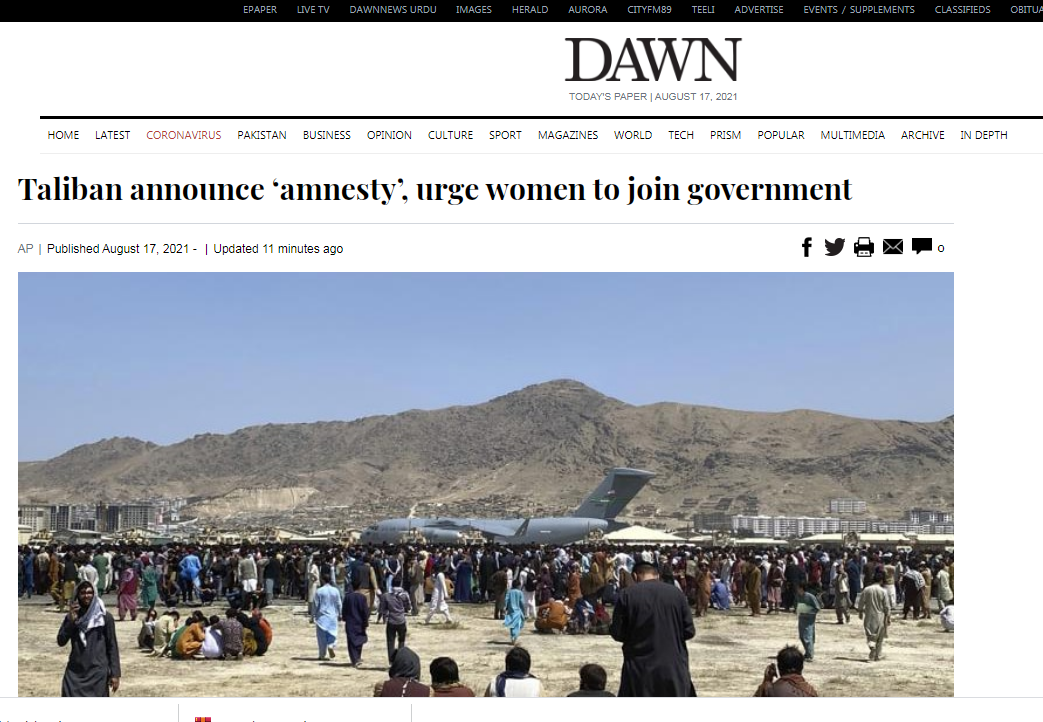
Watching Taliban take over the last few remaining bits of Afghanistan, and the live footage of tens of thousands of terrified Afghans still trying to flee the country (some killing themselves or getting killed in the process), brings to mind the identical scenes from 1989-90 when Taliban first swept to power and began their Reign of Horror in Afghanistan – under the benign watch of Pakistan and the US.

Remember: Taliban is a creation of the USA and its then-stooge, Pakistan.

Remember:  Osama bin Laden was a creation of the USA and its then-stooge, Pakistan.

It’s a good time to remember these things. It’s very important never to forget these facts.

We must not waste energy screeching ‘foul’ at USA or US President Joe Biden or his GI Joes for ‘abandoning’ Afghanistan.

Because, for the USA, its entire involvement in Afghanistan , Iraq and other regions of Central Asia and the Middle East from the 1980s till 2021 has been nothing more, nothing less, than a long-term  project aimed at securing the USA’s long-term energy security: specifically, USA’s command and control over the region’s vast oil and natural gas reserves.

After all, in statecraft there is no ‘morality’; there is no ‘good or ‘bad’, there is only Supreme National Interest.

And Taliban, Jihad, Osama bin Laden, the 9/11 attacks, the ‘War on Terror’, Hamid Karzai, Zalmay Khalilzad, Saddam Hussein…all these have been just actors and components and phases of this wonderful American-led project that has spanned several US Presidencies, both Democratic and Republican: from Reagan to Biden.  

This is a project that never ends.

Bear with me, O tolerant Reader, as I dust off and present two of a few articles I’d written on this theme for Indian Express from nearly two decades ago.   I do hope they jog thy memories as they did mine, and help discern hazy outlines of the unchanging truth from the ephemeral peta-tonnes of post-truths, half-truths and plain lies that now fill our media and numb our minds.

Free kick to Unocal!

[Indian Express: June 17th , 2002]

Saeed Naqvi’s criticism of India’s apathy and lack of vision in dealing with the post-Taliban Afghanistan (‘Mindsets with Manacles’, IE June 14) is timely, because Hamid Karzai’s coming to power has deep implications for India’s economy and long-term security.

If the USSR invaded Afghanistan in the 1980s to secure a strategic gateway on to the Arabian Sea, the US-backed mujahideen war to evict the Soviets was driven by the Americans’ desire to wrest control of the vast reserves of oil and gas in the (then-Soviet) Central Asian nations.

There were two fronts to the US campaign. On the one hand, the CIA and Pakistan’s ISI set up a vast operation to recruit, arm and train Islamic radicals from all over the world to fight a jihad against the Soviets in Afghanistan. Simultaneously, the $ 6 billion American oil company, Unocal, drew up plans for a giant pipeline that would transport LNG from Turkmenistan via Afghanistan to Pakistan, and thence, to Southeast Asian markets by sea.

Throughout the war-torn 1990s, then, Unocal busily lobbied with various ethnic factions in Afghanistan to secure its proposed pipeline. In 1995, it strongly backed the Taliban regime. Its efforts were openly endorsed by Robin Raphel, then US assistant secretary of state (South Asia), and by Tom Simmons, then US ambassador to Pakistan, who encouraged the Pakistan prime minister, Benazir Bhutto, to grant Unocal exclusive transit rights for oil and gas across Pakistan.

One of Unocal’s most able executives in Afghanistan during this period was Hamid Karzai.

On February 8 this year, Pakistan’s General Musharraf and Karzai agreed on a $ 10 million deal confirming the pipeline arrangement.

There is another strange and murky twist to the Unocal tale. The company is closely associated with Saudi oil giant Delta; and Delta is closely linked to Turki bin Faisal, who until 2001, had headed Saudi Arabia’s intelligence service Istakhbarat.

 In the early 1990s, Faisal promoted the image of Taliban as ‘liberators’ to the US, thus endorsing Unocal’s stand. But Faisal did much more (as recorded by Pakistan journalist Ahmed Rashid in his book, Taliban: Militant Islam, Oil and Fundamentalism in Central Asia).

At the urgings of Pakistan’s ISI, Turki bin Faisal provided a ‘royal prince’ to inspire and lead the Saudi contingent of mujahideen in Afghanistan

This ‘prince’ was none other than Osama bin Laden.

In the absence of any credible alternative, Hamid Karzai has now been chosen by the Loya Jirga as leader of Afghanistan for the next two years. Hopefully his election will bring a measure of unity and peace to the shattered peoples of Afghanistan. But his ascension to power also means that the US has finally have achieved the goal it has sought since the early 1990s — absolute control over Central Asian oil reserves.

A victory soaked in children’s blood

[Indian Express: Apr 22, 2003]

Iraq’s tragedy is symbolized by the fate of 12-year-old Ali Ismael Abbas. A Coalition missile strike killed Ali’s mother and father, sheared off his arms and destroyed his home. Ali has now been shifted to a hospital in Kuwait; there is talk of his being sent to the UK for advanced medical treatment. Surely this innocent child deserves the best care and assistance to start life anew.

But there are a thousand other Iraqi children like Ali: maimed, orphaned, homeless, nameless. What did they have to do with issues such as the removal of Saddam Hussein, weapons of mass destruction, or terrorism, issues cited by the US and UK to justify the Coalition campaign?

The military strikes are all but over. The Coalition forces have not captured Saddam or any key figures of his regime (unless an estranged ‘half-brother’ falls under the category). They have not found any WMD. The only ‘terrorist’ they have found is an ageing Palestinian who hijacked an Italian airliner 19 years ago, and against whom even Israel dropped all charges long ago. As for liberating the Iraqis, the irony is that the Coalition faced far fiercer resistance in Basra populated mainly by Shias, who were brutally oppressed by Saddam’s Sunni-dominated Ba’ath regime, than they did in Baghdad or even Saddam’s hometown of Tikrit.

So what has the Coalition campaign achieved?

The plain truth is, the US has secured its long-term strategic interests by paving the way for the installation of a regime that will allow it control over Iraq’s vast oil reserves.

In an energy-starved world, control over energy resources is the key to global dominance. Iraq has proven reserves of 115 billion barrels of oil (compared to Russia’s 49 billion and the Caspian states’ 15 billion barrels).

Significantly, US President Bush has appointed Zalmay Khalilzad as his special envoy to Iraq.

Khalilzad was earlier special envoy to Hamid Karzai in Afghanistan and both Karzai and Khalilzad were key advisors to US oil giant Unocal. Karzai’s installation in Afghanistan has enabled US oil majors to finalize plans to access Turkmenistan’s oil resources via a trans-Afghanistan pipeline to Pakistan. With control over Iraq’s oil resources, the US has in effect acquired a stranglehold over two-thirds of the world’s proven oil reserves. America will now use energy costs to wield global economic influence.

Today, the US and UK media strive to project their forces as saviours providing drinking water, medical assistance and electricity to Iraqis. Conveniently overlooked is the fact that the water and power infrastructure was destroyed in the first place by Coalition air strikes. Like little Ali, surely the Iraqi people need all the help they can get. But they know and the world knows that the Coalition campaign was never about saving the Iraqi people; it was about their oil.

[P.S.: Spare a thought – though perhaps little sympathy – for the Pakistani establishment: with Taliban at their gates, and no USA any more to turn to for dollars or for refuge in the short-term, they will soon learn the bitter truth of the old maxim: “Sow the wind, and thou shalt reap the whirlwind.” Of course, there’s always China...]