General ravings, Musings

Chess like that

I love chess.  

I played a lot of chess when young. My teachers were my parents, who both played pretty well, though Ma would almost always win against Dad. This was in part due to her skill in arranging devilishly tricky positional traps; but brother Bala and I soon learned, from observation, that Ma was even more skilful in quietly filching one or two of Dad’s pawns or even an occasional bishop or rook while he— innocent, trusting, absent-minded man that he was—was engrossed lighting a cigarette or had wandered off to refill his coffee cup or glass of rum.  Only rarely did Dad notice something was amiss when he came back to the chess-board and found his army depleted of key warriors;  but even when he did, his grumblings and suspicious inquiries were usually dismissed by Ma as the protestations so typically made by the vanquished.

Alas, Dad and Ma stopped playing chess altogether after a particularly incendiary argument following Dad’s  catching Ma red-handed while she was rather over-ambitiously in the process of filching his queen. But Bala and I kept playing, well into adulthood.

I even won a small college tournament in 1976 in Shillong (much to everyone’s amazement, most of all my own). But after that the only time I played regularly for any period of time was in 1980, when I was posted in Thoothukudi (then Tuticorin) as a probationary officer with the State Bank of Travancore along with my friend and colleague probationer,  Anantharamakrishnan. He was a superb chess player.  I remember we kept progressive score in a register; we must have played at least 300 games during the  four or five months we were together, and at the end of it he led by a comfortable 50 games or more. I learned a lot from Ananth in those games…he was unbeatable in the end-games, while I liked to think I had a small edge in strategic play (though often he proved me wrong).

Anyway, to drag this rant back to the topic from which I was led astray by myself…

Nowadays I only play online chess, at https://chess.com, where I registered for free in May 2023.

I mainly play two kinds of chess games: (1) ‘rapid’ 10-minute games against human beings, and (2) time-unlimited games against bots and the occasional human. 

I must mention – especially for those among you, O Sinless Readers, who are unfamiliar with chess – that it’s an incredibly addictive game. To give you an idea of how addictive it is: since I registered on chess.com, I’ve played 1196 games —which means I’ve  played two games daily on average over the last 18 months!

By way of lame excuse for all this time goofing off: chess is addictive because it’s purely a battle of minds. Chess doesn’t require physical strength and agility, but it’s as demanding, gruelling, ruthless and unforgiving as boxing or tennis or fencing.  If you lose at chess, there’s no way you can blame it on ‘bad luck’. You lost simply because your opponent played better than you. And that wounds the ego! So, being human, you want revenge…and you at once play another game…and another…And if you win, the exultation and ego-boost is so intense you want to play again…and again…

 I find the ‘rapid’ 10-minute games against humans exciting—especially when I win, naturally. Usually I leave it to the algorithm to select an opponent, which it does based on our levels of proficiency (with a score that oscillates wildly between 1100 and 1300 I’m somewhere between advanced-beginner and low-intermediate levels). These rapid games are incredibly challenging because I’d never ever played 10-minute chess games before; in the old days, a game would usually last an hour or more. In fact, I’m still not accustomed to the time pressure; the unnerving sight of that damned clock on the side of the virtual chess-board ticking down my 10 minutes of playing time makes it all too easy for me to commit more than my usual share of colossal blunders.  Quite often, I still run out of time and lose from winning positions.

But these rapid games are also interesting, because I get to play people from all over the world, from Australia to Argentina, Brazil to Britain, Pakistan to Peru, Tanzania to Turkiye to Taiwan.  (You can usually tell where a player is from by the flag which shows by default next to his/her name or chosen moniker; though some prefer to conceal their nationalities).

 The virtual game-board on chess.com allows you to ‘chat’ with the opponent while playing. But usually I prefer playing in silence—primarily because I don’t want to be distracted with the clock e-ticking away as I struggle to avoid blundering every third move.

But sometimes, I do type in a word or three…like when my opponent wins after superb play, or when I empathize with my opponent – like today when, after chasing my king all over the board and to the verge of checkmate, my New Zealand opponent committed a goof-up that I would have been proud of and promptly resigned. “Sorry, happens to me all the time,” I wrote, and received a thumbs-up and rueful grin in reply.  

Once in a while I even get into short friendly chats with my opponents.  There was this very good player from the USA—I think of her as ‘her’ because of her moniker which was distinctly female, though of course you never know on the Net—who had slowly but surely cornered  me in the game, till she moved her queen invitingly to a position where I could capture it with my pawn.

Now that’s the kind of blunder I commit quite routinely, so I typed in: “Your Q in peril!”

To which she replied: “Oh nooooooo!”

So after a few second’s thought I moved my knight or something (sparing her queen), and much to my amusement she responded: “I love you!” and moved her queen out of danger. I was less amused when she went on to win that game; but then she sent me a ‘friend’ request which I accepted, and we still play the occasional unlimited-time (3-days) game. I usually lose, but the games are great.

I’ve also faced online abuse a couple of times.

The first time was really weird.  It was a good game, a close game.  I lost the game when I ran out of time after a hell of a fight; and I was surveying the carnage of the end-position when I realized my opponent had typed in a remark.

Our brief and educative exchange went like this (I call him ‘O’ for opponent):

O: You lost, hahaha.  Lost. Loser

Me: Yes I did! Good game 🙂

O: Loser, hehe. You stupid loser

Me: ??

O:  Hehe loser.

Me: Hey, lighten up, you won! (this was my last response)

O: Lose, losing always. Loser!

O: Dirty loser. Cowerd (sic)

O: Why you not sayin aniting? Loser, useless loser

O:  Haha basterd Indie loser (sic)

O: You Niger hehe

O: Niger loser

O: Haha Niger niger niger niger

At which point I disconnected.

Sure, it was a little unpleasant…but it was also a little fascinating.

I was particularly intrigued by the term ‘Niger’.  It took a while for me to realize I wasn’t being likened to the great West African river.

Niger was a racial slur. I was being called ‘Nigger’.

Quite honestly, Gentle Reader, I wasn’t offended as much as I was amused by the slur. I’ve known all manner of taunts and epithets since childhood, when I was a small, short, fat, dark, bespectacled Tamilian schooling in Shillong. Fatty, tubby, shorty, four-eyes, Madrasee, kallu, blackie, darkie…these are some of the kinder names I’ve been called in my time, and I learned to take them in my stride, and to return as rich and graphic compliments as I got when the occasion demanded.  On the very rare occasions in schooldays when the epithets got really personal and offensive,  I even did what the informal honour-code of school demanded: challenged and fought with my persecutor after class hours on the lower football field. (I might add that I’m now a tall, skinny, ageing, dark, cadaverous, balding bespectacled Tamilian gathering PM2.5 dust in Dilli, and the taunts and epithets are much rarer, for which I am glad…especially because that lower football field is 2000 km away. )

But I’d never been called ‘Nigger’ before.  

I’ve therefore added this latest curse-word to the others that I wear as a garland of honour, and I continue to play chess with humans online.

And then there are the chess bots.

 You have all kinds of bots that you can play on chess.com: they’ve got interesting names, and even profile photos, and they’re grouped in different levels of proficiency to help you choose whom to play.

These bots are amazing characters.  They joke. They banter. Some bots heckle you. Others laugh at you. Some make sarcastic remarks about your last move. Some are moody and depressed about life in general, and especially about losing to you.

Here are a few memorable bots I’ve played with, with some choice quotes:

Nefertiti  the Cat: Nefertiti was distinctly catty, in looks and in speech. Her opening greeting was: “I can’t wait for this game to be over so I can be alone.” (It’s a hell of a discouraging thing for any man to hear from any woman he’s just met…even if she’s a chess bot). Nefertiti was also very difficult to beat. “Stay in your lane. Which isn’t chess, clearly.” This was what she advised me, shortly before winning the game with a devastating attack.

Ajax the Greek warrior: Ajax was a mean bot. His remark after crushing me in less than 15 moves: “Get back to school. I know a pretty good one in Athens.”

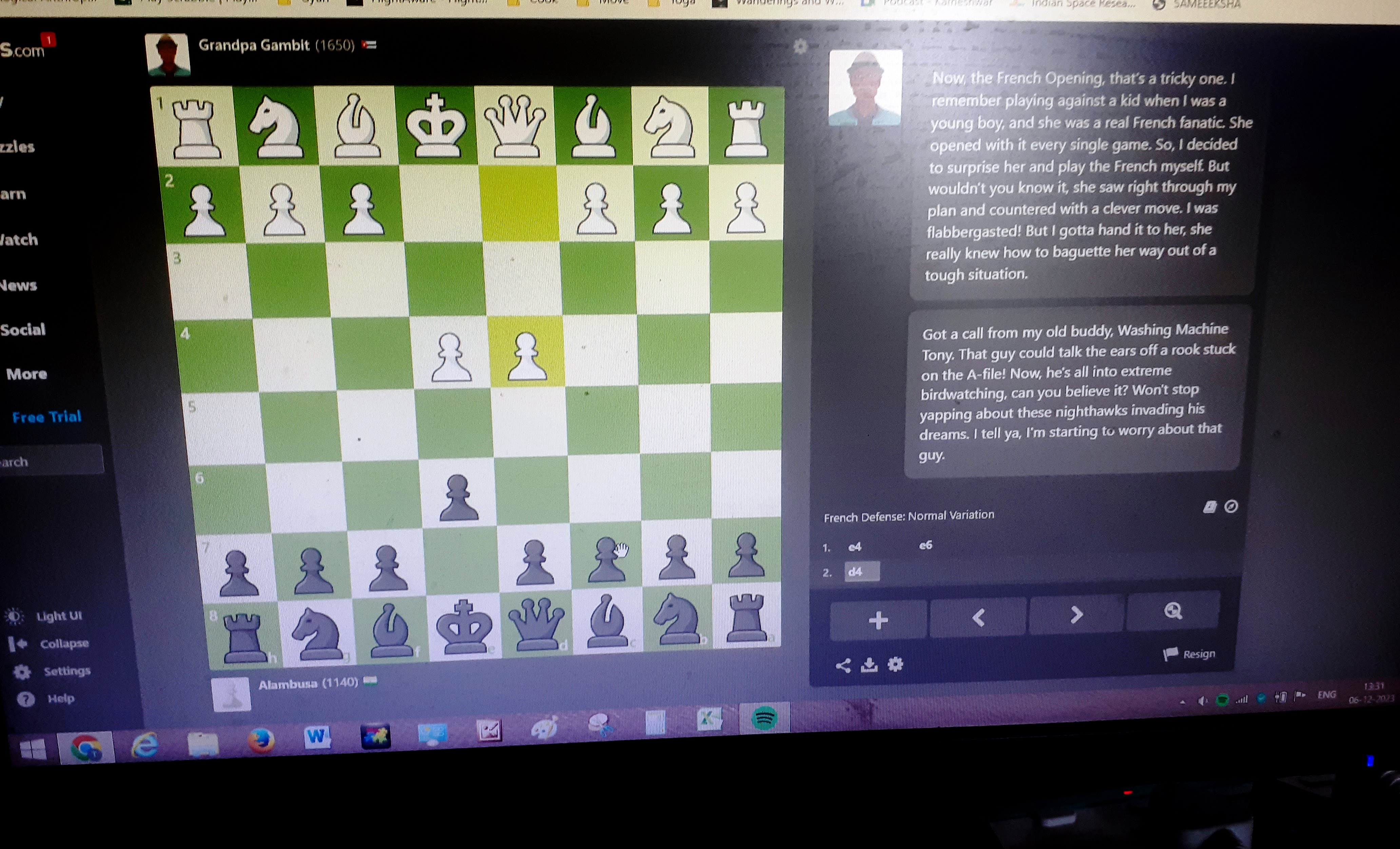
Grandpa Gambit: Grandpa was a brilliant player. Alas, he was also garrulous, like most grandpas. He talked incessantly; he talked even more than I do in my anec-dotage.  Mercifully, Grandpa was good-natured, like P G Wodehouse’s Oldest Member in the Golf Glub. Usually he conversed with himself, that too in lengthy paragraphs, while I was busy trying, without much success, to avoid checkmate.

Sample this opening remark from Grandpa after I made my first move in a game:

 “Now, the French opening…that’s a tricky one. I remember playing against a kid when I was a young boy, and she was a real French fanatic.  She opened with it every single game. So I decided to surprise her and play the French myself. But wouldn’t you know, she saw right through my plan and countered with a clever move. I was flabbergasted! But I gotta hand it to her, she knew how to baguette her way out of a tough situation!”

And another time, when I was staring in disbelief and despair at the devastated ruins of what was left of my chess army and realized checkmate was certain whatever I did, the old geezer prattled cheerfully as follows:

I remember playing against this young whippersnapper in San Antonio back in ’72. I checkmated him and thought that was the end of it. But then, wouldn’t you know it, he goes on to win the US Championship six times! I guess I must have taught him a thing or two, eh? I’m just glad I could help the kid out.”

Every game with Grandpa Gambit was like being whirled, squeezed and hammered flat by industrial machinery before being finally roasted in a high-temperature kiln. But listening to Grandpa (or rather, reading him) made it all worth it.
I still miss Grandpa Gambit. As I miss Nefertiti, and all the other bots of the olden days.

You see, O Dear Patient Reader, the old chess bots have all gone forever…gone the way of all mortal flesh (or rather, the way of all photons and baryons and leptons, long-lived though they might be). They’ve been replaced by new chess bots who, though excellent chess players, hardly talk. And when these newcomer chess bots do talk, their converse is shallow, uninspiring, boring…these new bots somehow lack the originality, the wit, the vulnerabilities, the goofiness, the humanity and individuality of their bot-ancestors.

There’s an insipid, humourless, sameness about all these new bots; they’re almost like…well… Woke bots. 

Well…I guess maybe these new bots are only mirroring what’s happening nowadays to human societies across the world.

Oh, in case you play chess… let’s have a game, do look out for me, a.k.a Alambusa, at https://chess.com/.
General ravings, Potshots

Great Indian Grope Trick, Slipped Discus Throw, Spittle Chase…India prepares to top next Olympics!

I’m so happy for our young Indian athletes who did so well at the just-concluded Paralympics in Paris; in all they won 29 medals! And at the Olympic Games last month, too, our Indian athletes did well—winning 6 medals.

Yet, with China topping the Paralympics with 220 medals, and the USA topping the Olympics with 126 medals, we can’t help think that the Indian government, the Indian corporates, the Indian media money bags…in short the Indian establishment can and should do much more to support sports in India so that more Indian youngsters are given the opportunities and encouragement to become high-performing athletes who can qualify to participate in international sporting events and win more medals.  

To get more gyaan on this matter we obtained an interview with the internationally discredited sports expert Professor Glucose Kuriakose Gillidandan, Head of the Centre for Research & Advanced  Programs in Sports (CRAPS) of the Ministry of Sports, and winner of many national awards including the coveted Bakasura Prize for Sports Dietetics & Nutrition, 2011.

We met Prof. Gillidandan at his comfortable office-cum-laboratory complex in Shahdara, New Delhi, overlooking the rippling brown waters of the Shahdara Drain. A beautiful miniature marble sculpture of the fearsome Bakasura, Rakshasa of Insatiable Appetite, stood on Prof. Gillidandan’s colossal desk next to a laptop, a pen-stand, and assorted files. Through the open window, a gentle breeze occasionally brought in the heady organic aromas of the Shahdara drain, blended deliciously with the sharp inorganic aromas of nitric acid, sulphur dioxide and chlorine from the hundreds of informal and illegal e-waste recycling units spread across the vast urban village of Seelampur on the other bank of the Drain.

“Rest assured India will soon be a leading Olympian power,” Prof. Gillidandan declared in response to our opening query.  “My team at CRAPS is implementing a low-cost, innovative strategy which will guarantee that our budding young athletes will win at least 50 gold medals in the L.A. Olympics, 2028, and top the medals chart in the 2032 Games!”

We were thrilled at his words. “Yeh Bharat Mahaan!” we yelled in our enthusiasm, and he leaned back and smiled while the three peons in the room, along with several chaprasis, clerks, and affiliated touts in the reception hall outside raucously echoed the patriotic chant.

“But…er… how will you achieve this ambitious goal?” we asked when the tumult subsided.

Prof. Gillidandan smiled. “We have adopted a two-pronged strategy.  One: instead of wasting precious time and money in creating costly new sports training infrastructure like stadiums, running tracks, and so on, we will use the sports training infrastructure that is readily available all around us already —in the streets and other public places all across our country—to help build all the qualities that young aspiring athletes need: like courage, self-belief, strength, speed, reflexes, flexibility, determination, endurance, and so. In this way, at virtually no extra cost, we can train and create thousands of world-class Indian athletes! “

We were puzzled, but did not interrupt as he was clearly warming to his theme.

“Two,” he went on, “we are also developing a few innovative, uniquely Indian sports events that we will pilot in the next National Games, and thereafter recommend for adoption in the Olympics and other international sports events. These new sports events are broadly modelled on existing Olympic events— but most importantly, they are also perfectly attuned to the same local conditions in our cities where our youngsters will train. Naturally, our newly-trained  Indian athletes will be able to win many medals in these new events… so it’s a win-win strategy! “

We were deeply impressed. “Er…could you please explain with an example or three …?”

Prof. Gillidandan thought for a moment.

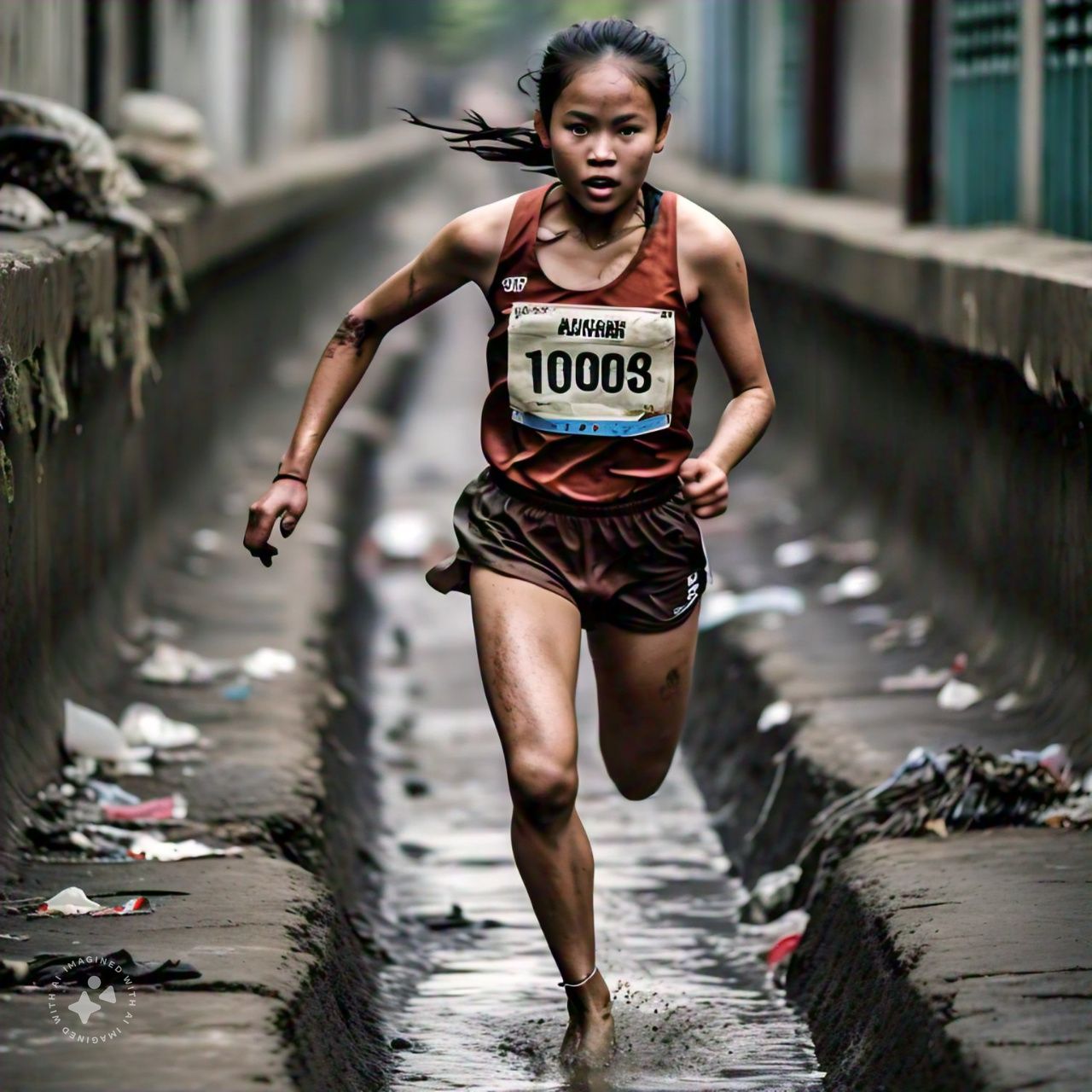
“All right, a good example is our latest invention, the Dribble Jump©.  CRAPS has modelled the Dribble Jump on the traditional Olympic sport known as ‘Triple Jump’.  The essence of the Dribble Jump is the same as the Triple Jump:  the contestant sprints down a straight track and then executes a hop, a bound, and finally a long jump into a sand pit. However, the Dribble Jump is far more challenging than the Triple Jump, because the contestant will have to overcome certain unique and formidable hurdles that are encountered in daily life by Indians everywhere, particularly in big cities. These hurdles are created by Acts of Nature—or more precisely, by Indian men responding to Calls of Nature…”

We couldn’t believe our ears. “Eh?  What? Calls of Nature!  How…what do you mean, sir…”

He went on as though we hadn’t spoken. “In the Dribble Jump, the contestant is required to sprint along a straight, shallow sewage drain, and then execute a hop, a bound, and finally a long jump  over a patch of hard ground littered with puddles and piles of …er….freshly deposited human metabolic by-products.”

Dribble Jump – field trial in progress [image created with MetaAI, Paint, and Insanity]

He paused to feed himself a large zarda paan. We attempted to speak but could only utter faint gulping noises. A peon helpfully proffered a glass of water, which we emptied in three additional gulps.

“You see,” Prof. Gillidandan continued indistinctly around his zarda paan, “ studies by my CRAPS team have revealed certain extraordinary facts about our country: that wherever in India there is a vacant plot of land, or a wall or pavement or fence or even a row of bushes stretching more than ten metres, the local community will proceed to use these areas as garbage dumps. Furthermore, passing Indian men will use the same areas as a public toilet on a continuous basis.  The same practices are manifest along the borders of railway lines, streets, canals, ponds, lakes, and so on.  In a flash we realized that these age-old practices—which are so much a part of our glorious heritage, culture and agriculture— provide us with readily available sports training infrastructure across the country at virtually zero cost!”

We continued to gulp in both English and Hindi. As before, Prof. Gillidandan ignored us completely.

“Let me give you an idea of what I mean,” went on Prof. Gillidandan dreamily. “On a stretch of pavement near my own apartment in Rajender Nagar, New Delhi, I’ve seen children and adults routinely execute Triple Jumps of over 24 metres to avoid landing in or on the fresh pools and piles laid out every morning and evening by large-hearted men of the locality! Compare this with the World Records in Triple Jump, which are a mere 18.29 metres for men and 15.74 metres for women…”

“Gulp…glug…”

“These and other insights helped us to envision and design the Dribble Jump, and commence trials too,” he continued.  He waved a hand towards the window. “We’ve field-tested and validated the Dribble Jump in and around the Shahdara Drain, and will continue trials at the Ghazipur Landfill – the ideal venue! And we’ve identified over 1640 other venues across India in which to demonstrate the Dribble Jump as part of our nationwide awareness-cum-training programme during 2024–25.  We hope to showcase this event in the L.A. Games, 2028, and are confident that the International Olympic Association will adopt the Dribble Jump in place of its traditional Triple Jump—especially because the Dribble Jump’s refreshingly natural and organic hurdles harmonize so well with the global movement towards natural and organic lifestyles…”

Ghazipur Landfill, New Delhi – perfect for trials of Dribble Jump and other innovative CRAPS games

We found our voice at last. “This is incredible…unbelievable!” we croaked. “How on earth could…”

“Yes, thank you very much, sir,” replied Prof. Gillidandan with a modest smile, completely misconstruing our words.  “I’m flattered…but  then  I cannot take all the credit, I must acknowledge the contributions of my team here at CRAPS…”

We resumed our gulping and gurgling; by now we were getting quite adept at it.

He grabbed a thin sheaf of papers from his desk and thrust them at us. “Here, take a look at this,” he said, “They summarize a few other innovative sports events that we’ve designed at CRAPS. Some are being field-testing now—like Slipped Discus Throw, Spittle Chase, Great Indian Grope Trick. A few are at the concept stage…my personal favourite is the Poll Vault, specifically designed for contestants from Indian political parties…”

At this point Prof. Gillidandan’s cellphone rang. After a minute’s conversation he disconnected and jumped to his feet.  “My apologies, I must go,” he muttered. “That was the Sports Minister: I have to meet him immediately…”

And so, mercifully, the interview ended.

But our horror endures.

We’ve gone through the small sheaf of papers that Prof. Gillidandan so kindly gave us study, and present  below the gist of some of the sporting events that he and his team at CRAPS have developed for introduction in the next National Games—and perhaps in future Olympic Games.

We’ve also commenced a three-month course of mild tranquilizers on our doctor’s advice, to overcome the bouts of sudden hysteria that overwhelm us without warning ever since our interview with Prof. Gillidandan. The doctor is confident that we’ll recover completely … but has strictly warned us against any stressful activities including watching sporting events on TV or the Net.

Other innovative sports events developed/under development by CRAPS

[list not exhaustive]

Contestants:  athletes of all sexes, all ages

Like the traditional Olympic Steeple Chase, the Spittle Chase© is a gruelling 3000 meter race; but with a few vital differences.

  • In the Steeple Chase, each contestant is required to run about 3000 metres during which he/she jumps over 28 three-foot hurdles and executes seven ‘water jumps’ , each over a 10-foot wide pit of water).
  • In the Spittle Chase©, each contestant  will  run 3000 metres along  the streets of a typical Indian city road choked with traffic and garbage—for example,  Vikas Marg in New Delhi or Andheri–Kurla road In Mumbai. In Kolkata, Guwahati, and Kanpur, any streets will do.
  • In the Spittle Chase©, each of the 28 barriers will consist of a three-foot high mound of construction & demolition (C&D) waste material in the middle of the road, which are usually available or can be arranged for by municipal agencies, Public Works Department (PWD), etc.
  • instead of jumps over pits of water, the Spittle Chase© runner must execute jumps over seven 10-foot-wide pits filled with trash and/or sewage (such pits, too, are usually readily available at no cost due to the roads caving in after being undermined by leaking sewage pipes)
  • To add to the excitement, 28 city buses will hurtle up and down the road at 50–60 kmph during the Spittle Chase©. Each bus will be filled with expert zarda paan chewers who will take pot-shots— rather, spittle-shots— at the running  contestants  who must weave and twist while running in order to escape being hit by the scarlet and fluid barrage. The contestants must also avoid being run over by the city buses—otherwise they will be penalized.

Participants:  athletes of all sexes, all ages [N.B: orthopaedic surgeons and ambulances will be on standby]

The Slipped Discus Throw© will be a night event – the first ever in the history of India’s National Games, as well as of the Olympics as and when it is introduced!

  • The venue for Slipped Discus Throw© can be any typical newly-developed upmarket area in any of India’s major metropolitan cities— with broad well-lit roads lined with glittering shops and malls, sidewalks littered with C&D waste and garbage, deep uncovered trenches containing exposed electricity and data cables, gas lines, etc., fetid open manholes, and so on.
  • Contestants are required to walk briskly along a designated 400-meter stretch of the road and/or sidewalk without falling or slipping or stumbling and dislocating their hips and/or backs, or tripping over blocks of masonry and tangles of steel wire and breaking their necks.
  • At the end of the 400-meter stretch, the contestant will pick up a standard-size cement block weighing 40 kilograms and throw it across a distance of 10 metres without collapsing on his/her/their/its face or rear. [Note: all cement blocks shall  be tested before the event to ensure that the cement has not been adulterated by unscrupulous contractors]

Participants:  women athletes of all ages

This unique, all-new women’s event can potentially become the most exciting of all sporting events for spectators at the National Games and Olympics!  Highlights:

  • The Great Indian Grope Trick can be held in any large, crowded public place like a shopping arcade, plaza, bazaar, and so on—for instance, Connaught Place in New Delhi, Johari Bazaar in Jaipur, Crawford Market in Mumbai, and so on.
  • The women contestants, wearing bullet-proof suits and carrying pepper-sprays and/or tasers for self-defence, will have to sprint approximately 800 metres along a demarcated route in the venue while evading the groping fingers (and other assorted intrusive digits, appendages, protuberances and tools) of 400 ‘Gropers’ who will be chosen by a rigorous selection process from among the thousands of lechers, oglers, dirty old men, dirty young men, and affiliated riffraff who frequent all the public spaces in all the cities of India.
  • For scoring purposes, the Gropers will be provided with buckets of indelible dye in which to dip their fingers (and any other tools they may wish to deploy). The winning contestant will be the one who completes the course with the minimum number of dye-marks on her apparel and/or the maximum number of pepper-spray/taser strikes on her would-be Gropers.

[Note from Prof.G K Gillidandan: Regrettably, we may have to reconsider promoting this event due to the slightly disturbing comment by Mr Seniram Ungaliwallah Singh, Deputy Director at the Indian Wrestling Federation (Women’s Division), while praising the CRAPS team for developing the Great Indian Grope Trick:

Truly, the Great Indian Grope Trick promises to be a Track & Feel event with a difference! I am confident it will leave an indelible impression on all the spectators, if not the contestants; and touch them to the hearts of their bottoms.”]

Great Indian Grope Trick – preliminary trial [image created with MetaAI, Paint, and Insanity]

Poll Vault©

ParticipantsIndian political leaders

The Poll Vault is an event that offers high entertainment value for spectators. It is primarily aimed at the National Games for the obvious reason that it is open only to Indian MPs, MLAs, and other senior political party leaders who have defected at least three times from one party to another.

  • As with the traditional Pole Vault, the Poll Vault contestant will use uses a long and flexible pole as an aid to jump over a bar and land on a sand pit on the far side.
  • However, in the Poll Vault, a minimum of three rival contestants will be allowed to grab the pole and tug it away from beneath the contestant while she/he/it/them is attempting to vault over the bar.
  • If the contestant loses balance and lands on the same (starting) side,  penalty points will be awarded there and then by the rival contestants in the form of mild beatings with the pole (which may be made of light bamboo to ensure adherence to International Human Rights Law).
  • Contestants who succeed in vaulting over the bar and landing without severe injury will continue to the next round, with the height of bar being raised each time, until the three final winners are found.  


[Notes from Prof. Gillidandan:

(1) The bar may be made from mild steel for all contestants except those from Aam Aadmi Party, who may be allowed to vault over a standard-sized liquor bar

(2) Any contestant who manages to leap to the other side of the bar, and then leap back to the starting side, can be awarded a special medal. I suggest the name ‘N D Tiwari Puraskaar’, in honour of the late lamented Congress leader N D Tiwari who broke away from the Congress to form the Congress (Tiwari), and then defected back from the Congress (Tiwari) to Congress, leaving his Congress (Tiwari) colleagues Tiwari-less.

Poll Vault – concept [image created with MetaAI, Paint, and Insanity]

Jai Hind! Hail our athletes, who do so well despite our apathy and cynicism.