General ravings, Potshots

Great Indian Grope Trick, Slipped Discus Throw, Spittle Chase…India prepares to top next Olympics!

I’m so happy for our young Indian athletes who did so well at the just-concluded Paralympics in Paris; in all they won 29 medals! And at the Olympic Games last month, too, our Indian athletes did well—winning 6 medals.

Yet, with China topping the Paralympics with 220 medals, and the USA topping the Olympics with 126 medals, we can’t help think that the Indian government, the Indian corporates, the Indian media money bags…in short the Indian establishment can and should do much more to support sports in India so that more Indian youngsters are given the opportunities and encouragement to become high-performing athletes who can qualify to participate in international sporting events and win more medals.  

To get more gyaan on this matter we obtained an interview with the internationally discredited sports expert Professor Glucose Kuriakose Gillidandan, Head of the Centre for Research & Advanced  Programs in Sports (CRAPS) of the Ministry of Sports, and winner of many national awards including the coveted Bakasura Prize for Sports Dietetics & Nutrition, 2011.

We met Prof. Gillidandan at his comfortable office-cum-laboratory complex in Shahdara, New Delhi, overlooking the rippling brown waters of the Shahdara Drain. A beautiful miniature marble sculpture of the fearsome Bakasura, Rakshasa of Insatiable Appetite, stood on Prof. Gillidandan’s colossal desk next to a laptop, a pen-stand, and assorted files. Through the open window, a gentle breeze occasionally brought in the heady organic aromas of the Shahdara drain, blended deliciously with the sharp inorganic aromas of nitric acid, sulphur dioxide and chlorine from the hundreds of informal and illegal e-waste recycling units spread across the vast urban village of Seelampur on the other bank of the Drain.

“Rest assured India will soon be a leading Olympian power,” Prof. Gillidandan declared in response to our opening query.  “My team at CRAPS is implementing a low-cost, innovative strategy which will guarantee that our budding young athletes will win at least 50 gold medals in the L.A. Olympics, 2028, and top the medals chart in the 2032 Games!”

We were thrilled at his words. “Yeh Bharat Mahaan!” we yelled in our enthusiasm, and he leaned back and smiled while the three peons in the room, along with several chaprasis, clerks, and affiliated touts in the reception hall outside raucously echoed the patriotic chant.

“But…er… how will you achieve this ambitious goal?” we asked when the tumult subsided.

Prof. Gillidandan smiled. “We have adopted a two-pronged strategy.  One: instead of wasting precious time and money in creating costly new sports training infrastructure like stadiums, running tracks, and so on, we will use the sports training infrastructure that is readily available all around us already —in the streets and other public places all across our country—to help build all the qualities that young aspiring athletes need: like courage, self-belief, strength, speed, reflexes, flexibility, determination, endurance, and so. In this way, at virtually no extra cost, we can train and create thousands of world-class Indian athletes! “

We were puzzled, but did not interrupt as he was clearly warming to his theme.

“Two,” he went on, “we are also developing a few innovative, uniquely Indian sports events that we will pilot in the next National Games, and thereafter recommend for adoption in the Olympics and other international sports events. These new sports events are broadly modelled on existing Olympic events— but most importantly, they are also perfectly attuned to the same local conditions in our cities where our youngsters will train. Naturally, our newly-trained  Indian athletes will be able to win many medals in these new events… so it’s a win-win strategy! “

We were deeply impressed. “Er…could you please explain with an example or three …?”

Prof. Gillidandan thought for a moment.

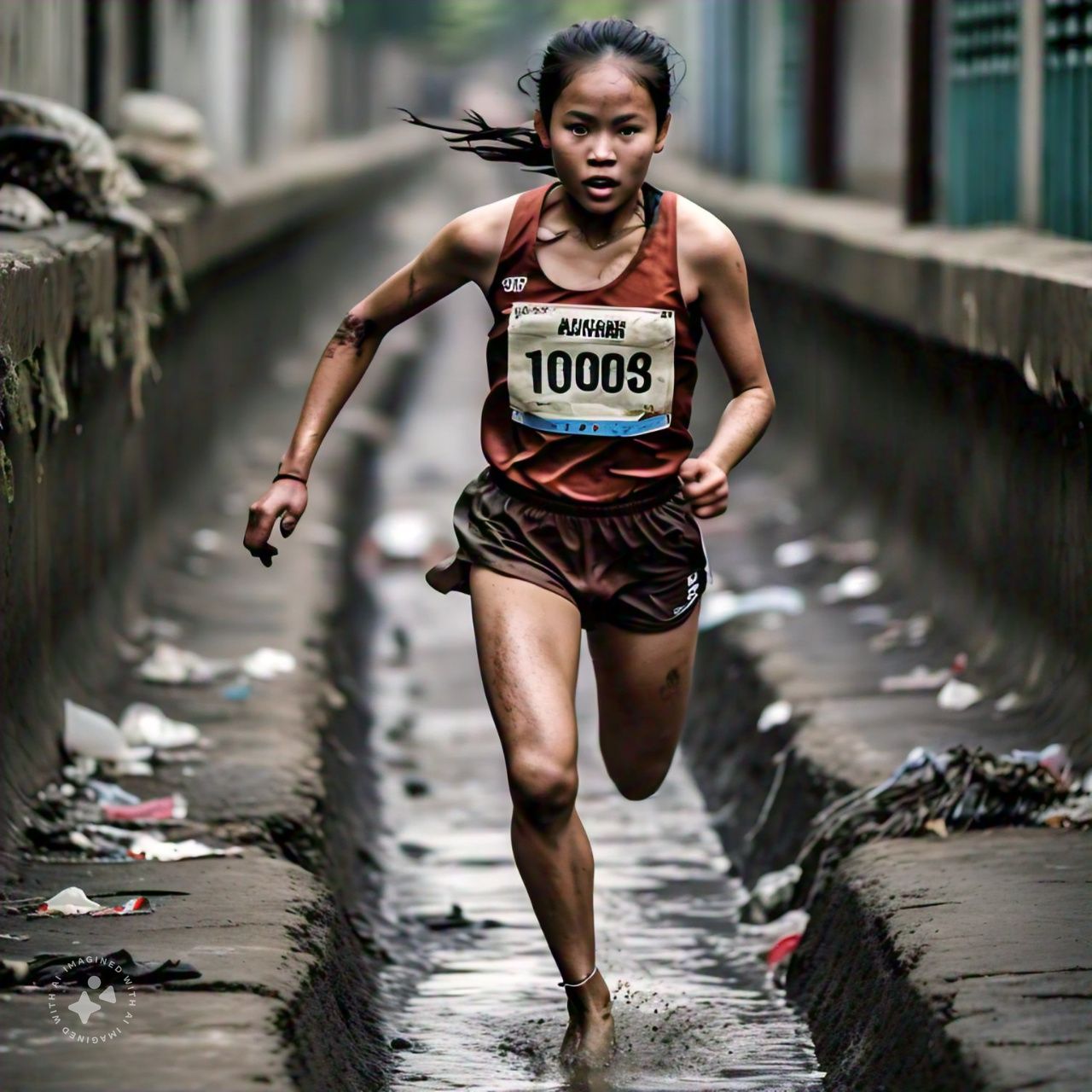
“All right, a good example is our latest invention, the Dribble Jump©.  CRAPS has modelled the Dribble Jump on the traditional Olympic sport known as ‘Triple Jump’.  The essence of the Dribble Jump is the same as the Triple Jump:  the contestant sprints down a straight track and then executes a hop, a bound, and finally a long jump into a sand pit. However, the Dribble Jump is far more challenging than the Triple Jump, because the contestant will have to overcome certain unique and formidable hurdles that are encountered in daily life by Indians everywhere, particularly in big cities. These hurdles are created by Acts of Nature—or more precisely, by Indian men responding to Calls of Nature…”

We couldn’t believe our ears. “Eh?  What? Calls of Nature!  How…what do you mean, sir…”

He went on as though we hadn’t spoken. “In the Dribble Jump, the contestant is required to sprint along a straight, shallow sewage drain, and then execute a hop, a bound, and finally a long jump  over a patch of hard ground littered with puddles and piles of …er….freshly deposited human metabolic by-products.”

Dribble Jump – field trial in progress [image created with MetaAI, Paint, and Insanity]

He paused to feed himself a large zarda paan. We attempted to speak but could only utter faint gulping noises. A peon helpfully proffered a glass of water, which we emptied in three additional gulps.

“You see,” Prof. Gillidandan continued indistinctly around his zarda paan, “ studies by my CRAPS team have revealed certain extraordinary facts about our country: that wherever in India there is a vacant plot of land, or a wall or pavement or fence or even a row of bushes stretching more than ten metres, the local community will proceed to use these areas as garbage dumps. Furthermore, passing Indian men will use the same areas as a public toilet on a continuous basis.  The same practices are manifest along the borders of railway lines, streets, canals, ponds, lakes, and so on.  In a flash we realized that these age-old practices—which are so much a part of our glorious heritage, culture and agriculture— provide us with readily available sports training infrastructure across the country at virtually zero cost!”

We continued to gulp in both English and Hindi. As before, Prof. Gillidandan ignored us completely.

“Let me give you an idea of what I mean,” went on Prof. Gillidandan dreamily. “On a stretch of pavement near my own apartment in Rajender Nagar, New Delhi, I’ve seen children and adults routinely execute Triple Jumps of over 24 metres to avoid landing in or on the fresh pools and piles laid out every morning and evening by large-hearted men of the locality! Compare this with the World Records in Triple Jump, which are a mere 18.29 metres for men and 15.74 metres for women…”

“Gulp…glug…”

“These and other insights helped us to envision and design the Dribble Jump, and commence trials too,” he continued.  He waved a hand towards the window. “We’ve field-tested and validated the Dribble Jump in and around the Shahdara Drain, and will continue trials at the Ghazipur Landfill – the ideal venue! And we’ve identified over 1640 other venues across India in which to demonstrate the Dribble Jump as part of our nationwide awareness-cum-training programme during 2024–25.  We hope to showcase this event in the L.A. Games, 2028, and are confident that the International Olympic Association will adopt the Dribble Jump in place of its traditional Triple Jump—especially because the Dribble Jump’s refreshingly natural and organic hurdles harmonize so well with the global movement towards natural and organic lifestyles…”

Ghazipur Landfill, New Delhi – perfect for trials of Dribble Jump and other innovative CRAPS games

We found our voice at last. “This is incredible…unbelievable!” we croaked. “How on earth could…”

“Yes, thank you very much, sir,” replied Prof. Gillidandan with a modest smile, completely misconstruing our words.  “I’m flattered…but  then  I cannot take all the credit, I must acknowledge the contributions of my team here at CRAPS…”

We resumed our gulping and gurgling; by now we were getting quite adept at it.

He grabbed a thin sheaf of papers from his desk and thrust them at us. “Here, take a look at this,” he said, “They summarize a few other innovative sports events that we’ve designed at CRAPS. Some are being field-testing now—like Slipped Discus Throw, Spittle Chase, Great Indian Grope Trick. A few are at the concept stage…my personal favourite is the Poll Vault, specifically designed for contestants from Indian political parties…”

At this point Prof. Gillidandan’s cellphone rang. After a minute’s conversation he disconnected and jumped to his feet.  “My apologies, I must go,” he muttered. “That was the Sports Minister: I have to meet him immediately…”

And so, mercifully, the interview ended.

But our horror endures.

We’ve gone through the small sheaf of papers that Prof. Gillidandan so kindly gave us study, and present  below the gist of some of the sporting events that he and his team at CRAPS have developed for introduction in the next National Games—and perhaps in future Olympic Games.

We’ve also commenced a three-month course of mild tranquilizers on our doctor’s advice, to overcome the bouts of sudden hysteria that overwhelm us without warning ever since our interview with Prof. Gillidandan. The doctor is confident that we’ll recover completely … but has strictly warned us against any stressful activities including watching sporting events on TV or the Net.

Other innovative sports events developed/under development by CRAPS

[list not exhaustive]

Contestants:  athletes of all sexes, all ages

Like the traditional Olympic Steeple Chase, the Spittle Chase© is a gruelling 3000 meter race; but with a few vital differences.

  • In the Steeple Chase, each contestant is required to run about 3000 metres during which he/she jumps over 28 three-foot hurdles and executes seven ‘water jumps’ , each over a 10-foot wide pit of water).
  • In the Spittle Chase©, each contestant  will  run 3000 metres along  the streets of a typical Indian city road choked with traffic and garbage—for example,  Vikas Marg in New Delhi or Andheri–Kurla road In Mumbai. In Kolkata, Guwahati, and Kanpur, any streets will do.
  • In the Spittle Chase©, each of the 28 barriers will consist of a three-foot high mound of construction & demolition (C&D) waste material in the middle of the road, which are usually available or can be arranged for by municipal agencies, Public Works Department (PWD), etc.
  • instead of jumps over pits of water, the Spittle Chase© runner must execute jumps over seven 10-foot-wide pits filled with trash and/or sewage (such pits, too, are usually readily available at no cost due to the roads caving in after being undermined by leaking sewage pipes)
  • To add to the excitement, 28 city buses will hurtle up and down the road at 50–60 kmph during the Spittle Chase©. Each bus will be filled with expert zarda paan chewers who will take pot-shots— rather, spittle-shots— at the running  contestants  who must weave and twist while running in order to escape being hit by the scarlet and fluid barrage. The contestants must also avoid being run over by the city buses—otherwise they will be penalized.

Participants:  athletes of all sexes, all ages [N.B: orthopaedic surgeons and ambulances will be on standby]

The Slipped Discus Throw© will be a night event – the first ever in the history of India’s National Games, as well as of the Olympics as and when it is introduced!

  • The venue for Slipped Discus Throw© can be any typical newly-developed upmarket area in any of India’s major metropolitan cities— with broad well-lit roads lined with glittering shops and malls, sidewalks littered with C&D waste and garbage, deep uncovered trenches containing exposed electricity and data cables, gas lines, etc., fetid open manholes, and so on.
  • Contestants are required to walk briskly along a designated 400-meter stretch of the road and/or sidewalk without falling or slipping or stumbling and dislocating their hips and/or backs, or tripping over blocks of masonry and tangles of steel wire and breaking their necks.
  • At the end of the 400-meter stretch, the contestant will pick up a standard-size cement block weighing 40 kilograms and throw it across a distance of 10 metres without collapsing on his/her/their/its face or rear. [Note: all cement blocks shall  be tested before the event to ensure that the cement has not been adulterated by unscrupulous contractors]

Participants:  women athletes of all ages

This unique, all-new women’s event can potentially become the most exciting of all sporting events for spectators at the National Games and Olympics!  Highlights:

  • The Great Indian Grope Trick can be held in any large, crowded public place like a shopping arcade, plaza, bazaar, and so on—for instance, Connaught Place in New Delhi, Johari Bazaar in Jaipur, Crawford Market in Mumbai, and so on.
  • The women contestants, wearing bullet-proof suits and carrying pepper-sprays and/or tasers for self-defence, will have to sprint approximately 800 metres along a demarcated route in the venue while evading the groping fingers (and other assorted intrusive digits, appendages, protuberances and tools) of 400 ‘Gropers’ who will be chosen by a rigorous selection process from among the thousands of lechers, oglers, dirty old men, dirty young men, and affiliated riffraff who frequent all the public spaces in all the cities of India.
  • For scoring purposes, the Gropers will be provided with buckets of indelible dye in which to dip their fingers (and any other tools they may wish to deploy). The winning contestant will be the one who completes the course with the minimum number of dye-marks on her apparel and/or the maximum number of pepper-spray/taser strikes on her would-be Gropers.

[Note from Prof.G K Gillidandan: Regrettably, we may have to reconsider promoting this event due to the slightly disturbing comment by Mr Seniram Ungaliwallah Singh, Deputy Director at the Indian Wrestling Federation (Women’s Division), while praising the CRAPS team for developing the Great Indian Grope Trick:

Truly, the Great Indian Grope Trick promises to be a Track & Feel event with a difference! I am confident it will leave an indelible impression on all the spectators, if not the contestants; and touch them to the hearts of their bottoms.”]

Great Indian Grope Trick – preliminary trial [image created with MetaAI, Paint, and Insanity]

Poll Vault©

ParticipantsIndian political leaders

The Poll Vault is an event that offers high entertainment value for spectators. It is primarily aimed at the National Games for the obvious reason that it is open only to Indian MPs, MLAs, and other senior political party leaders who have defected at least three times from one party to another.

  • As with the traditional Pole Vault, the Poll Vault contestant will use uses a long and flexible pole as an aid to jump over a bar and land on a sand pit on the far side.
  • However, in the Poll Vault, a minimum of three rival contestants will be allowed to grab the pole and tug it away from beneath the contestant while she/he/it/them is attempting to vault over the bar.
  • If the contestant loses balance and lands on the same (starting) side,  penalty points will be awarded there and then by the rival contestants in the form of mild beatings with the pole (which may be made of light bamboo to ensure adherence to International Human Rights Law).
  • Contestants who succeed in vaulting over the bar and landing without severe injury will continue to the next round, with the height of bar being raised each time, until the three final winners are found.  


[Notes from Prof. Gillidandan:

(1) The bar may be made from mild steel for all contestants except those from Aam Aadmi Party, who may be allowed to vault over a standard-sized liquor bar

(2) Any contestant who manages to leap to the other side of the bar, and then leap back to the starting side, can be awarded a special medal. I suggest the name ‘N D Tiwari Puraskaar’, in honour of the late lamented Congress leader N D Tiwari who broke away from the Congress to form the Congress (Tiwari), and then defected back from the Congress (Tiwari) to Congress, leaving his Congress (Tiwari) colleagues Tiwari-less.

Poll Vault – concept [image created with MetaAI, Paint, and Insanity]

Jai Hind! Hail our athletes, who do so well despite our apathy and cynicism.

Ancient writings, General ravings

The Rain of Terror [or, Electricity Department Blues]

Please do forgive me for my long silence, O Most Loyal Reader…for Clouds of Angst have filled my deranged mind ever since the Lok Sabha polls, especially because the Aam Aadmi Party candidate for whom I voted—whose name I have forgotten, if at all I ever knew it—lost his/her/its deposit.

But now, as I struggle to cast aside Writer’s Block and emerge from the churning brown Monsoon waters that have turned Delhi into a mosquito-and-politician-infested swamp,  the Gates of Memory briefly open to reveal a dreadful yet inspiring tale I narrated 22 years ago; a tale that I inflict upon Thee now (with some slight modifications), in the hope that it might relieve Thee too of any depression with its moral message—that even within the deepest Pits of Darkness, we may find the Lights of Optimism and Good Cheer….    

Amid the fire and brimstone raised by the recent debates in Delhi and indeed across India over collapsing buildings, flooded streets, and rewriting our history books, an archaeological discovery of immense significance escaped public attention—much to the relief of an embattled government! Indeed, it was only with the greatest reluctance, and that too on conditions of strict anonymity, that a senior archaeologist attached to the Department of Ancient Monuments agreed to reveal details of their extraordinary find.

“The MTNL chaps unearthed it,” he began, “while digging a trench during a routine cable-laying operation in West Delhi. As soon as they alerted us, we rushed to the site to investigate what they’d found. Careful excavations at the site eventually revealed a large rectangular room with a single doorway. It was buried two metres below the surface, and built entirely of a sickly yellow material, that upon chemical analysis turned out to be a kind of inferior grade cement…”

“Cement?” we broke in, startled.  “How could that be…surely cement is a modern construction material…?”

“Exactly!” he cried. “We, too, were excited at the idea that we might have stumbled upon a facet of some hitherto unknown, technologically advanced civilization! At first the chamber we were in appeared to be an ancient necropolis, similar to those found in Egyptian and Mesopotamian sites of contiguous depth. Strange, sinister-looking objects stood here and there on the floor of the chamber, smothered in dirt and dust: some tall and vaguely cuboid, others squat and flat-topped, still others on spindly legs and clustered in little groups. There was something curiously familiar about them…a colleague remarked that they resembled the great dolmens of Stonehenge and Meghalaya. We also found hideous crimson streaks on all the walls, particularly near the corners. They suggested that the chamber might have been the site of ritual sacrifices in ages gone by!”

“It took us a month to survey the layout of the chamber and to record our findings on dictaphones and digital diaries, notebooks and camcorders. Even now I remember the moment when we finally commenced physical verification of the artefacts in the chamber, starting with a flattish mound near the doorway.” He shuddered slightly. “Ahh! Even now I recall the stillness all around, the eerie glow of our solar lanterns, the silence broken only by the hum of our scrapers and the hoarse breathing of my colleagues, the odours of decay and the heaviness of ancient memories in the air…” his voice trailed away.

“And…?” we prompted him gently.

“Oh ye Gods, give me strength!” he choked: the poor man was obviously still traumatized by his experience. He took a deep breath, lit a noxious cigarette with trembling fingers, and went on in a calmer tone: “As we worked away with scrapers and chisels, all of a sudden a great chunk of dirt fell away from the mound. We brushed away the last traces of earth and held aloft two lanterns to better illuminate the scene. Before us stood a crude wooden table, its legs still encased in muck. And on the table lay a monograph; a standard-issue Staff Attendance Register, open at a page marked ‘July 22, 1986..” and again he broke off into a spasm of choking and gasping.

“What!” we cried, aghast. “But what…but how…what did it mean!”

He held up a weary hand. “It meant,” he whispered hoarsely, “that after a month’s painstaking work, we had succeeded in unearthing a long-buried Area Office of the Delhi government’s sole electricity distribution company— the Delhi Electricity Supply Undertaking,DESU.” He paused to wipe his glistening brow.

We gaped at him, attempted to speak but could only make strange gargling noises.

“The other artefacts in the room,” he went on shakily, “revealed themselves to be cupboards, tables, chairs…little wonder they’d looked familiar to us despite being covered in muck! Our subsequent investigations revealed that on the afternoon of that fateful 22nd day of July, 1986, this particular DESU office had suddenly subsided beneath ground level. The cause for its subsidence was a nearby sewage canal, whose waters had progressively undermined the foundations of the DESU office building. Almost immediately thereafter, a violent monsoon storm had struck the city: whereupon a partly-constructed and wholly illegal building on an adjacent plot of land had collapsed onto the site where the DESU office had stood, burying it beneath tonnes of muddy waters, plaster, sand and assorted rubbish. It was fortunate indeed, that these events took place only at 3 p.m—two hours before official closing time, by which time of course all the staff had long left the office—or else the casualties might have been heavy.”

He wiped his brow again. “And so the DESU office remained concealed through the years, buried underground, till our arrival.”

“This is impossible to believe…it’s insane!” we yelled, having at last found our voice. “What about the employees, the DESU office staff? Surely they’d have turned up for work the following day and found their office missing? Surely they’d have tried to locate it, done something …?”

Our colleague emitted a hideous cackle. “Indeed they did!” he replied. “But all of them, from the Officer-in-Charge down to the lowliest assistant peon, were ‘Lessee Employees’: that is to say, each employee held his post in a purely unofficial capacity, on lease as it were, having paid a lump-sum for this privilege to the person whose name was actually on the official roles of DESU.”

We stared at him blankly.

“This system of Lessee Employment,” he explained patiently, “is still in vogue across India, particularly in government and public-sector undertakings . On the one hand, the official employee continues to draw his/her monthly salary but is unshackled of any duties, and thereby able to learn other skills and earn additional income elsewhere. On the other hand, the lessee employee rests content in the fact that under-the-table earnings more than compensate him/her for the absence of an official salary. Indeed, the overall effect of this system is to increase employment and national productivity!”

We made some more strange gargling noises. He ignored them and went on.

“Understandably, then, when these Lessee Employees of the DESU office could not locate their office the following day, there was no question of their lodging any kind of report or complaint—the poor fellows had no locus standi whatsoever! After searching awhile in vain, they therefore quietly dispersed. Our investigations have confirmed that in due course all of them found re-employment, on similar lessee terms, in other Delhi government and municipal bodies.”

A wave of unreality had come over us. “But…but what about the members of the public?” we quavered. “What about all the people in the neighbourhood who had electricity connections, who were served by this DESU office…what of their bills and applications, their files and records? Surely they at least would have complained when their DESU office disappeared?”

“Yes, yes!” our spokesman retorted impatiently. Clearly, he had had enough of the subject and wanted us to leave. “The more naïve and ignorant citizens did indeed lodge reports and complaints—naturally, to no avail whatsoever. One foolish person even filed a PIL before the Delhi High Court—we understand it is scheduled to come up for hearing in October 2029. The majority of people, however, regarded the disappearance of their DESU office—and with it, their files and records—as a supreme stroke of good fortune.”

“What! Why?”

“You see, at a stroke every electricity connection under this Area Office became unauthorized and illegal, because there were no documents left to prove that these connections had ever been sanctioned or even existed! This in turn freed the local citizens forever from power-related worries. Each grateful citizen—householder or shopkeeper, industrialist or businessman—simply made a suitable one-time lump-sum payment to designated DESU personnel who called on him/her at home…and lo! After that there were no more electricity bills to pay or files to chase, no faulty meters to complain about…”

He leaned back in his chair, glanced pointedly at the wall-clock and fed himself a large paan.

Outside the window, we could see the skies had turned a forbidding grey, and there was a heaviness in the air; a brooding stillness that mean only one thing: a great monsoon storm was brewing. Hastily we rose, thanked our spokesman for his enlightening discourse, but paused at the door as a sudden thought struck us: “One thing remains puzzling,” we ventured hesitantly. “What were those crimson stains you found on the walls of the buried chamber…?”

His reply was fluid if not eloquent. With accuracy born of years of practice, a jet of scarlet betel-juice shot out from his mouth straight out the window. We fled even as the lights suddenly flickered, heralding the usual evening power-cut…

[The Sunday Pioneer: January 20th, 2002]

Beastly encounters, General ravings, Musings, Potshots

What’s in a Mane?

Once upon a time, not so long ago, while on a stroll in my neighbourhood, I met a girl, aged about 15, long-faced and short-haired, wearing that sulky, world-weary and prematurely cynical expression that’s so fashionable among today’s young urban elite activist-revolutionaries.

“Have you seen Bombshell?” she asked. Her tone was imperious, peremptory; her accent a pleasant blend of the USA’s North-East and India’s North-West.

I gaped at her. “Bombshell? Which…what…whose bombshell?”

She frowned. “Bombshell’s a cat,” she snapped.

“Oh..ah..yes, I see, your cat! You call it…er… Bombshell? “

“Bombshell’s a He or Him, not an It,” she replied in the withering tone youngsters reserve for dinosaurs like me who come from a time when Tweets were what birds did and Spotify was what leaking fountain pens did. “And you’re saying his name all wrong; his name’s pronounced Zhomm-Shell, not Bombshell. “

I gaped some more and her frown deepened. “Well, have you seen him?” she demanded.

“No, no,” I mumbled. “Meaning, I know a few cats around here, we get along quite well, but I don’t think I’ve met your cat…er…Zhomm-Shell. What a nice name…ah… how do you spell it?”

“Why, J-E-A-N -M-I-C-H-E-L, of course…how else could one spell it for Chrissake?” she snapped.

Wisdom dawned in my foggy brain. “Ah, so you’ve named your cat Jean-Michel?!”

“Yeah, yeah, his name is Jean-Michel,” she replied, slowly and patiently, stressing each word and syllable as a primary school teacher would while explaining something to a particularly dense child. “And Jean-Michel’s not MY cat; he’s a stray. He’s just one of the many stray cats that live here, I’ve given them all names, do you understand? So that I can keep an eye on them…”

“Ah, I see,” I muttered weakly, not seeing at all.

“I think I’ll have to change Jean-Michel’s name, ” she went on, shaking her head sadly. “People are so dumb …especially grown-ups…they can’t even pronounce Jean-Michel properly…”

“But does Jean-Michel know that you’ve named him Jean-Michel?” I asked. I was genuinely interested to know, because I like cats and do believe cats are extremely sharp and sensitive creatures. I also wanted to ask her whether Jean-Michel the cat had learned to pronounce his own name properly, but alas, I didn’t get the chance. Her face turned deep red at my query, she stamped her foot hard, glared at me, let out an explosive “Ooff!” which sounded exactly like a bombshell or rather a Jean-Michel (and even that “Ooff” had a Californian twang in it, mixed with a trace of a Scottish burr, or maybe it was a Karol Bagh rasp)… and then, with a snort of disgust she stormed off looking for the elusive feline.

I remember Jean-Michel the cat now, as I contemplate the national hysteria that’s brewing around the names given to two slightly larger cats in Bengal: a lion named Akbar and a lioness named Sita.

For the benefit of readers who might not be familiar with the facts of this case – which, judging by the saturation media coverage it’s receiving, is a case of supreme national importance that might well determine India’s Standing in the World as a Secular Democracy – here is a quick summary:

  • On 12th February, 2024, two large cats – a lion named Akbar and a lioness named Sita – were transferred from the Sepahijala Zoo in Tripura to the Siliguri Zoo in West Bengal.
  • According to the West Bengal government, the cats had been given their respective names while in Tripura. However, an official from Sepahijala Zoo refuted this allegation, saying: “We had sent a lion and a lioness named Ram and Sita respectively from Sepahijala to Siliguri. We are not aware of what happened at the destination.”
  • On 17th February the Vishwa Hindu Parishad (VHP) filed a case in the Calcutta High Court urging the Court to take immediate corrective action, including “changing the lioness’s name to a non-religious one and directing authorities to refrain from using religious names for animals in zoological parks.”
  • On 22nd February a single-judge bench of the High Court directed the West Bengal government to “reconsider” the names of the two hapless cats. During the proceedings, the judge asked the state government’s counsel: “Mr Counsel, will you yourself name your own pet after some Hindu God or Muslim Prophet … I think, if any one of us would have been the authority, none of us would have named them [the cats] as Akbar and Sita...goddess Sita is worshipped by a large majority of people in the country and Akbar was a successful and secular Mughal Emperor.”
  • Meanwhile, West Bengal Forest Minister and TMC leader Birbaha Hansda added her own twist to this cats’ tale by declaring that the whole issue was ‘dirty politics’ by VHP. “We didn’t name the animals which came to us from Tripura Zoo…It is our Chief Minister (Mamata Bannerjee) who will formally give names to the animals...”

On 24th February, the Tripura government suspended Shri Prabin Lal Agarwal, Principal Chief Conservator of Forests and Ecotourism, for his alleged role in the lion-naming controversy. While a copy of the suspension order against the unfortunate Mr Agarwal is not readily available, highly misplaced and usually uncreditable sources say that he is being accused of “not following the Prescribed Guidebook on Secular Methodologies and Practices for Naming Plants, Insects, Terrestrial and Aquatic Animals, Birds, and other non-Human Species, thereby hurting the religious feelings of the lion and lioness concerned as well as upsetting the secular feelings and communal harmony of India’s citizens as a Hole.”

Seriously, O Sinless Reader, this whole business is so very distressful and confusing.

How sad, that all it takes to set a cat among the pigeons in India is to name a cat – a cat!!! – after some historical and/or revered figure.

Surely Akbar the lion would still grunt and belch in his leonine manner and laze around scratching his ample belly if he had instead been named Subramanian, or Sukhwinder, or Prafullah, or Jalaluddin, or Joseph? Surely Sita the lioness would still wolf down her daily rations with feminine growls of contentment had she been named Yvonne or Shahnaz or Jaswanti or Girija or Harbans Kaur?

Now I fondly recall a monitor lizard that used to hang about our terrace here in Delhi, in the 1990s. We named him Ruknuddin. Why Ruknuddin? We don’t know…but it seemed the perfect name for him. Ruknuddin never knew he was called Ruknuddin, of course; nor did he care…he was too busy being a monitor lizard, which role included regular shikar of sparrows, mynahs, pigeons, squirrels, and other citizens that visited the birdbath on the terrace. [To know more about Ruknuddin, please do click here].

What’s in a name, after all? Or in a mane, for that matter?

Especially, we Hindus ought to understand this….considering the joyous elan with which we attach the names of our Gods and Goddesses and Saints to virtually every sphere of existence, from our own names to our business undertakings. Whether we live in Agartala or Alapuzha, Delhi or Dibrugarh, Madurai or Morena, all we need do is step outside to see a plethora of establishments with names like Shiva Wines, Vishnu Hair Dressers, Sai Stationers, Krishna Dental Clinic, Parvati Shoe Store, Ganesh Liquors, Uma Opticals, Murugan Pathology Lab…

To me it’s not ‘wrong’ to do this; it’s not ‘blasphemous’; it’s simply wonderful! Because it reflects a healthy carelessness and irreverence for blind obeisance, unthinking religious orthodoxy.

It underlines the idiocy of reading ‘sacrilege’ into the naming of a lioness as Sita.

So, get off your moralistic and hobbled hobby-horse, O ye VHP comrades..your outlook and behaviour are almost absurd enough to make a Mamata Bannerjee laugh.

To help my VHP colleagues – and indeed the learned judge who presided over the single-judge bench of the Calcutta High Court – appreciate the irrelevance of names as understood in ancient Hindu culture, and thereby shed their needless anthropomorphism and soothe their over-heated cerebro-neural systems, I urge them to listen to ‘Madalasa’s lullaby’ from the Markandeya Purana…here’s a nice rendition with English sub-titling.

Oh…and just to help my friends experience the healing effects of a chuckle, I also offer an ancient, much-disavowed and universally applicable joke on the fleeting importance of names when it comes to the deeper aspects of Life (apologies to those who might find it a trifle risque):

Ancient writings, Beastly encounters, Potshots

His last bough

[or, Why We Must Do Proper Environmental Impact Assessments]

[O gentle Reader, I inflict this long, dark, dank and dismal tale upon thee at a time when We the Wee-Wee Pee-Pee People of Inundated India are blaming everyone from Kejriwalbhai and Modibhai to Rahulbeta and Priyankabehn for our flood-related woes…blaming everyone but the real culprits, namely, all of us City-wallahs. You and I. Humlog. Aami.

We are all to blame collectively, and must bear responsibility to differing degrees individually: “not wholly or in full measure, but very substantially,” as Jawaharlal Nehru quoth in a slightly different yet relevant context.

I wrote this story 30 years ago – in 1993. A mangled form was published, in two parts, by The Daily Pioneer in 2002. That fine newspaper added insult to editorial injury by mangling my byline so that my full name Subramanian became Subramonium in Part 1, and then Subramanium in Part 2 (doubtless had there been a Part 3 I would have become Plutonium); and by way of final abuse they paid me the princely sum of zero rupees for my contribution.

I dedicate this slightly revised version to the journalists of The Daily Pioneer…assuming it still exists…and to all my friends, colleagues and other co-swimmers in the Ocean of the Enviro-Socio-Economic Development World.

Warning: do NOT expect political correctness here!

His last bough

He lay on the bough and screamed, but there was no one to hear him.

He was stretched out on his belly, his bare feet lodged in the fork of the trunk behind him. With every gust of wind the branches over his head whipped to and fro, and a hundred sharp twigs scraped painfully against his back and legs, scratching his skin through the sodden kurta-pajamas he wore. The branch upon which he lay was almost horizontal—that is, when it was not being tossed up and down by the demented gale—and as thick as his thigh where his arms encircled its slippery grey bark. Subsidiary branches sprung from it at regular intervals, each in turn dividing into scores of limbs festooned with broad, leathery, pendulous  leaves that hung all about him. Ahead of him the bough tapered off to end, about three metres away, in a tangle of vines and leaves.

All around him stretched the floodwaters: a vast, turbulent plain, disappearing in a haze of moisture that obscured the horizon on every side. Trees stood out of the surface everywhere, silhouetted blackly against the leaden backdrop. Many of them were bent at crazy angles, limbs trailing in the waters; others were so deeply immersed that only their crowns were visible. Thousands of nameless objects moved across the liquid plain; some bobbing up and down or drifting about sluggishly in small circles, others tumbling and crashing through the foaming white rapids that ran about a hundred metres to his right, and still others that coursed through the waters beyond the line of rapids, moving swiftly and purposefully as though borne by powerful, hidden currents.

The swirling brown waters chuckled and slapped at the tree-trunk below, the wind and the rain tore through the canopy of dripping leaves that surrounded him. He lay there and screamed, but his shrill cry was snatched away by the wind and lost in the tumultuous roar that filled the landscape.

Hours had passed since daybreak, but brought little change to the unreal grey light which enveloped the world. Now he raised his head slightly and peered, for the tenth time, at his wristwatch.

4:14, his watch said. His beautiful, 22-carat, waterproof, scratchproof, shock-resistant watch; its dial so pitted, its interior so foggy that the motionless hands were all but invisible.

4:14 was when the dam must have burst.

It had all happened so suddenly. The rain had begun late yesterday morning, and continued through the afternoon into the night. He’d been with Bose and the others inside the inspection tunnel till about eleven, when he’d left them and returned to his little prefab cottage on the hillside overlooking the barrage. But sleep had been impossible, the rain had sounded like ten thousand iron fists beating a frenzied tattoo upon the C.I sheet roof, and it had kept him tossing and turning in his cot till eventually he’d risen, switched on the light and decided to brew himself some tea. While waiting for the water to boil he’d listened to the rain, and to the shrieking wind, and he’d thought to himself: three days, just three more days, and then he could finalize his audit report on the dam (“built to last a thousand years!” Bose had proclaimed last month, damn him!), and then he could get Bose to sign off on the report and pack his bags and get the hell out of this accursed province and return to his beloved city with its lights and its warm nights and his friends and duplex flat and music and movies and car…

And suddenly, the light had gone out. Cursing, he’d stepped to the door, opened it and peered out. Instantly, he’d known something was wrong…for, where the dam’s causeway lights ought to have been blazing, there was only pitch-black darkness. And then the earth had trembled beneath his feet and he’d heard the roar, dear God he could still hear that roar, the triumphant thundering of one hundred and ninety three million cubic metres of water breaking their puny concrete shackles…there’d been no time to run, no time to do anything, he’d just stood there, frozen in horror, listening to that roar.

And suddenly the ground had fallen away beneath his feet and he was under what felt like a million tonnes of ice-cold sub-Himalayan waters; and then he was flying or falling or rolling or tumbling along at an unbelievable speed, and his spectacles were snatched off his nose by a giant hand, and he’d tried to gather his limbs about him but was unable to find them, unable to tell up from down, and his lungs and stomach filled up with water till he was sure he would burst, and even in that madness he remembered thinking, this was what it was like to die. Again and again he’d gone down under; and once when he surfaced briefly he’d had a split-second terrifying vision of jagged, rocky walls streaking past inches from his nose; and a million wasps had stung him repeatedly all over his body and he’d tried to scream but only swallowed more water, and time had stood still for a while thereafter, he could remember only inky darkness, enormous fluid pressure, the burning in his lungs…

And then his buttocks had smashed against something hard, spinning him round and round beneath the waters. He’d felt tentacles brush his body, grabbed despairingly at them and held on to one while the stupendous current dragged his body sideways. He’d dug his fingers into the pliant cord and pulled himself along its length till, all at once, his head emerged from the raging tide. He’d fought his way along the vine towards its parent tree-trunk till finally he reached it, and wrapped his arms around its rough wet bark and drawn breath after shuddering breath into his tortured lungs while his sodden clothes threatened to drag him back into the waters again.

At length, he’d clawed his way up the tree. Inch by inch he’d climbed, while the rain lashed his face and the wind rocked the trunk about, seeing and feeling and hearing nothing, mind filled only with the terrors of the waters beneath. He’d reached the fork of the trunk, collapsed onto the bough, wrapped his arms around it and regurgitated what had felt like a thousand litres of muddy, foul-tasting water before lapsing into unconsciousness.

He’d come to, in the nightmare darkness. With returning awareness had come the tremors of reaction, and for a long time he had lain there, shuddering from head to toe while the fractured memories of his voyage returned to his mind. But at last the trembling had ceased, his teeth stopped chattering, and he was able to consider the miracle of his survival.

Initially, hysteria had taken hold of him; and his shrieks of laughter had rung out in the wild night till a fit of coughing had convulsed his body and nearly thrown him off the bough. A semblance of sanity had returned, then; he’d locked his arms around the branch and willed himself to lie still. He’d muttered fervent thanks to the long-forgotten Gods and Prophets and sundry Angels of his childhood. He’d sworn wild and improbable oaths to them in token of his gratitude for salvation. He would pay them obeisance in a hundred temples, mosques and churches; he would undertake a pilgrimage to the mountains; he would henceforth lead a life of austerity.

He’d read about such things happening, of course. About men being swept away by flash floods and deposited, unharmed, kilometers away from where they’d been. About tsunamis lifting ships over entire islands and down onto the surface of the ocean on the other side without injuring a soul on board. He’d read of many such occurrences, read them and dismissed them as packs of lies! But now it had happened to him, here he was, alive! He was alive!

After a while, he’d tested his limbs, one by one, for possible breakages. He’d found none—although he appeared to have lost several of his fingernails. His skin, however, was a different matter…every square inch of it burned as though on fire. He recalled the stinging pains during his voyage, and with a shudder realized what they must have been due to…a million fragments of stone and sand and concrete and God knew what else, pulverized by the waters and hurled against his rushing body till he was a mass of tiny cuts from head to foot.

His ears were filled with the roar of the tides beneath the bough; over the howling wind came the most alarming creaks and groans from the branches surrounding him; the rain poured down upon him, the rough bark dug painfully into his ribs and stomach.

But he was alive. He was alive! Surely that was all that mattered…surely daybreak would bring hope, and rescue.

But dawn had come, and in its pale, watery light he had beheld his surroundings… and now, many hours later, the bleak and unchanged horror of the landscape had driven hope, and much of his sanity, from his mind.

He had no idea where he was. Shortly after daybreak the curtains of mist had thinned momentarily, and he’d caught a brief glimpse of pale blue hill-slopes in the indeterminate distance before a fresh torrent of rain had erased the view. All that he’d gathered from that view, however, was that he was utterly lost. Having never journeyed downstream below the Command Village—and they’d always driven down to the Command Village—he had absolutely no idea about the lands further downstream. He’d had no reason to, after all…he’d come here merely to compile an interim Safety-cum-Environmental Impact Assessment Report on the hydel project, with the status of an `independent consultant’. It had suited everybody; for, that way, he didn’t get in the way of the project engineers and technicians who were in the process of commissioning the power plant. Besides, the international donor agency which had funded a very large chunk of the project  had made it very clear to him that his Report was to be `positive’ in tone and content. His Report, they’d stressed, was in fact a mere formality…nevertheless, an essential one. It would of course require his spending at least three months on-site, `for the record’. By way of compensation for his hard work and hardships, the donor agency had paid him an extremely fat advance on his fees, in addition to a suitable per diem allowance which he could claim upon his return…

It had all seemed too good to be true.

And, he thought bitterly, so it had turned out to be.

Oh, to be sure he’d had no problems getting the information he needed for his Report: Bose had been only too cooperative on that score. Bose had provided him full access to all project documentation since the first proposal had been put up by the power utility to the state government. He had devoted the first two months to the safety aspects of the dam; a task which had consisted, principally, of taking copious notes from the reports already filed by the engineers of the Electricity Board and independent technical consultancies, and rehashing them with liberal use of copy-and-paste into a form suitable for his own Report.

Bose had caught on mighty fast, of course, the cynical bastard. `You could’ve done all this at home!’ he’d said, with that slightly contemptuous look on his weather-beaten face. Much as he hated to admit it, Bose was right. But all the same, Bose had allowed him access to anything he wanted down at the Command Village Office; and it was Bose who had suggested a visit to one of the Tribal Resettlement Villages…`to enable you to make an on-the-spot assessment of the dam’s impact on the local populace…’ he’d said with a sardonic chuckle.

He would never forget that visit. They’d driven up a dirt road along the western shore of the vast reservoir till the road petered out next to a swift stream. They’d left the jeep there and trudged along a path through thick vegetation till, after about half-a-kilometer, they’d come upon a little clearing in the forest. About twenty huts stood in a rough circle in the clearing; wooden-roofed structures with crude plank walls, identical in all respects. To the right, narrow wooden canoes lay beached upon the banks of the stream. It  was Resettlement Village number 4A; one of 45 such villages built by the Project Authorities for the indigenous people, the tribals, who had been displaced by the project and whose ancestral villages were already deep beneath the reservoir waters.

The tribals had emerged from their huts, every one of them. Dark-brown men with fuzzy hair and high cheekbones, the men clad in loincloths, the women in rough skirts and strips of cloth that barely concealed their breasts, the naked children with their solemn, wide-open eyes…they’d stood around and stared at him, their faces totally devoid of expression even when he’d attempted a shaky smile.

It had been a relief when Bose finally emerged from one of the huts with an ancient man wearing a wide-brimmed straw hat. He was the Headman, Bose explained. The Headman would answer all his questions, and he, Bose, would do the translating.

His hands tightened about the bough as he thought back to that interview. It had unnerved him, the whole experience had had a quality of hidden menace normally associated with nightmare. The warm humid air, the reek of damp vegetation and rotting fish; the towering trees all about the clearing, the silent, statue-like brown figures all around him, watching him through impassive eyes; no noise but that of the forest birds, and the constant drip-drip-drip of the morning’s rain from a billion leaves…and the wizened face of the Headman, shadowy beneath the straw hat, as he replied to Bose’s translated queries in a cracked whisper.

He’d asked the Headman: Are you content with your new homes?

And the old man had replied: Nothing has changed.

He’d tried again: Are your people happy with their new location?

The old man had repeated: Nothing has changed.

Feeling more and more unreal, he’d persisted: Was he, were his people, aware of the great changes for the better that would come with the setting up of the Project?

All things would pass away.

But they, the tribals, could look forward to the coming of industry, roads, to employment opportunities and prosperity?

All things would pass away.

But the children would soon have a school to go to, down at the Command Village?

Nothing would change.

Did they not want education, then?

The children would learn to hunt and fish. As their parents did.

Were the tribals resentful that their ancient village, and much of their forest lands, now lay beneath the lake waters?

All things would pass away.

Were they unhappy with the dam?

(Silence.)

Were they unhappy with the dam?

And then the old man had turned away from him, whispered something to Bose, looked back at him again and then limped back towards his hut. Silently, the other villagers had disappeared into their doorways till only he and Bose were left standing there in the open. Bose had roared with laughter upon seeing the expression on his face, and at length they had returned to the jeep.

On the way back, Bose had told him a little more about the tribals. He’d realized, with something of a shock, that Bose actually harboured affectionate feelings towards them,  and felt more than a little sympathy with their lot. The tribals were a small community,  Bose had told him; an ancient people in an ancient land. There were barely two thousand of them distributed sparsely in tiny villages all over the mountainous province. A peaceful enough folk, they lived off the land…jungle-fowl and fish, with maybe the occasional wild boar or antelope. Once in a while they journeyed down to the Town, eighty-seven kilometers away, where they bartered wild honey, snakeskins and bamboo-ware for sugar and coarse rice grain.

And what, he had asked Bose, had the Headman said to Bose before he turned away?

Bose had chuckled and told him.

The old man had said: Tell your foolish friend that the White Water is untameable.

He shivered, now, as he thought back to that remark.

The Headman had been right. The White Water had, indeed, proved to be untameable.

Undoubtedly, Bose and the others were dead. They’d have been in their quarters lower down in the gorge, or worse, in the inspection tunnel deep within the bowels of the dam, when it had disintegrated. He remembered the dank, narrow passage of the inspection tunnel, imagined the concrete cracking and fissuring, steel plates buckling as walls of water plunged through, crushing everything in their path…his mind strove to dispel the vision.

But now a sudden, electrifying thought struck him. He might well be the only surviving witness to the collapse of the dam! None of the power plant engineers would have seen it happen; except, maybe, the two security guards on the causeway—who would have been the first to go. Yes, he must be the sole witness. And that would mean, for sure, a lot of fame. And a lot of money as well, if he played his cards right…

All provided, of course, that he was rescued before he died of thirst or starved to death on the tree.

He stared down at the murky swirl beneath the bough, and then thrust aside the leaves to his right and peered out. The rain poured down upon the seething floodwaters with unabated fury, and the hill-slopes he’d seen earlier were invisible. A sudden gust of wind rocked the bough violently, and he hastily dropped his hand and wrapped his arms round the rough wood once more. Despair welled in him, and in its aftermath rose hatred, the hatred he’d felt all along for this accursed land. With its intolerable humidity and its devastating monsoon; its blood-thirsty leeches, its diabolic mosquitoes, its hideous running-spiders…and the tribals! With their wooden faces and guttural tongue and supreme indifference to all things outside their own world…the hatred bubbled over till he was screaming at the top of his voice, ranting and railing against the land and its creatures.

The elements bore down upon him with renewed strength, and the indifferent waters eddied and foamed about the tree-trunk below.

At length he stopped screaming and lay there, breathing heavily, with his eyes shut. A vision of the old Headman swam up, unbidden, in his mind, and he moaned and shook his head violently. After that one trip, he’d refused Bose’s offers to visit other Resettlement Villages. He’d taken careful notes, of course, of their names and locations. And he’d fabricated brief but informative accounts of his visits to them, including several interviews with their inhabitants. Just last week he’d drafted out the conclusion to his report on the tribals. They were, he had recorded, very happy with their relocation. And they eagerly looked forward to being associated with the great socio-economic development of the region, consequent to the building of the Hydel Project.

After all, he’d reflected, it was a mere formality. Just as the donor agency people had assured him. The dam was a fait accompli. The province was so remote, so wild as to have attracted little or no attention from either the media or the environmental activists. The tribals were so few in number that they didn’t even merit consideration as a vote bank. The state needed power; the donor agency needed to invest its money; everyone was happy.

Or should have been happy, but for the dam burst.

The cramp which had set in on his legs before dawn, had progressed till it was now a white fire, consuming the muscles of his back and neck and spreading down his arms. So far he’d dared not shift to a more comfortable position—the bough was slippery, the waters a good three metres below him. But now he decided to wriggle backwards towards the fork of the tree, so that he might sit back against the trunk and stretch his legs out in front of him, along the bough.

He drew a deep breath, tensed the muscles of his back…and heard a loud splash below him. Startled, he peered myopically at the muddy swirl beneath and saw it an instant later: a great wedge-shaped head arrowing through the waters, faint black coils undulating in its wake just beneath the surface, seeming to go on forever…it disappeared from view beyond the fringe of the surrounding foliage, leaving him trembling from head to toe.

Snake.

And that splash could only mean…his eyes darted about fearfully, examining the leafy boughs above his head and on either side; he was just beginning to relax, convinced that no sinuous terrors lurked in his vicinity, when he saw it.

It was literally in front of his nose, about a metre away from his goggling eyes. A greenish-brown, glistening twist, wrapped about its own coils in a little hollow where a slender branch extended sideways from the bough, blending perfectly with the twisted vines and dark green leaves that surrounded it, its flat head resting upon its coils, a fuzzy white patch barely visible on its neck…

A cobra.

Dear God, a monocled cobra, he knew that was what it was because a couple of weeks ago they’d killed one near Bose’s cottage, he remembered the white patch on its hood, how it had reared its frightful head and lashed out at the sticks with which they’d beaten it to death.

Don’t move, he told himself frantically. DON’T MOVE.

He stared at the snake, fought to control his shaking limbs. It must have been there all along, he thought incoherently. Sought refuge from the floodwaters, just as he had. Lain there while he’d shouted and screamed and laughed, it was a miracle it hadn’t been disturbed by his ravings…unless it was deaf. Yes! Snakes were deaf, weren’t they? He vaguely recalled a reference in some book or the other to a Deaf Adder…

But what about vibrations? Surely snakes were sensitive to vibrations! That meant he had to remain still, perfectly still, even if every muscle in his body was knotted with cramp, ached for relief…

Reason fled his mind for a while. A fit of shuddering overcame him, and he lay there babbling and shrieking with laughter while the storm raged about him. Hr didn’t stop even when the snake’s head rose suddenly from its coils and its yellow-white tongue darted in and out of its mouth while its tiny, stone-grey eyes stared into his own. But after a while the tongue ceased to flicker, the flat head sank back upon the gleaming coils and remained there, though the eyes continued to watch him.

Sanity returned like a freezing wave of water. He lay there gulping for breath, unable to believe his eyes. He counted slowly up to two hundred, but not a flicker of movement was there on the part of the snake. It must be sleeping, he decided, and a giggle escaped his lips. Sleep, Old Man Snake, he thought. You and I are in the same boat. Or rather, on the same bough. He giggled again but the cobra didn’t move, not even when the giggle became a cackle and then a whooping roar of laughter.

At length he subsided into silence, chest heaving, his entire frame shivering in the cold wind and rain. He parted the leaves on either side and beheld the slate-grey sky and the wild waters beneath. The wind howled, the raindrops felt like needles being plunged into his flesh. He dropped his hands back onto the bough and pressed his head against the slimy grey bark, listening to the endless drumming of the raindrops on the broad oval leaves that surrounded him. From time to time he raised his head and cried out; but only the wind and the roaring waters answered his calls.

In a moment of reason, an idea struck him. He peered over the bough till he could see the base of the tree-trunk, where the waters lapped at the iron grey bark. There was a white streak on the trunk, just above the water line, where the bark had been peeled off. All he had to do, he reasoned, was watch that mark and see if the water level fell away from it. He would then know, for sure, whether the floodwaters were receding or not.

He stared at the white mark for a long time, but it was no use. Each time he decided that the water level had indeed fallen off, a fresh wave of water came along and slapped against the trunk, obscuring the mark entirely. For all he knew, the floodwaters might actually be rising. A great rockfall might have occurred in some gorge downstream, forming a natural barrier that blocked the White Water far more effectively than Bose’s glorious dam…his heart sank at the thought.

The hours drew by with no visible sign of their passage. The mad fits that overcame him grew more and more frequent. He recited childhood poems in a shrill falsetto. He sang lullabies to the snake. Sudden, terrible paroxysms of rage seized him, and he showered curses upon the land, its populace and its snakes till sheer exhaustion stilled his voice. But the snake didn’t move a muscle, the deluge from the skies didn’t cease, and the savage roar from the flooded landscape only seemed to grow louder as time passed.

A wild notion struck him. For all he knew, the bough upon which he lay belonged to a very tall tree; one with most of its length submerged in the floodwaters. And so even if the waters receded, he might well find himself trapped upon on of the tree’s uppermost branches, tens of metres above the ground…he went into convulsions of laughter at the thought.

But as the day wore on and the grey light deepened, his manic fits grew less and less frequent till, eventually, they ceased altogether. Slowly but surely, a dreadful idea had taken root in his mind, and grown and grown till he was paralysed by the sheer terror of it.

He was sole witness to the Final Flood, harbinger of Dissolution. Pralayam.

A cry carried across the waters to his left. Ethereal, like the cry of a mountain shepherd.

He did not move.

The cry came again; and this time he stiffened and raised his head slightly. With an effort he parted the dripping foliage to gaze out at the watery expanse; but all he could see were petrified trees, and countless dark shapes floating in between them.

 A bird, he thought dully. But just then came the noise of thumping, hollow and flat, as of wood against wood.

And the snake moved.

With incredible swiftness the flat hood rose; and now he saw for the first time the spear-tip head surmounted by a great hood, with its yellow-white O-shaped pattern like an eye in a mask of death. The snake swayed from side to side, the forked yellow-white tongue flicked in and out of its slash of a mouth, tasting the air; and he moaned in his terror, convinced that his end had come, that after all he’d gone through his end had come…

But the cobra, he soon realized, wasn’t interested in him at all. Its head was turned to the left, from where even now the hollow thumping noise carried again over the waters. And immediately upon the noise came the eerie cry, sounding much closer now.

A wave of hope flooded his mind. He forgot the snake, forgot his aches and pains, forgot everything in the realization that rescue might, at long last, be on hand. He thrust the leaves aside, peered through the rain, and there it was, barely ten metres away. A long black canoe drifting past, the boatman slouched at one end, a black figure against the deepening twilight, wide-brimmed hat on his head…

He opened his mouth and yelled. His voice was hoarse, weak, but he distinctly saw the boatman jerk his hatted head before a noise like steam escaping from a pressure cooker brought him around to face the snake. His eyes bulged in terror. Old Man Snake was looking towards the boat and hissing, the great hood weaving from side to side upon the whipcord tail, he’d never heard a more frightening sound in his life.

He screamed aloud in his fear, and the cobra abruptly stopped hissing. It turned its sharp head, its cold, flint-like eyes looked straight into his own while the monocled hood above remained perfectly still. And in that timeless moment a strange conviction came upon him. Old Man Snake was telling him something.

Old Man Snake was warning him.

Yes, Old Man Snake was warning him against the boatman out there on the waters…he, the boatman, was the real danger, the real terror

But then the guttural cry rose again from nearby, shattering the spell. The cobra turned away and resumed its hissing and weaving. With trembling fingers he parted the foliage once again and saw that the canoe was barely two metres away, bobbing up and down on the murky waters beneath the bough. The boatman was looking up at him, his right hand resting upon the long paddle across his knees. He couldn’t make out the boatman’s face beneath the hat, but there was no mistaking the gestures he made now, bringing his left hand up and down rapidly.

He wants me to jump, he thought. To jump!

He looked down, and his hands tightened their grip on the bough. He was suddenly afraid, the ominous brown swell seemed so far below…

The boatman cried out yet again, the snake redoubled its frenzied hissing, and he shook off his paralysis. He unlocked his hands, fell off the bough and landed in the waters with a tremendous splash. He thrashed about blindly, thinking of gharials and swimming snakes while cold, slimy fingers clutched at him beneath the waters…and then he felt strong sinewy arms grasp him beneath the shoulders and haul him out of the waters. He clutched the side of the canoe, had a brief glimpse of a wizened face beneath the shadowy hat; and then he was over the wooden side and lying on his back, feeling the canoe’s wooden planking press against his spine and shoulder-blades.

For a while he couldn’t move. He just lay there, eyes closed, feeling the cold rain upon his upturned face and the gentle rocking of the boat beneath him. At first in a trickle, and then in a great rush, relief swept over him, flooding his body and mind, washing away even the tingling pains of returning blood circulation. He shifted his legs and groaned with pleasure, revelling in the new-found freedom to stretch out on his back, to straighten his elbows, to twiddle his toes…he wanted to cry out in joy, sing paeans to the gods who had delivered him from certain death. What an experience he’d had, what an experience…

He opened his eyes at last. Just a metre beyond his feet hunched the boatman: dark-limbed, wiry of build, brown arms glistening with moisture as they wielded the paddle. He glanced to his left and right but found his view blocked by the smoked-wood sides of the canoe. Grunting with effort, he rose upon his elbows and sought the tree upon which he’d lain. He found it almost immediately, about ten metres away to the right. There was no mistaking it; for upon its lowermost branch, and clearly silhouetted against the pewter sky, he saw the erect, hooded shape of the monocle cobra…now silent and still, as though carved of stone.

Goodbye, Old Man Snake, he thought. God, what a story he had, to tell his friends. Why, his story might hit the national headlines! He sank back and closed his eyes again, and he imagined telling his story to an admiring circle of friends while TV reporters filmed him and cameras flashed in his face.

I spent fifteen hours on that narrow branch above the floodwaters, with only a monocled cobra for company,” he’d say. Quietly, in a matter-of-fact way. “And I couldn’t have wished for a better companion.”

And then he’d watch their faces while they cheered. Yes, especially the girls’ faces.

He opened his eyes. The boatman’s hat was lowered; but now it rose and he saw yellow-white teeth flash in the shadows beneath the rim. He smiled back, though his lips were cracked and swollen.

The boatman was a tribal. A stone-age barbarian, like the ones he’d met at that Resettlement Village. Presumably this creature lived in one of the villages scattered about the valley beneath the dam…well, he would find out soon enough.

There was, he thought, no point in trying to communicate with the moron. Neither of them would understand a word of what the other said.

An unpleasant thought struck him. He would almost certainly have to spend the night at this resettlement village, wherever it was. And eat the muck they served as food, and no doubt share his bed with hordes of bedbugs and spiders and other creepy-crawlies. He grimaced at the prospect, and then shrugged it away. He needed some rest, that was certain. And some food, however rotten it might be.

After that…tomorrow, at any cost, he should be able to contact the Command Village, or what was left of it. By tomorrow, surely, the bigwigs would be there. From the state government, the disaster relief people, maybe even the army, the press…he couldn’t wait to see their faces. And as for the donor agency…well, he knew how he could make them fork out a reasonable sum of money. And after doing that he might well go ahead and blame them for the dam collapse anyway, yes…

The rain had eased off to a chill drizzle. He felt the boatman’s eyes upon him, but couldn’t make them out beneath the hat. As he watched, however, the yellow-white teeth flashed again in the shadows, reminding him in a strange way of the snake’s fangs.

Funny, he reflected, how Old Man Snake had looked at him back there, just before he’d slipped off the bough. He frowned at the memory, and then dismissed it from his mind.

He arched his back and wriggled to find a more comfortable position. His neck, which had been resting on a pile of wet sackcloth, came into painful contact with something sharp and hard. He raised his head slightly to look…it was a metal watchstrap, poking out from beneath the sodden hessian.

He rose on his elbow and pushed the sackcloth aside; aware of the boatman’s gaze upon him; aware, too, that the roar of the rapids had steadily grown till now it was almost a thunder…

Beneath the sackcloth lay an untidy pile of objects. His eyes took in half-a-dozen wristwatches, several cheap ballpoint pens, a pair of broken spectacles, soggy wallets, an assortment of shoes…

Realization dawned, but it was too late.

His last thought, before the heavy wooden paddle drove it and everything else from his mind, was tinged with regret.

He wished he’d heeded Old Man Snake’s warning.

Musings, Remembering

Cerebral cords and chords

[or, when Nothing threatens to become Something]

How time flies.

How time stands still.

Afternoon now. The 9th of July 2023. The mind in vacuous vacuum state, that so typically follows days of intense work.

I just did what I usually do…browse through a folder titled ‘Random Space’ in which I place all manner of scrawls on a continuing basis. This browsing activity acts on me like grazing on grass acts on cattle: it relaxes the fevered brain, especially when I delete utter rubbish that I come across (as happens quite frequently). 

Lest you don’t believe me, here’s something I found, written in February…in strangely similar mood. Strangely enough, it too dwells on grass grazed upon long ago…well, a refined form of grass anyway:  

[Verbatim…]

Feb 15th 2023:

Afternoon now.  After desultory work, editing news clippings after two days’ intense design and review of newsletter. What better time than to relapse into reminisce, to sink effortlessly through the decades to the dreamscape that was 1973–77…

Hawkwind plays, now, selected for me by that monstrous yet lovable Spotify algorithm. An album called, simply, Hawkwind. And now on the screen the calibri-11 and arial-9 exactly 17-point spaced mishmash of text melts and rearranges itself at dizzying speed, briefly I see shadowed faces in it, of friends of eons ago, Shankar and Raju, Kalyan and Raghu, Hocky and Sojan and Buddha and Rohan and Bhaiyya and Sen and Ronnie and Geeta and Meera and Shanks and so many others, appearing and dissolving in the cerebral grey-brown smoke that was so characteristic of Asharam’s hash (it came with golden seals on it, Farsi script too, all the way from Afghanistan, like chocolate bars but so much headier…12 rupees a tola.

A time when my monthly allowance—meant among other things for mess fees of 200-something rupees and for survival on the rest – was 300 rupees; at a time when dad’s salary back in Shillong was – what? About Rs 900 take-home?

Ah yes, I went through that 300 as smoothly as an otter through water, as Asharam’s hash went down the throat and lungs into the blood and brain. At least twice I ‘forgot’ the mess fees and asked dad for more; what were my excuses, I remember not.

And now, the lyrics from ‘Mirror of illusion’ caress the mind, draw me down, down the Great Chasm of Contemplation and hurl me over the raging, eternal,  Cataracts of Cerebral Chaos…

In the cold gray mask of morning I cry out
But no one feels the sound that I shout

And you don’t hear me through the tears you’ve shed
In the dreamworld that you’ve found
Will one day drag you down
The mirror of illusion reflects the smile

The world from your back door seems so wide
The house, so tiny it is from inside
A box that you’re still living in
I cannot see for why
You think you’ve found Perception’s doors
They open to a lie

Briefly, I emerge from the maelstrom at the shout of a remembered quote, echoing off the canyon walls:

One of the most important rules to follow on the Path to Contentment is to erase, on ongoing basis, any and all memories that evoke strong emotions:  good or bad. Especially the bad, which tend to burrow deeper and create far many more encrypted-password copies of themselves in different regions of the cerebellum.

[Alambusa IV: “Recombinant AI and other neuroquantal speculations”: Rakshasa Press, 2144 CE]

I try and follow this principle by efforts to keep up with what is being researched – and sometimes, discovered – in science. Usually, within minutes of reading something I achieve that utterly blissful amoeba-like state of complete blankness that restores equanimity with the blessed knowledge that with each passing second I understand even less than I did before, and that the end is in sight…but I’m never quite there (or I wouldn’t be writing this, would I?)

Consider this gem of an insight into the nature of ‘quantum entanglement’, from a most wonderful article dated 22 February 2023 in the Quanta Magazine  titled ‘Physicists Use Quantum Mechanics to Pull Energy out of Nothing’ [read it here]:

The trouble arises from the bizarre nature of the quantum vacuum, which is a peculiar type of nothing that comes dangerously close to resembling a something. The uncertainty principle forbids any quantum system from settling down into a perfectly quiet state of exactly zero energy. As a result, even the vacuum must always crackle with fluctuations in the quantum fields that fill it. These never-ending fluctuations imbue every field with some minimum amount of energy, known as the zero-point energy. Physicists say that a system with this minimal energy is in the ground state. A system in its ground state is a bit like a car parked on the streets of Denver. Even though it’s well above sea level, it can’t go any lower…”

I just love this idea of a ‘peculiar type of nothing that comes dangerously close to resembling a something.’

It reminds me of the description of the One in every religious book I’ve read.

It also reminds me of exactly how I felt when I first heard Rahul Gandhi explain, at length, his vision for India’s socio-economic development.

[Mercifully, this 5-month-old reminisce on nothing, tantamount to nothing, ended here…indeed, I’d forgotten all about it till today. ]

How time flies.

How time stands still.

Quick! Hit the delete button!

General ravings

My careering career

For some time now, O most cherished Reader, I’ve been contemplating a change in career.

Not that I’m in a hurry, of course.  

Having voyaged round the sun barely 67 times, and remaining singularly single in status and peculiarly plural in pursuits,  I know I have plenty of time to think about and decide on things like what next to study and forget, what to do when I’m grown up, where to explore work opportunities that bring satori and satisfaction, and so forth.  

Still, I think it’s important to start thinking along these lines while I’m still reasonably fit and independent and flexible in terms of time and commitments…don’t you agree? 

To begin with, I’m really not sure what exactly I want to do.

This, of course, is a huge advantage in planning my future career.

You see, not knowing what exactly I want to do is evidence of my unqualified willingness to absorb new ideas and learn new skills—as unqualified as my general lack of any meaningful academic qualifications. It also underlines my unmatched ability to abandon or forget earlier ideas and skills with equal rapidity. These are, I do believe, attributes that constitute the very foundations of a scientific temper.  All in all, I state without false modesty that I have a mind as uncluttered, unfathomable and uniformly vacant as that of any successful member of the Indian National Congress party: and the Congress, as I have scientifically predicted in an earlier post, is destined to thrash the BJP-led NDA and win the Lok Sabha elections in 2024!

This advantage— of not knowing what I want to do— is further strengthened by the fact that I’m not quite sure what I’m doing now, or indeed what I’ve been doing for the past 30 years.

Before that, I dimly recall, I was a banker, with State Bank of Travancore:  for over 12 years, from end-1979 to late-1992. I quit the bank in 1992,  the year during which the late and much-maligned stockbroker Harshad Mehta raised several thousands of crores of public money from complicit Indian banks and the gullible Indian public with far more ease and success, and far less fuss and public complaint, than any of our Finance Ministers since Independence.  

Let me candidly and freely admit that what I did during my years as banker, too, is no longer clear to me. Indeed, I must add that what I did during those years was never very clear to my erstwhile bank management either.

All I remember is that when I quit being a banker, I was enthused from black topi to pinkie toe with one blazing resolve: to write. And thus it was that in late 1992—armed with a portable typewriter, vivid memories and fanatical purpose— I adopted the guise of a freelance writer; a shabby, worn-out, ink-stained shawl that I still wear with pride, fully 30 years later.

Oh, now I recall a brief summary of my banking career that I wrote in 1994; it was carried as a middle by Times of India—you can read it here.

I also have a LinkedIn profile outlining my writing career! It’s something I created about 17 years ago at the suggestion of a young HR-manager friend. “Everyone needs a LinkedIn profile,” she declared firmly.  (It took nine years for me to discover, with chagrin, that she herself didn’t have one…never trust these HR people.)  I’ve been told my LinkedIn profile is quite therapeutic—it relieves the deepest of manic depressions.

But to return to the point from which I was rudely distracted by myself: namely, my contemplating a career shift.  Without further do, I present a brief resume for your information, entertainment and valuable comments and suggestions. I trust it conveys that I possess vast experience and diverse skills in a range of intensely obscure and significantly pointless vocations and fields.

 [Disclaimer: I shall not be held responsible for any injuries including and not restricted to dislocated jaws, involuntary expulsions of false teeth, sprains or breakages to fingers, bones, etc. caused by slapping or punching hard surfaces in paroxysm of mirth, or any other kinds of physical discomfort or distress that the Reader might undergo in the course of reading this document]

Profile

Basic

Name:  R P Subramanian

Age: Completed 47 years less than 20 years ago.  

Sex: Yes! (Registered readers above 18 years of age may click here for full details)

Marital status.  Singularly plural.

Gender pronoun:  He/Hey Ra/Abbe oye/Saar

Academic

  • Graduate in Science from North Eastern Hill University with Major in Vacuum Speculations and Distinction in Absolutely-Zero Physical Phenomena
  • Advanced research and intensive experimentation on the metabolism of a spectrum of psychoactive cyclic biochemicals including a broad spectrum of naturally occurring cannabinoids and extracts from the flowering Papaver somniferum. Also investigated the neuro-biological effects of the dextro and levo-isomers of certain chiral compounds (notably, 1-phenylpropan-2-amine)
  • Blue Card (‘Good’ ranking) in Class 3, St Edmund’s School, Shillong (1964)

Publications

  • Over 150 highly disclaimed op-ed articles and 400 eminently forgettable letters in Indian Express, Times of India and other mainstream print media; over 300 articles online gathering e-dust
  • Five books and a number of anthologized short stories for children (some of whom have hopefully survived and grown up, older and wiser)
  • About 18 universally unread books on energy efficiency and clean energy technologies in Indian industry

Skill sets  

  • Can walk eight kilometres briskly without forthwith giving up my last meal or my ghost, or alternatively run two kilometres at 24–26 kmph when chased by angry mosquitoes and/or Congress mobs (have demonstrated I can run significantly faster and further when mobs comprise members of  CPI(M) and/or Shiv Sena )
  • Over 40 years’ proven experience running a reasonably clean, dust-free household in which the PM 10 levels are at least 250% lower than the ambient air quality in Delhi.
  • Cooking for over 45 years (mainly veg, some non-veg) with a track record of not having poisoned anybody (yet). 
  • Comprehensive household management including essential O&M tasks such as hand-washing dishes;  jhadoo-pocha; dusting;  hand-washing clothes; Ironing; and primary-level stitching. 
  • Fluent in English and Hindi; proficient in Tamil, Malayalam and Assamese; working knowledge of Marathi and Bengali. Can banter and give gaali in three more Indian languages.

 I eagerly await your comments, most honoured Reader. In the meanwhile, I shall work on my next post, in which I shall outline some career paths that I would like to pursue before the Dreaded Donkeys of Dudgeon decide to pursue me.  

Caught you!!

I knew you’d come here looking for titillation, you naughty devil, you…!!

,

Musings, Remembering

The Lamp of Life…and Death

Today’s Saturday; a day to go before Deepavali dawns.

Death floated lazily over me today morning, as She so often does.

Yea, today I saw Death as She. Tomorrow perhaps Death will be He; or perhaps It; or simply the One.  Death takes infinite forms, Death rules us all, Death alone among all Gods and Prophets and other fantastic creatures with which we populate our skies and imagination is ever close to us, from the day we are born. 

As a dear doctor friend puts it: by far the most common cause of Death is Birth.

No, no, there’s nothing ‘fatalistic’ or morbid at all about discussing Death. In fact, the eve of Deepavali is such an appropriate time to muse on Death; for Death is the End and the Beginning of all things including Time itself.

“Yama, Death, is never to be feared…only respected,” another dear friend had once counselled me, long ago, at a time when she —and we—knew she would die within weeks; a time when I felt the numb desolation and dread that you have felt, all of us have felt, with the realization that one, whom you love dearly, is going to die soon.  “Sure, fear pain if you must; but never fear Death. We’re all afraid of pain, of becoming helpless, dependent on others …but Death ends all pain, ends fear…and so never fear Death. You need not invite Yama…He will come when He has to! You needn’t wait for Yama’s arrival, he is never late. But you must respect Him when He arrives.”  

The dear friend was Jaya; my mother. The conversation took place over 26 years ago…the morning of 2nd August 1996. She’d gone through a few days of mild, recurring headaches, and when she’d experienced a sudden dizzy spell our neighbor and doctor-friend advised her to get a routine scan just to rule out the possibility of a ‘mild stroke’. So, we called the scanning centre and got an appointment for the next morning; and Jaya and I took an auto-rickshaw to the scanning centre – she vociferously criticizing me and dad all the way for needlessly fussing, and wasting half-a-day (she had a book of hers to proofread, another one to write with a tight deadline), and declaring that it was all a complete waste of time and money, and that just to prove she was fitter than any of us, we would walk home the nine kilometers from the scanning centre.

Well… we sat around at the centre and waited our turn, and I remember there was a little kid there waiting like us with his young parents, the kid was teary-eyed with pain but bravely silent—a terrible spinal injury, his anxious parents told us—and Jaya chatted with the little tyke and teased him and even got him to smile (she had a magical way with children); and then our turn came and I stood next to her while they did the scan, lead-lined coat and all, and even then I knew something was seriously wrong because I had to hold Jaya steady on the trolley, her left arm and leg kept sliding off though she was quite conscious; and then the doctors came out of their little console room and asked permission to do a contrast scan or MRI or something. “Sure…but why?” I asked. “We’re seeing something we’re a little concerned about, we want a better look at it,” they replied. So they injected her with a radio-dye and did the scan again while I stood beside Jaya, and then they took me into their little room and showed me what their screen was showing them, and I forget their exact words but the image on the screen and some of their words phrases are burned into the mind. Mass lesions. Temporo-parietal region. Aggressive glioma. In essence, she was in the terminal stages of a brain cancer.

And after we returned home—of course we didn’t walk—and told dad, and we called brother Bala who was in Bangalore, the enormity of the situation hit like a tidal wave, and Jaya was calmest among us, and she took my hand and led me up to the little corner which was her puja room and she lit the lamp and we had this little chat about respecting Death, and she made me vow that I would not let any surgeon’s knife come near her.  She wanted no surgery, no medical interventions. She just wanted to be at home with us. She made me vow by the lamp of the little puja-room upstairs, the lamp that I’d always lit for her from when I was a kid whenever she couldn’t light it herself because she was away, or during the time she’d suffered burns from batik and taken months to recover.

And so I vowed.  

Jaya stayed with us at home for two weeks, growing weaker by the day yet almost gently, in little pain other than the on-off mild headaches…she kind of faded away till the night of August 17th when she slipped into coma and we moved her to a hospital where a wonderful doctor took her under his wing, a doctor who knew precisely what to do—and perhaps as important, what not to do. She stayed there for ten days, till Death came for her on the 27th August.

Sorry, gentle Reader, I didn’t expect to meander down this path of personal memory when I started this; but I think that’s the nature of the strange, misty trails that Death sometimes allows us to walk awhile, alongside with those whom She has come for. You too must have walked these trails…they transcend time and space. I mean, here’s something that happened 26 years ago; yet it’s as clear as it happened a moment ago, while I can’t remember anything about yesterday or even much of what’s happened today since I saw Death a few hours ago, while lying on my yoga mat out on the terrace.

Today morning Death took the shape of a bird; a kite, to be precise.  Even before I opened my eyes I knew Death was approaching; for the quiet of early morning was shattered by a sudden frenzy of chirping and cheeping and chattering, and hundreds of pigeons and mynahs and bulbuls and doves and sparrows took flight and squirrels and chameleons and garden lizards scampered and scuttled in a mad scramble for cover among the leafy boughs of the park trees or behind walls and flower-pots or beneath bushes and roofs and piles of leaves.  The kite floated lazily in an ever-widening circle, high overhead, ever higher, till She disappeared from view beyond the edge of the awning.  

The silence endured awhile…but presently, the Wild-Creatures’ all-clear signal was given and the birds and squirrels and lizards and the rest of them returned to their normal morning activities. For a little while, it seemed, there was a new watchfulness in them, perhaps because they’d been reminded of Death, inexorable, inevitable; up there, down here, among us, unseen, watching and waiting, waiting to pick us up at the appointed time. But very soon they were all cheerful and boisterous as before, any fleeting fear evaporated, forgotten.

Perhaps this is as it should be with Death.

Yudhisthira of Great Vyasa’s eternal Play, the ever-questioning Seeker, that impulsive, often unthinking, ever-self-doubting human whom each one of us resembles to some degree,  got it right in his interrogation by Death:

Yama: And what is the greatest wonder of the world?

Yudhisthira: Every day, every moment, we see living creatures depart through the Gateway of Yama…yet we live as though we are immortal.  

We live as though we are immortal. We must. It is right that we live Life without fearing or obsessing about or dreading Death. What is Life but a fleeting spark in the timeless, dimension-less Realm of Serenity whence comes all that is and was and shall ever be, to flicker and dance awhile in this dream we call Reality and thence return? The Realm that is the Supreme Singularity, the One, the Maha Black Hole whose Event Horizon is the Gateway we call Death?

Omar beheld it so clearly, expressed it so joyfully:

What, without asking, hither hurried whence?

And without asking, thither hurried hence!

Another, another Cup to drown

The Memory of this impertinence!

Death is a mercy, a gift, a blessing, the Lamp-Bearer on the Path Home. Death is a wonderful reason for us to live Life to the fullest; lives that don’t cause others or our own selves hurt or pain or sorrow or despair; lives of joy and laughter and light-heartedness and contentment and exploration and discovery and reflection, of compassion and love and fulfilment.

Happy Deepavali.