 Mani
ManiAsim Munir’s Dump Truck, Trump’s Grump, Pakistan’s Bhagavad Gita Inspiration, and How Pakistan Won the Asia Cup
Believe it or not, O Dear Gentle Reader, I started to write this a few days after the Indian Director General of Military Operations (DGMO) granted the Pakistan’s DGMO’s pleas for an end to hostilities; and that, after the Indian military administered a much-deserved thrashing to the Pakistan military during Operation Sindhoor, May 7–10, 2025.
But I’ve kept adding to this rant, and subtracting from it, and amending it, all these weeks and months because so much has been happening so fast since then: between India and Pakistan, and between India and the USA, and Pakistan and USA, and India and China, and Israel and Iran, and Pakistan and Iran, and Pakistan and Bangladesh, and India and Afghanistan, and Pakistan and Afghanistan, and Russia and Ukraine and the EU and the USA, and the USA and Israel and Iran and China and Myanmar and Russia and Bangladesh and …well…the USA and the rest of the world. And it’s been hard staying up to date and keeping tabs on all of these developments and events and discerning patterns in them.
Because they’re all closely, weirdly related, and not at all in a nice and friendly way for India and you and I and the Resident Lizard who, as usual, even now reads over my shoulder and chuckles derisively as I type this.
That’s why, in the interim, I only posted a kind of foreword to this long rant titled “The redness of Sindhoor-1” in August : a kind of grim remembrance of the Indian civilian establishment’s collective cowardice following the Pakistan-sponsored terrorist attack on Mumbai in November 2008.
But now, driven by impatience and exhausted by Cacoethes Scribendi, I scribble the last few words and post this rant before Dilli’s toxic air drives the last ergs of energy from body and last vestiges of rationality from mind.
First, in the warm and generous spirit of Deepavali, may I offer a (mercifully) short poem to Pakistan’s Field Marshal Asim Munir (though I suspect Munir-bhai may not like to be reminded of things like bright lights, flames and explosions after Operation Sindhoor):
Cast away thy angst, O Munir-Bhai
Abandon thy well-trodden Path of Sigh and Cry
For, Ignoble Laureate Trump shall soon free thee of Tamas
With his calling on Pakistan’s military to disarm Hamas
And Deepavali’s Warm Light shall cure all…even thy ISI
By and by
I post this just over four months after Pakistan, led by the devout Gen. Munir and the beatific Pak Prime Minister Shabaz Sharief, snatched victory from India in Operation Sindhoor in May 2025; and barely a month after Pakistan snatched the Asia Cricket Cup from India in September 2025.
Let me hasten to explain, before I’m pilloried by my Adored Readers for being high on smooth whiskey and/or good ganja, or arrested by the Indian government or assassinated by Indian vigilantes for expressing ‘anti-Bharatiya sentiments’.
Asim Munir’s dump truck
Consider Operation Sindhoor.
Sure, during Operation Sindhoor, India flattened terrorist training camps in Pakistan-Occupied Kashmir as well as the headquarters of Jaish e Mohammed and Lashkar e Tayyeba in Pakistan itself, killing a hundred or more terrorists of different degrees of murderousness and kookiness in the process.
Sure, the Indian Air Force (IAF) destroyed 12, possibly 13, Pakistani air force planes, including F16 and JF17 fighters and at least one AWACS and ELINT aircraft each—some of them shot out of the air, others incinerated in their hangars or on the tarmac in airbases across and deep within Pakistan by drones and rockets and long-range missiles. Sure, India attacked and destroyed assorted high-value infrastructure in at least 11 strategic (N-strike) Pak airbases including the runways, hangars with aircraft in them, air defence systems, and strategic command-and-control infrastructure, killing a hundred or more Pak military personnel in the process. Sure, evidence of all the havoc caused by the Indian military has been presented in public, not just by the Indian military but by defense/strategic analysts worldwide, and the evidence is still available to you and me and Pakistan and the world in public domain, in satellite imagery and on the Net and in print.
Sure, there is also clear evidence that in the course of its attack on Pakistan’s Nur Khan and Sargodha strategic air bases, the IAF severely damaged an undeclared (i.e., secret) underground N-reactor complex in the nearby Kirana Hills along with an unknown number of dis-assembled N- warheads. Judging by reports, these N-warheads were plutonium-239 (Pu-239) devices. [This conclusion is based on a simple fact: unlike uranium-235 warheads which are very stable once shaped and pre-assembled, plutonium-239 warheads constantly decay to non-fissile isotopes like Pu-240, Pu-241 etc. which ‘contaminate’ the Pu-239 over time, till the warheads become like soggy Deepavali crackers that go ‘Phuuussss’ instead of creating a hole the size of Delhi. And so, Pu-239 warheads require a dedicated N-reactor to refine the plutonium in them back to fissile-grade, in a complex never-ending cycle. ]
Most interestingly, there is also damning evidence that some or all the N-warheads in the underground N-facility in Kirana Hills—and indeed the entire Nur Khan air base— was under the direct command and control, if not full OWNERSHIP, of the US Air Force (USAF) and had been so for at least 15 years, perhaps ever since the so-called ‘War Against Terror’ launched by the USA under George Bush Jr. And that the USA set up and controlled Nur Khan to keep a baleful N-watch on China, just as the USA had set up the Bagram base in Afghanistan to keep a strategic eye on China.
In effect, then, India not only delivered several painful kicks to Pakistan’s collective military butt during Operation Sindhoor; India also knowingly or unknowingly (I suspect the former) attacked and destroyed or severely damaged a secret and fully operational USA-run N- strike air base located in Nur Khan, along with USA-built F-16 fighters and a secret, USA-owned ,underground N-complex including N-warheads and N-reactor in Kirana Hills.
But Pakistan declared – and continues to declare – that it defeated India in the battles of May 2025.
Pakistan’s Field Marshal described the inevitability of Pakistan’s victory over India as follows while addressing a Pakistani community event in Florida, USA in August 2025:
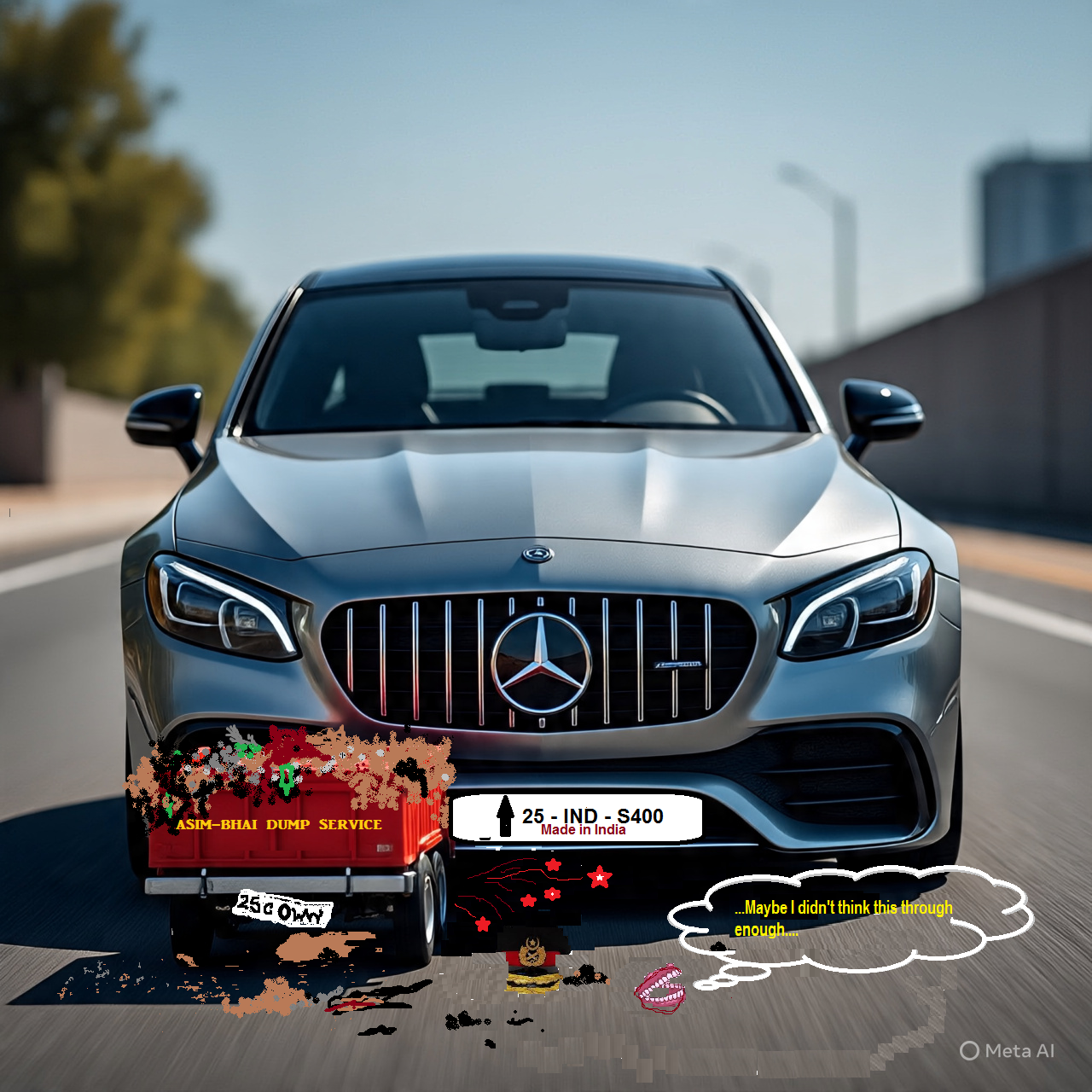
“India is like a shining Mercedes coming on a highway like Ferrari, but we (Pakistan) are a dump truck…If the truck hits the car, who is going to be the loser?”
Trump’s Grump
In destroying the USA-owned N-assets in Nur Khan and Kirana Hills in Pakistan, India has put not only Pakistan but Trump and the USA in a hell of a hot spot—militarily, diplomatically and politically.
There’s the money angle, of course…so important to Trump and his cronies. The USA set up the Nur Khan air base alone for over 550 million dollars—and that was only the capital cost. The annual recurring costs would have been many times that figure. The Kirana Hills N-infrastructure would have cost billions of dollars.
That’s a lot of money, even for a do-numberi builder-don like Donald Trump.
Losing all that money to Indian strikes must be terribly painful to Trump and his Deep State cronies, especially when all those beautiful American assets have been reduced to piles of radioactive rubble underground.
In fact, Trump et al. must be feeling the same pain as Iran did, when Trump’s USAF reduced Iran’s N-complexes in Fordow, Isfahan and Natanz to piles of radioactive rubble underground…
But it’s much more serious than that for Trump and the Americans.
On the one hand, the USA simply cannot ever admit that it owned and ran these N-weapon facilities in Kirana Hills or owned and managed Nur Khan N-strike airbase in Pakistan. Because, to do so would be to admit that the USA had installed N-weapons and N-delivery assets targeted at China in a secret US base located right next to China—in Pakistan, ostensibly, a ‘friendly’ neighbouring country of China!
And THAT would put the USA exactly where the Soviet Union had put itself when it started to establish Soviet N-missile bases very close to the USA, in Cuba, in 1962…bringing all humankind close to thermonuclear incineration before better sense prevailed thanks to John F Kennedy and Nikita Khrushchev…but that’s another story.
On the other hand, the USA cannot hide the evidence of its perfidious ownership and management of the Nur Khan air base or the Kirana Hills N-weapon facilities for long—because not only is all the evidence out there for the world to see, but N-radiation has an inexorable and horrible way of revealing itself in time…however deeply it might be buried
Most important, Pakistan is not going to let the USA escape responsibility and leave Pakistan to bear the fallout—nuclear and figuratively—of the devastated underground N-facility and the remnants of N-warheads lying inside there, and its ruined air bases and related military losses.
Yep folks, Pakistan has really got Trump and the USA by their short and curly N-hairs this time. For a while, at least.
And that’s why Trump toadies up to and ingratiates himself with Munir-bhai and Shabbaz-bhai of Pakistan by the passing day, even as his rage against India intensifies by the passing second and by the midnight tweet.
The USA will never admit any of this: they dare not, for their own reasons.
Pakistan will never admit any of this; they dare not either, for their own reasons.
Pakistan’s Bhagavad Gita Inspiration
A related question arises: why did Pak PM Shehbaz Sharif promote Pak military chief Asim Munir to Field Marshal and felicitate him for ‘defeating India ’ in Operation Sindhoor?
Well…let’s empathize with Shabbaz Sharief on this one. Sharief had no choice but to promote Munir to Field Marshal; because to demote or court-martial Munir— as any other country in the world with a microgram of self-respect would have done after Munir led his military to such a humiliating defeat— would be to admit that Pakistan’s military had suffered defeat at the hands of India’s military.
And that admission simply cannot be made by any Pakistani PM.
As Pakistan’s brief but bloody history shows, such an admission, however truthful it might be, would lead to a speedy and unpleasant end for that Pak PM.
Whatever little poor Shabbaz Sharief understands about anything else in life, he certainly remembers what happened to erstwhile Pak PMs Zulfikar Bhutto and to Benazir Bhutto, even nearly to his own brother Nawaz Sharief….
Pakistan believes its supremacy over India, making ‘peace’ with India an absurd proposition. This belief is non-negotiable; it is, in Pakistan’s collective psyche, so deeply ingrained that it is the God-given Truth.
It is taught in Pakistani schools upwards. It is taught in religious seminaries. It is naturally, understandably, echoed in the Pakistani media, in the civilian and military streets of Pakistan.
That is why Pakistan declares that it won the conflict against India in May 2025; as it has won every earlier conflict with India since 1947.
For Pakistan, eternal victory against India is the Holy Hallowed Truth. However Holey and Hollow that ‘truth’ is.
This is Pakistan’s strength. In a weird and wonderful way (though Munir might not like the analogy), Pakistan is in fact practising a fundamental tenet of Hindu philosophy: a tenet taught by Krishna to Arjuna in the Bhagavad Gita:
You cannot ever be defeated if you believe strongly enough that you haven’t ever been defeated and can’t ever be defeated.
“All that’s very well,” the Patient and Revered Reader might justifiably ask: “But why should this false, hole-ridden Pakistani version of the truth be published as the Truth in the Supreme Court of the World, also popularly known as Western English Media which includes BBC, New York Times, The Washington Post, The Guardian, and affiliated rags?”
The answer to this is best illustrated by the old joke about God and Devil.
Once upon a time there was a long and fruitless argument between God and Devil over which one of them was the greatest.
Finally, an Impartial Mediator (who some say was Brahma’s son Narada on a White Horse, and others say was a direct ancestor of Donald Trump in a White House) proposed that God and Devil should settle the matter once and for all through a game of football.
Naturally, there was great excitement throughout the Universe among the respective fans and followers of Devil and God (the former, of course, far outnumbered the latter). Tickets for the Greatest Ever Football Game were bought and resold at stellar premiums in galactic black markets, astrologers made astronomical fortunes predicting who would win, and lawyers, investment bankers, Congressmen from the USA and India, and other scoundrels staked entire galaxies (which usually they didn’t own) on outcomes like who would score the maximum goals and how many, who would be red-carded first, and so on.
As for God and Devil, they remained busy with their Holy Heavenly duties and Unholy Hellish duties respectively till, on the eve of the Great Game, they met for a friendly cup of Single Malt Soma.
“Listen, old friend,” murmured God, who was actually quite fond of Devil (though he didn’t care too much for Devil’s horned head, red eyes and sulphurous breath), “you’re going to lose the game tomorrow, you know. Just look at my Divine Team! I’ve got guys like Diego Maradona, Johann Cruyff, Didi, Silvio Piola, Lev Yashin, Bobby Moore, and Zoltan Czibor playing for me…and as captain I’ve got Edson Arantes do Nascimento, whom the Universe knows as Pele!” God paused for a breath (creating a hundred million new galaxies in the process), smiled and murmured: “You don’t stand a chance in Hell of winning, O Devil!”
Devil chuckled, and replied: “Ah, dear God, you’ve forgotten that the Referee and the Linesmen are playing for me!”
The Asia Cricket Cup
And lastly (phew, at last), consider the Asia Cricket Cup, September 2025.
Sure, India and Pakistan played each other thrice during the tournament. Sure, India defeated Pakistan all three times, including in the Final.
But guess where the Asia Cup is?
The Asia Cup is NOT with the Indian cricket team. The Cup is not even in India.
The Asia Cricket Cup is in fact in Pakistan, in the grubby hands of one Mohsin Naqvi who is the Chief of the Pakistani Cricket Board, and also works as Pakistan’s Interior Minister when he is not otherwise preoccupied stealing cups, awards and affiliated symbols of victory that belong to other nations.

How come Pakistan and this Mohsin Naqvi fellow snatched the Asia Cup from India after losing the Asia Cup tournament to India?
Well…now we know…
Because Pakistan can never be defeated by India. Pakistan always must win… one way or the other.
Jai Hind!


 Wanderings and Wonderings