Musings, Potshots

Presidential Broad-Caste and our Caste-Ironed Media

The ugly, cruel media brouhaha over who will be the next ‘Dalit’ President of India, Ram Nath Kovind or  Meira Kumar, brings to mind two anecdotes:

  • When Dr. Zakir Husain became the President of India, a journalist asked him – Was it not the victory of secularism in the country that a Muslim had become the President? Dr. Zakir Husain replied – “I would have been very happy if you had not mentioned my religion. It is because of the beauty of our Constitution where every citizen is equal that I have become the president.”
  • A famous pianist accidentally bruised his finger severely minutes before a major performance. Despite his heavily bandaged finger and pain, he insisted on playing as scheduled. The Master of Ceremonies was aghast. Having failed to dissuade the pianist from performing, he sought permission to inform the audience about the accident, and that the maestro would perform nevertheless. “You shall do nothing of the sort!” cried the maestro. “Why, tonight I might perform better than I ever have or ever shall in my life…yet, remembering your words, the people in the hall will shake their heads and look at one another and say: ‘The maestro played quite well tonightalas, if only he hadn’t injured his finger, how much better his performance might have been!’ No, no, I shall play to minds unclouded by irrelevant sympathies for my finger!” And so he did. The performance was brilliant.

Consider, gentle reader, the case of Ram Nath Kovind, nominated for the post of President of India by the ruling NDA government. The entire Indian media sees Kovind as nothing more than a ‘Dalit’; indeed, barring a precious few noble exceptions, our journalists see Kovind’s nomination as being based on this single loathsome argument: by nominating Kovind the Dalit, the BJP-led NDA is assuring itself of Dalit votes in the 2019 Lok Sabha polls.

Worse, the media couches its twisted presentations in the enervating, patronizing gobbledygook of political correctness. One example is an editorial which brightly suggests that there is ‘rich symbolism’ in the prospect of a Dalit president [click here to read]. Such an outlook views every Indian through the narrow, warped lenses of caste, religion, ethnicity, language—lenses that are selected and discarded as per convenience and context to make this or that argument. It is this very vision that fractures Indians into thousands of mutually hostile social groupings; that continues to prevent the Dalit from ever shedding his/her ‘Dalit identity’ (our intellectuals have even coined a term for this: ‘dalitness’); that indeed drove Rohith Vemula, the student from University of Hyderabad,  to take his own life in despair.

When K R Narayanan, and later  APJ Abdul Kalam, assumed the office of President, great swathes of us ‘educated, urbane’ Indians did not, or could not, recognize or celebrate the fact that these were self-made men of humble origins, who were supremely qualified for the highest office because of their humaneness, moral fibre, formidable intellects and scholarly achievements. All we saw was that a ‘Dalit’ and ‘a Muslim’  had become President! And thus we diminished them. …as we now diminish Kovind.

As we now diminish Meira Kumar, nominated by the Opposition against Kovind.

Thus do we diminish, degrade ourselves.

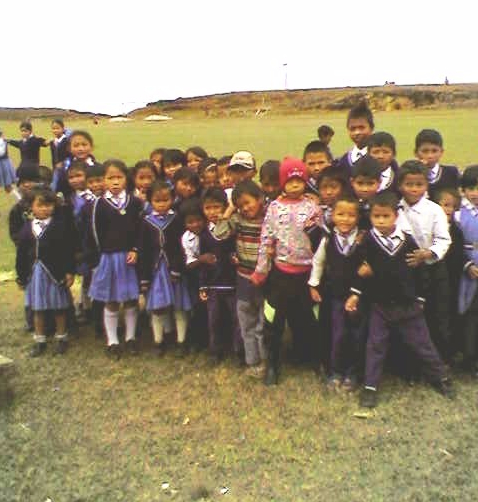
Can you spot the Muslim Hindu Brahmin ST SC OBC
Can you spot the Muslim? the Hindu? the Brahmin? the Dalit?

This narrow-minded vision of humanity has cursed India and its populace for thousands of years; like a long-lived radioactive poison, it has spread across the country, seeped into our educational policies, our political and governance structures, our minds, our deeds. The only cure is incredibly simple: to awaken to, and accept, the simple, scientific truth that beneath our many-hued skins and assumed symbols of religious, caste, and other forms of social exclusivity, we are all simply and equally human. It is a truth that frightens the hell out of the bigots among us, the casteists, communalists, racists. But it brings incredible joy…for we truly then see the One in All, and All in One.

Nothing religious about that, no?


Beastly encounters, Musings, Potshots

A coffee bean’s trauma (or, Nightmare on Dung Street)

Feverish insights into the goodness of dung and the oneness of all living things

Warning

A week or so ago,  a great Indian thinker—the Hon. Mahesh Chandra Sharma, recently retired judge of Rajasthan High Court—provided new and wondrous insights into the Divine Attributes of the Indian Cow [click here to read full report].  We were enthralled, delighted, by his revelations; we were eager to believe.

Alas, many highly ill-reputed intellectuals in India and abroad greeted Hon. Sharma’s revelations with amusement, skepticism, and even scorn. Our belief was shattered.

Was Sharma-jee wrong?

Is the bovine no divine but a mere mortal?

These and other weighty  questions kept us tossing restlessly in bed night after night, till we resolved to seek wise counsel from one of the world’s leaders in bovine research: Dr Pashupalan Moosa, Senior Director at  the Indian Cow Research Institute (ICRI), Gurgaon and  Head of the Product Innovations, Design & Development Labs (PIDDL), located in the sprawling 1400-acre campus of ICRI.

We met Dr Moosa in his spotlessly clean lab-cum-office. He was a curly-haired, bespectacled gentleman of about sixty-five, wearing a white lab coat and the placid expression of the Indian water buffalo. On the wall behind his desk was a fetching portrait of Kamadhenu, the Celestial Cow. Dr Moosa bade us sit and poured out two cups of black coffee from a large percolator. We accepted a cup gratefully and took a sip. The coffee was excellent: just the right warmth, strong yet not bitter, heady in fragrance, with a kind of wild, mossy, moist flavour that evoked the freshness of rain forests.

“We have ten minutes,” Dr Moosa murmured.

“Sir,” we began hesitantly, “the Hon. Mahesh Chandra Sharma has provoked considerable mirth and wrath with his claims that the cow is a divine creature. As a leading expert in bovine sciences, what do you make of his statements?”

“Of course Sharma is right: the cow is divine,” Dr Moosa murmured. “Just as you are divine! As indeed is a tapeworm, an ant, a chicken, a tick, a bacterium, a cuttlefish!” He leaned forward, warming to his theme.  “Listen: all living creatures on Earth are made of the same genetic stuff. Whether we are bacteria or Bactrian camels, conger eels or Congressmen, capuchin monkeys or capitalists, Komodo dragons or communists, giraffes or jihadists, all of us share the same DNA and RNA at the cellular level. We are all, at the core, truly One—whether we like the idea or not. All living things have spawned and evolved in the same great river of the Genetic Code, which some people call God by various names and others simply call names. So why should we exclude the poor bovine from this all-embracing divine realm?”

He was being a tad evasive, of course; but we were so awestruck by the potency of his words and his coffee that we let it pass. “All right, sir…but what about Sharma-jee’s other claims? For instance, he declares that a cow inhales as well as exhales oxygen! What kind of respiration is that, sir? It flies in the face of science!”

“Not at all,” said our colleague gently. “Haven’t you heard of mouth-to-mouth resuscitation?  It works because you can actually exhale part of the oxygen you inhale. So…it’s not only the cow that can inhale and exhale oxygen: we all can!”

“But…Hon. Sharma also quotes some obscure research by some untraceable Russian scientist named Shirovich to claim that a cow’s bellows can kill germs in the vicinity! Surely that’s absurd enough to make a buffalo laugh?”

Our learned colleague chuckled. “Well, first the point about a cow’s bellows killing germs. Here too Sharma is factually correct. It’s the media that’s got the story wrong! The media has misinterpreted the word ‘bellows’ to mean the sound a cow makes with its mouth, and ended up looking at the wrong end of the cow…um…pipe. You see, a cow does not bellow; it moos. By ‘bellows’, Sharma is referring to the simple, age-old mechanical device used for squeezing out gas from a bag at high pressure. Now, it is an established fact that a cow…er… squeezes out more than 60 litres of methane and other gases daily from its stomach bag – a direct result of its grassy, high-protein diet.  Think of it: 60 litres! Forget germs, no living creature can possibly survive such saturation bombardment by the highly aromatic emissions from a cow—not even an elephant that’s lost its sense of smell!” Dr Moosa paused and looked at us keenly. “If you like, I can take you across to PIDDL’s integrated cattle shed complex; you’ll vividly appreciate the point when we’re half-a-kilometre away.”

“There’s no need for that, sir!” we assured him hastily. “But then, what about this Shirovich, the Russian bovine scientist that Hon. Sharma referred to? He’s untraceable! We’ve hunted for Shirovich and his purported work on the Net, in libraries…but to no avail.”

Dr Moosa shook his head sadly. “I have no doubts at all that this Shirovich exists or existed, and that his work is authentic. My guess is that Shirovich must have quietly succumbed to an excess intake of bovine emissions while undertaking some long-term experiment, doubtless in some remote bovine lab in Siberia or the Ural Mountains where his demise went unnoticed. That’s why he is untraceable, poor fellow: a great loss to the scientific world.”  He sighed and refilled our cups with steaming coffee.

We fought off the feeling of unreality that was slowly enveloping us. “There’s also been a lot of unkind comment in social media over other things Hon. Sharma said. Like, he says the cow is a clinic! And he goes on and on about the healing powers of cow urine and cow dung…”

“Of course he’s right!” broke in Dr Moosa.  “You must try and ignore the cackling of the hoi-polloi!”  He paused, reached into a desk drawer, took out a small dark-brown package wrapped in plastic and handed it to us.

“Behold!” he cried. “This is the latest product from the PIDDL stables…er…cattle pens. It’s pure, fresh cow dung, painstakingly collected by my team from cows that have grazed only in the ISO 9001:2008-certified organic pastures of PIDDL. We’ve enriched the dung with vitamins and minerals, added subtle flavours, and given it a catchy brand-name: ‘PIDDL Dung’!” His face was flushed with pride and enthusiasm. “PIDDL-Dung is now being marketed as a breakfast-food supplement in 114 countries, including USA, EU, UAE, Japan and Australia. It’s one of the greatest success stories of the Make in India initiative!”Grazing dream
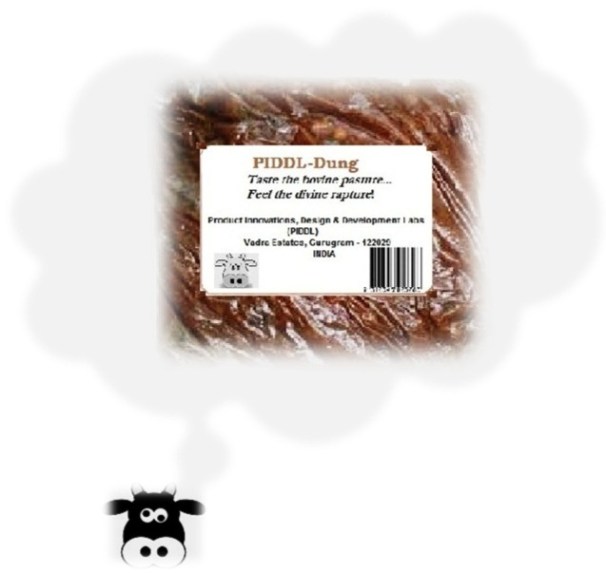
“That’s amazing,” we whispered, holding the PIDDL-Dung package gingerly. “But why is it only being exported? Why aren’t you marketing it in India?”

Dr Moosa smiled tolerantly. “Our marketing team knows what it is doing. Indians will never embrace any traditional Indian product—until the West first embraces it. Now that other countries, particularly the West, have started consuming PIDDL-Dung by the ton, Indians will soon follow in droves!”

We tried to speak but only succeeded in making soft mooing noises.  On the wall, Kamadhenu twitched her tail and gave us an inquiring look.

“PIDDL-Dung comes in six flavours at present,” Dr Moosa went on. “This one’s chocolate-almond; please accept it as a gift!”

“Thanks, but sorry, sir,” we mumbled, placing the package down on the desk. “It’s just a little hard to stomach the idea of eating cow dung…”

Arre bhai!” he cried. “If you can eat sheep’s brains and goat’s gonads, if you can gobble up fish eggs and frog’s legs, if you can wolf down globs of pounded flesh stuffed into bags stitched from pig’s intestines in the name of sausages, why’s it so hard to savour some clean, tasty cow dung? Hahn-jee?”

His logic was irrefutable, yet hard to swallow. “But …but these are animal feces!” we protested feebly.

Dr Moosa relapsed into moody silence.  But after a moment he looked up and smiled. “Did you like the coffee? Would you like some more?”

“So kind of you, sir… the coffee’s really superb. But we’ve taken up enough of your time, thank you.” We rose, nodded at Kamadhenu who nodded back, and shook our host’s hand.  He walked with us to the door.

“This is Kopi Luwak coffee, you know,” he murmured as we reached the door.  “It’s from Indonesia. It’s the most expensive coffee in the world. A kilo costs anything from 1200 dollars to 3000 dollars, that’s two lakh rupees…”

We were stunned. “What’s in that coffee, gold?” we asked.

He chuckled. “No, it’s not gold.  Although curiously, gold is the word used by local Indonesians to describe the animal feces from which they get the coffee beans…”

We clutched the door for support. “What!”

“Yes…you see, the coffee beans are picked out from the feces of the Indonesian palm civet cat. This lovely animal likes eating coffee cherries. The cherries are digested, but the beans stay intact as they pass through the animal’s stomach and intestine. In the process they absorb certain unique flavours, and so when they emerge…”

Dr Moosa broke off and started to laugh at our horrified expression. It was an extraordinary laugh: not quite human, rather a series of shrill, persistent monotonic beeps that grew louder and louder. It was almost like the sound of a morning alarm…

Mercifully, it was.

Musings, Potshots

Desi Valentine

It is the eve of Valentine’s Day! An appropriate time, then, to dust off and (ignoring thy shrieks of despair and protest) inflict upon thee a learned essay I wrote 14 years ago on this ancient Indian festival of love [actually, a ‘middle’ in Times of India on February 6th 2002; still viewable, in garbled form, here]

Lovers can celebrate Valentine’s Day with a whole new fervour!

Recent studies by Indologists reveal that the roots of this festival, celebrated on February 14 each year, can be traced back to ancient India: specifically, to the Harappa civilization. It appears that the name itself is derived from belan din (rolling pin day), an occasion when the young Harappan woman put down her rolling pin and embraced her flower-bearing lover with flour-coated hands. Over the centuries, this name inevitably underwent change. at some stage the word daine (right) was added on, to emphasize the fact that the sensible woman held on to her belan with her right hand just so that her man did not get any funny ideas about decamping with some shameless hussy from Sumeria or Samarkand. The resulting belan daine din in due course became Valentine’s Day in the twisted tongue of the British colonialists.

However, as with all things Indian, this central theme gave rise to an amazing variety of subsidiary myths elsewhere in our country. For instance, in Maharashtra there are reasons to believe that the festival gets its name from the ubiquitous and much-loved bhelpuri. Wonderful indeed are the legends that tell of how, on this day many millennia ago, an ardent young Maratha lad gazed into his beloved’s eyes as she stirred the bhelpuri pot and whispered: bhel ani tumi which of course means “Bhel… and thou!” It was the ultimate expression of love.

The cow belt has a different version. In ancient times this day was an occasion for young men and women to jointly feed the community’s bullocks or bel with mounds of that green and tasteless vegetable known as tinda. How romantic bel tinda day must have been to those young wooers of Uttar Pradesh and Bihar as they stood amidst the snorting beasts and watched them slurp down their victuals by the pail-full.

Bengal puts a totally different spin to the story. Tradition here has it that a beautiful young lass named Bela had to choose her mate on this day from three equally suitable suitors of the Dey clan. The tale ends in typically tragic fashion; unable to choose, Bela becomes a wandering songstress renowned for that immortal ditty to love, Bela teeni dey….

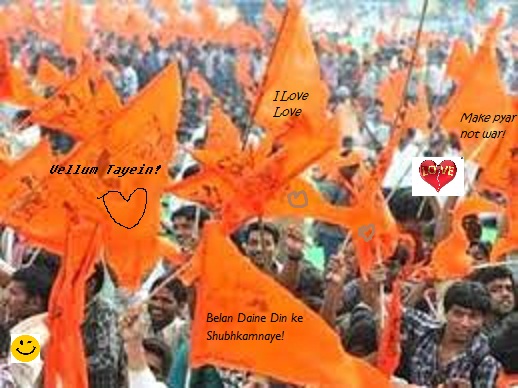
Most relevant to our troubled times, however, is the Tamil Nadu version. On this day, amorous Tamilian teenagers of yore greeted others with sweets and joyous cries of “Vellum tayen!” meaning, ”Give us some sugar!”. Naturally, ignorant Englishmen corrupted ‘tayen‘ to ‘tine’ and the whole thing became Valentine. But wait a minute:  a tine, as we know, is one of those pointed things a fork has; and a fork is but a trident by another name. And who do we associate most commonly with  tridents nowadays? The Bajrang Dal, of course!

Here, then, lies the key to ensuring happy and peaceful Valentine’s Day in the coming years. The Bajrang Dal, recognizing the festival’s intimate connections with the ancient traditions of India, will hereafter join in the Valentine’s Day celebrations, greeting one and all with succulent sweets, serenades and secular hymns…

bajrang-dal-celebrates-belan-daine-din
Bajtrang Dal celebrate Valentine’s Day, 2017

Belan Daine Din ke Shubhkamnaye!

Musings, Verse perverse

Dark speculations on RFPs, Log Frames, and other profanities

[Dedicated to all fellow-spinmeisters in the Development World]


The more one delves into the Project Cycle

The stronger its leek-like reek; as palatable

As being ensconced in a warm, softly lit room

Sippin’ spiced spirits while gazing out at the chilly gloom

And shedding copious tears for the shivering poor without

E’en while raising crystal glass to quivering snout…

Joyously do we journey through forests of Problem Trees

Skinny-dip in Expertise Pools, as we compute our Consultancy Fees

From Global Conferences to Regional Workshops we flit, by jet

To meet, in every Core Committee and Advisory Group, those we just met

Globetrotting arachnids, spinning a web of silken jargon and hype

In which to ensnare, and feed on, suckers of every type

We’ve fabricated a Cage of Fabrications, a Programmatic Framework

In which we fatten ourselves all the more, on those who understand less

Creativity drowned, in a swamp of glutinous verbosity

Spontaneity lost, in Missions of pompous piety

Where did we start this? Why did we at all?

When did we start this slide? Last Tuesday, or last year’s Fall?

It makes no difference: it doesn’t matter at all

It’s enough for us, great Omar’s words to recall…

What without thinking, hither hurries whence?

And, mindlessly, whither hurries hence?

Oh! Another, another cup to drown

The memory of this impertinence!”

All we need do is keep churning out the gobbledygook

By the petabyte and ppt; throwing in a report or book

Outcomes and Outputs, Short-Term Extensions

Mid-Term Reviews, Course Corrections

Just fabricate those Indicators, by hook or by crook

And if some dare raise questions—cock them a snook!


Musings, Potshots

The chortle of the mosquito

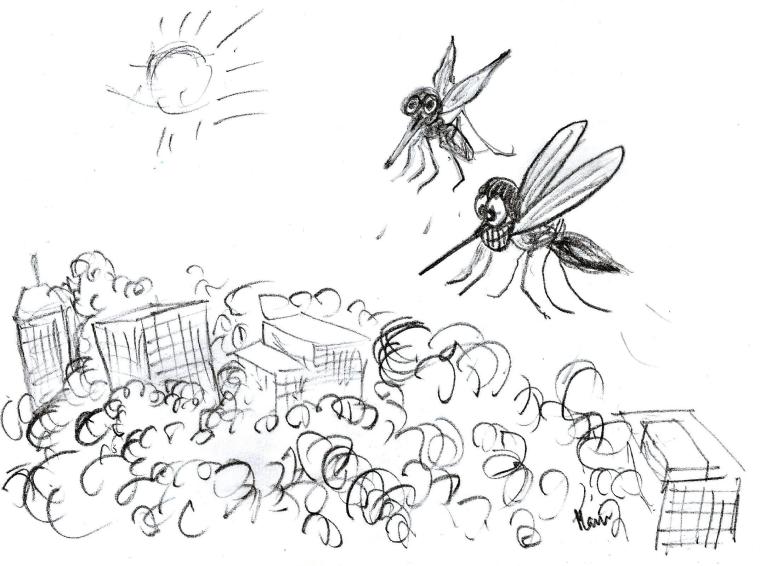
Is Delhi  a gas chamber because of  AAP’s foggy scheme to fog out mosquitoes ?

fogged-out-by-aap
“For years they’ve been trying to fog us out…never knew they’d fog themselves in!”

Even as we gasp for breath in this Hell that passes for our beloved national Capital, a burning question troubles the remnants of the brain: who is responsible for replacing our air with this foggy, reeking cocktail of poisonous gases and microscopic dust particles that clouds the mind and sets the nose and eyes and lungs and throat ablaze?

The Hon. Arvind Kejriwal, our beloved Delhi Chief Minister and Aam Aadmi Party leader, proclaims from the confines of his air-conditioned chambers that the answer to this burning question lies with two groups of anti-social elements:

  • farmers in Uttar Pradesh, Punjab and Haryana, who are burning the post-harvest crop stubble in their fields and blowing the smoke towards Delhi (using some mysterious technology that does not disturb the still air)
  • Delhi residents – most of them supporters of the Narendra Modi-led Union Government – who  lit fireworks on Diwali, 30th October.

Is Kejriwal right? The jury is still out.

Unconfirmed reports suggest that most of Kejriwal’s cabinet colleagues, too, are still out. Out of Delhi, that is; on overseas study tours, to learn from Peru and Macedonia, Nauru and Patagonia, how to better manage Delhi’s environmental and other problems.

In their absence, let’s try figure it out ourselves.

It is a fact that this year, Delhi’s air pollution levels – particularly the levels of the deadly ultra-fine dust (particulate matter) known as PM 2.5 – actually started rising sharply and steadily long before Diwali, from the third week of September onward,  till they were five times or more above safety levels by mid-October [click here to read more]. After spiking on Diwali night (predictably), the PM 2.5 levels fell sharply the next day (again, predictably).

delhi-pollution-exposing-the-lie
From cseindia.org

But the weirdest thing this year is that, since 3rd November – that’s four days after Diwali – the PM 2.5 levels have again risen sharply…and they continue to rise. Scarily. Today (6th November), the PM 2.5 levels in Anand Vihar were 813 micrograms/cu.m. The maximum safe limit is 60 micrograms/cu.m….

What on earth is going on?

The facts are fraught; the numbers numb the senses; yet they together tell a telling tale that would make an Aedes Egyptii mosquito shiver as though it had malaria.

  • The third week of September always marks the end of the monsoon. Which means, after that there’s no more rain to  dissolve or bring down the dust and other muck we spew into the air. Naturally, we can expect air pollution to rise from end-September. And it does…every year.
  • Early October is the time winter starts to set in. With winter’s onset, a layer of cold (denser) air tends to hang above the City – and there’s no breeze to dissipate this cold air layer. So we can expect pollution to climb even higher during this period And it does…every year.
  • According to Delhi Traffic Police, Delhi has 9,634,976 registered vehicles [click here for details] – most all of them are on the City roads every day, burning diesel and petrol and CNG, and belching the hot, noxious gases and particulate products of combustion into the air around us. Naturally the air gets warmer with all these hot emissions…but the warm air can’t break through the heavier layer of cold air above the City.
  • So, we Delhiwallahs are trapped in a bubble of warm air, that’s trapped inside a larger bubble of cold air.
  • Naturally, the more  foul stuff we spew into our bubble of warm air, the fouler our air-bubble is going to get. Yet we’re doing just that, day after day, with our 9,000,000-plus vehicles. And we’re adding 50,000 new vehicles every month to the City! Oh, let’s not  forget to add  the mega-tonnes of toxic dust we spew into our air-bubble every day:  from our garbage-strewn roads, the gargantuan landfills, the mountains of clinker and ash from power plants, the thousands of under-construction flyovers, buildings, Metro projects… aaarrrggghhh!
  • As for Diwali…well, like with so many traditional festivals/observances, Diwali’s date is determined by the lunar calendar. By definition,  Diwali always falls between mid-October and mid-November— precisely when winter is setting in; precisely when pollution has already become awful. Of course Diwali fireworks spew huge amounts of PM 2.5—but they only add to the already-stupendous, ever-growing load of  pollution in the City’s air-bubble.

Given these facts, it’s not very fair, or very intelligent, for Kejriwal and affiliated AAP netas to blame Delhi’s polluted air on farmers in neighbouring states who are burning crop-stubble, or on Diwali fireworks.

By doing so, the AAP is being as fair, and as intelligent, as the US and  other developed countries who blame India and China and other developing countries for causing climate change. (For 200 years  the US et al.  burned humongous amounts of wood and coke and coal and oil  to power their ‘Industrial Revolutions’, filling the earth’s atmosphere with carbon dioxide and other greenhouse gases till we reached the tipping point of irreversible climate change. And now, when China and India et al. are embarking on their own Industrial Revolution, the US and the others rant and rave about how we are  polluting the atmosphere and threatening the future of the earth!)

The harsh truth is, we Delhiwallahs have created the horror we’re breathing. And it’s just going to get worse and worse…until we reduce the number of vehicles on our roads, replace dirty vehicles by cleaner ones, halt the endless construction,  mend our garbage-spewing ways.

Yet, all is not grey and dismal. An unnameable and possibly non-existent IAS officer, recently shunted out by AAP from the Delhi Health Ministry, points out a silver lining in the hideous grey-brown cloud that envelops the Capital. “Cases of dengue and other mosquito-borne diseases have come down drastically in the past month,” he proclaims, in a voice slightly muffled by an N99 mask and No.120 zarda paan.

Great God Google reveals that the officer speaks the truth. Dengue cases have indeed fallen dramatically since the last week of September  [click here to read more].

But wait a minute…the last week of September is precisely  when Delhi’s air quality started to worsen.

It makes us wonder: could this mega-pollution of Delhi’s air actually be  a brilliant scheme by Kejriwal et al. to end the epidemic of dengue and chikungunya that has given the AAP such an AAPalling reputation? Has the AAP government  deliberately ignored the air pollution problem? So that it can get rid  of mosquito-borne diseases by getting rid of the mosquitoes themselves? By fogging the mosquitoes (and in the process, us) to death?

We ran our theory past the IAS officer. His response, delivered from the left corner of his N99 mask, was fluid and swift: a scarlet arc of paan juice that missed us by millimeters. It was followed by a torrent of crimson abuse against the AAP, and ended with an Urdu couplet, slightly modified from Allama Iqbal’s original: a couplet so beautiful and AAPt…er…apt, that we humbly present it here with rough translation:

Raat Machar Ne Keh Diya Mujh Se
Majra Apni Na-Tamami Ka

“Mujh Ko Dete Hain Aik Boond Lahoo
Sila Shab Bhar Ki Tashna Kaami Ka

Aur Ye Be-Wakoof Be-Zehmat
Pe Gya Sub Lahoo Aam Aadmi Ka

 Last night the mosquito related to me
The tale, in full, of her misery:

“They give me only one drop of blood
In return for my full night’s labour

While, without any toil, these asses
Suck the entire blood of the masses!”


Jai hind.

General ravings, Musings

Writhing on Writer’s Block

Writer’s Block is a tough thing to handle.

The symptoms of the dreaded ailment vary in their form and severity.  Currently, I’m in the midst of an attack; from the intensity of the symptoms, I would rate it at about 7.5 on the logarithmic Writher Scale of Writer’s Block. The cranium feels as though it’s filled with a mixture of brick dust, goat’s droppings and fragments of bad memories in stoichiometric proportions, bonded together into a kind of gloopy mass by pressurized chlorine that occasionally emerges from the ears with a muted but high-pitched whistle.

Strangely, no-one else seems to hear the whistle.

From decades of experience, I know that the whistle is in fact nothing more than my Early Warning System, telling me that I must desist from any attempt to write anything at all, or even think in sentences that have more than six words each.

To ignore this warning is to risk a slow, lingering descent into that ghastly hell specially created for writers by the One.  I have tried ignoring the warning, oh yes! I have. And I have suffered agonies, gentle reader, against which would pale into insignificance even the exquisite horrors of watching and hearing  Barkha Dutt, Arnab Goswami and Rajdeep Sardesai  in seriatim non-stop for 72 hours.

To try and overcome Writer’s Block by brute force is to risk entering a nightmarish, torturous eternity sans creativity.

I call it the Aiyo Aeon.

In Aiyo Aeon
The Ecstasy of the Aiyo Aeon

Usually, what I do at such times is what Vyasa, Milton, Shakespeare, Wodehouse, O Henry and the rest of them doubtless did: I engage in innocuous activities.

Like, I weed flower-pots. At an earlier, more innocent age, I would have smoked weed – or pot – while weeding flower-pots.

Or, I sort out the piles of paper,  books and affiliated trash that usually cover most all the furniture in the house.

Or I walk. I stroll around the house, the colony, the park. On occasion, I attempt crawling up assorted walls.

I go buy vegetables and fruit. I come home and wash them, dry them, store them away in fridge.  I clean out the fridge; the loos; the window shutters.  The terrace. The wallet.

I stare sightlessly at walls, ceilings, clouds, treetops, TV screen (on or off). Or I go to the library and stare sightlessly at books on shelves, or pages of magazines and journals, or at the other members sitting and staring sightlessly at me or at the walls or their books and things.

Or I listen to music. Play the guitar, drum on the dining table (the acoustics are specially good on its  wood) or on chairs, occasional tables, glazed clay pots, kitchen counter, steel utensils, passing neighbour’s dog (meaning the dog is passing, not the neighbor; the acoustics of the dog’s ribs are pretty good too).

Sometimes I sing while playing music. I make faces at the mynahs, bulbuls and squirrels that gather at the windows and heckle me when I sing. The crows, credit to them, never heckle me; they only listen in rapt attention; perhaps my voice reminds them of some long-lost relative.

And if all this fails, if and only if I’ve tried every other possible option to no avail…only then do I dare try the most dangerous method to overcome the dreaded barrier of Writer’s Block.

I take pen and paper, or I sit at the desktop.  I draw a deep breath or seven, put down a question, and then attempt to answer the question in not less than 10 words, within an hour.

It is a strenuous task indeed. To quote the great 11th century Roman poet Ibn Muralidhara Digestus, it is as strenuous as overcoming a two-month-long constipation. Even when successful, it usually yields about as interesting end-results, to misquote Steinbeck entirely out of context.

For instance, the following profoundly philosophical question kept me tossing restlessly all night.

Q: At what levels of molecular complexity do social constructs and practices like casteism, racism and fanaticism manifest in Reality?

Today morning, I tried to calm the feverish remnants of my mind and discern the answer by cooking baby potatoes.

It was no use.  The net outcome of my frenzied cerebral processes was amorphous, dry and indigestible; as indeed were the baby potatoes.

However, even as I washed way the cindered remains of the little tubers down the tube, the answer dawned on me—like the welcome glow of light one sees at the end of a long dark tunnel, which upon closer inspection reveals itself to be the headlamp of a diesel  locomotive bearing down upon one at 160 kilometers per hour. The impact was equally powerful; I tottered and clutched the draining board next to the kitchen sink for support, ignoring the three plates, seven spoons, cast-iron kadai and steel davara that I dislodged; ignoring even the sharp pain as the kadai glanced off my right knee, bounced and finally came to a quivering stop on top of my left pinky toe.

Social constructs and practices like casteism, racism and fanaticism do not manifest at atomic, molecular or even macro-molecular level.  They are Unreal.

There are no Brahmin neutrons or Dalit protons, no Hindu gamma rays or Muslim alpha particles, no Aryan DNA or Australo-Dravidian RNA, no White or Black or Brown or Yellow blood groups.

Social constructs and practices like racism, casteism, religious fanaticism, and the rest are insubstantial. They are as meaningless as last week’s dream.  The very terms used to define them are mere bromides to dull the senses; gobbledygook to explain away the senseless, often cruel, thoughts and impulses and deeds of humans who, in greed and ignorance and stupidity, seek to enslave others.

We need to get back to basics! To Science, the True Faith!

Alas, we can’t expect today’s bunch of political leaders or religious teachers to show the Way. Not even today’s scientists. Because, in the century-and-two-decades that have elapsed since J J Thomson discovered the electron, the world’s scientists have not only burrowed deeper and deeper into the Tree of Knowledge, losing sight of the Forest in the process; they’ve gone and drunk up all the Tree Sap, and in their inebriated state started gnawing at the Pith…thereby forgetting even the last concept of the Tree, which now totters on its frail roots.

Yet, the Tree stands. And its seeds are hardy.

We are the seeds. We can find the Way ourselves; we can shrug off the grey despair that we feel with every morning’s newspaper headlines, every TV news bulletin.  We can shrug off the veils of gloom in a trice and see that all humankind, indeed, all Life, the Universe, is One.  And that nothing can ever threaten the One.

Not even Writer’s Block.

Consider the following facts, gentle reader:

  • All Reality is – seemingly – made of Energy and Matter.
  • Matter is no more than a kind of dynamic, crystalline form of Energy; so ultimately, all Reality is pure Energy.
  • We, that call ourselves humans and spend this illusion called Time pondering the nature of Reality while not cindering baby potatoes, are ourselves made from Matter; we therefore are mere manifestations of Energy. As is all Reality.
  • When we sit and observe Reality, then, it’s nothing more (or less) than Energy observing Energy.
  • Therefore, Matter doesn’t matter at all.
  • Nor does Energy, for that matter.

Do I understand any of this crap? Does it make the slightest sense? That’s immaterial; it hardly matters.

All that matters is, my Writer’s Block, on which I have writhed for six weeks, has gone.

May the One illumine our minds, O unsuspecting readers…if there remain any.

Readers, I mean.


Musings, Potshots

Behold! The Banyan in the Lotus

A shady analogy for a shady party?

Prime Minister Narendra Modi said a curious thing on 20th March 2016, while addressing the BJP National Executive . [click here to read the full report on what Modi said that day].

Modi called on his party members and workers to view the BJP party like a ‘big banyan tree that provides shade to all kinds of people

It’s a curious analogy: the BJP as a banyan tree?

Banyan Lotus TreeNow, before going further, it’s important for me to state right away that as a true Nationalistic and Patriotic Indian I have nothing but love for all banyan trees, irrespective of their class, caste, religion or race. I am aware that the banyan is the National Tree of India. It is a place of honour well deserved, and derived primarily from the banyan’s profusion across the country, its robustness and ability to thrive in rugged soils and survive hard climes, and its sheer awe-inspiring size and capacity to provide shade to huge numbers of people at a time.

This disclaimer re. the National Tree is important in this day and age, when everyone, from professional politicians to professors professing politics, is obsessing at shriek-level on main-scream media over the profound question of what one can, cannot, or need not say to prove that one is Nationalistic and Patriotic.

But still, I think it’s curious to liken the banyan to the BJP, a political party.

For one, it’s common knowledge that the banyan allows nothing else to grow in its shade; not even a blade of grass. The only thing that grows beneath a banyan is the banyan itself; for, as it grows, the banyan puts innumerable aerial roots down, and in time these roots themselves grow thick as trunks…and so a single banyan extends itself laterally, often covering many thousands of square metres in area.   And nothing else grows in that area.

Besides, the banyan bears no fruit – at least, none that we humans can eat. It also has a well-known propensity to attach itself to a host tree and grow around it till it eventually strangles the host – for which reason the banyan is also called the ‘strangler fig’.

And it is precisely because of these characteristics of the banyan that ancient Indian tradition – over which, curiously enough, the BJP claims sole copyright – while venerating the banyan tree or Vata Vriksha,  also associates the banyan tree with unfriendly spirits and ghosts…and with  Yama, the God of Death.

Actually, on reflection, Modi’s analogy might fit the BJP well.

In fact, the analogy might fit not only the BJP but all our political parties – Left, Right and Congress – to a tee.

Or rather, to a banian, if not a banyan.

Jai Hind! Jai Banyan!