Beastly encounters, General ravings, Musings

Anopheles Dream: an exploration into the Nature of Reality

I’m not sure what philosophy is.

It’s such a heavy, intimidating word: like ‘intellectual’.

I’ve read a few people who are called ‘philosophers’ – Russell, Thoreau, Camus, Huxley, Gandhi, Sartre, Vivekananda come to mind (and leave the mind as quickly as they come). I’ve found them really interesting and absorbing to read because…well…they are common-sensey in a kind of deeper way. They don’t use long, hard-to-understand words like ‘philosophy’. They talk about the simplest, most common day-to-day things: people, situations, events and feelings and emotions that you and I and everyone else feel and experience. But they delve so deep into these things they talk about that very soon you find you’re looking at and experiencing just about every possible thing in the universe.

Right now I sit here, muttering and stuck for ideas as I always am, while Tangerine Dream’s moody notes beat on my tympani and gently stir the frail wings of the mosquito that sits on the wall across the room, relaxing and soothing our respective muscles and joints and nerves jointly and severally in gentle, soporific and sonorous waves.

I stare at the mosquito. It stares back at me.

I drink, therefore I am…

I shift my stare to the white rectangle of a blank Word document. It too stares blankly back at me.

After profound thought, I decide to undertake a philosophical Exploration of Reality.

I touch the ‘Enter’ key.

Now.

I feel, I felt, the Enter key!  It felt hard but not too hard. As I pressed it down, I heard a slight, soft click. I released the pressure of my finger; the key sprung back. And even as I went through these steps, in a fraction of a second, I saw the blinking vertical line of the cursor dart down the white virtual page on the screen.  I felt, I heard, I saw.

All these things I understand well! I know what these senses are, of touch, sight, of hearing. As I do the sense of smell, of taste.

I am aware.

I know the shapes and hues of the hills and forests, the houses where I lived in childhood, the expressions on people’s faces; I can feel winter sun’s warmth, a neem tree’s cool shade, a caress, the slap of an affectionate cat; I know and can recall the taste of mango and rum, of keema and sambar; the sighs of pine trees and tired people in a queue, the howls of lonely puppies and unseated politicians. I know the smells of coffee, of freshly peeled oranges, of grass growing in a Himalayan meadow and smouldering in a chillum, of Mumbai in the monsoon and crowded Metro trains in Delhi.  I know the sights, sounds, smells, tastes, feels of the millions of things, living and non-living, small and big, that I have ever encountered in my long and misspent life and that have influenced me, shaped me, made me what I am.

But now I ask myself: are these sensory phenomena and their vasanas—their impacts on the sense organs by which I perceive them—really ‘real’? Do these phenomena actually have an absolute, immutable, non-relativistic quality about them? Do their characteristics transcend space-time, are they perceived the same way by others, human and non-human, irrespective of frame of reference?

Do bacteria shiver in winter the way I do? Are goats and dust-mites moved by music as I am?

‘Of course not!’ shrieks the Voice of Rationality in my skull. Pressed for evidence to the contrary or in favour, however, the Voice of Rationality subsides into muttering curse-words like an aggressive Delhi driver who’s not been allowed to overtake on the wrong side.

The Voice of Rationality, too, has no answer.

Ha.

If, then, a cloud of uncertainty hangs over the reality or unreality of the animate and inanimate things that impinge on my senses and enables me to sense them….what of my senses themselves? Are these senses with which I perceive the Reality around me false? These senses that have helped me define and delineate and categorize and sort and arrange and play around with the objects – living and non-living – that have surrounded me from birth, and indeed enabled me to create my version of Reality; are these senses ‘unfixed’, variable, entirely subjective, and therefore unreal?

‘Of course not!’ comes a feeble croak from the Voice of Rationality. ‘Because if indeed our senses are unreal, non-Absolute, then what you and I and everyone else’s devar and mausee and periappa think of as Reality is in fact Unreal. Illusion.

Ha!

In that case, I press on triumphantly, what I think of as Reality is real only to me –  this world of shapes, of objects living and non-living and their interactions with me and with one another, their patterns of behaviour – are quite unique to me, and me alone.

I, I alone AM.

Kazhudai vishtaham,whispers the mosquito on the wall. It has covertly been listening to my thoughts.

It is, I realize with a start, a Tamil-Sanskrit scholar whose ancestors date back to the Sangam era.

“Donkey’s droppings,” the mosquito translates helpfully, and takes flight.

I am chagrined, deflated. I am also bitten several times by the mosquito.

As I mentioned earlier before I rudely interrupted myself: philosophy and I don’t get along.
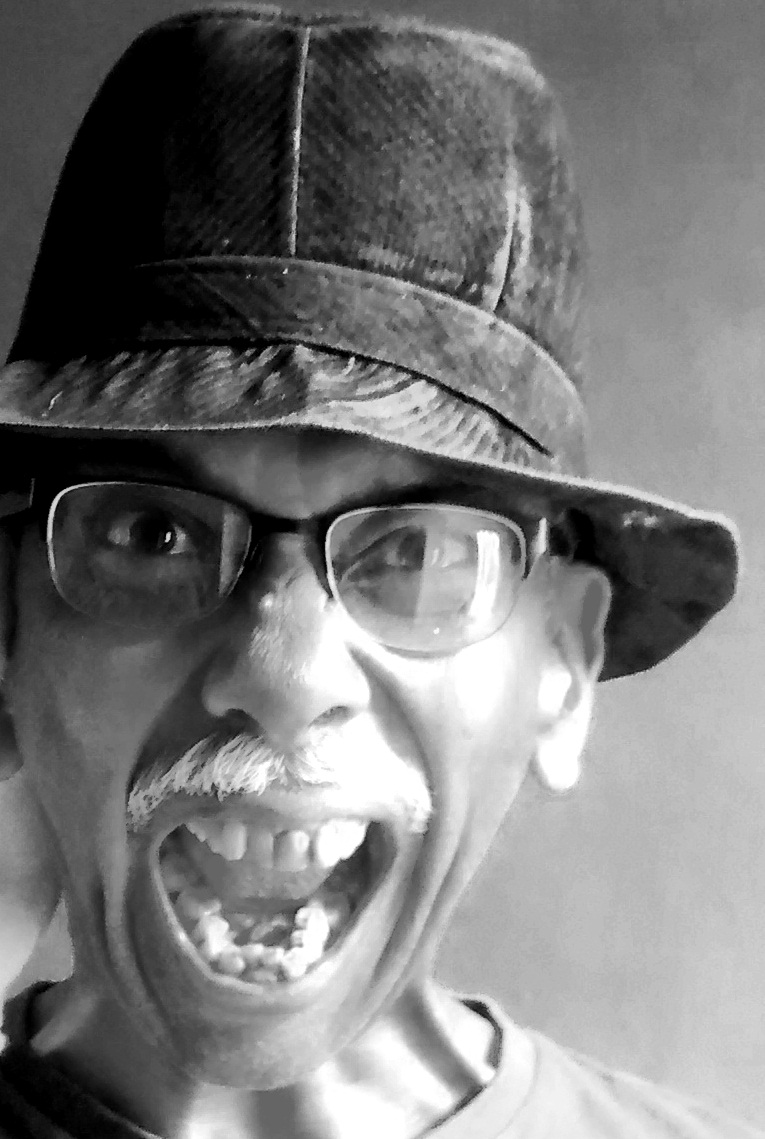
My moment of enlightenment (mosquito can be seen near right ear)

I find solace in Odomos, and in the fact that physicist Richard Feynman didn’t like philosophy too much either: he found it boring, pointless, filled with long, complicated words and explanations that didn’t seem to mean anything.

Feynman’s supposed to have said: “Philosophy is about as useful to scientists as ornithology is to birds”.

By his own admission, Feynman took an unholy delight in replying, in the most philosophical manner, to the too-clever-by-half questions framed by people who want to appear extremely profound and deep.

An example—Feynman’s reply to a question from the audience, at the end of a lecture he had given on the properties of light:

Q: When you look at something, do you see only light or do you see the object?

Feynman: The question of whether or not when you see something, you see only the light or the thing you’re looking at, is one of those dopey philosophical things that an ordinary person has no difficulty with. Even the most profound philosopher who’s sitting eating his dinner, hasn’t any difficulty in making out that what he’s looking at perhaps might only be the light from the steak, but it still implies the existence of the steak which he’s able to lift by his fork to his mouth. The philosophers who are unable to make that analysis and that idea have fallen by the wayside through hunger!

Hail Feynman, hail the great philosophers of MAD Magazine and other immortal epics.

General ravings, Musings, Potshots

Infernal principles for Internal Security

Now that a new BJP-led Union government has been sworn in amid much swearing by Congress-led Opposition leaders,  the time is ripe for all Indian citizens to play a role in helping the government chart a course for our nation over the next five years. In this spirit, and sans any influence of ethylated spirits, we humbly offer the following guidelines that we hope will help the government in protecting our notional national interest.

General ravings, Musings

Holland: Remembering Eternity…

It’s 43° C in the shade here in Delhi, with a scalding hot wind ripping the  leaves off trees and propelling kilograms of nano-sized dust particles through the tiniest cracks and crevices in the doors and windows to fill the room where I sit, listening to the air cooler roaring in futile rage, eating juicy chunks of chilled watermelon in between keystrokes and cheering myself with visions of my not-so-favourite netas roaming the streets and campaigning for votes in this infernal weather.

Indeed, there is Dharma in this world.

Delhi’s incendiary summer is a good time to remember the crisp chill of Holland’s winter. I visited Holland in December-January; a dreamy, timeless three weeks during which I re-learned the sublime and long-forgotten art of simply being. Base camp was my friend Udai’s apartment in Delft –  it’s the prettiest little town I’ve ever been in. Delft is young by Indian standards (it’s only 600 years old) but its history is linked closely—oh so closely— to the history of India, indeed of the whole world.  There was so much to see, to experience, to learn…not only in Delft but in Leiden, Rotterdam, The Hague … no, it’s impossible to find words to describe it all, I don’t know where to start, so  I won’t even try – at least not now.

Right now I’m just going to place a few photos of Delft, from here and there. Like this…

I did miss two things, briefly but deeply, in Holland.

One was seeing tulips carpeting the earth out in the countryside like in the photos I’ve seen. Winter is off-season for tulips. So, I plan visiting Holland again, in April/May 2020.

Yayy.

The other thing I missed is actually a person: a friend, the first Dutchman I ever met, I’ll call him Helm, for it wouldn’t be fair for me to use his real name without asking him, and sadly I can’t do that now because Helm and I’ve lost touch since we last met in Shillong in the mid-1970s. I was then pursuing an elusive college degree in Shillong, invigorated in my chase by the healing vapours of garden-fresh cannabis and affiliated psychoactive substances. Helm was a visitor to Shillong from Calcutta, over three successive years, each time just for a fortnight or so. He was a Masters student (of Comparative Religions, if memory serves right) at the Viswa Bharati University, Santiniketan (Calcutta); a few years older than I, tall, broad, strong, golden-haired, ruddy-faced, always clad in white kurta-pajama and clogs. Helm was learned, earnest, serene, yet with a ready smile and a huge laugh that could shake the dust and woodlice off the  rafters. Helm lugged his classical guitar along wherever we wandered—exploring the hills and rills, meadows and forests, taverns and caverns—and when the heady ganja and mellow kyat had soothed the spirits sufficiently and the comfortable silences had settled, he would pull out the guitar and pluck and strum beautiful melodies and belt out folk  songs – Dutch, sometimes English – in a powerful baritone. He even taught me one Dutch song: I only remember the tune now, the lyrics are long forgotten.

I learned much from Helm: about the beauty of all religions and the horrors inflicted across the world in the names of gods and prophets, about humanism, tolerance, the need to remain curious as a child throughout life, how travel can open minds. Helm didn’t educate me on the tulips of Holland, but he taught me a far more valuable life-skill, one that is deeply rooted in India’s glorious heritage and culture—the refined art of making the purest charas (hashish) from the cannabis plants that grow in such profusion in the meadows of Meghalaya. It was a primary objective of his annual pilgrimage to Shillong, to manufacture sufficient stocks of charas to keep him going in Calcutta till the winter break when he went home to Holland.  Thanks to Helm, I and a few friends drastically cut down our ganja-smoking; we switched to charas.

Wherever you are, Helm of Holland, may peace be with you. It was wonderful visiting your beautiful, eternal country: I remembered you, briefly but deeply, when there.  Who knows, the One willing, perhaps we shall meet again someday, in this life or in another, in some timeless rolling meadow filled with music and laughter and companionship and comfortable silences and mounds of stroopwaffel and the divine fragrances of tulips and mellow wine and ripening ganja plants in the sunshine…


General ravings, Potshots

Political A-SAT and SAT

ASAT
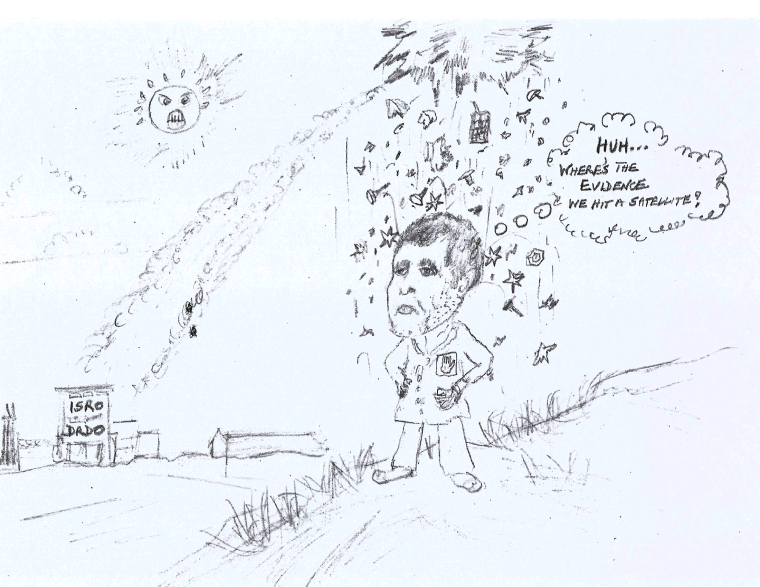
Stellar vision?

Ever since India successfully conducted its anti-satellite (A-SAT) missile test, our crass netas have given political twists to the event that would make a boa constrictor straighten in envy. Considering the kinds of comments that they and their acolytes are making, and with Lok Sabha polls looming over the horizon, we, the wee people, have good reasons to worry about whether our newly elected MPs will even understand, let alone be capable of handling, critical strategic issues such as space technologies, missile defense, nuclear deterrence and the like.

But there is hope! Unconfirmed and officially disavowed sources reveal that the Lok Sabha Secretariat is alive to the challenge, and is preparing a series of small booklets on science and technology for the enlightenment of our newly-elected MPs.

Here are a few sample definitions leaked from the draft Lok Sabha booklet on ‘Aerospace Science for MPs’:

 Satellite: This is simply another name for party follower or chamcha. Satellites can be of two common kinds:

  • ‘Polar’ or ‘Poll-ar’ satellites are rather unstable, and remain loyal only so long as their leader has a chance of winning in polls.
  • ‘Jio-synchronous’ satellites, also known as ‘Jio-stationary’ satellites, are more stable and loyal, because they are held securely to their leader/party by the attractive gravitational forces of G, 2G or even 4G.

Space Debris: The countless pieces of metal, plastic, composites and affiliated junk that are now orbiting the earth, and that have resulted from the break-up of old satellites launched by different countries during the last 50 years. About 97.9% of all the space debris is ‘clean’ debris, because it comes from NASA satellites sent up by USA. The remaining 2.1% of the debris is ‘dirty’ debris because it comes from Indian and Chinese satellites.

Escape velocity: The very high velocity with which politically connected fraudsters and affiliated crooks escape from India to other countries when a new government takes over in Delhi. ‘Relativistic’ velocity (also known as ‘Maxis’ or maximum velocity) is the highest attainable escape velocity, usually achieved only by crooks who are close relatives of political leaders.

Global positioning system (GPS): A wonderful technology that helps government to keep track of the escaped crooks, and guide them to safe havens when necessary.

Inertia: Describes the tendency of a government to remain forever in a state of supreme inactivity; or if roused into motion (usually by sting operation), to continue moving aimlessly along a fixed path to nowhere until halted by the ‘fictional’ force of Opposition.

Launch window: The auspicious interval of time for a new politician to launch her/his political career by filing nomination papers for Lok Sabha or assembly elections.  Launch window is determined by specialists in astral science called ‘astronauts’. The term astronaut itself is derived from the ancient Sanskrit: astra-nath—‘one who rules over stars’ (Ref: Goru Gauswamy et al., 4300 BCE. Space Explorations. Muttal Press: Takshashila).

Re-entry vehicle: Pathway for political deserters to return to their parent (or grandparent) party. As re-entry usually generates intense heat from party rivals, re-entering politicians require rings of protective coating. Hence, the re-entering politicians are popularly called ‘turncoats’.

Star wars:Spectacular electoral battles waged between stars affiliated to Bollywood, Mollywood, Tollywood and other non-Dawood studios. If firearms such as Shotguns are used by the star-candidates during poll campaigns, we call them ‘shooting stars’. Sometimes, the winning stars are given Cabinet portfolios, in which case we call them ‘acting ministers’ if they turn up for work; or else, ‘deadwood’.

Warhead: An especially strident jingoist, usually seen on TV talking-head shows calling for nuclear attack on neighbouring nations, political opponents, and occasionally, neighbouring panelists.

Jai hind!


General ravings

Surviving the Indian Railways: perfecting the Pajama Hop

 Guidelines for Indian Railway travellers on how to change into pajamas at 130 kmph

Some years ago, O gentle and hapless reader, I’d drawn up a set of guidelines for the intrepid male Indian Railway traveller, on the fine art of shaving on express trains without performing involuntary self-circumcision or castration.  [Click here to view]

Now, bowing to widespread demands from orthopaedists, podiatrists and orthodontists who wish to remain anonymous, and ignoring thy vociferous protestations, I present a similar set of guidelines on how to change safely into pajamas during overnight train journeys…a process that is normally, and in the interests of public decency, undertaken in the toilet. For the sake of simplicity and brevity, these guidelines too are directed at male travellers: however, they can be adopted, with slight adaptations as needed, by travellers of all genders.

1 – Enter toilet with pajamas securely wrapped around neck, or tucked into waistband of trousers. Bolt door.

2- Carefully open up pajamas and tie them by the string (naada) to the clothes-hook behind the door. Use a good, strong knot like a square knot or clove hitch (you may click here to learn how to tie these knots and/or tie yourself in knots). Note: do not simply hang the pajamas from the hook, because the slightest jerk of the train will dislodge them on to the yucky floor.

3- Roll up both* trouser legs to at least 6 inches above the ankles (*if three-legged or more-legged,  roll up all trouser legs). This will protect your trousers from the swirling muck on the floor, and also make removal of the trousers easier.

4- Remove trousers, step by step and leg by leg as outlined in (a) to (d) below. [Warning: This entire process demands patience, extraordinary courage and lightning reflexes, to counter the violent lateral movements of the speeding train and to guard you against the perils of falling headlong into the W.C., and/or injuring various limbs, bones, joints and appendages]

(a) Lift right leg and use left hand to clutch on to clothes-hook or pajamas tied to hook, in the absence of any alternative dependable object to clutch. Note: do not attempt to clutch edge of washbasin, W.C. chain or pipes, for these may suddenly disengage from wall, plunging you into W.C. Also, do not clutch tap of washbasin, as the tap might open, soaking you head to foot in spray of water that adds to slush on floor and undoes all the gains of Swacch Bharat Mission.

(b) Balancing on left leg and lengthening the spine, take several deep breaths (depending on freshness of air) and then slowly and cautiously draw off trousers from right leg, using your right hand. Be alert against losing balance and lunging head-first into wash basin, wall or W.C.

(c) Clamp your teeth firmly around the rolled-up bottom of removed (right) trouser leg. Lower right leg to floor. Carefully replace the left-handed grip on clothes-hook with right-handed grip. Then, breathing shallowly through the trouser-leg clenched in teeth, lift your left leg and draw off the trousers from that leg, using your left hand.

(d) Open jaws and grab at the falling (right) trouser leg with left hand. Ensure that you have not inadvertently pulled off underwear along with the trousers (a chill draft in the nether regions is a sure indicator of this unfortunate situation – in which case, you may retrace earlier steps and start afresh).

5- Sling trousers over the right shoulder, taking care that you do not sling them into W.C. or allow any dangling portion of trousers or self to touch the inundated floor. Regain balance and composure by taking several deep breaths (if possible).

6- Untie pajamas from clothes-hook. The process of undoing the good knot(s) you tied earlier requires you to use both hands and possibly your teeth as well; hence, extreme care is advised.

7- Sling pajamas over left shoulder (taking same precautions as you did with trousers on right shoulder). Now, remove trousers from right shoulder and secure trousers to the clothes-hook by belt-loops, or fly zipper if loops are not strong enough.

8- Roll up both pajama legs to half their lengths. Then, lean against door for support, and with pajamas pressed against the left hip, execute a series of small, kangaroo-like hops till you succeed in slipping your right foot into right pajama leg. Note: All too often, the hasty traveller inadvertently slips right foot into left pajama leg, setting off a catastrophic sequence of agonized leaps that invariably ends in strained muscles, sprained joints and worst of all, ruined pajamas. [Tip: use fluorescent marker pen to mark right and left legs of pajamas before-hand (rather, before-leg)]

9- In similar fashion, slip your left foot into left pajama leg.

10- Lean away from door, and standing upright, use both hands to pull up pajamas and knot them around waist. This penultimate step is also the most dangerous, as with both your hands occupied in tying the pajama knot, chances of diving into the W.C at various angles are maximum.

11- Remove trousers from clothes-hook. Clutch hair in agony as you see your cellphone drop from the trouser pocket into the W.C. Pull chain, open door and exit.


General ravings, Musings

Jai Vijaye Bhava,T M Krishna!

The other evening – 17th of November it was – I went with a couple of friends and heard T M Krishna sing at the Garden of Five Senses, Delhi.

It was great!

Krishna was in fine voice; a voice I’d heard only a couple of times earlier, rendering Thyagaraja krithis as smoothly as folk songs. Oh, and also singing in a short but powerful campaign video against Unilever for dumping toxic chemicals and endangering the people and ecology of Kodaikanal (click here to see it)

That’s all I knew of Krishna till around the 14th of November; that he was a great musician, innovative, that he sang for good causes.

And then this great big thing blew up in our faces, amplified to megaton levels by media: that Airports Authority of India  and Spic-Macay had abruptly cancelled a scheduled concert on 17th November featuring Krishna, among other artistes. AAI gave no reasons for the cancellation; but I understood, from editorials print and online, that Krishna was regarded by BJP sympathizers – and therefore, the Central Government, and by inference, AAI too— as ‘anti-Hindu’ and ‘anti-Indian culture’, all because he, Krishna, conveyed pithy political and social messages through his songs. I also heard and read that Krishna had been cruelly trolled by ‘right-wing Hindutva’ nuts.

All this I found profoundly disheartening, disturbing, disgusting.  I hoped, over those two days that followed, for some strong reaction from the Central Government, from AAI…but there was only stony silence.

And so, when Delhi’s AAP government announced that it would host a performance by Krishna on the 17th, I decided I must attend. Not to convey some glorious ‘secular message’ or make a ‘political statement’ or anything pretentious as that, but to simply hear Krishna, a musician who just wanted to sing from his heart about things he felt strongly about… and had been cruelly treated for wanting to do that.

Given the circumstances, I was a little worried about the event becoming more a political jamboree than a music concert. But credit to AAP leaders Kejriwal and Sisodia, not only did they arrive only about 20 minutes late, which is incredibly early by Delhi standards, but their bhashans were mercifully brief and non-incendiary. Krishna himself was all dignity: he murmured that he was there not to speak but to sing…and so he did: wonderfully, passionately, movingly.

Now, clacking out these words, I wonder: why must we taint everything in our lives that brings joy, with the corrosive acid of divisive politics?

My music or writing or theatre, my art, my rendering of what I think of as art, might not be to your liking, and vice versa; but surely we can each find the art we like and peacefully enjoy it without having to mock, disfigure, destroy others’ likes, others’ art? Without hurting others?

Just as you, gentle reader, might hold the view that I can’t write for nuts (doubtless with great justification). But that shouldn’t drive us – and our fans, our acolytes, assuming we have any – at each others’ throats?

Like:  I never liked M F Hussain’s paintings. M F Hussain, in my view, couldn’t paint for nuts. I have said so to friends who like M F Hussain’s paintings. It hasn’t affected our friendship.

I remember even writing so once (in Indian Express, in a letter): in the late 1990s, a time when, weirdly, it had become the politically correct thing to like M F Hussain, and you risked being branded ‘Hindu communalist’ or ‘fascist’ if you said you didn’t like Hussain. Well, I wrote I didn’t like M F Hussain’s work, not because his work offended my religious or cultural sensibilities but because his work offended my artistic sensibilities. But (I added) that didn’t mean I had the right to burn his paintings or run the man out of the country.

You, I, anyone at all, can take on T M Krishna fair and square, one-on-one, for his political views, such as they are…just as Krishna has the right to take on any of us fair and square for our political views, such as ours are.

But when Krishna the musician is invited to present his music, we must welcome him and respect him as musician.

I have heard Krishna, I love his music, I admire his politics. But that’s my opinion; you can think differently, it’s okay.

But none of us, none of us can allow a government institution like AAI to judge  an artiste, any artiste, by his or her perceived ‘politics’.

It is terrible, the way AAI has capitulated before a gang of nameless, faceless e-thugs whose claim to represent ‘Hinduism’ or ‘Indian culture’  is as well-founded as Lashkar e Toiba’s claim to represent ‘Islam’ or ‘Islamic culture’.

It is good that Delhi’s AAP government gave Krishna a chance to play at the Garden of Five Senses…and us the chance to hear him.

As of today, 19th November 2018, I am a votary of AAP.

But I shall watch AAP’s future activities with considerable interest before taking the call at the next polls. Knowing our politicians, be they from Left, Right or virtually non-existent Centre, chances are high that the AAP will commit some colossal balls-up ere long…

That’s why we need you, T M Krishna! Jai Vijaye Bhava! Jai Hind.

General ravings, Musings

A road forgotten…a road remembered

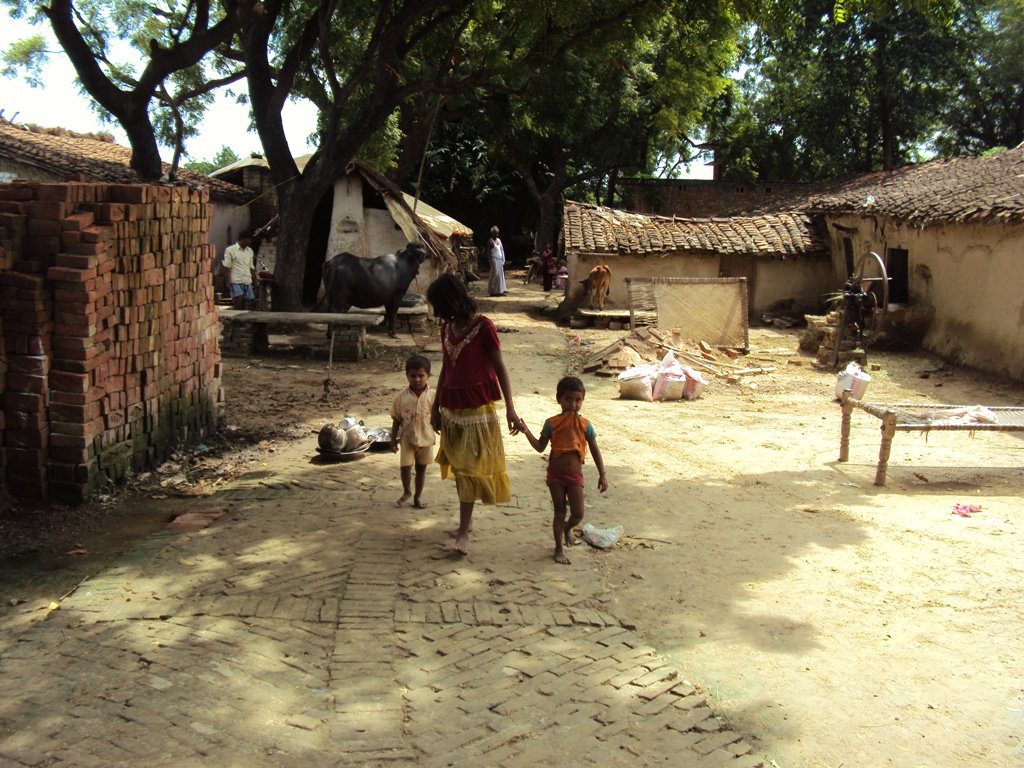
Wandering through some long-forgotten folders, I came across a few ancient F-class photos from late September 2008, when I travelled for a few days in eastern Uttar Pradesh, visiting villages in Allahabad and Pratapgarh districts. These villages were home to migrant brick kiln workers: primarily, kiln firemen and their families.

I’d taken these photos with my first and most favorite camera phone. How I miss its simple practicability: no frills, no fancy apps, just the large-sized alpha-numeric keyboard, left–right button navigation, and a 1-megapixel camera. The phone, alas, is long expired; as indeed are most of the memories of that trip. The sights, sounds, scents, emotions, the people I met, our conversations, the food we ate, the places I stayed in, the sequence of events, their vividness, the once-sharp outlines, are now smoothed and rounded off and merged into one amorphous, uniform, featureless, mass…like the distant hill you see from a speeding car or train, a blurry pile shimmering in mid-afternoon haze like a dream, seemingly moving along with you, keeping pace as you speed along across a vast plain, but ever-so-slowly lagging, slipping back, till it is left behind forever.

Yet the photos now bring back shards of memory; and even memory of memory. Broken memories they are, discontinuous, yet sharp and clear as glass splinters. A few village names come to mind:  Ghuisarnath, Akhirajpur, Lakhram, Tharia. The drives to the villages, from Allahabad or Lalganj or Pratapgarh, were very hard on the bones and muscles, especially the stretches along rutted, pot-holed country roads. Yet I’d loved the experience. With the monsoon over and winter yet to set in, the streams and canals ran deep and wide, the exhilarating aromas of moist earth and damp vegetation hung over the rich green countryside, raucous birds rejoiced in the dense copses of mango, babool, neem, amla.

Amidst this richness, the firemen’s villages presented a sharply contrasting picture of poverty, endless toil, of quiet, timeless despair. Typically, each village was located on elevated ground; a few score huts scattered across the slopes, linked by mud-and-rubble-and-brick paths, with the inevitable tank at the base of the village, filled to the brim post the rains, some with flotillas of duck. Every village had a shrine, usually a temple of sorts, beneath some giant pipal or banyan, fronted by a large swept clearing that was the community meeting ground.

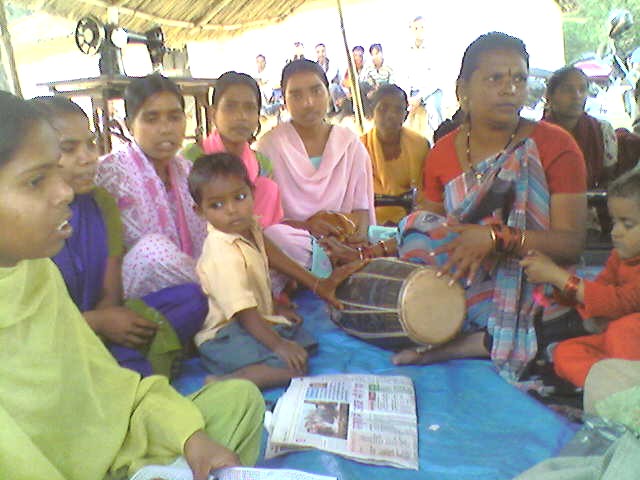
Sewing class taking a break – the newspapers are not for reading, but used instead of waste cloth (a costly and hard- to-get raw material) to train the young seamstresses
Tharia

Such was the little village of Mendara. Memories of trudging across broken land and halfway up a small hillock to where a great banyan stood, ringed at a respectful distance from its hanging roots by other smaller trees. Sitting in a circle with the villagers beneath the banyan, conversing about the lives they led—at the kilns, which were sometimes thousands of kilometers away, where the firemen worked ceaselessly for seven months or more each year in the most horrific conditions; and in the villages where, with the menfolk gone for most of the year, the women and children and the elderly faced extreme hardships.  How deeply moving was their warmth, their innocence, their incredible generosity. Hogging large quantities of fresh gur, bananas, drinking sweet yet deliciously strong chai liberally laced with goat’s milk. Walking around the village; making comic faces at the little children who scampered around and giggled and guffawed and made faces right back at me. The small village shrine, exquisitely clean, utterly peaceful, with fresh flowers and a bunch of bananas placed in front of the tiny sanctum lit by a single lamp, redolent of goat’s butter.

Mendara

The village elder led the way up toward the crest of the hillock. The trees thinned, the ground levelled off, and suddenly, we were standing on the edge of a cliff that followed the contours of the hillock on either side: a broken, fifty-foot- high wall of angular rock faces and red, iron-rich earth, strewn with stone and rubble and the corpses of countless trees and bushes that had once dwelt on the slopes. Far across the shallow valley I saw a line of low hills; and running across their midriffs like a jagged knife wound, a road under construction—its course marked by the hideous, characteristic signs of road building in Indian hills: scarred slopes, littered with mounds of earth, blasted boulders, tree trunks scattered like matchsticks on the denuded expanses.

“That is the new road from Allahabad,” the elder murmured.

“The Allahabad Bypass Expressway,” a young fireman corrected him politely. “It will turn round that slope and pass close to Mendara, right below us. See? They are working quite close already.” He pointed toward the left and I saw in the distance a stretch of muddy track carved out from the hillside. A bright yellow earth-mover was gouging out great chunks of earth from the slope; the clattering roars of its engines faint but distinct.

“They say the Expressway will bring us jobs; that it will bring prosperity to us,” the young fireman went on. His voice was hesitant. “With jobs, maybe we can earn more, be closer to home through the year; we can take care of our women, our children. Maybe we won’t have to travel to work in faraway brick kilns any more…”

The elder sighed. “Yes…but with the coming of the road, our old ways are vanishing,” he went on softly, his eighty-five years carved into deep lines that divided his face into a thousand weathered segments.  “So many trees have been felled; entire forests are gone. We have always grazed our goats, our buffalo, in the plains down there, but now the grasses are withered, the ground is hard, the streams are bitter, or have dried up. Where  will we take our animals for grazing when the road is finished? When thousands of vehicles are moving up and down, day and night?”

His voice trailed away and we stood there in silence.

And that’s when, without warning, a memory flooded my mind like a river; a much older memory, from a time when I was much younger, maybe ten years old. It was during a drive in the mid-1960s, somewhere between Jorhat and Kaziranga in Assam; father was driving the car, mother seated next to him, brother and I were dozing in the back…till we were woken up with a start by the screeching of tyres as the car braked to a shuddering stop. Through bleary eyes I saw, in the dull red light of dusk, a dozen goats milling about on the road in front of the car, a young goatherd – a boy about my age – frantically darting about, crying out and wielding a bamboo stick expertly till he assembled the animals in a loose group and led them across the road and up a path leading to a cluster of huts on the slopes to the left.

“My God, I nearly hit them,” father murmured, his voice trembling, hands gripped tight on the wheel.

“It’s all right,” mother murmured. “I’ll drive for a bit…you take a break, you’ve driven the whole afternoon…”

As we set off again, mother at the wheel, I spoke up. “Stupid goats. Stupid villagers! Why do they have to live so close to the road?”

Father glanced around sharply but before he could speak mother replied. “Understand, always remember, they were here before us.” Her voice was soft but stern. “The villages, the villagers, were here long before this road came…before we came…”

On that hillock above Mendara, I heard and felt the impact of those words undiminished by the decades…as I do now, fifty years older but not much wiser.