From recent illuminating conversations with a few young sociologist friends, I’ve learned a new word; rather, a new meaning for an old and familiar word. The word is ‘space’. Hitherto, I’ve understood and used ‘space’ to mean ‘room’ (living space; space for one more; spacing between letters or tiles) or at times ‘realm’ (like in ‘outer space’), or even a state of mind (‘spaced out’ as in cannabis-induced euphoria).
Now, thanks to my sociologist gurus, I perceive that each one of us has a ‘personal space’ (p-space), and that we all live our lives in a complex, dynamic grid of p-spaces that overlap and interact with one another to form ‘public spaces’ and ‘social spaces’. Armed with my new-found understanding, I see all people – indeed, all creatures, from Brahminy ducks to Brahmins, cows to Congressmen, mosquitoes to musk deer, terrapins to terrorists – enveloped by pale, shimmering, p-spaces; surely these must be the ‘auras’ described and discerned by psychics. And even as our bodies corporeal inhabit and move and interact in the mundane material world, our individual p-spaces move with us and encounter and tryst with one another: whirling and swirling, coiling and recoiling, merging and submerging in larger spaces, often disappearing entirely only to emerge in different forms and dimensions…
Behold! A universe of Personal Spaces
Contemplating itself with a trillion ephemeral faces
Creation itself an interplay of Spaces unseen
From whose shadows Life springs into being
Eager to explore manifestations of p-space in the diverse and perverse environs of India that is Bharat, I trawl the foggy swamps of memory…and remember an incident in Bombay, where I spent a decade of decadence. Bombay! For that was the Great City’s name in the halcyon days before the Tides of Chauvinism rose and pounded its shores, leaving in their foul-smelling wake a battered and bent signpost bearing the name ‘Mumbai’ lying on the garbage-strewn sands of Chowpatty.
It was in Bombay that I first discerned the presence and value, if not the sociological meaning, of p-space. For the gentle reader unfamiliar with this greatest of cities, Bombay comprises a ragged row of rather narrow islands, joined to one another by causeways consisting primarily of the trash and rubble cast out by the City’s 20 million inhabitants and trampled down into concrete-like texture and strength over the centuries. Unlike the City’s cockroaches which are large and agile, a vast majority of the City’s dwellings are small and cramped. However, the lack of sufficient physical space at home has only strengthened the Bombay citizen’s awareness of her/his own p-space, and evolved over the decades into a remarkable ability to extend individual p-space into the public domain. Nowhere is this ability more vividly manifest than in the suburban trains, in which millions of Bombay citizens spend a substantial portion of their daily lives.
Like Death, Income Tax and Arnab Goswami, the Bombay suburban trains are great levelers. Within their hot and densely packed coaches all overt and covert symbols of social division – race, ethnicity, class, caste, language, religion, wealth, education – are melted down and compressed into a kind of thermonuclear plasma held together by the glue of sweat and common suffering. For the most part, the conditions in these trains are what the Western Railways define tersely and vividly as ‘super-dense crush load’; a state of being in which, as one hardened commuter put it, “When you try and scratch your nose you end up scratching someone else’s.” Paradoxically, though, even as this plasma-state twists and squeezes individual physical bodies to fusion point, it creates a strange and wonderful synergy among the various individual p-spaces inside the coach. It is almost as though the traveller attains an elevated plane of space-consciousness during the commute; a dual-consciousness that functions at two simultaneous levels:
(1) the individual p-space level, in which she/he indulges in individualistic or small-group activities ranging from bhajan singing, crossword solving and stitching to political discussions, munching snacks and scratching various parts of the anatomy;
(2) the collective social space level, in which the traveller is acutely conscious of creating and being part of a larger synergetic social space, and remains ever alert and ready to defend this synergetic social space against external disturbances.
Perhaps an anecdote might illustrate this synergetic space environment better. I recall one fine morning on a Churchgate-bound Slow Train; the 06:04 from Borivali, if memory serves right. I boarded at Malad and occupied my favourite position: standing beside the door, strap of shoulder bag firmly held between teeth, clutching on to a strap with a pinky finger and half-a-thumb as were about seven other commuters. Around me was the usual writhing, wriggling, rolling, swaying forest of tangled limbs, torsos and hair, from which rose the strange, feral noise known only to the Bombay commuter: the hoarse collective cry of two hundred and fifty humans squeezed into a space meant for twenty while hurtling through space at 60 kmph.
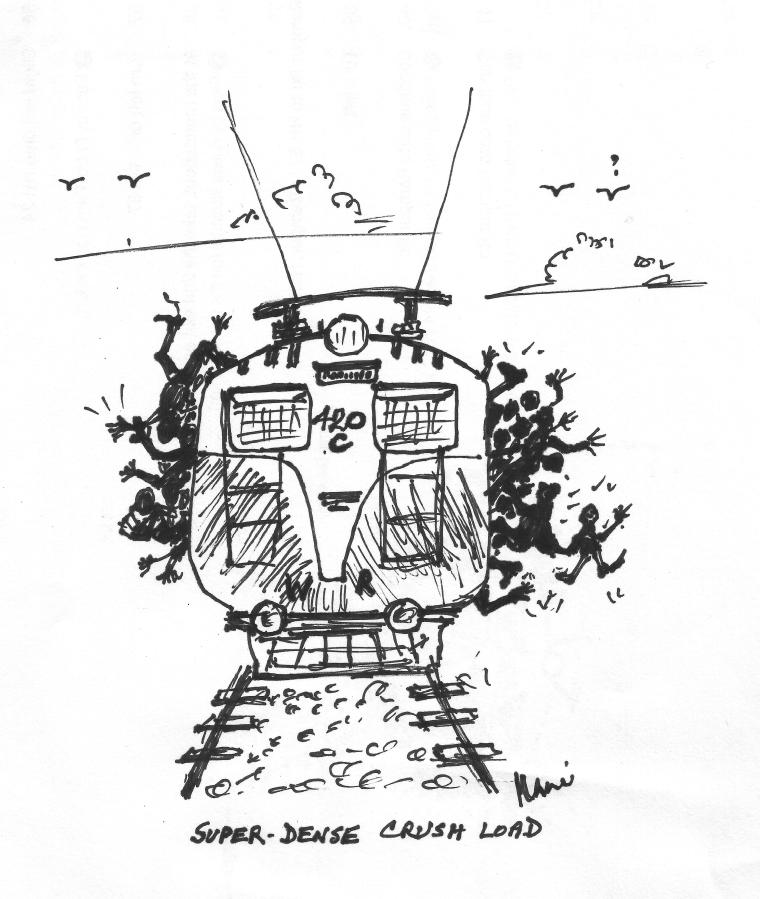
As the train sped along, the wriggling mass of humanity presently disaggregated into vaguely human forms: some clutching newspapers with pens poised over crosswords in Marathi, Hindi and English; others playing stand-up rummy, with one player collecting the discards under a rubber band stretched across his raised palm; a few crooners and hummers, a peanut vendor, a dozen peanut munchers, the many loners staring into space, at spots on walls or at one another; and the standard quota of loiterers, conmen and pickpockets scattered among the crowd. With each approaching halt – at Goregaon, Jogeshwari and so on – a score or so travellers would form a lump near the door on the far side and shoot out on to the platform like some giant hairy pea from a pea-shooter. At once, the space vacated by them would be occupied by a larger mass of humanity charging in through the door; the train would move again, things settled down a bit…and so it went.
Everything was normal, then, until we reached Andheri. About fifty people hurtled out of the coach; about eighty took their place; and suddenly, just as the train jerked into motion, a voice rose above the general din: a voice that brought instant silence into the coach, till the only audible sound was of rumbling wheels and the soprano hum of the pantographs gliding along the overhead traction lines.
“Tickets! Let’s see your tickets!”
The words were chanted in Hindi, then Marathi. The voice was not loud; but it cut through the silence like a bhelpuri-wallah’s knife through an onion. An instant later, I saw the Ticket Checker; white-trousered and black-coated, with black bag slung on his shoulders and pen and receipt book in hand, he had pushed his way from the vicinity of the far-side door into the middle of the crowd.
“Quickly now! Tickets…let’s see your tickets!”
The dynamic, invisible, synergetic social space inside the coach suddenly and soundlessly crystallized, revealing its six hundred glowing individual p-space shards. It was a dire socio-anthropological warning; but the TC was oblivious to it.
“Tickets, quickly now…” he chanted.
A young burly man, who might have been a football coach or perhaps a Matunga bar bouncer in his prime, responded. “Am I dreaming or do we have a TC with us?” He was standing right next to the TC; he spoke softly, courteously, a puzzled frown on his face as he scanned the faces all around him, including that of the TC.
The TC stiffened and opened his mouth to reply, but another voice came from his left; from a white-haired bespectacled man with the slightly distracted look and disheveled clothes of a long-retired Science Teacher. “I too heard a TC, son; but surely we are both mistaken. The last time I saw a TC enter a train during rush hour was in 1964…”
The TE found his voice. “What do you mean,” he sputtered. “I’m right here. Now show me your tickets…”
“Ah! There you are!” exclaimed the Bouncer, looking pleased. He patted the TC’s shoulder affectionately. “My ears are deceiving me, I’m afraid; I thought I heard you ask to see our tickets!” He laughed heartily, and was joined in his mirth by about sixty others. The TC did not laugh; instead he looked slightly grim as he rubbed his shoulder.
“Doubtless our TC is off-duty,” murmured a thin young man with frizzly hair. He was clad in kurta-pajamas and had a satchel slung across his scrawny chest; he looked every bit the Social Activist. “Doubtless he is heading home, after weeks of non-stop work in the service of the Railways and the nation.”
Many heads nodded, and all eyes turned to the TC. “Now look here,” the TC protested, “I am on duty, I must see your tickets…”
“You’re on duty!” cried the Social Activist, eyes wide in horror. “Do you realize what you have done? You have committed a grave injustice by boarding this coach…”
“What!” The TC’s eyes were round as saucers. “What injustice? What have I done?”
“You have snatched away food from the hungry when you boarded this coach,” went on the Social Activist, his voice gentle but persuasive. “Do you not see that by your very presence in this coach you have deprived another man, a poor man, from boarding this coach?”
“Because you have occupied a space that could have been better occupied by that poor man,” broke in the Science Teacher.
“That poor man now has to wait for the next train,” growled the Bouncer.
“He will be late for work…perhaps he will lose a day’s salary,” remarked a short, stocky man with a briefcase; doubtless a bank clerk.
A babble of voices broke out.
“Aye, yes, that poor fellow will pay the price for your thoughtlessness…”
“It’s a cruel day…”
“Are we all not honest travellers with tickets?”
“It’s a callous world…”
“Such is the lot of the common man…”
“What kind of government do we have, I ask you…”
The TC, who had been gaping all this while, found his voice. “Now wait a minute,” he protested, his voice thin and feeble.
“A single human adult male typically occupies a volume V in litres given by the equation V = 1.02W- 4.76,” went on the Science Teacher, his face glowing with eagerness, “where W is the weight in kilograms…”
“In fact, I remember seeing a poor man trying to get in at Andheri,” said the Bouncer thoughtfully. He looked at the faces around him. “Do you remember? He was weak and thin, had a faded shirt… torn pajamas…”
Several voices shouted agreement and added supplementary details.
“Of course, he looked starved…”
“He probably has seven children to feed…”
“And an ailing wife…”
“And a worthless good-for-nothing brother to support too…”
“Perhaps the brother too is a TC…”
“By my reckoning you weigh at least 80 kilos, so you occupy no less than 75 litres of space,” remarked the Science Teacher, eyeing the TC critically. “That’s enough to accommodate two normal-sized people…”
“What! So two poor people have been prevented from earning their daily wage!” came the general cry.
The TC now had a slightly hunted look. He began to edge backwards towards the doorway.
“Imagine if this injustice were to happen every day,” went on the Social Activist. “Why, not only would a family starve…
“Two families starve,” corrected the Science Teacher.
“Ah, yes sir, two families starve,” continued the Social Activist, “but over 1400 man-days would be lost because of this TC’s thoughtlessness…”
“Which, if you calculate even at minimum daily wage rate, works out to over 28,000 rupees…”
“And multiply that by the number of trains running each day…”
“Imagine the loss to the economy…”
“The GDP…”
“Little wonder India remains poor…”
“And all because this TC thinks we are so dishonest that we don’t have our passes or tickets!”
The crowd fell silent and two hundred pairs of eyes eyed the TC severely.
A small, meek-looking gentleman, who hadn’t spoken till then, suddenly piped up: “Does this TC himself have a ticket?”
The TC started, even as the cry was taken up. “Oye TC, do you have a ticket?”
“Do you? Do you?”
The TC wiped his brow. “No…I mean, I have a badge…” he mumbled.
“Oye, he doesn’t have a ticket!”
“Ah, the TC himself doesn’t have a ticket!”
“Chuck him out! He doesn’t have a ticket!”
The train slowed down and pulled into Matunga. Eager hands reached for the TC and helped him on his way to the doorway. The TC shot out on to the platform, rear-first, his velocity reduced and landing cushioned to some extent by about a hundred people who were waiting to enter. He was still running towards the exit when the train pulled out of the station. As the train pulled out and gathered speed, the travellers in the coach settled into their individual and small-group activities…and soon, the coach was filled with the dynamic, watchful peace of synergetic p-space again.
[P.S: I submitted this thesis to a sociologist friend, with the suggestion that it might be a useful case study to deepen knowledge and understanding of p-space. She has urged me to forget p-space, and instead take urgent measures to fill the discernibly voluminous space that, according to her, occupies the region between my cranium and mandible.]
 Mani
Mani
 Wanderings and Wonderings