Beastly encounters, Musings, Potshots

A coffee bean’s trauma (or, Nightmare on Dung Street)

Feverish insights into the goodness of dung and the oneness of all living things

Warning

A week or so ago,  a great Indian thinker—the Hon. Mahesh Chandra Sharma, recently retired judge of Rajasthan High Court—provided new and wondrous insights into the Divine Attributes of the Indian Cow [click here to read full report].  We were enthralled, delighted, by his revelations; we were eager to believe.

Alas, many highly ill-reputed intellectuals in India and abroad greeted Hon. Sharma’s revelations with amusement, skepticism, and even scorn. Our belief was shattered.

Was Sharma-jee wrong?

Is the bovine no divine but a mere mortal?

These and other weighty  questions kept us tossing restlessly in bed night after night, till we resolved to seek wise counsel from one of the world’s leaders in bovine research: Dr Pashupalan Moosa, Senior Director at  the Indian Cow Research Institute (ICRI), Gurgaon and  Head of the Product Innovations, Design & Development Labs (PIDDL), located in the sprawling 1400-acre campus of ICRI.

We met Dr Moosa in his spotlessly clean lab-cum-office. He was a curly-haired, bespectacled gentleman of about sixty-five, wearing a white lab coat and the placid expression of the Indian water buffalo. On the wall behind his desk was a fetching portrait of Kamadhenu, the Celestial Cow. Dr Moosa bade us sit and poured out two cups of black coffee from a large percolator. We accepted a cup gratefully and took a sip. The coffee was excellent: just the right warmth, strong yet not bitter, heady in fragrance, with a kind of wild, mossy, moist flavour that evoked the freshness of rain forests.

“We have ten minutes,” Dr Moosa murmured.

“Sir,” we began hesitantly, “the Hon. Mahesh Chandra Sharma has provoked considerable mirth and wrath with his claims that the cow is a divine creature. As a leading expert in bovine sciences, what do you make of his statements?”

“Of course Sharma is right: the cow is divine,” Dr Moosa murmured. “Just as you are divine! As indeed is a tapeworm, an ant, a chicken, a tick, a bacterium, a cuttlefish!” He leaned forward, warming to his theme.  “Listen: all living creatures on Earth are made of the same genetic stuff. Whether we are bacteria or Bactrian camels, conger eels or Congressmen, capuchin monkeys or capitalists, Komodo dragons or communists, giraffes or jihadists, all of us share the same DNA and RNA at the cellular level. We are all, at the core, truly One—whether we like the idea or not. All living things have spawned and evolved in the same great river of the Genetic Code, which some people call God by various names and others simply call names. So why should we exclude the poor bovine from this all-embracing divine realm?”

He was being a tad evasive, of course; but we were so awestruck by the potency of his words and his coffee that we let it pass. “All right, sir…but what about Sharma-jee’s other claims? For instance, he declares that a cow inhales as well as exhales oxygen! What kind of respiration is that, sir? It flies in the face of science!”

“Not at all,” said our colleague gently. “Haven’t you heard of mouth-to-mouth resuscitation?  It works because you can actually exhale part of the oxygen you inhale. So…it’s not only the cow that can inhale and exhale oxygen: we all can!”

“But…Hon. Sharma also quotes some obscure research by some untraceable Russian scientist named Shirovich to claim that a cow’s bellows can kill germs in the vicinity! Surely that’s absurd enough to make a buffalo laugh?”

Our learned colleague chuckled. “Well, first the point about a cow’s bellows killing germs. Here too Sharma is factually correct. It’s the media that’s got the story wrong! The media has misinterpreted the word ‘bellows’ to mean the sound a cow makes with its mouth, and ended up looking at the wrong end of the cow…um…pipe. You see, a cow does not bellow; it moos. By ‘bellows’, Sharma is referring to the simple, age-old mechanical device used for squeezing out gas from a bag at high pressure. Now, it is an established fact that a cow…er… squeezes out more than 60 litres of methane and other gases daily from its stomach bag – a direct result of its grassy, high-protein diet.  Think of it: 60 litres! Forget germs, no living creature can possibly survive such saturation bombardment by the highly aromatic emissions from a cow—not even an elephant that’s lost its sense of smell!” Dr Moosa paused and looked at us keenly. “If you like, I can take you across to PIDDL’s integrated cattle shed complex; you’ll vividly appreciate the point when we’re half-a-kilometre away.”

“There’s no need for that, sir!” we assured him hastily. “But then, what about this Shirovich, the Russian bovine scientist that Hon. Sharma referred to? He’s untraceable! We’ve hunted for Shirovich and his purported work on the Net, in libraries…but to no avail.”

Dr Moosa shook his head sadly. “I have no doubts at all that this Shirovich exists or existed, and that his work is authentic. My guess is that Shirovich must have quietly succumbed to an excess intake of bovine emissions while undertaking some long-term experiment, doubtless in some remote bovine lab in Siberia or the Ural Mountains where his demise went unnoticed. That’s why he is untraceable, poor fellow: a great loss to the scientific world.”  He sighed and refilled our cups with steaming coffee.

We fought off the feeling of unreality that was slowly enveloping us. “There’s also been a lot of unkind comment in social media over other things Hon. Sharma said. Like, he says the cow is a clinic! And he goes on and on about the healing powers of cow urine and cow dung…”

“Of course he’s right!” broke in Dr Moosa.  “You must try and ignore the cackling of the hoi-polloi!”  He paused, reached into a desk drawer, took out a small dark-brown package wrapped in plastic and handed it to us.

“Behold!” he cried. “This is the latest product from the PIDDL stables…er…cattle pens. It’s pure, fresh cow dung, painstakingly collected by my team from cows that have grazed only in the ISO 9001:2008-certified organic pastures of PIDDL. We’ve enriched the dung with vitamins and minerals, added subtle flavours, and given it a catchy brand-name: ‘PIDDL Dung’!” His face was flushed with pride and enthusiasm. “PIDDL-Dung is now being marketed as a breakfast-food supplement in 114 countries, including USA, EU, UAE, Japan and Australia. It’s one of the greatest success stories of the Make in India initiative!”Grazing dream
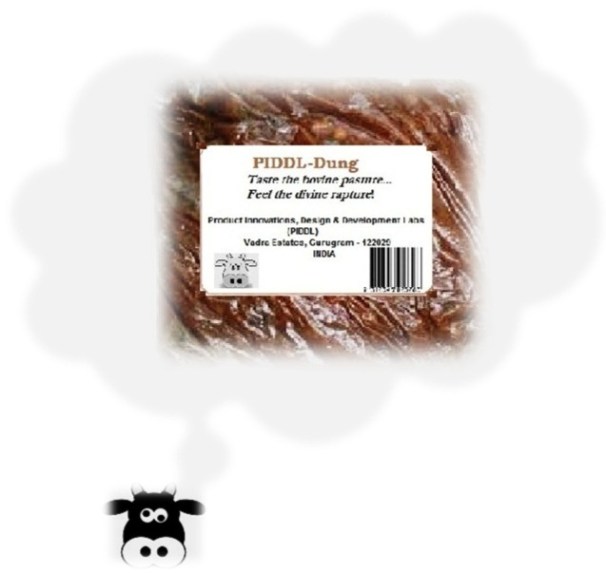
“That’s amazing,” we whispered, holding the PIDDL-Dung package gingerly. “But why is it only being exported? Why aren’t you marketing it in India?”

Dr Moosa smiled tolerantly. “Our marketing team knows what it is doing. Indians will never embrace any traditional Indian product—until the West first embraces it. Now that other countries, particularly the West, have started consuming PIDDL-Dung by the ton, Indians will soon follow in droves!”

We tried to speak but only succeeded in making soft mooing noises.  On the wall, Kamadhenu twitched her tail and gave us an inquiring look.

“PIDDL-Dung comes in six flavours at present,” Dr Moosa went on. “This one’s chocolate-almond; please accept it as a gift!”

“Thanks, but sorry, sir,” we mumbled, placing the package down on the desk. “It’s just a little hard to stomach the idea of eating cow dung…”

Arre bhai!” he cried. “If you can eat sheep’s brains and goat’s gonads, if you can gobble up fish eggs and frog’s legs, if you can wolf down globs of pounded flesh stuffed into bags stitched from pig’s intestines in the name of sausages, why’s it so hard to savour some clean, tasty cow dung? Hahn-jee?”

His logic was irrefutable, yet hard to swallow. “But …but these are animal feces!” we protested feebly.

Dr Moosa relapsed into moody silence.  But after a moment he looked up and smiled. “Did you like the coffee? Would you like some more?”

“So kind of you, sir… the coffee’s really superb. But we’ve taken up enough of your time, thank you.” We rose, nodded at Kamadhenu who nodded back, and shook our host’s hand.  He walked with us to the door.

“This is Kopi Luwak coffee, you know,” he murmured as we reached the door.  “It’s from Indonesia. It’s the most expensive coffee in the world. A kilo costs anything from 1200 dollars to 3000 dollars, that’s two lakh rupees…”

We were stunned. “What’s in that coffee, gold?” we asked.

He chuckled. “No, it’s not gold.  Although curiously, gold is the word used by local Indonesians to describe the animal feces from which they get the coffee beans…”

We clutched the door for support. “What!”

“Yes…you see, the coffee beans are picked out from the feces of the Indonesian palm civet cat. This lovely animal likes eating coffee cherries. The cherries are digested, but the beans stay intact as they pass through the animal’s stomach and intestine. In the process they absorb certain unique flavours, and so when they emerge…”

Dr Moosa broke off and started to laugh at our horrified expression. It was an extraordinary laugh: not quite human, rather a series of shrill, persistent monotonic beeps that grew louder and louder. It was almost like the sound of a morning alarm…

Mercifully, it was.
Beastly encounters, Potshots

Cow’s laughter

Cow's laughter 001

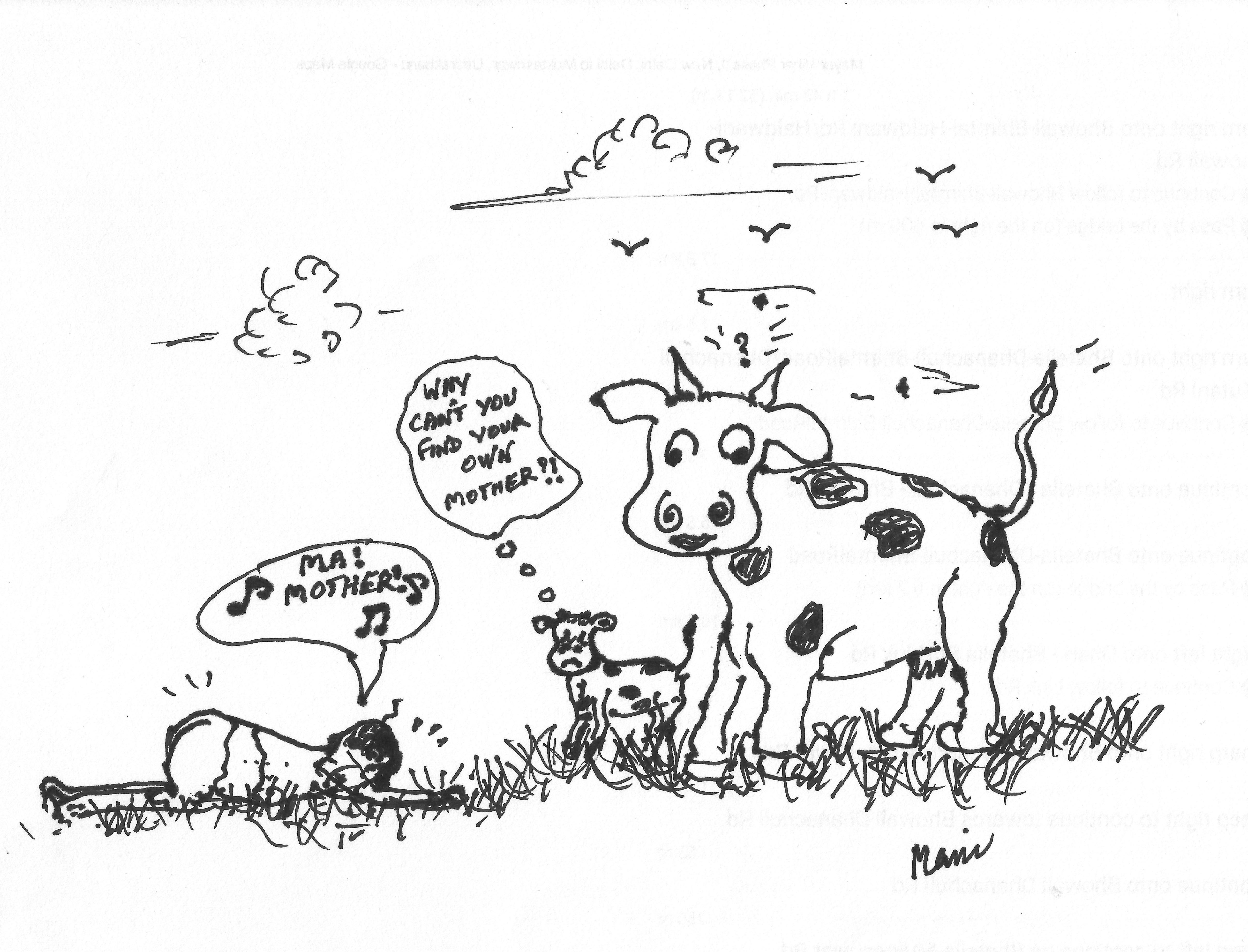
Ah! Recycling is such a joy, for the environmentally aware citizen as well as the struggling writer. Buoyed by this ignoble sentiment and by the nationwide brouhaha over divine bovinity (bovine divinity?) and whether it is right to hog beef, I dust off and present an ancient piece carried by The Times of India on 15 April 1999 under the title ‘Cow’s laughter’.

“What do you feel about cow slaughter?” asked the chairman of the interview board.

“Well,” I began confidently, “the issue’s unfortunately been clouded by religious sentiment…”

“Indeed, we know cows have religious feelings,” interrupted the chairman, “but what do you feel about the issue?”

Mercifully, the interview was terminated soon thereafter. Yet the true significance of the chairman’s remarks struck me – literally and rather forcefully – only many years later. I was in an auto-rickshaw, and my driver, like so many of his tribe in the Great City, was knowledgeable and voluble. Having discoursed at length on rising prices, falling morals and the urgent need for a Truck Driver Eradication Programme, he turned to the subject of cows.

“Ah! What a creature!” he breathed reverentially, swerving us towards a passing dog and missing narrowly. “She gives us milk, from which we make butter, cheese, curds, ghee…her strength pulls the cart and the plough, her very dung fertilises the soil…”

“And her meat is rich and nutritious!” I cried, caught up in his enthusiasm. “Her hide makes footwear, and her…” but I stopped short at his cry of horror. Indeed, so agitated was he at my remarks that he accelerated and braked at the same time, and our chariot executed a series of skips and jumps before shuddering to a halt. He turned to me.

“Sacrilege!” he whispered hoarsely. “To speak of eating cow’s flesh. But then you, sir, are undoubtedly a product of inadequate spiritual education, and therefore ignorant of the divine attributes of the cow. Let me tell you…”

At that moment, disaster struck. A dappled cow had been grazing contentedly on the grassy divider nearby. A passing truck sounded its horn; the cow jumped out of her skin; and the next instant she was charging straight towards us, mooing plaintively. I yelled in alarm; the driver twisted around, but too late. The cow lowered her horns instinctively before hitting the windshield, which disintegrated with a splintering crash. Stunned by the impact, I watched as the cow – not a bit put out by the incident – poked her head through the gaping hole where the windshield had been.

“Moo?” she inquired softly. But the driver, who had assumed a foetal position on his seat, did not reply; and so, with an apologetic nod at me, the beast withdrew her head and trotted off briskly down the road.

I disembarked and joined the interested crowd of sidewalk ghouls which had gathered. At length, the driver uncurled himself, a limb at a time, and lurched to his feet. And then, he began to curse.

We were awestruck by the flow and fluency of his expression. He began with a general character assassination of the impugned cow, went on to cast ghastly aspersions on its antecedents and parentage, and finally dismembered it with ritualistic slowness. “It should have been strangled at birth!” he cried, and demanded to know what the government was doing in the matter.

At this, a bystander chided him gently for speaking ill of divine bovinity.

“Rubbish!” the driver yelled. “That was no Bharatiya cow! I saw the spots on it: it had foreign blood in it. It was a foreigner, I tell you, a foreigner…”

Beastly encounters, Musings

Bondla Ramble

The silence is deafening.

Last night too there was silence, when we were sitting out on the verandah of our little cottage. It was quiet then too, but a different quiet – the dense forest around us was alive, filled with a sizzling, electric, watchful kind of silence, a silence strangely intensified  by the rhythmic breek-breeks of an orchestra of crickets, muffled bumps and thuds, sudden bird calls, a startled cry from some unknown animal (a fawn? a bear cub?), the excited chatter of a faraway monkey, the rustling of leaves, the steady drip-drip of raindrops from a billion leaves…

Our abode in Bondla
Our abode in Bondla

But now, at dawn, the silence is absolute. The air is clear, cool, still but for an occasional stray breeze; the sky is overcast, a great brooding grey presence that portends more heavy downpours. The creatures of the night are deep in slumber; the leopards and civets and owls and other nocturnal hunters doubtless dreaming of sweet meals had and yet to be had, while the deer and squirrel and countless other hunted ones are only now wakening wearily yet watchfully from the shadowy realms of half-sleep, thankful to have survived another dreadful night, already gearing themselves to brave a day filled with perils old and new…and the night to come.

I look to the right, up the road. About fifty metres away stands a small spotted deer, nibbling leaves off a bush. It looks up at me and then gets back to its repast; but its ears are cocked now, there’s a new tenseness to its limbs. I turn and hesitate…should I wake the others? Udai is in deep delta sleep; the door to the other room, where Rekha, Nisha and Tarini are, is shut. Quietly – or so I think – I step back into the room and open the side door, thinking to step down the path that leads to the road. The door swings open silently, but the deer is gone.

I walk down the slippery, mossy flagstone path and amble along the road, looking in vain for signs of animals among the mist-blurred thickets on either side. Giant carpenter ants march busily among the inch-thick avenues of dead leaves on both sides of the road. Countless black centipedes wander about like tourists lost in a metropolis; one runs headlong into a soldier ant, pauses and scratches its head thoughtfully with about seventeen limbs; doubtless it is asking for directions?  But the ant offers no assistance; instead it executes a remarkable backward spring of about three inches, capers around the centipede several times in an ever-widening circle, and then sprints away at about 60 kilometers an hour. Clearly put off by this discourteous behaviour, the centipede flexes its mandibles, shakes its head in disgust and moves on.

I wander into the gently sloping forest on the right, walking as silently as I can—the faded blue bathroom slippers make this task easier, but I am acutely conscious of how vulnerable my toes and ankles are to uninvited explorations by all manner of creatures, from leeches and spiders to centipedes and snakes. A slight flicker of movement in the corner of the eye…and I see them! A group of five, no, six spotted deer are standing about a hundred metres away, staring at me; their bodies are barely visible in the deep shadows , but the occasional twitch of an ear gives them away. After a long moment they decide I am harmless; with twitching tails they turn and walk away deeper into the woods, soon to be lost among the dark green caverns beneath the tall trees.

I move on towards a small hillock where the road ends in a flight of steps, leading up to a low, rectangular building with CI-sheet roof; this must be the canteen. The steps are covered in bright green moss and treacherously slippery. Emerging on to a large paved courtyard,  I stare at the sightless windows of the canteen; there is a large lock on the door. To the right of the door is a small shed—just a roofed enclosure with low walls, inside which are piled rusting table fans, broken chairs, a cracked plastic table, and similar junk. As I approach the shed there is a sudden scuttling noise from within; I freeze and hastily move the other way, towards the low wall around the courtyard. All of the Bondla Wildlife Sanctuary is visible from here. Beyond the wall, the forests fall away into a valley; above the tree-tops, and behind and all around, are high forested hills, their outlines blurred by the moisture-laden air.

A steady drizzle begins as I make my way down the steps. I see Nisha wandering through the woods where the deer were browsing. We meet on the road and walk slowly back towards the cottage.

“When does Krishna take his morning walk?” I ask, a tad anxiously.

“Around 9.30, I think,” Nisha replies. Krishna is the lone, slightly psychotic tusker who resides in magnificent isolation in the forested hills surrounding us; last evening we’d been told by Loveleen – the Veterinarian in charge of the Bondla Zoo and the Sanctuary – that Krishna enjoys taking a stroll down this very road every morning to inspect the lower reaches of his kingdom.

Nisha pauses and points towards an overgrown path leading off the grassy verge down into the wooded valley. “Here’s one of the nature trails.”

“Ah…so should we walk down it a bit?”

She nods. We move slowly and cautiously down the path, she leading the way, treading as silently as we can on the wet leaves. The slope is steep and slippery in parts; I stumble now and again, trying hard not to make so much noise as to scare away every living thing from Bondla to Kaziranga.  At one point the path curves sharply to the right, ducking behind thick undergrowth. I decide on a short-cut and plunge bravely into the thicket.  The earth seems alive beneath my feet…I look down and realize that it is, with large, fierce red ants. I execute an agonized leap that would have turned a spotted  deer green with envy, and narrowly  escape the ignominy of landing rear-first on the other side of the path.

As we descend, the forest closes in on us. It is like walking through a colossal green cathedral; a hall pillared and arched with countless trees of every imaginable size, shape and hue, tall and thickly leaved and so densely gathered in patches that the grey sky above is completely obscured. Many tree-trunks are festooned with creepers that swing lazily in the slightly chill breeze. The air is filled with a cocktail of scents, the primary ingredients comprising damp soil, crushed leaves and rotting wood. The earth is carpeted with a thick layer of sodden leaves. Bushes gather in fraternal clumps; some tall and thin with tendril-like leaves, others short and thickly leaved, with huge curved thorns;  still others sporting flowers blue, white, yellow and red. Mushrooms poke their yellow-white heads from rotting twigs and fallen boughs. There is water everywhere; myriad little trickles of rainwater flowing down the slopes, coalescing to form larger channels that eventually merge with the stream that bubbles and chuckles its way along the bottom of the valley.

Gallery of green
Gallery of green

Nisha pauses, holds up a warning hand, points to her left. I squint in the direction she’s pointing and see nothing but a large tree with thickly-leaved branches. And then, one of the branches shakes violently and I see two huge squirrels leap off it on to an adjacent branch, where they sit on their haunches and make derisive faces at me. They’re the largest squirrels I’ve ever seen in my life; each the size of a well-fed cat, and as agile too. “Malabar giant squirrels,” Nisha murmurs. The squirrels stare at us awhile, chattering their disapproval of the current political climate, and then turn in unison and leap out of view behind the foliage.

Spot the squirrel
Watching me watching you [photo: Nisha]
The drizzle is now a heavy rain; Nisha steps off the path to find shelter under a huge tree. I join her and we wait for the rain to subside. Incredibly, not a drop of rain falls where we stand; so thick is the canopy above us.  I am acutely conscious of the gaping hole in the tree-trunk right next to my shoulder. A perfect nesting place for a cobra, I think to myself gloomily; perhaps there’s an entire joint family of cobras in there, the young ones even now fighting over who among them gets to take the first nip at my scrawny neck…

Nisha touches my shoulder, startling me out of my serpentine reverie. She’s pointing towards a tall tree about a hundred metres away.  I stare hard at the tree, bringing into play all my powers of observation honed by two decades’ wanderings in the wilds of Meghalaya and Assam.  All I can see is the tree. Like a befuddled visitor at some gallery of modern installation art, I study the tree very carefully, closing one eye and then the other as I examine and appreciate its features. No doubt it is a fine tree, with a thick tapering trunk and many branches. The lowest branch is long and twisted, with a large oval-shaped knot halfway along its length…

“I don’t give a hoot” [photo: Nisha]
“It’s an owl…a tawny frogmouth owl,” Nisha murmurs helpfully. She’s now aiming her camera at the knot on the branch.

And then, at last, I see it. The knot is not a knot; it’s an owl. It’s huge, perched on the branch with its back to us, shoulders stiff and slightly hunched, its ruffled feathers clearly silhouetted against the slate-grey sky. “It’s sulking,” whispers Nisha. “Maybe because it’s wet…or maybe it doesn’t like being photographed by strangers.”

The rain thins; we leave the owl to its sulking and move on. Suddenly the sun breaks through a gap in the clouds, bathing the green hall in golden light from a billion glittering leaves. But only for a moment; like a curtain dropping, the thick grey veils of cloud conceal the sun again.

Now, slowly but surely, the creatures of the forest are waking up.  The air is filled with the hum of insects; dragonflies hover, butterflies flit about.  A sweet, fluting bird call wafts through the trees.   Nisha pauses, holds up a hand. “That’s a ruby throated yellow bulbul…the state bird of Goa,” she murmurs, scanning the tree-tops above us. After a moment or two she points; I see only a bewildering tangle of leafy branches.  She takes a few pictures, and then all of a sudden there is a flash of brilliant yellow amidst the green, and the bulbul does a fly-pass high above my head, a distinctly sardonic tone in its musical cheeping as it stares down at me. “Whee wit wit wheeNow do you see me?” it seems to chant.

The gurgling and murmuring of the stream grows louder and deeper, the light grows dimmer, as we near the base of the valley. Suddenly the stream is before us, about five metres wide, its dark but clear waters foaming among rounded rocks and pebbles and rushing between the bushy banks.  I step down to ford the water, and pause as a faint but pungent aroma reaches my nostrils. It’s a distinct odour, evocative…

“Elephant dung!” I whisper hoarsely. Nisha nods, eyes wide.

Silently, cautiously, I cross the stream, clamber up the bank on the other side, and emerge into a small clearing. On all sides the dense forested slopes press in; in the foreground on the left stands a light-grey rock formation; a monolith with an extraordinary shape…

It’s Krishna. He stands at least four metres high at the shoulders; his tusks are like giant yellow-white pincers; his legs as thick as tree-trunks. His eyes are open, but he is as still as rock from giant rear to pliant ears, from slender tail to stupendous trunk.

Nisha’s already crossed the stream and is climbing the bank. I point towards Krishna. For a moment we stand there, frozen, staring at our colossal slumbering colleague. And then, we turn and hasten back across the stream. Our ascent through the forest is far more rapid than our descent. I bravely lead all the way, happy that I’ve redeemed my reputation as a keen-eyed wildlife spotter.

After all, I’ve successfully spotted a three-tonne elephant at ten metres.

Beastly encounters, General ravings

Weather Monitor

[Middle: Times of India: April 28, 1995]

Now the days grow longer, with golden dawns and crimson sunsets, with Spring in the air and in the pedestrians’ footsteps. Winter yet possesses a weapon. His final kick will be hard, the ancients murmur: yet, hearing the incredible tumult of sparrows each morning and seeing, at dusk, great formations of parrots winging their way northwards, it seems hard to believe.

Till one remembers Ruknuddin.

Never wrong in his weather predictions, Ruknuddin has yet to make his appearance. And that means, Spring is not yet come.

A quiet and unassuming fellow, Ruknuddin is nevertheless firm in his principles and will, when pushed to the wall, fight tooth and nail to defend his rights. He is essentially an outdoor person, and lists rock-climbing among his favourite pursuits. His scaly hide would put most public sector employees to shame; but no lounge-lizard is he! His ancestors ruled the earth for a hundred million years—and that, even on the geological scale, is a long time.

Ruknuddin now hibernates, deep within the stormwater pipe that leads from the terrace to the ground four storeys beneath. It must be pleasant in there…quiet, cool, with just a glimmer of light filtering in through the narrow vents above and below. For these past three months he has dreamed, sheltered from the biting winds of cruel Winter—though what, after all, would he care for cold! He, whose genes carry memory of the Ice Ages, of the great glaciers of yester-eon.

But there will soon come a day when Ruknuddin will awake, and stretch his cramped limbs, and wave his 18-inch tail about languidly. And presently he will glide up the drain, his taloned feet finding effortless purchase on the stone, and peer out through the iron grating at the broken-tiled expanse of the terrace.

And Ruknuddin will smile as he beholds the blazing sunlight; for he knows the time has come for him to break his fast. And while possessed of neither fork nor knife, he will carry in him a tremendous appetite, whetted by his fourteen-week-long penance; and there before him, the table is laid.

The service is simple, as befits an individual of his austerity—a flattish ceramic bowl filled with fresh water, resting on a stone flower pot. To this limpid pool come, each day, the sparrows, pigeons, mynahs, crows, transitory parrots, squirrels, and even the occasional kite and eagle. Ruknuddin will wait in silence while six sparrows finish their ritual immersions. Shy by nature, he is uncomfortable in the midst of strangers; and besides, he far prefers to arrive at lunch unannounced.

But hark! Five sparrows flutter  their wings, converse earnestly, and shoot off towards a neighbouring tree. Now the sixth is alone. It looks about, is reassured by the stillness of the landscape, and dips its little head into the pool for a final sip. A brown blur of movement, a flash of glistening scale, a millisecond-long glimpse of a rearing snakes-head…and then the sparrow is gone and Ruknuddin’s tail is vanishing down the stormwater drain.

For a while the golden sun will shine benignly upon the terrace; and soon, the sparrows will return to their pool to drink and frolic—but now there will be a new watchfulness about them. For they, too, will know that with the coming of Ruknuddin, Spring has returned.