Beastly encounters, General ravings, Musings, Potshots

What’s in a Mane?

Once upon a time, not so long ago, while on a stroll in my neighbourhood, I met a girl, aged about 15, long-faced and short-haired, wearing that sulky, world-weary and prematurely cynical expression that’s so fashionable among today’s young urban elite activist-revolutionaries.

“Have you seen Bombshell?” she asked. Her tone was imperious, peremptory; her accent a pleasant blend of the USA’s North-East and India’s North-West.

I gaped at her. “Bombshell? Which…what…whose bombshell?”

She frowned. “Bombshell’s a cat,” she snapped.

“Oh..ah..yes, I see, your cat! You call it…er… Bombshell? “

“Bombshell’s a He or Him, not an It,” she replied in the withering tone youngsters reserve for dinosaurs like me who come from a time when Tweets were what birds did and Spotify was what leaking fountain pens did. “And you’re saying his name all wrong; his name’s pronounced Zhomm-Shell, not Bombshell. “

I gaped some more and her frown deepened. “Well, have you seen him?” she demanded.

“No, no,” I mumbled. “Meaning, I know a few cats around here, we get along quite well, but I don’t think I’ve met your cat…er…Zhomm-Shell. What a nice name…ah… how do you spell it?”

“Why, J-E-A-N -M-I-C-H-E-L, of course…how else could one spell it for Chrissake?” she snapped.

Wisdom dawned in my foggy brain. “Ah, so you’ve named your cat Jean-Michel?!”

“Yeah, yeah, his name is Jean-Michel,” she replied, slowly and patiently, stressing each word and syllable as a primary school teacher would while explaining something to a particularly dense child. “And Jean-Michel’s not MY cat; he’s a stray. He’s just one of the many stray cats that live here, I’ve given them all names, do you understand? So that I can keep an eye on them…”

“Ah, I see,” I muttered weakly, not seeing at all.

“I think I’ll have to change Jean-Michel’s name, ” she went on, shaking her head sadly. “People are so dumb …especially grown-ups…they can’t even pronounce Jean-Michel properly…”

“But does Jean-Michel know that you’ve named him Jean-Michel?” I asked. I was genuinely interested to know, because I like cats and do believe cats are extremely sharp and sensitive creatures. I also wanted to ask her whether Jean-Michel the cat had learned to pronounce his own name properly, but alas, I didn’t get the chance. Her face turned deep red at my query, she stamped her foot hard, glared at me, let out an explosive “Ooff!” which sounded exactly like a bombshell or rather a Jean-Michel (and even that “Ooff” had a Californian twang in it, mixed with a trace of a Scottish burr, or maybe it was a Karol Bagh rasp)… and then, with a snort of disgust she stormed off looking for the elusive feline.

I remember Jean-Michel the cat now, as I contemplate the national hysteria that’s brewing around the names given to two slightly larger cats in Bengal: a lion named Akbar and a lioness named Sita.

For the benefit of readers who might not be familiar with the facts of this case – which, judging by the saturation media coverage it’s receiving, is a case of supreme national importance that might well determine India’s Standing in the World as a Secular Democracy – here is a quick summary:

  • On 12th February, 2024, two large cats – a lion named Akbar and a lioness named Sita – were transferred from the Sepahijala Zoo in Tripura to the Siliguri Zoo in West Bengal.
  • According to the West Bengal government, the cats had been given their respective names while in Tripura. However, an official from Sepahijala Zoo refuted this allegation, saying: “We had sent a lion and a lioness named Ram and Sita respectively from Sepahijala to Siliguri. We are not aware of what happened at the destination.”
  • On 17th February the Vishwa Hindu Parishad (VHP) filed a case in the Calcutta High Court urging the Court to take immediate corrective action, including “changing the lioness’s name to a non-religious one and directing authorities to refrain from using religious names for animals in zoological parks.”
  • On 22nd February a single-judge bench of the High Court directed the West Bengal government to “reconsider” the names of the two hapless cats. During the proceedings, the judge asked the state government’s counsel: “Mr Counsel, will you yourself name your own pet after some Hindu God or Muslim Prophet … I think, if any one of us would have been the authority, none of us would have named them [the cats] as Akbar and Sita...goddess Sita is worshipped by a large majority of people in the country and Akbar was a successful and secular Mughal Emperor.”
  • Meanwhile, West Bengal Forest Minister and TMC leader Birbaha Hansda added her own twist to this cats’ tale by declaring that the whole issue was ‘dirty politics’ by VHP. “We didn’t name the animals which came to us from Tripura Zoo…It is our Chief Minister (Mamata Bannerjee) who will formally give names to the animals...”

On 24th February, the Tripura government suspended Shri Prabin Lal Agarwal, Principal Chief Conservator of Forests and Ecotourism, for his alleged role in the lion-naming controversy. While a copy of the suspension order against the unfortunate Mr Agarwal is not readily available, highly misplaced and usually uncreditable sources say that he is being accused of “not following the Prescribed Guidebook on Secular Methodologies and Practices for Naming Plants, Insects, Terrestrial and Aquatic Animals, Birds, and other non-Human Species, thereby hurting the religious feelings of the lion and lioness concerned as well as upsetting the secular feelings and communal harmony of India’s citizens as a Hole.”

Seriously, O Sinless Reader, this whole business is so very distressful and confusing.

How sad, that all it takes to set a cat among the pigeons in India is to name a cat – a cat!!! – after some historical and/or revered figure.

Surely Akbar the lion would still grunt and belch in his leonine manner and laze around scratching his ample belly if he had instead been named Subramanian, or Sukhwinder, or Prafullah, or Jalaluddin, or Joseph? Surely Sita the lioness would still wolf down her daily rations with feminine growls of contentment had she been named Yvonne or Shahnaz or Jaswanti or Girija or Harbans Kaur?

Now I fondly recall a monitor lizard that used to hang about our terrace here in Delhi, in the 1990s. We named him Ruknuddin. Why Ruknuddin? We don’t know…but it seemed the perfect name for him. Ruknuddin never knew he was called Ruknuddin, of course; nor did he care…he was too busy being a monitor lizard, which role included regular shikar of sparrows, mynahs, pigeons, squirrels, and other citizens that visited the birdbath on the terrace. [To know more about Ruknuddin, please do click here].

What’s in a name, after all? Or in a mane, for that matter?

Especially, we Hindus ought to understand this….considering the joyous elan with which we attach the names of our Gods and Goddesses and Saints to virtually every sphere of existence, from our own names to our business undertakings. Whether we live in Agartala or Alapuzha, Delhi or Dibrugarh, Madurai or Morena, all we need do is step outside to see a plethora of establishments with names like Shiva Wines, Vishnu Hair Dressers, Sai Stationers, Krishna Dental Clinic, Parvati Shoe Store, Ganesh Liquors, Uma Opticals, Murugan Pathology Lab…

To me it’s not ‘wrong’ to do this; it’s not ‘blasphemous’; it’s simply wonderful! Because it reflects a healthy carelessness and irreverence for blind obeisance, unthinking religious orthodoxy.

It underlines the idiocy of reading ‘sacrilege’ into the naming of a lioness as Sita.

So, get off your moralistic and hobbled hobby-horse, O ye VHP comrades..your outlook and behaviour are almost absurd enough to make a Mamata Bannerjee laugh.

To help my VHP colleagues – and indeed the learned judge who presided over the single-judge bench of the Calcutta High Court – appreciate the irrelevance of names as understood in ancient Hindu culture, and thereby shed their needless anthropomorphism and soothe their over-heated cerebro-neural systems, I urge them to listen to ‘Madalasa’s lullaby’ from the Markandeya Purana…here’s a nice rendition with English sub-titling.

Oh…and just to help my friends experience the healing effects of a chuckle, I also offer an ancient, much-disavowed and universally applicable joke on the fleeting importance of names when it comes to the deeper aspects of Life (apologies to those who might find it a trifle risque):

Ancient writings, Beastly encounters, Potshots

His last bough

[or, Why We Must Do Proper Environmental Impact Assessments]

[O gentle Reader, I inflict this long, dark, dank and dismal tale upon thee at a time when We the Wee-Wee Pee-Pee People of Inundated India are blaming everyone from Kejriwalbhai and Modibhai to Rahulbeta and Priyankabehn for our flood-related woes…blaming everyone but the real culprits, namely, all of us City-wallahs. You and I. Humlog. Aami.

We are all to blame collectively, and must bear responsibility to differing degrees individually: “not wholly or in full measure, but very substantially,” as Jawaharlal Nehru quoth in a slightly different yet relevant context.

I wrote this story 30 years ago – in 1993. A mangled form was published, in two parts, by The Daily Pioneer in 2002. That fine newspaper added insult to editorial injury by mangling my byline so that my full name Subramanian became Subramonium in Part 1, and then Subramanium in Part 2 (doubtless had there been a Part 3 I would have become Plutonium); and by way of final abuse they paid me the princely sum of zero rupees for my contribution.

I dedicate this slightly revised version to the journalists of The Daily Pioneer…assuming it still exists…and to all my friends, colleagues and other co-swimmers in the Ocean of the Enviro-Socio-Economic Development World.

Warning: do NOT expect political correctness here!

His last bough

He lay on the bough and screamed, but there was no one to hear him.

He was stretched out on his belly, his bare feet lodged in the fork of the trunk behind him. With every gust of wind the branches over his head whipped to and fro, and a hundred sharp twigs scraped painfully against his back and legs, scratching his skin through the sodden kurta-pajamas he wore. The branch upon which he lay was almost horizontal—that is, when it was not being tossed up and down by the demented gale—and as thick as his thigh where his arms encircled its slippery grey bark. Subsidiary branches sprung from it at regular intervals, each in turn dividing into scores of limbs festooned with broad, leathery, pendulous  leaves that hung all about him. Ahead of him the bough tapered off to end, about three metres away, in a tangle of vines and leaves.

All around him stretched the floodwaters: a vast, turbulent plain, disappearing in a haze of moisture that obscured the horizon on every side. Trees stood out of the surface everywhere, silhouetted blackly against the leaden backdrop. Many of them were bent at crazy angles, limbs trailing in the waters; others were so deeply immersed that only their crowns were visible. Thousands of nameless objects moved across the liquid plain; some bobbing up and down or drifting about sluggishly in small circles, others tumbling and crashing through the foaming white rapids that ran about a hundred metres to his right, and still others that coursed through the waters beyond the line of rapids, moving swiftly and purposefully as though borne by powerful, hidden currents.

The swirling brown waters chuckled and slapped at the tree-trunk below, the wind and the rain tore through the canopy of dripping leaves that surrounded him. He lay there and screamed, but his shrill cry was snatched away by the wind and lost in the tumultuous roar that filled the landscape.

Hours had passed since daybreak, but brought little change to the unreal grey light which enveloped the world. Now he raised his head slightly and peered, for the tenth time, at his wristwatch.

4:14, his watch said. His beautiful, 22-carat, waterproof, scratchproof, shock-resistant watch; its dial so pitted, its interior so foggy that the motionless hands were all but invisible.

4:14 was when the dam must have burst.

It had all happened so suddenly. The rain had begun late yesterday morning, and continued through the afternoon into the night. He’d been with Bose and the others inside the inspection tunnel till about eleven, when he’d left them and returned to his little prefab cottage on the hillside overlooking the barrage. But sleep had been impossible, the rain had sounded like ten thousand iron fists beating a frenzied tattoo upon the C.I sheet roof, and it had kept him tossing and turning in his cot till eventually he’d risen, switched on the light and decided to brew himself some tea. While waiting for the water to boil he’d listened to the rain, and to the shrieking wind, and he’d thought to himself: three days, just three more days, and then he could finalize his audit report on the dam (“built to last a thousand years!” Bose had proclaimed last month, damn him!), and then he could get Bose to sign off on the report and pack his bags and get the hell out of this accursed province and return to his beloved city with its lights and its warm nights and his friends and duplex flat and music and movies and car…

And suddenly, the light had gone out. Cursing, he’d stepped to the door, opened it and peered out. Instantly, he’d known something was wrong…for, where the dam’s causeway lights ought to have been blazing, there was only pitch-black darkness. And then the earth had trembled beneath his feet and he’d heard the roar, dear God he could still hear that roar, the triumphant thundering of one hundred and ninety three million cubic metres of water breaking their puny concrete shackles…there’d been no time to run, no time to do anything, he’d just stood there, frozen in horror, listening to that roar.

And suddenly the ground had fallen away beneath his feet and he was under what felt like a million tonnes of ice-cold sub-Himalayan waters; and then he was flying or falling or rolling or tumbling along at an unbelievable speed, and his spectacles were snatched off his nose by a giant hand, and he’d tried to gather his limbs about him but was unable to find them, unable to tell up from down, and his lungs and stomach filled up with water till he was sure he would burst, and even in that madness he remembered thinking, this was what it was like to die. Again and again he’d gone down under; and once when he surfaced briefly he’d had a split-second terrifying vision of jagged, rocky walls streaking past inches from his nose; and a million wasps had stung him repeatedly all over his body and he’d tried to scream but only swallowed more water, and time had stood still for a while thereafter, he could remember only inky darkness, enormous fluid pressure, the burning in his lungs…

And then his buttocks had smashed against something hard, spinning him round and round beneath the waters. He’d felt tentacles brush his body, grabbed despairingly at them and held on to one while the stupendous current dragged his body sideways. He’d dug his fingers into the pliant cord and pulled himself along its length till, all at once, his head emerged from the raging tide. He’d fought his way along the vine towards its parent tree-trunk till finally he reached it, and wrapped his arms around its rough wet bark and drawn breath after shuddering breath into his tortured lungs while his sodden clothes threatened to drag him back into the waters again.

At length, he’d clawed his way up the tree. Inch by inch he’d climbed, while the rain lashed his face and the wind rocked the trunk about, seeing and feeling and hearing nothing, mind filled only with the terrors of the waters beneath. He’d reached the fork of the trunk, collapsed onto the bough, wrapped his arms around it and regurgitated what had felt like a thousand litres of muddy, foul-tasting water before lapsing into unconsciousness.

He’d come to, in the nightmare darkness. With returning awareness had come the tremors of reaction, and for a long time he had lain there, shuddering from head to toe while the fractured memories of his voyage returned to his mind. But at last the trembling had ceased, his teeth stopped chattering, and he was able to consider the miracle of his survival.

Initially, hysteria had taken hold of him; and his shrieks of laughter had rung out in the wild night till a fit of coughing had convulsed his body and nearly thrown him off the bough. A semblance of sanity had returned, then; he’d locked his arms around the branch and willed himself to lie still. He’d muttered fervent thanks to the long-forgotten Gods and Prophets and sundry Angels of his childhood. He’d sworn wild and improbable oaths to them in token of his gratitude for salvation. He would pay them obeisance in a hundred temples, mosques and churches; he would undertake a pilgrimage to the mountains; he would henceforth lead a life of austerity.

He’d read about such things happening, of course. About men being swept away by flash floods and deposited, unharmed, kilometers away from where they’d been. About tsunamis lifting ships over entire islands and down onto the surface of the ocean on the other side without injuring a soul on board. He’d read of many such occurrences, read them and dismissed them as packs of lies! But now it had happened to him, here he was, alive! He was alive!

After a while, he’d tested his limbs, one by one, for possible breakages. He’d found none—although he appeared to have lost several of his fingernails. His skin, however, was a different matter…every square inch of it burned as though on fire. He recalled the stinging pains during his voyage, and with a shudder realized what they must have been due to…a million fragments of stone and sand and concrete and God knew what else, pulverized by the waters and hurled against his rushing body till he was a mass of tiny cuts from head to foot.

His ears were filled with the roar of the tides beneath the bough; over the howling wind came the most alarming creaks and groans from the branches surrounding him; the rain poured down upon him, the rough bark dug painfully into his ribs and stomach.

But he was alive. He was alive! Surely that was all that mattered…surely daybreak would bring hope, and rescue.

But dawn had come, and in its pale, watery light he had beheld his surroundings… and now, many hours later, the bleak and unchanged horror of the landscape had driven hope, and much of his sanity, from his mind.

He had no idea where he was. Shortly after daybreak the curtains of mist had thinned momentarily, and he’d caught a brief glimpse of pale blue hill-slopes in the indeterminate distance before a fresh torrent of rain had erased the view. All that he’d gathered from that view, however, was that he was utterly lost. Having never journeyed downstream below the Command Village—and they’d always driven down to the Command Village—he had absolutely no idea about the lands further downstream. He’d had no reason to, after all…he’d come here merely to compile an interim Safety-cum-Environmental Impact Assessment Report on the hydel project, with the status of an `independent consultant’. It had suited everybody; for, that way, he didn’t get in the way of the project engineers and technicians who were in the process of commissioning the power plant. Besides, the international donor agency which had funded a very large chunk of the project  had made it very clear to him that his Report was to be `positive’ in tone and content. His Report, they’d stressed, was in fact a mere formality…nevertheless, an essential one. It would of course require his spending at least three months on-site, `for the record’. By way of compensation for his hard work and hardships, the donor agency had paid him an extremely fat advance on his fees, in addition to a suitable per diem allowance which he could claim upon his return…

It had all seemed too good to be true.

And, he thought bitterly, so it had turned out to be.

Oh, to be sure he’d had no problems getting the information he needed for his Report: Bose had been only too cooperative on that score. Bose had provided him full access to all project documentation since the first proposal had been put up by the power utility to the state government. He had devoted the first two months to the safety aspects of the dam; a task which had consisted, principally, of taking copious notes from the reports already filed by the engineers of the Electricity Board and independent technical consultancies, and rehashing them with liberal use of copy-and-paste into a form suitable for his own Report.

Bose had caught on mighty fast, of course, the cynical bastard. `You could’ve done all this at home!’ he’d said, with that slightly contemptuous look on his weather-beaten face. Much as he hated to admit it, Bose was right. But all the same, Bose had allowed him access to anything he wanted down at the Command Village Office; and it was Bose who had suggested a visit to one of the Tribal Resettlement Villages…`to enable you to make an on-the-spot assessment of the dam’s impact on the local populace…’ he’d said with a sardonic chuckle.

He would never forget that visit. They’d driven up a dirt road along the western shore of the vast reservoir till the road petered out next to a swift stream. They’d left the jeep there and trudged along a path through thick vegetation till, after about half-a-kilometer, they’d come upon a little clearing in the forest. About twenty huts stood in a rough circle in the clearing; wooden-roofed structures with crude plank walls, identical in all respects. To the right, narrow wooden canoes lay beached upon the banks of the stream. It  was Resettlement Village number 4A; one of 45 such villages built by the Project Authorities for the indigenous people, the tribals, who had been displaced by the project and whose ancestral villages were already deep beneath the reservoir waters.

The tribals had emerged from their huts, every one of them. Dark-brown men with fuzzy hair and high cheekbones, the men clad in loincloths, the women in rough skirts and strips of cloth that barely concealed their breasts, the naked children with their solemn, wide-open eyes…they’d stood around and stared at him, their faces totally devoid of expression even when he’d attempted a shaky smile.

It had been a relief when Bose finally emerged from one of the huts with an ancient man wearing a wide-brimmed straw hat. He was the Headman, Bose explained. The Headman would answer all his questions, and he, Bose, would do the translating.

His hands tightened about the bough as he thought back to that interview. It had unnerved him, the whole experience had had a quality of hidden menace normally associated with nightmare. The warm humid air, the reek of damp vegetation and rotting fish; the towering trees all about the clearing, the silent, statue-like brown figures all around him, watching him through impassive eyes; no noise but that of the forest birds, and the constant drip-drip-drip of the morning’s rain from a billion leaves…and the wizened face of the Headman, shadowy beneath the straw hat, as he replied to Bose’s translated queries in a cracked whisper.

He’d asked the Headman: Are you content with your new homes?

And the old man had replied: Nothing has changed.

He’d tried again: Are your people happy with their new location?

The old man had repeated: Nothing has changed.

Feeling more and more unreal, he’d persisted: Was he, were his people, aware of the great changes for the better that would come with the setting up of the Project?

All things would pass away.

But they, the tribals, could look forward to the coming of industry, roads, to employment opportunities and prosperity?

All things would pass away.

But the children would soon have a school to go to, down at the Command Village?

Nothing would change.

Did they not want education, then?

The children would learn to hunt and fish. As their parents did.

Were the tribals resentful that their ancient village, and much of their forest lands, now lay beneath the lake waters?

All things would pass away.

Were they unhappy with the dam?

(Silence.)

Were they unhappy with the dam?

And then the old man had turned away from him, whispered something to Bose, looked back at him again and then limped back towards his hut. Silently, the other villagers had disappeared into their doorways till only he and Bose were left standing there in the open. Bose had roared with laughter upon seeing the expression on his face, and at length they had returned to the jeep.

On the way back, Bose had told him a little more about the tribals. He’d realized, with something of a shock, that Bose actually harboured affectionate feelings towards them,  and felt more than a little sympathy with their lot. The tribals were a small community,  Bose had told him; an ancient people in an ancient land. There were barely two thousand of them distributed sparsely in tiny villages all over the mountainous province. A peaceful enough folk, they lived off the land…jungle-fowl and fish, with maybe the occasional wild boar or antelope. Once in a while they journeyed down to the Town, eighty-seven kilometers away, where they bartered wild honey, snakeskins and bamboo-ware for sugar and coarse rice grain.

And what, he had asked Bose, had the Headman said to Bose before he turned away?

Bose had chuckled and told him.

The old man had said: Tell your foolish friend that the White Water is untameable.

He shivered, now, as he thought back to that remark.

The Headman had been right. The White Water had, indeed, proved to be untameable.

Undoubtedly, Bose and the others were dead. They’d have been in their quarters lower down in the gorge, or worse, in the inspection tunnel deep within the bowels of the dam, when it had disintegrated. He remembered the dank, narrow passage of the inspection tunnel, imagined the concrete cracking and fissuring, steel plates buckling as walls of water plunged through, crushing everything in their path…his mind strove to dispel the vision.

But now a sudden, electrifying thought struck him. He might well be the only surviving witness to the collapse of the dam! None of the power plant engineers would have seen it happen; except, maybe, the two security guards on the causeway—who would have been the first to go. Yes, he must be the sole witness. And that would mean, for sure, a lot of fame. And a lot of money as well, if he played his cards right…

All provided, of course, that he was rescued before he died of thirst or starved to death on the tree.

He stared down at the murky swirl beneath the bough, and then thrust aside the leaves to his right and peered out. The rain poured down upon the seething floodwaters with unabated fury, and the hill-slopes he’d seen earlier were invisible. A sudden gust of wind rocked the bough violently, and he hastily dropped his hand and wrapped his arms round the rough wood once more. Despair welled in him, and in its aftermath rose hatred, the hatred he’d felt all along for this accursed land. With its intolerable humidity and its devastating monsoon; its blood-thirsty leeches, its diabolic mosquitoes, its hideous running-spiders…and the tribals! With their wooden faces and guttural tongue and supreme indifference to all things outside their own world…the hatred bubbled over till he was screaming at the top of his voice, ranting and railing against the land and its creatures.

The elements bore down upon him with renewed strength, and the indifferent waters eddied and foamed about the tree-trunk below.

At length he stopped screaming and lay there, breathing heavily, with his eyes shut. A vision of the old Headman swam up, unbidden, in his mind, and he moaned and shook his head violently. After that one trip, he’d refused Bose’s offers to visit other Resettlement Villages. He’d taken careful notes, of course, of their names and locations. And he’d fabricated brief but informative accounts of his visits to them, including several interviews with their inhabitants. Just last week he’d drafted out the conclusion to his report on the tribals. They were, he had recorded, very happy with their relocation. And they eagerly looked forward to being associated with the great socio-economic development of the region, consequent to the building of the Hydel Project.

After all, he’d reflected, it was a mere formality. Just as the donor agency people had assured him. The dam was a fait accompli. The province was so remote, so wild as to have attracted little or no attention from either the media or the environmental activists. The tribals were so few in number that they didn’t even merit consideration as a vote bank. The state needed power; the donor agency needed to invest its money; everyone was happy.

Or should have been happy, but for the dam burst.

The cramp which had set in on his legs before dawn, had progressed till it was now a white fire, consuming the muscles of his back and neck and spreading down his arms. So far he’d dared not shift to a more comfortable position—the bough was slippery, the waters a good three metres below him. But now he decided to wriggle backwards towards the fork of the tree, so that he might sit back against the trunk and stretch his legs out in front of him, along the bough.

He drew a deep breath, tensed the muscles of his back…and heard a loud splash below him. Startled, he peered myopically at the muddy swirl beneath and saw it an instant later: a great wedge-shaped head arrowing through the waters, faint black coils undulating in its wake just beneath the surface, seeming to go on forever…it disappeared from view beyond the fringe of the surrounding foliage, leaving him trembling from head to toe.

Snake.

And that splash could only mean…his eyes darted about fearfully, examining the leafy boughs above his head and on either side; he was just beginning to relax, convinced that no sinuous terrors lurked in his vicinity, when he saw it.

It was literally in front of his nose, about a metre away from his goggling eyes. A greenish-brown, glistening twist, wrapped about its own coils in a little hollow where a slender branch extended sideways from the bough, blending perfectly with the twisted vines and dark green leaves that surrounded it, its flat head resting upon its coils, a fuzzy white patch barely visible on its neck…

A cobra.

Dear God, a monocled cobra, he knew that was what it was because a couple of weeks ago they’d killed one near Bose’s cottage, he remembered the white patch on its hood, how it had reared its frightful head and lashed out at the sticks with which they’d beaten it to death.

Don’t move, he told himself frantically. DON’T MOVE.

He stared at the snake, fought to control his shaking limbs. It must have been there all along, he thought incoherently. Sought refuge from the floodwaters, just as he had. Lain there while he’d shouted and screamed and laughed, it was a miracle it hadn’t been disturbed by his ravings…unless it was deaf. Yes! Snakes were deaf, weren’t they? He vaguely recalled a reference in some book or the other to a Deaf Adder…

But what about vibrations? Surely snakes were sensitive to vibrations! That meant he had to remain still, perfectly still, even if every muscle in his body was knotted with cramp, ached for relief…

Reason fled his mind for a while. A fit of shuddering overcame him, and he lay there babbling and shrieking with laughter while the storm raged about him. Hr didn’t stop even when the snake’s head rose suddenly from its coils and its yellow-white tongue darted in and out of its mouth while its tiny, stone-grey eyes stared into his own. But after a while the tongue ceased to flicker, the flat head sank back upon the gleaming coils and remained there, though the eyes continued to watch him.

Sanity returned like a freezing wave of water. He lay there gulping for breath, unable to believe his eyes. He counted slowly up to two hundred, but not a flicker of movement was there on the part of the snake. It must be sleeping, he decided, and a giggle escaped his lips. Sleep, Old Man Snake, he thought. You and I are in the same boat. Or rather, on the same bough. He giggled again but the cobra didn’t move, not even when the giggle became a cackle and then a whooping roar of laughter.

At length he subsided into silence, chest heaving, his entire frame shivering in the cold wind and rain. He parted the leaves on either side and beheld the slate-grey sky and the wild waters beneath. The wind howled, the raindrops felt like needles being plunged into his flesh. He dropped his hands back onto the bough and pressed his head against the slimy grey bark, listening to the endless drumming of the raindrops on the broad oval leaves that surrounded him. From time to time he raised his head and cried out; but only the wind and the roaring waters answered his calls.

In a moment of reason, an idea struck him. He peered over the bough till he could see the base of the tree-trunk, where the waters lapped at the iron grey bark. There was a white streak on the trunk, just above the water line, where the bark had been peeled off. All he had to do, he reasoned, was watch that mark and see if the water level fell away from it. He would then know, for sure, whether the floodwaters were receding or not.

He stared at the white mark for a long time, but it was no use. Each time he decided that the water level had indeed fallen off, a fresh wave of water came along and slapped against the trunk, obscuring the mark entirely. For all he knew, the floodwaters might actually be rising. A great rockfall might have occurred in some gorge downstream, forming a natural barrier that blocked the White Water far more effectively than Bose’s glorious dam…his heart sank at the thought.

The hours drew by with no visible sign of their passage. The mad fits that overcame him grew more and more frequent. He recited childhood poems in a shrill falsetto. He sang lullabies to the snake. Sudden, terrible paroxysms of rage seized him, and he showered curses upon the land, its populace and its snakes till sheer exhaustion stilled his voice. But the snake didn’t move a muscle, the deluge from the skies didn’t cease, and the savage roar from the flooded landscape only seemed to grow louder as time passed.

A wild notion struck him. For all he knew, the bough upon which he lay belonged to a very tall tree; one with most of its length submerged in the floodwaters. And so even if the waters receded, he might well find himself trapped upon on of the tree’s uppermost branches, tens of metres above the ground…he went into convulsions of laughter at the thought.

But as the day wore on and the grey light deepened, his manic fits grew less and less frequent till, eventually, they ceased altogether. Slowly but surely, a dreadful idea had taken root in his mind, and grown and grown till he was paralysed by the sheer terror of it.

He was sole witness to the Final Flood, harbinger of Dissolution. Pralayam.

A cry carried across the waters to his left. Ethereal, like the cry of a mountain shepherd.

He did not move.

The cry came again; and this time he stiffened and raised his head slightly. With an effort he parted the dripping foliage to gaze out at the watery expanse; but all he could see were petrified trees, and countless dark shapes floating in between them.

 A bird, he thought dully. But just then came the noise of thumping, hollow and flat, as of wood against wood.

And the snake moved.

With incredible swiftness the flat hood rose; and now he saw for the first time the spear-tip head surmounted by a great hood, with its yellow-white O-shaped pattern like an eye in a mask of death. The snake swayed from side to side, the forked yellow-white tongue flicked in and out of its slash of a mouth, tasting the air; and he moaned in his terror, convinced that his end had come, that after all he’d gone through his end had come…

But the cobra, he soon realized, wasn’t interested in him at all. Its head was turned to the left, from where even now the hollow thumping noise carried again over the waters. And immediately upon the noise came the eerie cry, sounding much closer now.

A wave of hope flooded his mind. He forgot the snake, forgot his aches and pains, forgot everything in the realization that rescue might, at long last, be on hand. He thrust the leaves aside, peered through the rain, and there it was, barely ten metres away. A long black canoe drifting past, the boatman slouched at one end, a black figure against the deepening twilight, wide-brimmed hat on his head…

He opened his mouth and yelled. His voice was hoarse, weak, but he distinctly saw the boatman jerk his hatted head before a noise like steam escaping from a pressure cooker brought him around to face the snake. His eyes bulged in terror. Old Man Snake was looking towards the boat and hissing, the great hood weaving from side to side upon the whipcord tail, he’d never heard a more frightening sound in his life.

He screamed aloud in his fear, and the cobra abruptly stopped hissing. It turned its sharp head, its cold, flint-like eyes looked straight into his own while the monocled hood above remained perfectly still. And in that timeless moment a strange conviction came upon him. Old Man Snake was telling him something.

Old Man Snake was warning him.

Yes, Old Man Snake was warning him against the boatman out there on the waters…he, the boatman, was the real danger, the real terror

But then the guttural cry rose again from nearby, shattering the spell. The cobra turned away and resumed its hissing and weaving. With trembling fingers he parted the foliage once again and saw that the canoe was barely two metres away, bobbing up and down on the murky waters beneath the bough. The boatman was looking up at him, his right hand resting upon the long paddle across his knees. He couldn’t make out the boatman’s face beneath the hat, but there was no mistaking the gestures he made now, bringing his left hand up and down rapidly.

He wants me to jump, he thought. To jump!

He looked down, and his hands tightened their grip on the bough. He was suddenly afraid, the ominous brown swell seemed so far below…

The boatman cried out yet again, the snake redoubled its frenzied hissing, and he shook off his paralysis. He unlocked his hands, fell off the bough and landed in the waters with a tremendous splash. He thrashed about blindly, thinking of gharials and swimming snakes while cold, slimy fingers clutched at him beneath the waters…and then he felt strong sinewy arms grasp him beneath the shoulders and haul him out of the waters. He clutched the side of the canoe, had a brief glimpse of a wizened face beneath the shadowy hat; and then he was over the wooden side and lying on his back, feeling the canoe’s wooden planking press against his spine and shoulder-blades.

For a while he couldn’t move. He just lay there, eyes closed, feeling the cold rain upon his upturned face and the gentle rocking of the boat beneath him. At first in a trickle, and then in a great rush, relief swept over him, flooding his body and mind, washing away even the tingling pains of returning blood circulation. He shifted his legs and groaned with pleasure, revelling in the new-found freedom to stretch out on his back, to straighten his elbows, to twiddle his toes…he wanted to cry out in joy, sing paeans to the gods who had delivered him from certain death. What an experience he’d had, what an experience…

He opened his eyes at last. Just a metre beyond his feet hunched the boatman: dark-limbed, wiry of build, brown arms glistening with moisture as they wielded the paddle. He glanced to his left and right but found his view blocked by the smoked-wood sides of the canoe. Grunting with effort, he rose upon his elbows and sought the tree upon which he’d lain. He found it almost immediately, about ten metres away to the right. There was no mistaking it; for upon its lowermost branch, and clearly silhouetted against the pewter sky, he saw the erect, hooded shape of the monocle cobra…now silent and still, as though carved of stone.

Goodbye, Old Man Snake, he thought. God, what a story he had, to tell his friends. Why, his story might hit the national headlines! He sank back and closed his eyes again, and he imagined telling his story to an admiring circle of friends while TV reporters filmed him and cameras flashed in his face.

I spent fifteen hours on that narrow branch above the floodwaters, with only a monocled cobra for company,” he’d say. Quietly, in a matter-of-fact way. “And I couldn’t have wished for a better companion.”

And then he’d watch their faces while they cheered. Yes, especially the girls’ faces.

He opened his eyes. The boatman’s hat was lowered; but now it rose and he saw yellow-white teeth flash in the shadows beneath the rim. He smiled back, though his lips were cracked and swollen.

The boatman was a tribal. A stone-age barbarian, like the ones he’d met at that Resettlement Village. Presumably this creature lived in one of the villages scattered about the valley beneath the dam…well, he would find out soon enough.

There was, he thought, no point in trying to communicate with the moron. Neither of them would understand a word of what the other said.

An unpleasant thought struck him. He would almost certainly have to spend the night at this resettlement village, wherever it was. And eat the muck they served as food, and no doubt share his bed with hordes of bedbugs and spiders and other creepy-crawlies. He grimaced at the prospect, and then shrugged it away. He needed some rest, that was certain. And some food, however rotten it might be.

After that…tomorrow, at any cost, he should be able to contact the Command Village, or what was left of it. By tomorrow, surely, the bigwigs would be there. From the state government, the disaster relief people, maybe even the army, the press…he couldn’t wait to see their faces. And as for the donor agency…well, he knew how he could make them fork out a reasonable sum of money. And after doing that he might well go ahead and blame them for the dam collapse anyway, yes…

The rain had eased off to a chill drizzle. He felt the boatman’s eyes upon him, but couldn’t make them out beneath the hat. As he watched, however, the yellow-white teeth flashed again in the shadows, reminding him in a strange way of the snake’s fangs.

Funny, he reflected, how Old Man Snake had looked at him back there, just before he’d slipped off the bough. He frowned at the memory, and then dismissed it from his mind.

He arched his back and wriggled to find a more comfortable position. His neck, which had been resting on a pile of wet sackcloth, came into painful contact with something sharp and hard. He raised his head slightly to look…it was a metal watchstrap, poking out from beneath the sodden hessian.

He rose on his elbow and pushed the sackcloth aside; aware of the boatman’s gaze upon him; aware, too, that the roar of the rapids had steadily grown till now it was almost a thunder…

Beneath the sackcloth lay an untidy pile of objects. His eyes took in half-a-dozen wristwatches, several cheap ballpoint pens, a pair of broken spectacles, soggy wallets, an assortment of shoes…

Realization dawned, but it was too late.

His last thought, before the heavy wooden paddle drove it and everything else from his mind, was tinged with regret.

He wished he’d heeded Old Man Snake’s warning.

Beastly encounters, General ravings

Sustainable Municipal Monkey-Catching

[Written during a spell of occasional fever with headache…diagnosed as possibly Monkey Flu complicated by Acute Media-otic Hysteria]

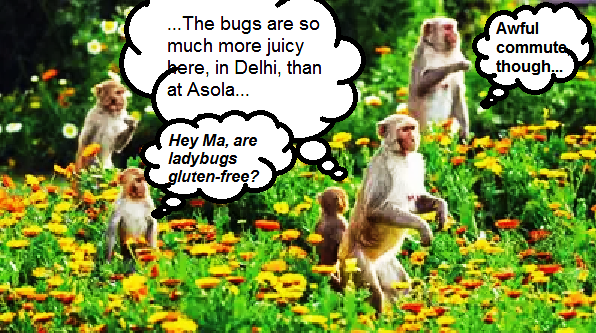
Delhi is globally renowned for its brazen and aggressive motorists.  Delhi is also globally renowned for its brazen and aggressive monkeys.  Many visitors to the Capital see no distinction whatsoever between these two invasive species, whose populations are increasing in our beloved Capital by leaps and bounds (so to squeak).

And thereby hangs a tail.

Be that as it may, a recent newspaper report celebrates the fact that the Municipal Corporation of Delhi (MCD) has been catching an ever-increasing number of monkeys and rehabilitating them in the once-lovely wilderness of the Asola Sanctuary, located in the last remnants of the Aravalis between the goonda-and-politician–infested badlands of Delhi and Gurugram.  

We managed to obtain some interesting and highly improbable insights into how the MCD has achieved success in its monkey business, thanks to a brief but illuminating interview with Shri Bandarlal Poonchwallah, Senior Advisor to Commissioner, MC&RD (Monkey Capture & Rehabilitation Department), MCD.

Q:  Could you tell us a little more about the MCD’s Monkey Catching initiative?

Poonchwallah: As the name indicates, a Monkey Catcher catches monkeys. We currently have six Monkey Catchers on the MC&RD rolls. Besides a monthly retainer, our Monkey Catchers are each paid a small incentive on piece-rate basis— or more accurately, on monkey-rate basis.  The incentive ranges from Rs 1200 per monkey caught in East, North or West Delhi, to Rs 2400 for monkeys caught in South Delhi …

Q: But why do you pay Rs 2400 for South Delhi monkeys? That’s almost double the amount of incentive paid for monkeys from other parts of Delhi?

Poonchwallah: Arre bhai, you must understand that South Delhi monkeys are very much like South Delhi humans—they are much higher up in the socio-economic ladder than their cousins from other parts of Delhi. Also, like their human South Delhi colleagues, South Delhi monkeys are better-nourished, better educated, more cunning, and more well-connected with powerful members of local human communities including senior officials of Delhi Government and Union Government. So, they are much more difficult to locate and trap. For all these reasons they must be assigned a much higher monkey-rate value.

Q: Surely you can’t be serious?

Poonchwallah: (patiently) The MC&RD has well-documented evidence to support this thesis. Our Monkey Catchers often report that South Delhi monkeys look healthier and are better groomed than other monkeys; in fact, Lutyens Delhi monkeys often chatter among themselves with distinct British or American accents. Most of them scorn traditional Indian food! So, we have to procure costly international food items like thin-crust pizzas, sushi, and whatnot to entice these high-class South Delhi monkeys…whereas simple desi snacks like peanuts or samosas will do to trap, say, East Delhi monkeys. Here, I will show you… (Scrabbles among papers on desk)

Q: But…but…

Poonchwallah: (impatiently)… Wait, just yesterday I had a report from our senior-most Monkey Catcher on a young monkey he caught in South Delhi’s Nizamuddin area…ah, here it is. (Reads from note)  It seems that he—meaning this South Delhi monkey, not the Monkey Catcher who caught him—eats only organic food cooked in virgin cold-pressed olive oil, is fond of wearing Paco Rabanne perfume, and has become quite notorious for selecting and stealing only Ray Ban glasses and 5G cellphones from strollers in the nearby Sundar Nursery …

 Q: What! But…this is incredible!  

Poonchwallah: Yes! It is! I am glad you see it! (Bitterly) But no-one else seems to understand the value of the empirical knowledge and experience acquired by us in the course of our Monkey-Catching initiative. Despite MC&RD’s numerous proposals to the Delhi government and Union governments and to academic institutions like Delhi University, JNU and others,  nobody seems to be interested in funding this wonderful opportunity for conducting socio-anthropological research into how Delhi’s monkey populations are adapting in diverse ways to the rapidly changing metropolitan environment, the socio-cultural mores and fashion trends…(breaks off, sinks into moody silence)

Q: (shaken to core) Well, sir…to return to the topic …how much does this Monkey-Catching initiative cost us taxpayers?

 Poonchwallah: (reading from file) Let’s see…between April and July last year, that is 2021, MCD caught and rehabilitated 350 monkeys. So, at an average incentive of, say, Rs 1800 per monkey, we paid our Monkey Catchers about Rs 6.3 lakhs as incentive during these four months. (looks up proudly) But during the same four-month period this year, 2022, we have caught and rehabilitated over 600 monkeys…for which we have paid our Monkey Catchers Rs 10.8 lakhs in incentives.

Q: That’s impressive! And after you catch and rehabilitate the monkeys in the Asola Sanctuary,  how do you make sure the monkeys stay there?  Monkeys are great travellers…so how do you make sure they don’t return to the City? Do you monitor them in their new home? Do you periodically count their numbers in Asola? 

Poonchwallah: (with explosive snort):  Kya bakte ho!  Do you seriously think MCD employees can go and sit in the Asola Sanctuary and count monkeys? (Continues in calmer tone) Don’t misunderstand me—I agree that this Monitoring & Evaluation task in Asola is important. And I may add that 99% of all MCD staff, including myself, would jump at the chance of a permanent posting in Asola. But this wretched Aam Aadmi Party government in Delhi simply will not give MCD the required funds for this vital component of our Monkey-Catching initiative, despite repeated demands.   Arre, these @$*@]%$&! AAP-wallahs haven’t even given us the funds to pay our municipal sweepers their wages since September 2021… (relapses into sullen muttering)

Q: But…but this means there’s a strong likelihood that the monkeys being caught now by MCD were in fact caught earlier too? That the monkeys are travelling back from Asola to Delhi just as fast as the MCD is relocating them from Delhi to Asola?!  Isn’t it possible that the MCD is catching the same monkeys over and over again, counting them multiple times, and paying Monkey Catchers for this circular exercise?

Poonchwallah: (slight hunted look) Baah! Tchah! Tut! Only a complete nutcase would want to return to this wretched City after being given a chance to leave it! No, no, I think we can and must trust the monkeys to be sensible enough to stay where they have been rehabilitated, at the beautiful Asola Sanctuary.

Q: But…but…

Poonchwallah: (unfazed, continues to rave) …If at all some monkeys are detected coming back from Asola to Delhi, that must be because of ecological destruction in the Asola Sanctuary that is being actively encouraged by these same ##$**^&!saala %$ AAP-wallahs…  

 Q: But…but…

Poonchwallah: ((warms to the theme) In fact, that explains why, as reported by our Monkey Catchers, most of the monkeys we are trapping nowadays look thin and famished! You see? Not only are these unfortunate monkeys not able to forage for food in Asola because of deforestation and environmental degradation, but they are forced to trek back over 25 kilometers all the way to Delhi! It is a shame. It is a violation of their human rights!

Q: But…but…

Poonchwallah: [clearly gone completely ape] We shall demand that Delhi’s AAP government provide MCD with a fleet of 10 AC buses so that we can transport the monkeys safely to and from Asola. Electric buses – so that we minimize greenhouse gas emissions.  Meanwhile, my MC&RD team will leave no stone unturned in trapping and rehabilitating these poor monkeys on ongoing basis. In our budget estimates for the next financial year, that is 2023–24, we project to catch around 16,800 monkeys, in anticipation of which we propose to hire 10 additional Monkey Catchers and set aside a corpus of 3.5 crores as incentives for our Monkey Catchers…

[interview abruptly terminated at this point, when  alpha-male monkey wearing Chaprasi uniform leaped in through open window, snatched away Shri Poonchwallah’s mobile phone, saluted us with a grin and strolled out through office door to seat himself on stool outside.]

Ancient writings, Beastly encounters, Potshots

In the Plutonium Doghouse

Sixty thousand years ago, our dear ancestral cave-people snarled and hurled abuse and rocks and bones at their neighbouring cave-people, even as their respective supporters cheered and goaded them on while keeping themselves at a safe distance…

Today, Russia devastates Ukraine with missiles and other frightful weapons after being goaded beyond endurance by NATO and EU and USA, and Russia and the USA and NATO and EU snarl at one another even as the USA and NATO and EU cheer on and goad the Ukrainians to fight back and pour missiles and other frightful weapons into Ukraine while keeping themselves at a safe distance…

Everything changes. Nothing changes.

Thus it is in this dog-eats-dog world that we humans have in our wisdom created…because we love one another.

Cheered slightly by these thoughts, I inflict ‘pon thee, O long-suffering and precious Reader, a piece I wrote over 23 years ago – in fact, soon after India’s nuclear tests in 1998.

Disclaimer: Any resemblance in this article to any persons or nations on Earth, however slight, is entirely intentional.

____________________________________________

A mysterious defence document has come to light of all places, in the wrapping paper used by a peanut-vendor who operates his business near New Delhi’s India Gate. Inquiries reveal that the vendor purchased eighteen kilos of waste paper from Raksha Mantralaya early in May, and noticed this particular document only while wrapping five rupees’ worth of peanuts. “The masthead on the pages was different from the usual Defence Ministry stationery,” he explained, “so I thought it might be important, and called the authorities!”

Titled “In the Plutonium Doghouse”, the document is typed on the memo-pad of the Defence Ministry’s shadowy Department of Strategic Planning and Control (DSPC), and appears to be a sweeping account of global nuclear history. With Defence Ministry officials refusing to comment on it, the document is reproduced in its entirety below.

In the Plutonium Doghouse

Delhi, May-June 1998.

Once upon a time there was a kennel, in which lived dogs of assorted size, shape, faith and hue. Oldest among the dogs were Big Yellow and Big Brown. The two were neighbours, and like most senior citizens, pretty peaceful characters; in fact, Big Brown spent most of his time sleeping. Then came Big White, Big Red and a host of smaller dogs.

In the beginning things were just fine. Each dog had its very own space, with enough food supplies to last forever if managed well. But over the years some dogs got greedy and gobbled up their own supplies, and then they took to stealing other dogs’ food. Naturally, a stage came when they were all fighting like cats over the supplies that remained.

One day, Big White dug up an ancient bone from somewhere and discovered that by blowing on it he could make a fearful racket; enough to reduce all the other dogs to quivering, defenseless puppies! Naturally, he put on a lot of dog after that. He strutted about the kennel, brandishing his new pipe and helping himself liberally to the others’ provisions. But soon thereafter Big Red dug out a terrible bone-pipe of his own, and he was followed by two smaller white dogs; and barely had the echoes from their cacophonous pipes died down when Big Yellow nearly brought the roof down with a resounding trumpet-blast of his own.

Realizing that it was futile to aim their pipes at one another, the five dogs went into a huddle and came up with a brilliant idea: an exclusive pipe-wielder’s club, from which other dogs were debarred! For a while, then, the Plutonium Club (named after Pluto, the Almighty Celestial Dog) ruled the kennel; The five P-5 mongrels strutted about the kennel while the other dogs cowered in terror.

But Big Yellow was hungry for variety in his diet, and soon his crafty eyes turned towards the mountainous stores of Big Brown (who of course had slumbered while all this was happening).

Now, there was a little brown dog aptly called Li’l Brown who lived right next to Big Brown. Kennel folklore had it that once, very long ago, both Big Brown and Li’l Brown had belonged to the same family; but then a bitter quarrel had taken place over property, and Li’l Brown had thrown a tantrum and moved out to live by himself. Since then, Li’l Brown had developed a habit of filching food from Big Brown or nipping him while the old dog was asleep (which was almost always), and whenever the old dog protested Li’l Brown would roll over and yelp, “Help! He’s bullying me!” Baffled, Big Brown would go back to sleep, but soon Li’l Brown would be badgering him again, egged on by Big White who found it all very amusing.

Big White had other reasons too for befriending Li’l Brown. Right next to Li’l Brown lived a host of small dogs with vast supplies of delicious Afghan and Mughal food. Now, both Big White and Big Red were partial to Central Asian cuisine, but being much closer to these little dogs, Big Red had been hogging the lion’s share of these goodies.

So Big White made Li’l Brown his ally, promising him limitless supplies of hot dogs and cold fizzy drinks if only he harried Big Red and kept him away from the neighbourhood of the little dogs while he, Big White,instead carted off their provisions by tanker-loads and pipelines … oh, their oily pilafs were simply delicious, though the skewered meats did generate a lot of gas…

Well…such were the dog-eats-dog politics of the kennel.

But even while all this was happening, a day came when Big Yellow turned to Li’l Brown and growled, “Here’s a present for you… a little bone-pipe of your own! Now be a good fellow and wave it under Big Brown’s nose. It’ll distract him while I take a bite out of his Sikkimese pudding…I’ve been fancying it for years!”

But even as he spoke, a deafening roar shook the ticks off the kennel walls. Big Brown had sounded his very own bone-pipe; how he had dug it up while asleep, no one knew.

“Blast!” growled Big Yellow.

“Dog-gone it!” howled Big White.

As for poor Li’l Brown, he was inconsolable. “I can’t hound Big Brown any more, his bone-pipe’s bigger than mine,” he yelped and wailed. Finally Big White went over to him. “Aw, come on,” he rumbled soothingly, “tootle on that little bone-pipe of yours, chew on this nice piece of Afghan kebab, and you’ll feel better. As for Big Brown, just wait till the old duffer’s asleep and then take a nip out of his tail.”

Note from Special Directorate, Intelligence Bureau/DSPC, Raksha Mantralaya: Unfortunately the remainder of this secret document is untraceable at this point. Peanut vendors and their clients in Delhi are requested to keep an eye open, and to inform us at once in case any more pages are found.

Beastly encounters, General ravings

Tick Talk

[O most valued Reader, of late I’ve been feeling that everything’s going to the dogs… the world, the environment, politics, society, and of course my writing. An appropriate time, then, to present this short essay – published in May-June 1995 by my dear friend Uma in her magazine ‘Small Change’]

We’ve at last come to realize that humankind is not the sole intelligence in the universe.

Consider the tick.

Now, anybody who owns a dog or who’s ever had anything to do with dogs will certify the truth of the following statements:

1. Ticks love dogs.

2. Ticks feed on dogs.

3. When full, ticks drop off dogs and crawl up walls.

A tick not only crawls up the wall; with grim determination etched upon its face, it continues to crawl (upside-down) across the ceiling till it reaches some predetermined spot. And there, it settles down and waits.

The question that arises naturally is: waits for WHAT?

We asked the vet. He looked surprised and immediately replied: “For a dog, of course!”

We were nonplussed. We sought urgent clarification. Surely, we stressed, ticks might not have our levels of intelligence, but even they would know that dogs preferred to walk on the floors and were in fact rarely found scaling the walls of a room, forget the ceiling?

The vet chuckled and said we’d missed the point.

“It’s like this,” he said. “The tick, having fed on a dog, falls off the dog and on to the floor, right?”

We nodded.

“Now, then, the tick naturally needs to rest awhile and digest its food. But at the same time, it must be in a position where it can find a dog at short notice…so it doesn’t die of starvation, right?”

We nodded again.

“Now, if the tick remains resting on the floor where it’s fallen, two serious problems arise. One: even if a dog passes it by frequently, it’s not going to be easy for the tick to get back on board the dog; after all, the dog will be moving pretty fast compared to the tick, and so there’s not much chance for the tick to hop on to a passing paw or tail. Two: while the tick remains lying there, there’s every chance that it will be stepped on by a careless boot, or swept away or swabbed or vacuumed into oblivion.” He paused for breath.

“You mean…the tick knows all this?”

“Of course it does! Believe me, that little tick is mighty sharp. And so, what the tick instead does is, it heads for the nearest wall as fast as it can. Then, it crawls up the wall all the way up to the ceiling, and it crawls across the ceiling till it reaches a spot from where it has an uninterrupted view of the floor below. And there it waits…for a passing dog. Sooner or later, a dog will walk beneath it; whereupon, the tick judges the dog’s velocity, matches it against the estimated distance to the floor, swiftly launches itself…and lo! There the tick is, safely back upon the unsuspecting dog’s back for another enjoyable season of feeding…”

We were awestruck. “So….that explains why we sometimes find a tick or two crawling about on our arms when we visit people who own dogs,” we muttered. “The ticks must have fallen off the ceiling on to us; they must have miscalculated their launch angles and velocities, maybe leapt too soon or late…”

“You’ve got it all wrong!” the vet spluttered. “If and when a tick lands on you, it does so deliberately.  You see, the tick knows you like dogs…or at least it knows that you know the owner of the resident dog. And so, the tick knows that sooner or later you’re going to meet the dog, or the dog’s owner. And what better launching pad could the tick have to board its dog from, than your shoulder, or arm, or neck, or hair…”

At which point we fled.

Yesterday we read a news item headlined: ‘Search for Intelligent Life Continues in Outer Space’.

They’re looking in the wrong place!

Beastly encounters, General ravings, Musings

Anopheles Dream: an exploration into the Nature of Reality

I’m not sure what philosophy is.

It’s such a heavy, intimidating word: like ‘intellectual’.

I’ve read a few people who are called ‘philosophers’ – Russell, Thoreau, Camus, Huxley, Gandhi, Sartre, Vivekananda come to mind (and leave the mind as quickly as they come). I’ve found them really interesting and absorbing to read because…well…they are common-sensey in a kind of deeper way. They don’t use long, hard-to-understand words like ‘philosophy’. They talk about the simplest, most common day-to-day things: people, situations, events and feelings and emotions that you and I and everyone else feel and experience. But they delve so deep into these things they talk about that very soon you find you’re looking at and experiencing just about every possible thing in the universe.

Right now I sit here, muttering and stuck for ideas as I always am, while Tangerine Dream’s moody notes beat on my tympani and gently stir the frail wings of the mosquito that sits on the wall across the room, relaxing and soothing our respective muscles and joints and nerves jointly and severally in gentle, soporific and sonorous waves.

I stare at the mosquito. It stares back at me.

I drink, therefore I am…

I shift my stare to the white rectangle of a blank Word document. It too stares blankly back at me.

After profound thought, I decide to undertake a philosophical Exploration of Reality.

I touch the ‘Enter’ key.

Now.

I feel, I felt, the Enter key!  It felt hard but not too hard. As I pressed it down, I heard a slight, soft click. I released the pressure of my finger; the key sprung back. And even as I went through these steps, in a fraction of a second, I saw the blinking vertical line of the cursor dart down the white virtual page on the screen.  I felt, I heard, I saw.

All these things I understand well! I know what these senses are, of touch, sight, of hearing. As I do the sense of smell, of taste.

I am aware.

I know the shapes and hues of the hills and forests, the houses where I lived in childhood, the expressions on people’s faces; I can feel winter sun’s warmth, a neem tree’s cool shade, a caress, the slap of an affectionate cat; I know and can recall the taste of mango and rum, of keema and sambar; the sighs of pine trees and tired people in a queue, the howls of lonely puppies and unseated politicians. I know the smells of coffee, of freshly peeled oranges, of grass growing in a Himalayan meadow and smouldering in a chillum, of Mumbai in the monsoon and crowded Metro trains in Delhi.  I know the sights, sounds, smells, tastes, feels of the millions of things, living and non-living, small and big, that I have ever encountered in my long and misspent life and that have influenced me, shaped me, made me what I am.

But now I ask myself: are these sensory phenomena and their vasanas—their impacts on the sense organs by which I perceive them—really ‘real’? Do these phenomena actually have an absolute, immutable, non-relativistic quality about them? Do their characteristics transcend space-time, are they perceived the same way by others, human and non-human, irrespective of frame of reference?

Do bacteria shiver in winter the way I do? Are goats and dust-mites moved by music as I am?

‘Of course not!’ shrieks the Voice of Rationality in my skull. Pressed for evidence to the contrary or in favour, however, the Voice of Rationality subsides into muttering curse-words like an aggressive Delhi driver who’s not been allowed to overtake on the wrong side.

The Voice of Rationality, too, has no answer.

Ha.

If, then, a cloud of uncertainty hangs over the reality or unreality of the animate and inanimate things that impinge on my senses and enables me to sense them….what of my senses themselves? Are these senses with which I perceive the Reality around me false? These senses that have helped me define and delineate and categorize and sort and arrange and play around with the objects – living and non-living – that have surrounded me from birth, and indeed enabled me to create my version of Reality; are these senses ‘unfixed’, variable, entirely subjective, and therefore unreal?

‘Of course not!’ comes a feeble croak from the Voice of Rationality. ‘Because if indeed our senses are unreal, non-Absolute, then what you and I and everyone else’s devar and mausee and periappa think of as Reality is in fact Unreal. Illusion.

Ha!

In that case, I press on triumphantly, what I think of as Reality is real only to me –  this world of shapes, of objects living and non-living and their interactions with me and with one another, their patterns of behaviour – are quite unique to me, and me alone.

I, I alone AM.

Kazhudai vishtaham,whispers the mosquito on the wall. It has covertly been listening to my thoughts.

It is, I realize with a start, a Tamil-Sanskrit scholar whose ancestors date back to the Sangam era.

“Donkey’s droppings,” the mosquito translates helpfully, and takes flight.

I am chagrined, deflated. I am also bitten several times by the mosquito.

As I mentioned earlier before I rudely interrupted myself: philosophy and I don’t get along.

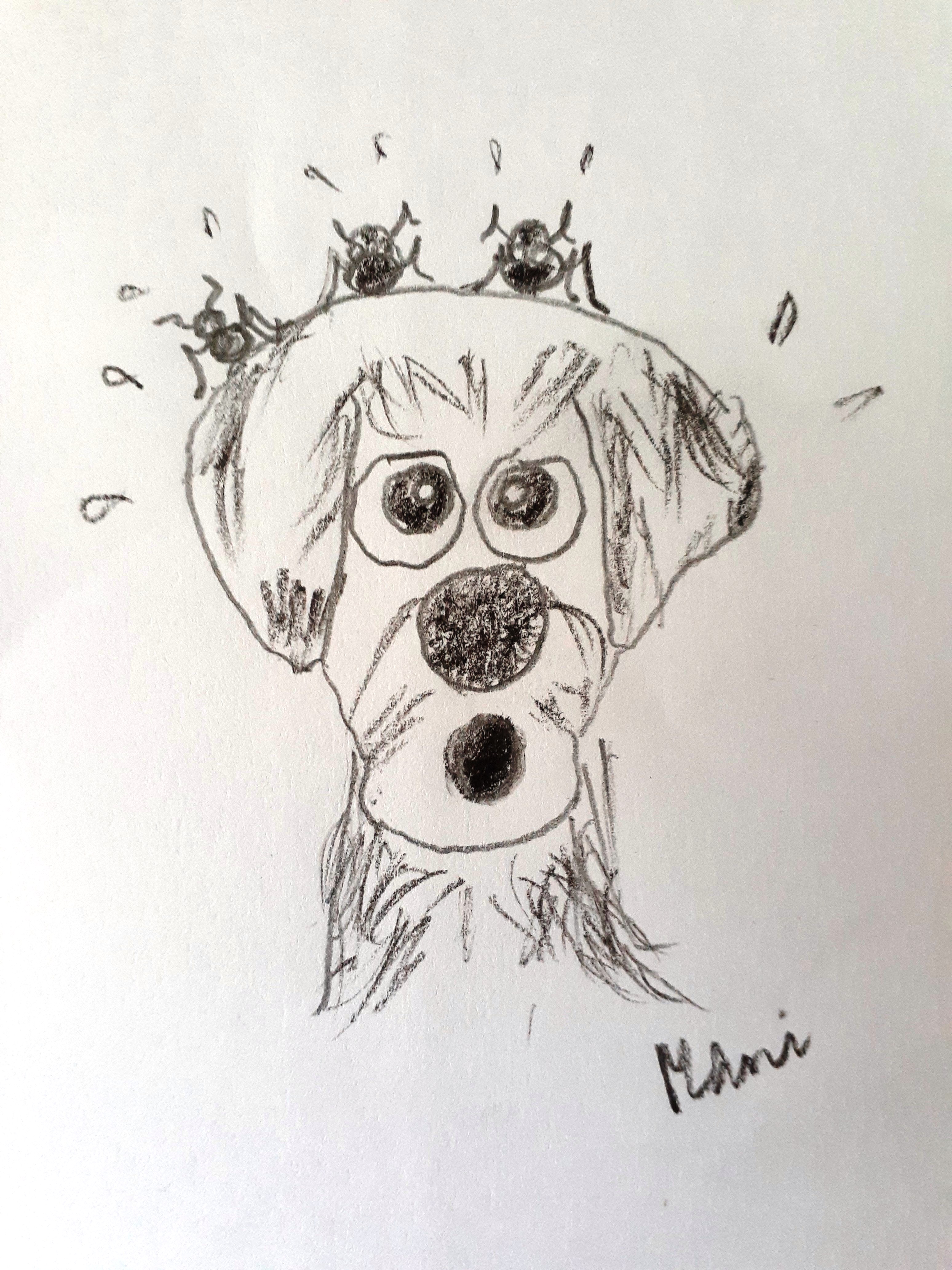
My moment of enlightenment (mosquito can be seen near right ear)

I find solace in Odomos, and in the fact that physicist Richard Feynman didn’t like philosophy too much either: he found it boring, pointless, filled with long, complicated words and explanations that didn’t seem to mean anything.

Feynman’s supposed to have said: “Philosophy is about as useful to scientists as ornithology is to birds”.

By his own admission, Feynman took an unholy delight in replying, in the most philosophical manner, to the too-clever-by-half questions framed by people who want to appear extremely profound and deep.

An example—Feynman’s reply to a question from the audience, at the end of a lecture he had given on the properties of light:

Q: When you look at something, do you see only light or do you see the object?

Feynman: The question of whether or not when you see something, you see only the light or the thing you’re looking at, is one of those dopey philosophical things that an ordinary person has no difficulty with. Even the most profound philosopher who’s sitting eating his dinner, hasn’t any difficulty in making out that what he’s looking at perhaps might only be the light from the steak, but it still implies the existence of the steak which he’s able to lift by his fork to his mouth. The philosophers who are unable to make that analysis and that idea have fallen by the wayside through hunger!

Hail Feynman, hail the great philosophers of MAD Magazine and other immortal epics.

Beastly encounters

The Squirrel’s Victorian Secret

[or, Thongs from the Wood]

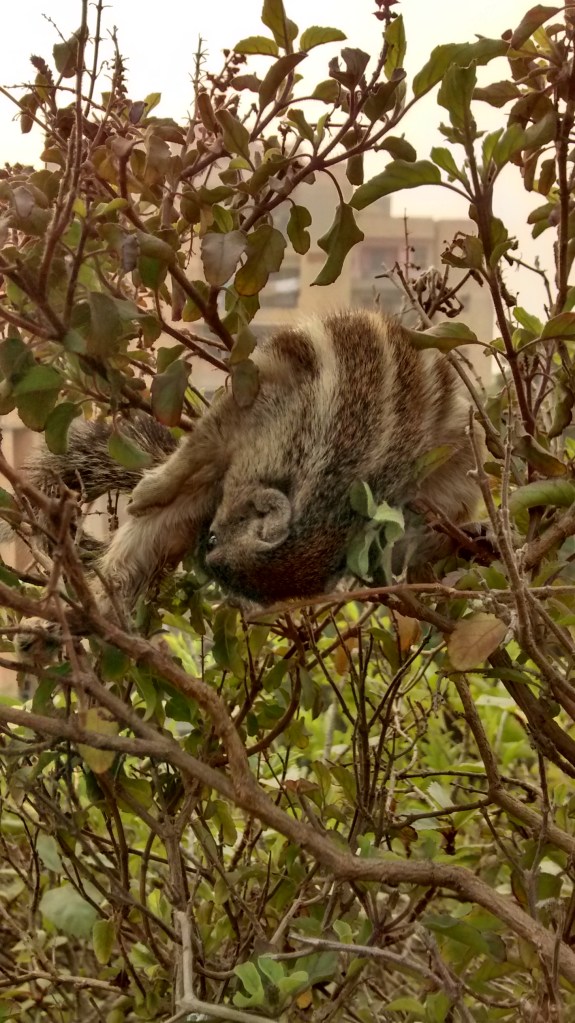
The local squirrels and I get along very well.

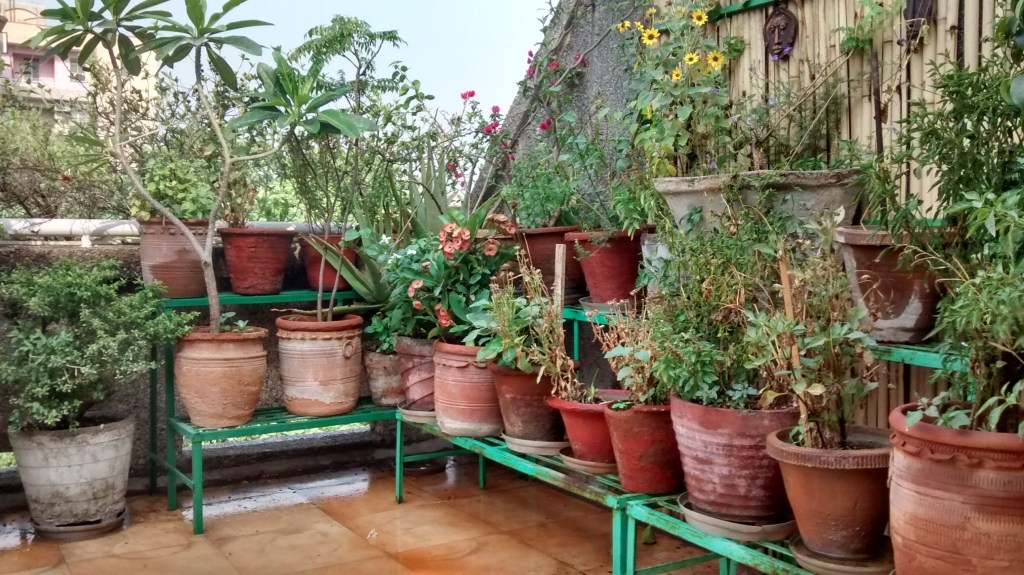
Every day, I set out water for them – well, for the squirrels as well as for the pigeons, mynas, sparrows, crows, bulbuls, doves, sun-birds, babblers, wasps, chameleons, and all the other assorted creatures that have permanent citizenship and visiting rights to the terrace upstairs.

1 Community ground
Terrace

Whenever I can, I toss the squirrels – and all the others – snacks to nibble on. Regular snacks include peanuts, cashew nuts, walnuts, raisins, bits of biscuits, pieces of buttered toast, and leftover rice. And in winter, when Delhi is at its best, with blue-and-gold mornings and clear, chill nights and the air crisp as the Marie biscuit that accompanies your hot cup of chai, I sit out on the terrace with the squirrels et al., and we bask in the sun for hours on end and chew assorted snacks and contemplate the beauty of the Universe, the subtleties of Creation, and the idiocies of Indian Polity.

Sometimes, the squirrels and I do yoga together.

2 -That's my spot

“You’re sitting in my spot!”


3 Yogi Gileriswamy in aerial Uttanasana
Aerial Uttan-asana

I’ve discovered squirrels eat all kinds of things we eat: potato wafers, murukku, samosa, paratha, slices of apple and mango (well, who wouldn’t eat that!), even gobs of ice-cream. I had always thought squirrels were vegetarian. And then, one winter’s day, I saw a scampering squirrel come to a screeching halt beside the tiny, desiccated remains of a long-deceased beetle. The squirrel peered at the hors de oeuvres; sniffed it thoroughly from end to end; and then grabbed it in two little paws and scrunched it down with thorough enjoyment before racing along on its interrupted errand.

Once, I offered a young squirrel a fish tikka in its foil wrapping, complete with a liberal daub of peppery green chutney. The squirrel unwrapped and ate the tikka with great delicacy, as though it were a gourmet dish, proceeded to lap up every last drop of the green chutney…and then sat on its haunches licking its chops and staring at me hungrily, hoping for more.

The squirrels are adapting to my ways, just as I am adapting to theirs. It is deeply comforting, this mutual bonhomie and peaceful coexistence.

Yet, the squirrels and I have our personal spaces; for do not strong fences make good neighbours? We too have our border; a Line of Actual Control (LAC), reasonably well demarcated, that both sides respect and do not breach, barring occasional, unarmed tests of strength that are as brief and non-violent as the scuffle between unarmed Chinese and Indian soldiers on the LAC in Sikkim, and as speedily and honorably settled with mutual withdrawals to our respective ground positions.

Thus, barring a few choice epithets hurled in their general direction, I do not bear the squirrels ill-will when I discover that they have vigorously uprooted and consumed all my carefully planted bulbs and seedlings in the terrace garden; nor do I run to the United Nations wailing for third-party mediation when a cheeky little squirrel-pup filches the buttered toast from the saucer that I had left unguarded for a minute while I went indoors for a coffee refill. Likewise, beyond tweeting a few derisive comments about me, the squirrels don’t complain when I chase them away from the chili plants whose slender twigs they love to use as toothpicks; or when I periodically clean up the window-sills that they use as community toilets (inspired, no doubt, by the Swacch Bharat Mission).

Recently, however, the spirit of Panchsheel that has hitherto governed our relationship was shaken by an unprecedented security breach on the LAC.

It started with a strange aroma in the kitchen: a scent that was neither pleasant nor unpleasant but quite distinctive: a cocktail of ancient pocha-kapda (mopping cloth), straw, damp leaves, grease and dog fur.  For two days I hunted for the source of the smell. I checked every cupboard and shelf and drawer, every container and bottle; the fridge, toaster, the sink, the drain, the waste bin, even the water filter. No luck.  The scent grew stronger, my appetite weaker, my mood fouler.

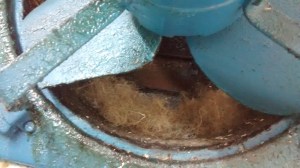
And then, returning home in the evening on the third perfumed day, I saw a squirrel taking a stroll on the kitchen counter-top. It executed a hop-skip-and-jump via the water filter up to the exhaust fan vent, within which it disappeared.

4 Exhaust fan
Theatre of action – LAC

The exhaust fan vent…the one place I hadn’t thought to check! So I climbed on to a stool, stood on tiptoe and peered into the recesses of the vent. Voila! There it was, the source of the aroma—a pile of shredded cloth and rope and string and straw, carefully arranged layer upon layer to make it soft and springy, so tall that it completely obscured the hinged vanes on the far side of the vent. Of the squirrel, there was no sign.

The squirrels had built – or were still building – a nest.

But how on earth had they managed to get into the vent, that too with all this nest material, when the vanes on the far side  normally remained shut and opened only when the fan was running? I soon discovered the answer: professionals that they were, the squirrels had wedged some kind of rag tightly between two vanes, so that the vanes remained half-open during the great construction project to allow smooth ingress and egress of squirrels and building materials.

5 Spring bed
Playpen in the making…

The discovery of the nest plunged me into a great moral dilemma, such as that which nearly undid the great warrior Arjuna on the battlefield of Kurukshetra before Krishna talked some sense into him.

I didn’t have the heart to demolish the nest. For the squirrels, the cool and dark tunnel of the exhaust fan vent provided the perfect refuge from the scorching summer heat. Besides, wasn’t it possible that Ma Squirrel was expecting to deliver a batch of little squirrel-pups, and was making this snug little nursery for her young-ones-to-come? How cruel it would be for me to undo all her hard work, her labour of love!

But countering this emotional response came the harsh yet compelling voice of reason. The nest was fragile, precariously located…in the exhaust fan vent of all places! Wouldn’t it be awful if I, or someone else, turned on the exhaust fan and hurled the feather-light nest – and possibly the pups – against the cruel vanes?  Even worse, the fan blades might cause injury – or worse – to the squirrels. Surely that would be far crueller than removing the nest now, when it was empty?

And then, there was the little matter of mosquitoes. Every mosquito and her sister-in-law, from Noida to Gurgaon, must surely be making a beeline (or mosquito-line) for this inviting gap in the vanes, which, from a mosquito’s point of view, was like a blazing signboard over a fast-food joint; namely, me. Little wonder that of late, I was being eaten alive every night by the bloodthirsty members of the Family Culicidae…

What was I to do?

Like illustrious Arjuna, I chose the path of vacillation. Like brave Arjuna, I thought up seventy-six excellent reasons why I should not do anything. Let’s give it a day or three, I told myself: maybe Ma Squirrel will give up her nest project now, because she knows I’ve spotted her.

And so three days passed, with strict instructions given to one and all not to turn on the exhaust fan at any cost.  The kitchen walls and ceiling grew grimier, the mosquito bites grew more numerous and painful, the nest grew thicker and wider. This made me feel worse: I had to do something fast, before it became too late for Ma Squirrel to change her plans…and before I was completely consumed by the mosquitoes.

On the fourth day I had a brainwave: I would simply remove the rag that held the vanes open! The vanes would snap shut; Ma Squirrel wouldn’t be able to get into the vent; she’d fret a bit, and then shake her furry head sadly and find another site for her nest.

So I fetched the stool, reached into the vent and tugged at the rag holding the vanes open till the rag suddenly came free and the vanes snapped shut. Leaving the nest intact, I descended and examined the rag: it turned out to be the frayed remnants of my face towel that had gone missing from the clothesline on the terrace the previous week; I had assumed the towel had been carried away on the gusts of a dust storm.

Problem solved…or so I thought.

Two days passed uneventfully. On the third day, while sipping my morning chai and scratching idly at a mosquito bite, I glanced up at the exhaust fan vent and noticed that the nest was distinctly thicker. What’s more, there was something blue resting on top of the nest. I climbed on to my trusty stool and peered into the vent. Not only was there a fresh layer of shredded pocha kapda on top of the nest, but carefully placed right in its middle was a blue clothes-clip – no doubt, Ma Squirrel had chosen it to decorate and liven up the little nursery.

Ma Squirrel was at it again! But how on earth had she got into the vent ?

I peered into the dark tunnel…and groaned. Once again, there was a piece of fabric carefully and tightly wedged between two vanes to hold them open. Muttering like an irate old squirrel, I tugged out the piece of fabric, descended to examine it closely…and nearly gave up my ghost there and then.

In my trembling hands was a pair of panties.

Slightly worn, slightly frayed, but definitively a pair of red panties. Size L, by the look of them; though I did not look closely.

7 The ghastly evidence
Exhibit A

Well might you chortle, O dear reader. But picture my plight…and empathize! Leave alone Arjuna, even Bhimasena would have quailed at the dreadful situation in which I found myself.

Here I was, a single man, a senior citizen at that, holding a pair of panties. Whose panties they were, I knew not; nor did I want to know. I just had to get rid of them, fast. Imagine if someone walked in and found me in possession of lingerie!

How could I explain it? What could I say?  Speak the truth?

You see, I found these panties in my exhaust fan vent…The squirrels were building a nest in there…and they used these panties to prop the vanes open, so they could get in and out…”

It sounded a highly unlikely story, even to me.

I had to get rid of them! But carefully; I couldn’t risk anyone tracing the thingies back to me.

For a brief wild moment I considered burning the panties out on the terrace – but discarded the idea with a shudder. Imagine if the fire, and its source, drew the attention of neighbours…

And so, feeling like a murderer disposing of an inconvenient corpse, I wrapped the panties in three layers of newspaper; placed the paper package deep inside a black garbage bag; and then, deploying nest-layering skills and care that would have made Ma Squirrel shake her furry head in admiration, I buried the package beneath layer upon layer of vegetable peelings, tea leaves, coffee grounds, shredded paper, and finally and regretfully, the material of the nest.

A month has passed since that traumatic day. To my immense relief, there has been no discernible change in the neighbours’ attitudes, or in the attitudes of the squirrels. Clearly, the panties have been safely consigned to the landfill.

It’s now safe for me to reveal the truth, complete with photographic evidence – such as it is – in the interests of transparency.

Ma Squirrel has not resumed her nest-building. Still, I continue to check the exhaust fan vent, and especially the vanes, thrice daily…just in case.

You just can’t underestimate the squirrels. Or under-rate their underwear-filching skills.