I was with a friend in her car. In the back were three more friends, all women, one of them Indian, the other two German: a mother–daughter duo.
It was the evening of January 25th, 2020, cloudy and chill at dusk. We were caught in a traffic jam—the only saving grace being that we were on the lovely Amrita Shergill Marg, bordering the Lodhi Garden in central Delhi, and so there was plenty of foliage (albeit blurry) to look at and discernible quantities of that rare element, oxygen, in the diesel-and- petrol -scented air.
After about 30 minutes of crawl-and-halt, we drew alongside a small group of policemen, who were trying with limited success to keep motorists to their lanes.
“Jai Hind,” I greeted them, as I always greet personnel of our armed forces and police.
“Jai Hind,” they responded.
“What’s going on?” I went on in my semi-tapori Hindi, “Why this jam?”
“The result of a little VIP transit, sir…it’ll all be cleared in a few minutes.”
I thanked him, and we sat in silence for a moment. And then my young German friend spoke up softly, clearly, in English: “Why did you say that to him?”
Puzzled, I looked around at her. Her Indian friend giggled but didn’t say anything. “Say what?” I asked.
“You said ‘Jai Hind’ to that policeman…why?” she murmured, now slightly embarrassed. Her mother, who spoke very little English, looked on in bemusement. Her Indian friend giggled again, in a slightly self-conscious way.
The question was simple, perfectly straightforward; but in a flash I realized what it was she was really asking and why she was asking; and what the young Indian’s slightly nervous giggle might mean too. It was January, 2020—that was the time when the Shaheen Bagh street blockade was at its peak; when young women and men not just in India but across the world were charged up with the heady passions and revolutionary slogans of the quaintly-oxymoronic ideology known as Left Liberalism; when any word, any sign, of showing solidarity with or pride in or support to even the idea of India was not only old-fashioned but had somehow become equated to becoming a ‘Modi-bhakt’, a ‘nationalist’, a ‘fascist’, an anti-Muslim fanatical Hindu. In India, and across the world.
It was a time when even uttering ‘Jai Hind’ more or less branded me as a narrow-minded bigot unless otherwise proven…or clarified.
The two young women were – are- very dear to me; the question was honest, direct and clear; and so I thought awhile before I replied. “’Jai Hind’means ‘Hail India’, or ‘Victory to India’ if you like,” I said. “I greeted that policeman with ‘Jai Hind’ because I am proud of my country, I love my country, and tomorrow is our Republic Day—the day when, in 1950, a couple of years after winning independence from British rule, India adopted its own Constitution and became a full-fledged Republic. So then, for the first time we Indians had drawn up and given ourselves our own rights, our own guiding principles to live by, the systems by which we would govern ourselves and so on…all the things that we had fought for and won, and that we must hold on to and defend. And so January 26th is a good day to remember. A good time to say ‘Jai Hind’, and of course that’s why ‘Jai Hind’ is a good way to greet military personnel, police…”
I trailed off, wondering whether I’d made any sense at all. She’d listened attentively as I spoke; silent, clear-eyed, nodding slightly.
“Ah yes, of course, now I see,” she murmured. In the meanwhile her mother, who had been listening as intently to our exchange, asked her daughter to explain in German, which she promptly did.
And then, both of them smiled and chanted: “Jai Hind!”
And we all chorused Jai Hind, and soon the jam cleared, and merriment returned and dissolved the tedium.
A trivial episode, no doubt; but for me it was important…and lingers in memory.
I will always be grateful to my German friend for her question.
It helped me think a little, reflect a little, learn and re-learn and un-learn much more than a little. About India, about what this insanely chaotic, wonderful nation means and what it is founded on, and what holds it together…and what can and does tear it apart.
I’ve never been embarrassed about wearing my sentiment on my sleeve – if only on occasion. And 26th July, 2001 was one occasion, the 2nd anniversary of Vijay Diwas – the Martyr’s Day in remembrance of the uniformed ones who gave their lives during the Kargil war, 1999…a war during which a few dear friends in Army and Air Force had played active roles. Today being 26th July, here it is: for all fauji friends, for all men and women of the fauj, past and present and future. With respect, with love.
On the night of 26th July last year we lit two little lamps out on the balcony and gazed at the lambent flames while, and on the still air we heard the whispers of names…Clifford Nongrum, Haneefuddin, Saravanan, Kalia, Ahuja…names of men we had never met yet seemed to have known so well.
Surely, they would have been no different from any other young men in the world? In their love for laughter and revelry, for the scents of rain upon earth and flowers in a woman’s hair, for home-cooked food, the warmth of a family gathering, a boisterous game with children…they too must have yearned for leisure, for romancing, for peace. One of them had played the guitar, another had a voice like Rafi’s. Rich and varied were their tastes in music, as indeed their backgrounds and origins. Yet fierce were the bonds that had joined these men of diverse faiths, united them in their battle to preserve this very diversity, this richness and variety.
A strange, overwhelming sense of loss came upon us even as the flames rose steady and unwavering. We glanced up at the high-rise apartment blocks all around, at their dark balconies and terraces. A stray breeze brought a brief snatch of canned laughter from some TV set in some curtained lounge. And bitterness and anger welled up, sudden and surprising. How could they all be so callous, the inner voice raged, how could they forget the martyrs of Kargil so soon.
But the self-righteous and sentimental mind’s voice was abruptly quelled by a remembered voice from childhood: easy, self-assured, slightly mocking in tone, the voice of a young soldier, slain in battle long ago.
“Listen,” he had murmured, “in life, what others think or do doesn’t matter a damn. What YOU do is the only thing that counts. Before you, before each one of us, there’s a path; the path of duty. Seek that path, follow it, all else falls into place. It is so simple…”
The voice faded back into the caverns of memory; the flames flickered. And suddenly the twisted, tangled coils of sentiment and anger dissolved into a moment of deep understanding. Indeed the martyrs of Kargil had fought obdurate foes, in the harshest of conditions. They had endured terrible pain, died warriors’ deaths. But they were men who believed – nay, who knew – that beyond death there is no joy or sorrow, neither friendship nor enmity; there are no borders or lines of control, nor remembrance nor names.
There is only the peace of Eternity.
That is why our soldiers treated even the enemy’s slain with dignity, with honour. And that is why they were victorious.
We turned away, then. Fleetingly, sadness returned as we beheld the dark balconies all around. A flicker of yellow drew our attention to the right…and we gazed spellbound.
Down there, beyond the compound wall, set in the humble doorway of a tarpaulin-roofed dwelling, two candles had been lit. Their flames rose steady and unwavering. And again on the still air came the whisper of names…Vikram Batra, Neikezhakuo Kengurüse, Kanad Bhattacharya, Vijayant Thapar, Mohammad Hussain…
How optimized food adulteration can make India a sustainable nation
Abstract
This paper presents an innovative approach to tackling the issue of food adulteration that causes so much stomach burn in India. It explains how, instead of griping about all the problems and dangers related to food adulteration, we can identify the hidden benefits of the adulterants being used, and find ways to recover, recycle, and reuse the adulterants to improve our individual and collective economic and gastronomic well-being. Thereby, we can increase overall resource efficiencies, contribute to India’s GDP, and enable our country to become a ‘net-zero’ economy by 2070 as announced at the Glasgow Climate Change Conference (COP-26).
Introduction
Adulteration is manifest in virtually every sector of India’s economy. It is indeed one of the pillars of our glorious heritage and culture. Historical and archaeological records reveal that indigenous and ingenious adulteration technologies and practices have been developed and successfully applied since 7800 BCE by Indian farmers, industrialists, merchants, retailers, middle-men, crooks, and other important stakeholders, and are constantly and enthusiastically being innovated upon to achieve maximum returns with minimum investments and efforts. As a result, today India has set global benchmarks for adulteration of materials, commodities and products in every sphere of human activity: from eggs to edible oils, cement to steel, cereals to spices, milk and medicines to condiments and condoms.
Alas, confusion still remains in policy-level circles on the exact meaning of adulteration.
In the course of researching this paper, the author invited a few Members of Parliament (MPs) from diverse political parties to share their views on adulteration. Here are their responses (names withheld in the interests of self-preservation and general social harmony):
MP 1: (brusque): “Why ask me about Adult Rating and such sensitive issues? (Irritably) How can I comment on what is adult content and what is not? I am a busy man; I have no time to see films, let alone Adult-rated films. You go and ask this question to the Film Censor Board…”
MP 2: (relaxed, courteous): “I think adulteration should be tolerated; is not India a land of tolerance and secularism? Yes, I know nowadays many men and women are adulterating freely and without care. But I say: It is all right! What is there? It is their personal choice, no? I always say, better to co-habit than to pick up bad habit! (Hastily adds): But speaking on my own behalf I do not adulterate. I believe in the holiness and wholesomeness of marriage, so I commit adulteration only with my wife… (Looks reverentially at sky) Do not all our great epicses and religious bookses say the same thing: ‘Thou shalt not commit adulteration?’
MP 3: (In great bitterness with much gnashing of teeth): Adult Ration is nothing but another big lie told by the communal BJP government to fool the people. You should ask your question to P.M Modi-jee and his friends, who keep shouting and screaming like anything about giving ‘Free Ration For All’! Arre Modi-jee, where is your Adult Ration? Who gets it? Do I get it? And why only give Adult Ration? Why not Children’s Ration? (Waves fist) I demand that central government should also give Minority Rations and Backward Rations with retrospective and retrogressive effect…” (relapses intounprintable muttering)
Clearly, there is urgent need for a massive nationwide awareness program to deepen understanding among the people— in particular, among our political leaders—on adulteration and related matters. Efforts in this direction are beyond the scope of this paper (and indeed, beyond the imagination and capacities of the author). However, using as examples a few commonly adulterated food products (milk, fruit & vegetables), the next section illustrates how adulteration can support highly profitable and sustainable business ventures with minimal investments and innovative technological interventions. These adulteration-based business ventures can be taken up by young Indian entrepreneurs under schemes like StartUpIndia and MakeInIndia. Such businesses will help create new jobs without threatening the livelihoods of the millions of hard-working people who currently depend on adulteration and allied activities for their income.
Adulteration-based business opportunities
Milk
Common adulterants: gypsum; urea.
Gypsum
Gypsum is a useful mineral, made up mainly of calcium sulphate. The gypsum in adulterated milk can be easily separated out by allowing the milk to stand awhile. The gypsum settles as a cloudy white precipitate, and can be recovered by filtration and dried out into a fine powder.
(L) milk adulterated with gypsum; (R) gypsum separated as precipitate
This gypsum powder may then be converted along parallel production lines into various high-value products such as:
Plaster-of-Paris, which is extensively used by orthopaedists in making plaster casts for setting broken bones. As explained in the next point, there is immense potential to create an ever-expanding market for Plaster-of-Paris in India and abroad.
Gypsum blocks, slabs, tiles etc. for use in making pavements, cycling tracks, floors, walls and other such applications in the construction industry. Usually, for such end-uses the gypsum is refined to remove impurities like calcium carbonate which make the gypsum brittle and prone to breakage. However, in the present context it is better to ensure that the gypsum products contain calibrated amounts of calcium carbonate and other impurities (if necessary, by adding them); because this will ensure that the brittle gypsum slabs and tiles will soon fracture and break, as will the bones of people walking on them. Thus, by paving the ground – so to speak – for an ever-increasing number of people to fracture and/or break their bones, we can create and sustain high-volume demands for Plaster-of-Paris from the orthopaedists to whom these afflicted people will rush for plaster casts.
Gypsum (‘chalk’) crayons and pencils for diverse uses: on blackboards, by teachers in schools and colleges; by pavement and wall artists; by police to mark crime scenes and accident sites; and so on. Here, the gypsum powder extracted from adulterated milk can be blended with the waxes, spent mobile oils and furnace oils, and various dyes and pigments extracted from adulterated fruit & vegetables (see below), and moulded into crayons and pencils of various sizes and colors.
Milking profits – gypsum crayons made from adulterated milk
Urea
Urea is a very important nitrogen-rich fertiliser. In India, urea is manufactured and sold at heavily subsidized prices to make it affordable for use by farmers—and of course, by milk adulterators, who by one estimate account for 44% of total annual urea consumption in India (Milavat Ali Khan and Saand Roy. 2011. “Milk adultery in India”. Al Nakhli Press, Delhi).
Urea is also a very important raw material for other industries like adhesives, paints & coatings, plastic, textiles and so on. Since Independence, these industries have prospered by buying urea meant for agriculture in huge quantities at the same highly subsidized prices. Unfortunately, the current evil and communal BJP-led government has prevented these industries from buying cheap urea, by making it mandatory for urea manufacturers to coat their urea granules with acrid-smelling neem oil. While farmers are happy with this ‘neem-coated urea’ as neem acts as a powerful, non-toxic natural pesticide, the industries and milk adulterators find it very difficult and expensive to separate the neem from the urea granules. Hence, they have to buy pure urea at much higher prices; sometimes they even have to import it. Due to high urea prices and crippling urea shortages, many of these industries and milk adulterating units—most of which are MSMEs—have suffered severe production losses, and some have even had to shut down for long periods, adding to unemployment distress.
This situation presents a huge business opportunity for young adulteration-based business entrepreneurs.
Urea, which is very soluble, can be recovered easily and economically from adulterated milk and purified for sale to industries. The purified urea can also be sold back directly to the milk adulterators. It is envisaged that in due course the milk adulterators and industry end-users of urea could form mutually beneficial consortia with the urea-extraction businesses, supported by suitable risk financing under ESCO-type models.
Organic urea made from best quality adulterated milk
In the long term—perhaps by 2070, to coincide with India’s becoming a ‘zero carbon economy’— the system can be streamlined with such high efficiency that the milk adulterators, urea-extraction businesses, and industries can achieve near-perfect circularity in resources management, eliminating the milk consumers entirely from the picture. By then, it is hoped, organic and eco-friendly milk substitutes such as desi tharra (indigenous whiskey) and bhang sherbet will be available in adequate quantities and at affordable prices for all.
Fruit & Vegetables
Common adulterants: wax; spent engine oil and furnace oils; grease; shoe polish; metanil yellow (pumpkin, capsicum); iron oxide (carrots, beetroot); malachite green (lady’s finger); oxytocin growth hormone (all vegetables and fruit); etc.
Waxes and oils
Many kinds of waxes and oils are used to polish eggplants (brinjal), tomatoes, gourds, apples, pomegranates, etc. and give them that special sheen so attractive to consumers and so toxic to consume. These waxes and oils represent high-value resources that can be recovered and reprocessed to bring significant profits and other benefits.
The waxes and oils can be extracted by simply warming the fruit and/or vegetables inside a dry container placed within a large pan of hot water (about 70°C). The wax/oil will soon melt and drip off the skins of the fruit/vegetable and collect as a congealed mass at the base of the container, from where it can be removed from time to time. [Warning: It is important NOT to use a direct flame for the wax/oil removing process; as applying direct high-temperature heat may end up frying the vegetables/fruit in their own waxes and oils, thereby reducing energy efficiency and also adding to India’s overall carbon emissions.]
The de-waxed and de-oiled fruit & vegetables may be sent for cooking, and the wax/oil pressed into small cakes and briquettes and sold as a high-calorific-value fuel to a range of end-users: from industries that can use it to fire furnaces and boilers, to street-vendors serving momos, chicken tikkas and dosas. Alternatively, the wax/oil briquettes can be sold back to the fruit & vegetable adulterators, thereby achieving circularity of resources.
High-energy fuel briquettes made from adulterated brinjal
It is worth underlining that the waxes and oils used in food adulteration not only contain high percentages of carbon, but are manufactured by highly energy intensive processes that consume huge amounts of fossil fuels such as coal, coke, and natural gas. Hence, the recovery of waxes and oils used as adulterants, and their recycling and reuse in such virtuous cycles, will contribute hugely to reducing India’s overall carbon emissions, and ultimately save the world from global warming.
Looking ahead
Based on the visible evidence in our food products, coupled with the invisible but often-painful evidence during our daily ablutions, it is clear that food adulteration poses grave dangers – and indeed cremation dangers– to the health of India’s body politic as well as Indian bodies corporeal.
However, as shown by the examples above, food adulteration also present exciting new opportunities for future generations to leverage the beneficial end-uses of food adulterants with innovative business models, and thereby create sustainable livelihoods as well as help India achieve its climate change commitments and become a circular economy.
It is hoped that the Union and state governments will borrow lessons from the highly disclaimed and globally discredited Universal Adult Education program, and launch a Universal Rapid Education on Adulteration (UREA) program that will create widespread awareness on the vast potential benefits offered by food adulteration. The UREA program could work in synergy with entrepreneurship development initiatives such as MakeInIndia and ZED. This Holistic approach will, we hope, enable India to assume a leadership role in making Adulteration For All a global movement, and benefit the world as a Hole.
Acknowledgements: The author has been greatly inspired by the collective wisdom of the late philosopher George Carlin as well as urban-based environmentalists, sociologists, journalists, academicians, developmental economists, the United Nations Organization, Greta Thunberg, Arundhati Roy, Dr Amartya Sen, and affiliated charlatans, conmen and con-women who (like this author) constantly struggle to ensure that humankind remains steeped in depression and teetering on the brink of crises —existential, emotional, environmental, ecological, sociological, biological, and/or scatological—so that we can all make successful, sustainable and lifelong careers in ensuring that humankind neither falls over the brink nor steps back from the brink, either of which situations would greatly threaten the livelihoods of future generations who might wish to follow our noble career paths.
Greetings, O loyal and cherished Reader; I bring glad tidings.
At last the glorious day has dawned—a day that you fervently hoped and prayed would never dawn.
Today is the day when I present to thee, and to the rest of long-suffering humanity, my prediction on the outcome of the Lok Sabha elections of 2024.
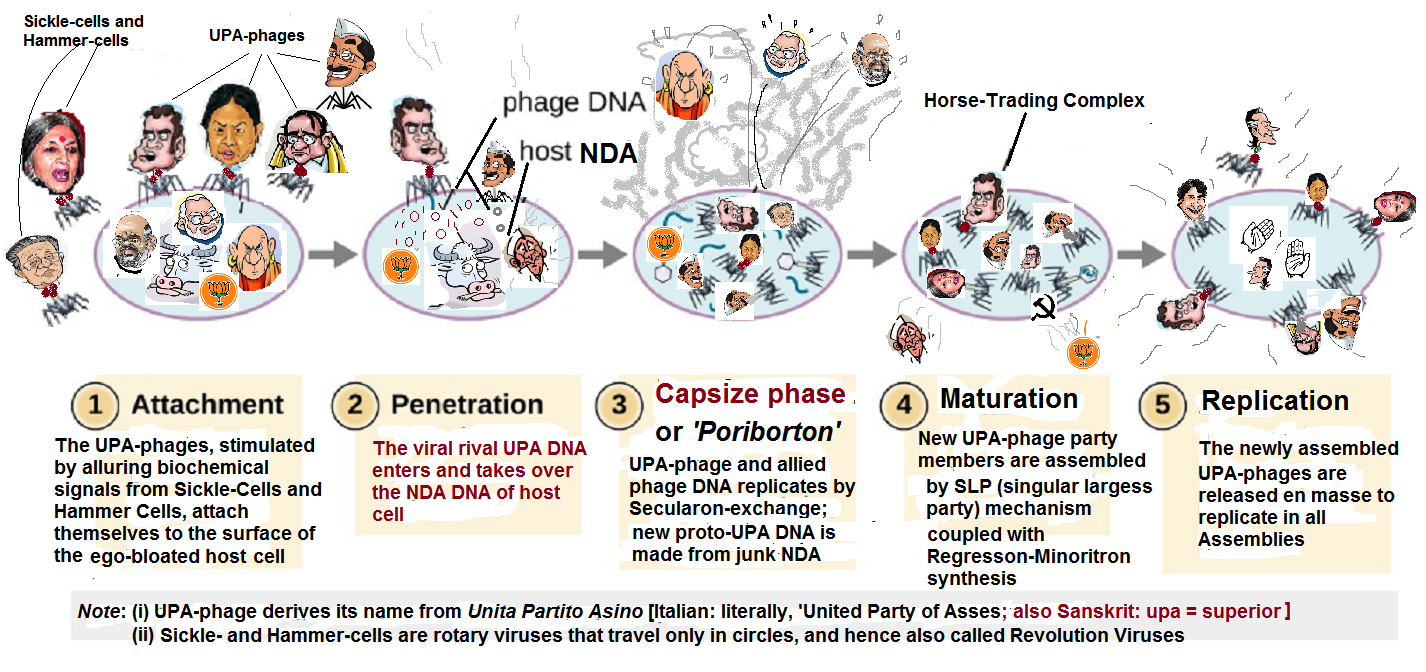
The broad theoretical elements of my research are presented in the form of two graphics, whose various components have been filched, misappropriated and/or lifted and morphed with all the usual care from an array of unaccredited online sources—to whom I am deeply grateful.
My Prediction
The BJP-led NDA will be totally erased from the Lok Sabha in 2024!
Rationale
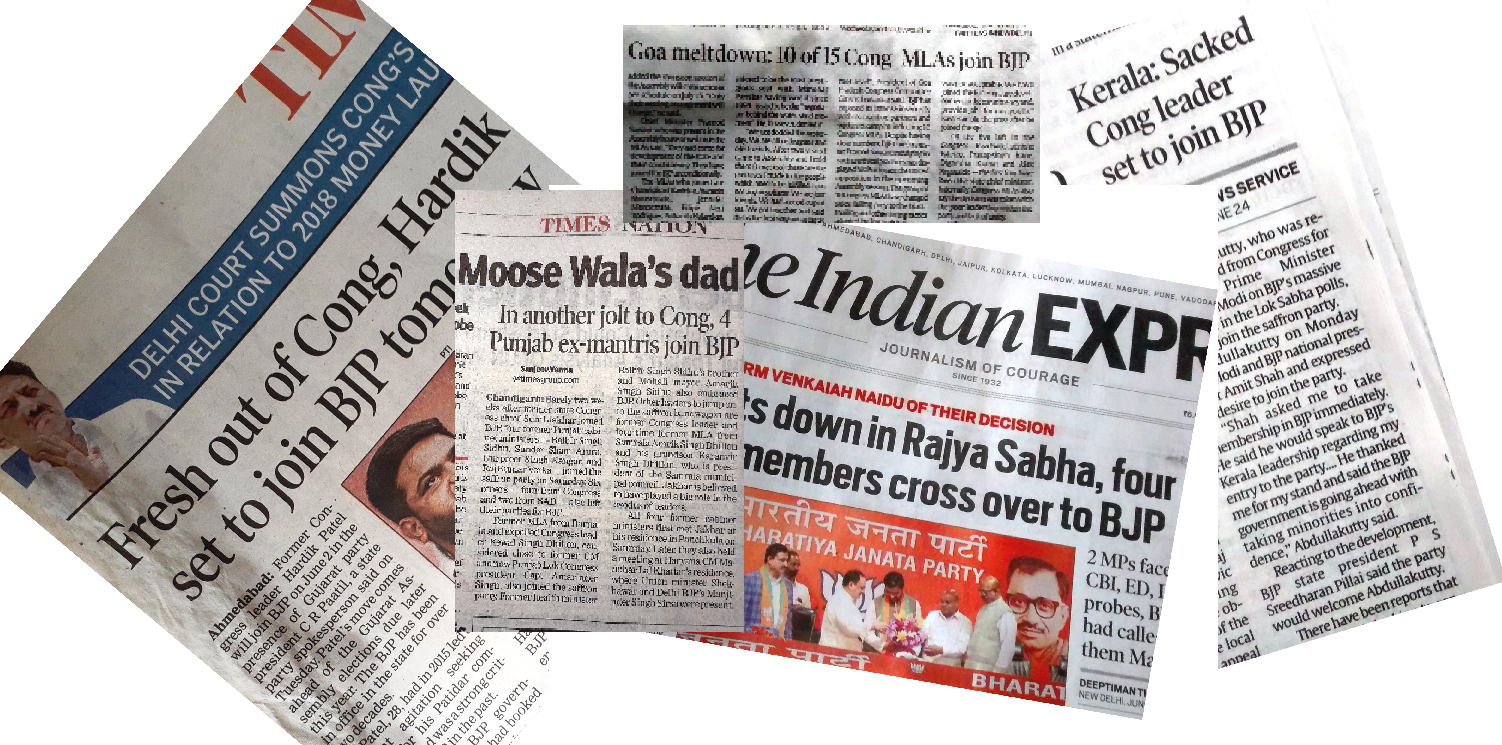
Defections from Congress and other Opposition parties to the BJP–led NDA will soon reach a Critical Mass; whereupon, the defectors and defecators will take over the NDA’s DNA through cellular-level dynamic transformations that are as effective, inexorable and deadly as the processes by which a virus takes command of a healthy cell.
Transformation and takeover of BJP in progress
1. How a migrating/invasive virus or bacteria takes over a healthy host cell
2. How migrating/invasive Congress-led members take over host BJP-led NDA cell
Afterword
My detailed research report is currently under review by a joint peer group of scientists from two of India’s most infamous, calumniated and globally disavowed academic institutes: the Indian Institute of Fundamentalist Sciences (IIFS), Delhi, and the Institute of Lactile Sociodynamics (ILS), Kanpur. It might be worth recalling (or perhaps it might not) that IIFS discovered two fundamentalist particles— Secularon and Minoritron—that are as important to sociologists as the electron and the Higgs boson are to primatologists; while ILS discovered the Regresson – the Backward-spinning cerebral particle, which has helped in formulation of the famous Creamy Layer Postulate regarding OBC Reservation that forms the bedrock of India’s affirmative action policy.
Disclaimer: This report is based on my independent de jure research and largely theoretical interactions with senior members of the political parties mentioned as well as other unmentionables, and backed by my professional knowledge acquired as Adjunct Liber Scholar with Master’s Degree in Prevarication & Associated Obfuscation from the globally disreputable Rannoy Poy–Khadka Butt Institute of Unhinged Psephology, New Delhi. Any inaccuracies, baseless allegations, errors, misrepresentations or incomplete data that might have crept in through deliberate inclusion are entirely my irresponsibility.
Sixty thousand years ago, our dear ancestral cave-people snarled and hurled abuse and rocks and bones at their neighbouring cave-people, even as their respective supporters cheered and goaded them on while keeping themselves at a safe distance…
Today, Russia devastates Ukraine with missiles and other frightful weapons after being goaded beyond endurance by NATO and EU and USA, and Russia and the USA and NATO and EU snarl at one another even as the USA and NATO and EU cheer on and goad the Ukrainians to fight back and pour missiles and other frightful weapons into Ukraine while keeping themselves at a safe distance…
Everything changes. Nothing changes.
Thus it is in this dog-eats-dog world that we humans have in our wisdom created…because we love one another.
Cheered slightly by these thoughts, I inflict ‘pon thee, O long-suffering and precious Reader, a piece I wrote over 23 years ago – in fact, soon after India’s nuclear tests in 1998.
Disclaimer: Any resemblance in this article to any persons or nations on Earth, however slight, is entirely intentional.
____________________________________________
A mysterious defence document has come to light of all places, in the wrapping paper used by a peanut-vendor who operates his business near New Delhi’s India Gate. Inquiries reveal that the vendor purchased eighteen kilos of waste paper from Raksha Mantralaya early in May, and noticed this particular document only while wrapping five rupees’ worth of peanuts. “The masthead on the pages was different from the usual Defence Ministry stationery,” he explained, “so I thought it might be important, and called the authorities!”
Titled “In the Plutonium Doghouse”, the document is typed on the memo-pad of the Defence Ministry’s shadowy Department of Strategic Planning and Control (DSPC), and appears to be a sweeping account of global nuclear history. With Defence Ministry officials refusing to comment on it, the document is reproduced in its entirety below.
In the Plutonium Doghouse
Delhi, May-June 1998.
Once upon a time there was a kennel, in which lived dogs of assorted size, shape, faith and hue. Oldest among the dogs were Big Yellow and Big Brown. The two were neighbours, and like most senior citizens, pretty peaceful characters; in fact, Big Brown spent most of his time sleeping. Then came Big White, Big Red and a host of smaller dogs.
In the beginning things were just fine. Each dog had its very own space, with enough food supplies to last forever if managed well. But over the years some dogs got greedy and gobbled up their own supplies, and then they took to stealing other dogs’ food. Naturally, a stage came when they were all fighting like cats over the supplies that remained.
One day, Big White dug up an ancient bone from somewhere and discovered that by blowing on it he could make a fearful racket; enough to reduce all the other dogs to quivering, defenseless puppies! Naturally, he put on a lot of dog after that. He strutted about the kennel, brandishing his new pipe and helping himself liberally to the others’ provisions. But soon thereafter Big Red dug out a terrible bone-pipe of his own, and he was followed by two smaller white dogs; and barely had the echoes from their cacophonous pipes died down when Big Yellow nearly brought the roof down with a resounding trumpet-blast of his own.
Realizing that it was futile to aim their pipes at one another, the five dogs went into a huddle and came up with a brilliant idea: an exclusive pipe-wielder’s club, from which other dogs were debarred! For a while, then, the Plutonium Club (named after Pluto, the Almighty Celestial Dog) ruled the kennel; The five P-5 mongrels strutted about the kennel while the other dogs cowered in terror.
But Big Yellow was hungry for variety in his diet, and soon his crafty eyes turned towards the mountainous stores of Big Brown (who of course had slumbered while all this was happening).
Now, there was a little brown dog aptly called Li’l Brown who lived right next to Big Brown. Kennel folklore had it that once, very long ago, both Big Brown and Li’l Brown had belonged to the same family; but then a bitter quarrel had taken place over property, and Li’l Brown had thrown a tantrum and moved out to live by himself. Since then, Li’l Brown had developed a habit of filching food from Big Brown or nipping him while the old dog was asleep (which was almost always), and whenever the old dog protested Li’l Brown would roll over and yelp, “Help! He’s bullying me!” Baffled, Big Brown would go back to sleep, but soon Li’l Brown would be badgering him again, egged on by Big White who found it all very amusing.
Big White had other reasons too for befriending Li’l Brown. Right next to Li’l Brown lived a host of small dogs with vast supplies of delicious Afghan and Mughal food. Now, both Big White and Big Red were partial to Central Asian cuisine, but being much closer to these little dogs, Big Red had been hogging the lion’s share of these goodies.
So Big White made Li’l Brown his ally, promising him limitless supplies of hot dogs and cold fizzy drinks if only he harried Big Red and kept him away from the neighbourhood of the little dogs while he, Big White,insteadcarted off their provisions by tanker-loads and pipelines … oh, their oilypilafs were simply delicious, though the skewered meats did generate a lot of gas…
Well…such were the dog-eats-dog politics of the kennel.
But even while all this was happening, a day came when Big Yellow turned to Li’l Brown and growled, “Here’s a present for you… a little bone-pipe of your own! Now be a good fellow and wave it under Big Brown’s nose. It’ll distract him while I take a bite out of his Sikkimese pudding…I’ve been fancying it for years!”
But even as he spoke, a deafening roar shook the ticks off the kennel walls. Big Brown had sounded his very own bone-pipe; how he had dug it up while asleep, no one knew.
“Blast!” growled Big Yellow.
“Dog-gone it!” howled Big White.
As for poor Li’l Brown, he was inconsolable. “I can’t hound Big Brown any more, his bone-pipe’s bigger than mine,” he yelped and wailed. Finally Big White went over to him. “Aw, come on,” he rumbled soothingly, “tootle on that little bone-pipe of yours, chew on this nice piece of Afghan kebab, and you’ll feel better. As for Big Brown, just wait till the old duffer’s asleep and then take a nip out of his tail.”
Note from Special Directorate, Intelligence Bureau/DSPC, Raksha Mantralaya: Unfortunately the remainder of this secret document is untraceable at this point. Peanut vendors and their clients in Delhi are requested to keep an eye open, and to inform us at once in case any more pages are found.
I wept all the more bitterly, because I’d never known he’d lived.
With these words – whose source has vanished from memory and is untraceable even by her exalted Holiness Google Devi – I dedicate this mercifully short ramble to the eternal spirit of one of the greatest spiritual teachers humankind has ever been cursed with: Alfred E Neuman, mascot of the long-deceased and bitterly mourned MAD Magazine, USA.
“What..me worry?”
It is with the angst in these words, O Most Noble Reader, that I lament… because I’d never known how important the Uniform was, or is, to college students.
I lament as I behold the Great Non-Issue Over Uniform that started in Karnataka a couple of weeks ago and is now exciting and inflaming passions among people across India—young and old, infants and geriatrics, irrespective of our castes, classes, religions, races, sexes and all the other important and puerile characteristics that make us all human, inhuman, sub-human and uniquely Indian.
I weep in empathy with today’s youngsters, who are devoting so much of their time and creative energies in agitating for what they hold as their ‘religious freedoms’ to wear Hijabs and Scarves and Burqas and Shawls of assorted hues to their colleges and railing against the directives of their educational institutions and the Karnataka government that disallow them to do so.
But I also weep in remembered joy, at the realization that I and others of my age had experienced and practised much more genuine liberalism, enjoyed much more genuine freedom—of thought, of belief, of choice, of action— in our seemingly backward colleges in our seemingly primitive times, 50 years ago, than the agitated and agitating youngsters who inhabit today’s so-called Modern Mainstream India.
I studied in Shillong, Meghalaya from the early 1960s to the mid-1970s.
First, at a missionary-run boys’ school where we were taught, pretty early on, what the Uniform meant.
It meant just that: Uniformity.
Wearing the Uniform meant shedding all our conceits, all the egoistic notions we had about ourselves— our homes, our privileges, our outside lives and identities. We left all this baggage in a heap outside the school gate. In school, wearing the Uniform, we students were all the same and we were all treated the same.
We were learners, expected to learn what we’d come to learn. We were all expected to obey the school rules.
And no rule was stricter than the rule about wearing the proper Uniform…which meant complying with the strict norms regarding design, quality, pattern, and hue prescribed for everything from shoes to sweater, socks to shirt, trousers to tie to blazer.
Corporal punishment, progressing in intensity from a resounding slap to a severe caning, was the standard punishment for breaking the rules including the Uniform rule. The canes were chosen with care by the Executioner from an array of options, ranging from stout local bamboo to the incredibly flexible, excruciatingly painful Malacca cane that occupied a special place of honour in the Principal’s Office (and whose ministrations I am glad to say I escaped). The caning was administered, if you were lucky, on the palms of your hand…or else on the seat of your trousers as you helpfully if unwillingly bent over a chair.
But here’s the interesting thing: back in our time, in that school run by the strictest and most wonderful Irish Catholic missionaries, you could wear anything you felt like wearing that announced your religion or identity (or lack thereof) so long as it didn’t obscure the Uniform…and so long as you were prepared and capable of tackling the not-so-loving attentions and ragging of your colleagues.
So, in school you would see the occasional kufi caps, vibhuti marks, kadas, threads round wrists, crosses round necks, turbans, and so on…all these were just fine. The Authorities really didn’t give a damn about what religion or social stratum or whatever any of us belonged to. And because of that, all of us too very early on learned not to give a fig about what religion or social stratum or whatever any one belonged to. We studied, we played, we ate and drank, argued, raged, fought, got caned, mourned and celebrated together and as equals. Because we were taught so, we discovered and knew we were at our core all the same.
Well…that was school.
In the missionary-run college too, the Authorities were very strict about certain things: like punctuality, attendance records, class discipline, performance in the quarterly tests, and suchlike.
But we had NO UNIFORM CODE in college. Nothing was disallowed in attire; nothing was compulsory in attire.
For the simple reason that, all of us having crossed the age of 16, the Authorities treated us as reasonably sane adults, and therefore expected us to behave as reasonably sane adults in all matters including attire.
And I do believe we students kept our side of the bargain. We wore what we liked to college; I personally chose the habit of an advanced derelict (and behaved as one), which has since then become my lifestyle.
And to the best of my recollection none of us ever roamed around naked on the campus – at least not during class hours and/or when sober.
Coming back to today’s lunacy playing out over Uniform…
I am all in favour of a Strict Uniform Code in schools. Because the Uniform is an important part of creating a ‘level playing field’ in school, as it is in the military services. It helps kids shed egos and pre-conceived notions about themselves and about others, it helps them make friends and engenders team spirit, it gives them courage and wisdom to fight and win their individual and often lonely battles against prejudices and discrimination outside the campus, throughout life.
But I believe it is utter madness, sheer stupidity, for the Authorities in Karnataka or anywhere else to dictate what teenaged college students (young men and women!) should wear or not wear to campus.
For the simple reason that youngsters aged 16 years or more are maturing or fully matured; they will be opinionated and contrarian, they will be cussed, they will revel in their new-found freedom and test the boundaries of the law and the rules, they will routinely do precisely the opposite of what the Authorities in their misbegotten wisdom tell them to do.
It is Nature’s way for young adults to be like this.
To the Authorities and to the youngsters I respectfully offer a namaskaaram and a couple of suggestions that I believe will satisfy all.
To the youngsters I murmur: wear your hijabs and scarves and whatever else you like if you insist on exercising your freedom to wear your religious or secular identities on your sleeves —and on your heads and necks and shoulders and anywhere else you choose.
Only… make sure you retain the freedom to take these things off when you choose to.
To the Authorities, I say: Let these young adults be. Let them wear what they like.
But if you want them notto wear something to college, don’t ban it – instead make it compulsoryto wear.
And if you want them to wear something to college, don’t make it compulsory – instead ban it.
Maybe, maybe then, the Authorities can get back to doing what they ought to be doing: improving curricula and faculty and infrastructure.
Maybe, maybe then, the youngsters can get back to doing what youngsters naturally love to do: running wild, breaking bounds, perhaps learning something in the interim, and driving each other and us crazy while taking charge of the future…which is their birthright.
 Mani
Mani