General ravings, Musings

Personal Space dynamics in a Bombay suburban train

From recent illuminating conversations with a few young sociologist friends, I’ve learned a new word; rather, a new meaning for an old and familiar word. The word is ‘space’. Hitherto, I’ve understood and used ‘space’ to mean ‘room’ (living space; space for one more; spacing between letters or tiles) or at times ‘realm’ (like in ‘outer space’), or even a state of mind (‘spaced out’ as in cannabis-induced euphoria).

Now, thanks to my sociologist gurus, I perceive that each one of us has a ‘personal space’ (p-space), and that we all live our lives in a complex, dynamic grid of p-spaces that overlap and interact with one another to form ‘public spaces’ and ‘social spaces’. Armed with my new-found understanding, I see all people – indeed, all creatures, from Brahminy ducks to Brahmins, cows to Congressmen, mosquitoes to musk deer, terrapins to terrorists – enveloped by pale, shimmering, p-spaces; surely these must be the ‘auras’ described and discerned by psychics. And even as our bodies corporeal inhabit and move and interact in the mundane material world, our individual p-spaces move with us and encounter and tryst with one another: whirling and swirling, coiling and recoiling, merging and submerging in larger spaces, often disappearing entirely only to emerge in different forms and dimensions…
Behold! A universe of Personal Spaces
Contemplating itself with a trillion ephemeral faces
Creation itself an interplay of Spaces unseen
From whose shadows Life springs into being

Eager to explore manifestations of p-space in the diverse and perverse environs of India that is Bharat, I trawl the foggy swamps of memory…and remember an incident in Bombay, where I spent a decade of decadence. Bombay! For that was the Great City’s name in the halcyon days before the Tides of Chauvinism rose and pounded its shores, leaving in their foul-smelling wake a battered and bent signpost bearing the name ‘Mumbai’ lying on the garbage-strewn sands of Chowpatty.

It was in Bombay that I first discerned the presence and value, if not the sociological meaning, of p-space. For the gentle reader unfamiliar with this greatest of cities, Bombay comprises a ragged row of rather narrow islands, joined to one another by causeways consisting primarily of the trash and rubble cast out by the City’s 20 million inhabitants and trampled down into concrete-like texture and strength over the centuries. Unlike the City’s cockroaches which are large and agile, a vast majority of the City’s dwellings are small and cramped. However, the lack of sufficient physical space at home has only strengthened the Bombay citizen’s awareness of her/his own p-space, and evolved over the decades into a remarkable ability to extend individual p-space into the public domain. Nowhere is this ability more vividly manifest than in the suburban trains, in which millions of Bombay citizens spend a substantial portion of their daily lives.

Like Death, Income Tax and Arnab Goswami, the Bombay suburban trains are great levelers. Within their hot and densely packed coaches all overt and covert symbols of social division – race, ethnicity, class, caste, language, religion, wealth, education – are melted down and compressed into a kind of thermonuclear plasma held together by the glue of sweat and common suffering. For the most part, the conditions in these trains are what the Western Railways define tersely and vividly as ‘super-dense crush load’; a state of being in which, as one hardened commuter put it, “When you try and scratch your nose you end up scratching someone else’s.” Paradoxically, though, even as this plasma-state twists and squeezes individual physical bodies to fusion point, it creates a strange and wonderful synergy among the various individual p-spaces inside the coach. It is almost as though the traveller attains an elevated plane of space-consciousness during the commute; a dual-consciousness that functions at two simultaneous levels:
(1) the individual p-space level, in which she/he indulges in individualistic or small-group activities ranging from bhajan singing, crossword solving and stitching to political discussions, munching snacks and scratching various parts of the anatomy;
(2) the collective social space level, in which the traveller is acutely conscious of creating and being part of a larger synergetic social space, and remains ever alert and ready to defend this synergetic social space against external disturbances.

Perhaps an anecdote might illustrate this synergetic space environment better. I recall one fine morning on a Churchgate-bound Slow Train; the 06:04 from Borivali, if memory serves right. I boarded at Malad and occupied my favourite position: standing beside the door, strap of shoulder bag firmly held between teeth, clutching on to a strap with a pinky finger and half-a-thumb as were about seven other commuters. Around me was the usual writhing, wriggling, rolling, swaying forest of tangled limbs, torsos and hair, from which rose the strange, feral noise known only to the Bombay commuter: the hoarse collective cry of two hundred and fifty humans squeezed into a space meant for twenty while hurtling through space at 60 kmph.
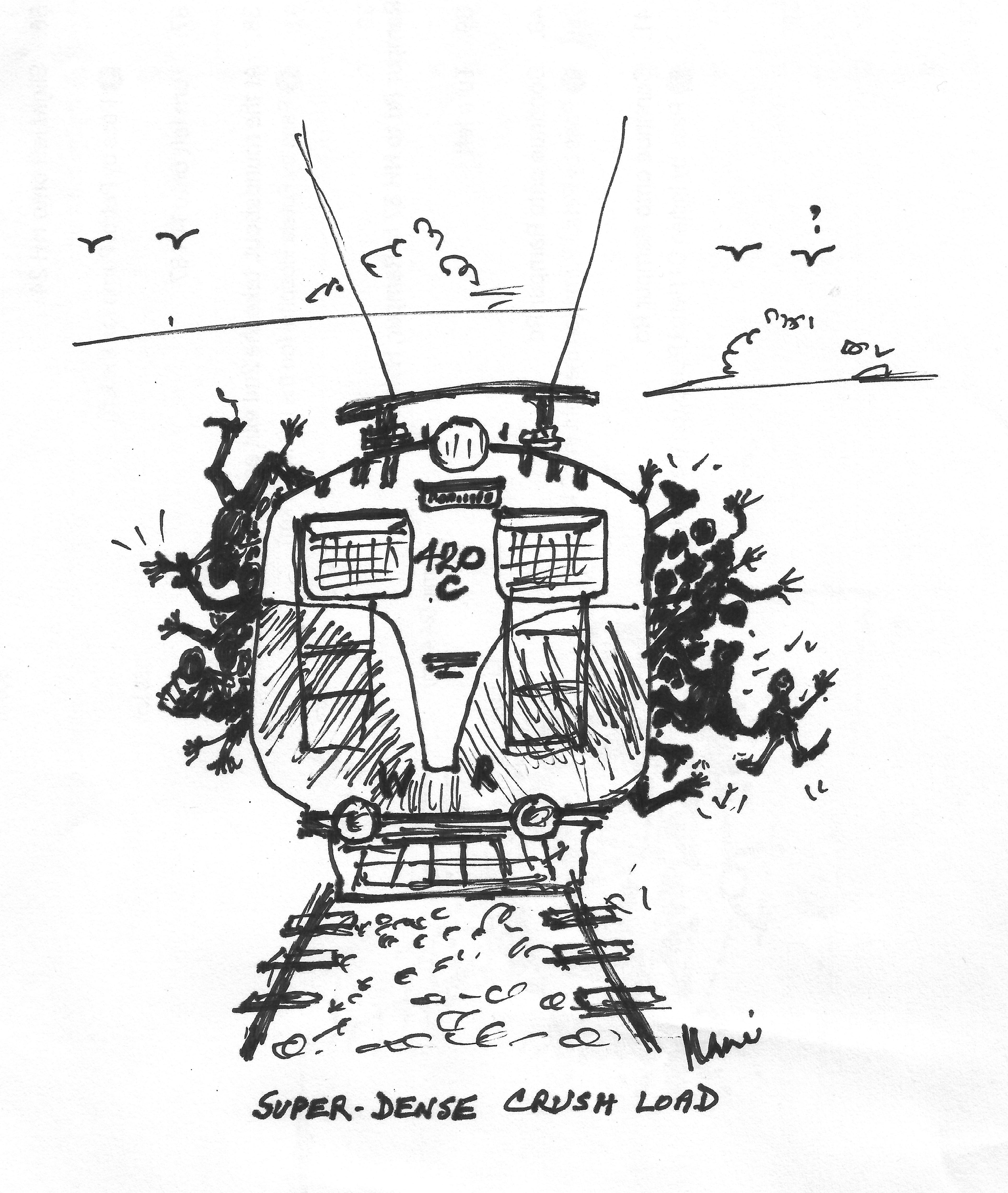
Superdense crush load 001
As the train sped along, the wriggling mass of humanity presently disaggregated into vaguely human forms: some clutching newspapers with pens poised over crosswords in Marathi, Hindi and English; others playing stand-up rummy, with one player collecting the discards under a rubber band stretched across his raised palm; a few crooners and hummers, a peanut vendor, a dozen peanut munchers, the many loners staring into space, at spots on walls or at one another; and the standard quota of loiterers, conmen and pickpockets scattered among the crowd. With each approaching halt – at Goregaon, Jogeshwari and so on – a score or so travellers would form a lump near the door on the far side and shoot out on to the platform like some giant hairy pea from a pea-shooter. At once, the space vacated by them would be occupied by a larger mass of humanity charging in through the door; the train would move again, things settled down a bit…and so it went.

Everything was normal, then, until we reached Andheri. About fifty people hurtled out of the coach; about eighty took their place; and suddenly, just as the train jerked into motion, a voice rose above the general din: a voice that brought instant silence into the coach, till the only audible sound was of rumbling wheels and the soprano hum of the pantographs gliding along the overhead traction lines.

“Tickets! Let’s see your tickets!”

The words were chanted in Hindi, then Marathi. The voice was not loud; but it cut through the silence like a bhelpuri-wallah’s knife through an onion. An instant later, I saw the Ticket Checker; white-trousered and black-coated, with black bag slung on his shoulders and pen and receipt book in hand, he had pushed his way from the vicinity of the far-side door into the middle of the crowd.

“Quickly now! Tickets…let’s see your tickets!”

The dynamic, invisible, synergetic social space inside the coach suddenly and soundlessly crystallized, revealing its six hundred glowing individual p-space shards. It was a dire socio-anthropological warning; but the TC was oblivious to it.

“Tickets, quickly now…” he chanted.

A young burly man, who might have been a football coach or perhaps a Matunga bar bouncer in his prime, responded. “Am I dreaming or do we have a TC with us?” He was standing right next to the TC; he spoke softly, courteously, a puzzled frown on his face as he scanned the faces all around him, including that of the TC.

The TC stiffened and opened his mouth to reply, but another voice came from his left; from a white-haired bespectacled man with the slightly distracted look and disheveled clothes of a long-retired Science Teacher. “I too heard a TC, son; but surely we are both mistaken. The last time I saw a TC enter a train during rush hour was in 1964…”

The TE found his voice. “What do you mean,” he sputtered. “I’m right here. Now show me your tickets…”

“Ah! There you are!” exclaimed the Bouncer, looking pleased. He patted the TC’s shoulder affectionately. “My ears are deceiving me, I’m afraid; I thought I heard you ask to see our tickets!” He laughed heartily, and was joined in his mirth by about sixty others. The TC did not laugh; instead he looked slightly grim as he rubbed his shoulder.

“Doubtless our TC is off-duty,” murmured a thin young man with frizzly hair. He was clad in kurta-pajamas and had a satchel slung across his scrawny chest; he looked every bit the Social Activist. “Doubtless he is heading home, after weeks of non-stop work in the service of the Railways and the nation.”

Many heads nodded, and all eyes turned to the TC. “Now look here,” the TC protested, “I am on duty, I must see your tickets…”

“You’re on duty!” cried the Social Activist, eyes wide in horror. “Do you realize what you have done? You have committed a grave injustice by boarding this coach…”

“What!” The TC’s eyes were round as saucers. “What injustice? What have I done?”

“You have snatched away food from the hungry when you boarded this coach,” went on the Social Activist, his voice gentle but persuasive. “Do you not see that by your very presence in this coach you have deprived another man, a poor man, from boarding this coach?”

“Because you have occupied a space that could have been better occupied by that poor man,” broke in the Science Teacher.

“That poor man now has to wait for the next train,” growled the Bouncer.

“He will be late for work…perhaps he will lose a day’s salary,” remarked a short, stocky man with a briefcase; doubtless a bank clerk.

A babble of voices broke out.

“Aye, yes, that poor fellow will pay the price for your thoughtlessness…”

“It’s a cruel day…”

“Are we all not honest travellers with tickets?”

“It’s a callous world…”

“Such is the lot of the common man…”

“What kind of government do we have, I ask you…”

The TC, who had been gaping all this while, found his voice. “Now wait a minute,” he protested, his voice thin and feeble.

“A single human adult male typically occupies a volume V in litres given by the equation V = 1.02W- 4.76,” went on the Science Teacher, his face glowing with eagerness, “where W is the weight in kilograms…”

“In fact, I remember seeing a poor man trying to get in at Andheri,” said the Bouncer thoughtfully. He looked at the faces around him. “Do you remember? He was weak and thin, had a faded shirt… torn pajamas…”

Several voices shouted agreement and added supplementary details.

“Of course, he looked starved…”

“He probably has seven children to feed…”

“And an ailing wife…”

“And a worthless good-for-nothing brother to support too…”

“Perhaps the brother too is a TC…”

“By my reckoning you weigh at least 80 kilos, so you occupy no less than 75 litres of space,” remarked the Science Teacher, eyeing the TC critically. “That’s enough to accommodate two normal-sized people…”

“What! So two poor people have been prevented from earning their daily wage!” came the general cry.

The TC now had a slightly hunted look. He began to edge backwards towards the doorway.

“Imagine if this injustice were to happen every day,” went on the Social Activist. “Why, not only would a family starve…

“Two families starve,” corrected the Science Teacher.

“Ah, yes sir, two families starve,” continued the Social Activist, “but over 1400 man-days would be lost because of this TC’s thoughtlessness…”

“Which, if you calculate even at minimum daily wage rate, works out to over 28,000 rupees…”

“And multiply that by the number of trains running each day…”

“Imagine the loss to the economy…”

“The GDP…”

“Little wonder India remains poor…”

“And all because this TC thinks we are so dishonest that we don’t have our passes or tickets!”

The crowd fell silent and two hundred pairs of eyes eyed the TC severely.

A small, meek-looking gentleman, who hadn’t spoken till then, suddenly piped up: “Does this TC himself have a ticket?”

The TC started, even as the cry was taken up. “Oye TC, do you have a ticket?”

“Do you? Do you?”

The TC wiped his brow. “No…I mean, I have a badge…” he mumbled.

“Oye, he doesn’t have a ticket!”

“Ah, the TC himself doesn’t have a ticket!”

“Chuck him out! He doesn’t have a ticket!”

The train slowed down and pulled into Matunga. Eager hands reached for the TC and helped him on his way to the doorway. The TC shot out on to the platform, rear-first, his velocity reduced and landing cushioned to some extent by about a hundred people who were waiting to enter. He was still running towards the exit when the train pulled out of the station. As the train pulled out and gathered speed, the travellers in the coach settled into their individual and small-group activities…and soon, the coach was filled with the dynamic, watchful peace of synergetic p-space again.

[P.S: I submitted this thesis to a sociologist friend, with the suggestion that it might be a useful case study to deepen knowledge and understanding of p-space. She has urged me to forget p-space, and instead take urgent measures to fill the discernibly voluminous space that, according to her, occupies the region between my cranium and mandible.]

Beastly encounters, Musings

Bondla Ramble

The silence is deafening.

Last night too there was silence, when we were sitting out on the verandah of our little cottage. It was quiet then too, but a different quiet – the dense forest around us was alive, filled with a sizzling, electric, watchful kind of silence, a silence strangely intensified  by the rhythmic breek-breeks of an orchestra of crickets, muffled bumps and thuds, sudden bird calls, a startled cry from some unknown animal (a fawn? a bear cub?), the excited chatter of a faraway monkey, the rustling of leaves, the steady drip-drip of raindrops from a billion leaves…

Our abode in Bondla
Our abode in Bondla

But now, at dawn, the silence is absolute. The air is clear, cool, still but for an occasional stray breeze; the sky is overcast, a great brooding grey presence that portends more heavy downpours. The creatures of the night are deep in slumber; the leopards and civets and owls and other nocturnal hunters doubtless dreaming of sweet meals had and yet to be had, while the deer and squirrel and countless other hunted ones are only now wakening wearily yet watchfully from the shadowy realms of half-sleep, thankful to have survived another dreadful night, already gearing themselves to brave a day filled with perils old and new…and the night to come.

I look to the right, up the road. About fifty metres away stands a small spotted deer, nibbling leaves off a bush. It looks up at me and then gets back to its repast; but its ears are cocked now, there’s a new tenseness to its limbs. I turn and hesitate…should I wake the others? Udai is in deep delta sleep; the door to the other room, where Rekha, Nisha and Tarini are, is shut. Quietly – or so I think – I step back into the room and open the side door, thinking to step down the path that leads to the road. The door swings open silently, but the deer is gone.

I walk down the slippery, mossy flagstone path and amble along the road, looking in vain for signs of animals among the mist-blurred thickets on either side. Giant carpenter ants march busily among the inch-thick avenues of dead leaves on both sides of the road. Countless black centipedes wander about like tourists lost in a metropolis; one runs headlong into a soldier ant, pauses and scratches its head thoughtfully with about seventeen limbs; doubtless it is asking for directions?  But the ant offers no assistance; instead it executes a remarkable backward spring of about three inches, capers around the centipede several times in an ever-widening circle, and then sprints away at about 60 kilometers an hour. Clearly put off by this discourteous behaviour, the centipede flexes its mandibles, shakes its head in disgust and moves on.

I wander into the gently sloping forest on the right, walking as silently as I can—the faded blue bathroom slippers make this task easier, but I am acutely conscious of how vulnerable my toes and ankles are to uninvited explorations by all manner of creatures, from leeches and spiders to centipedes and snakes. A slight flicker of movement in the corner of the eye…and I see them! A group of five, no, six spotted deer are standing about a hundred metres away, staring at me; their bodies are barely visible in the deep shadows , but the occasional twitch of an ear gives them away. After a long moment they decide I am harmless; with twitching tails they turn and walk away deeper into the woods, soon to be lost among the dark green caverns beneath the tall trees.

I move on towards a small hillock where the road ends in a flight of steps, leading up to a low, rectangular building with CI-sheet roof; this must be the canteen. The steps are covered in bright green moss and treacherously slippery. Emerging on to a large paved courtyard,  I stare at the sightless windows of the canteen; there is a large lock on the door. To the right of the door is a small shed—just a roofed enclosure with low walls, inside which are piled rusting table fans, broken chairs, a cracked plastic table, and similar junk. As I approach the shed there is a sudden scuttling noise from within; I freeze and hastily move the other way, towards the low wall around the courtyard. All of the Bondla Wildlife Sanctuary is visible from here. Beyond the wall, the forests fall away into a valley; above the tree-tops, and behind and all around, are high forested hills, their outlines blurred by the moisture-laden air.

A steady drizzle begins as I make my way down the steps. I see Nisha wandering through the woods where the deer were browsing. We meet on the road and walk slowly back towards the cottage.

“When does Krishna take his morning walk?” I ask, a tad anxiously.

“Around 9.30, I think,” Nisha replies. Krishna is the lone, slightly psychotic tusker who resides in magnificent isolation in the forested hills surrounding us; last evening we’d been told by Loveleen – the Veterinarian in charge of the Bondla Zoo and the Sanctuary – that Krishna enjoys taking a stroll down this very road every morning to inspect the lower reaches of his kingdom.

Nisha pauses and points towards an overgrown path leading off the grassy verge down into the wooded valley. “Here’s one of the nature trails.”

“Ah…so should we walk down it a bit?”

She nods. We move slowly and cautiously down the path, she leading the way, treading as silently as we can on the wet leaves. The slope is steep and slippery in parts; I stumble now and again, trying hard not to make so much noise as to scare away every living thing from Bondla to Kaziranga.  At one point the path curves sharply to the right, ducking behind thick undergrowth. I decide on a short-cut and plunge bravely into the thicket.  The earth seems alive beneath my feet…I look down and realize that it is, with large, fierce red ants. I execute an agonized leap that would have turned a spotted  deer green with envy, and narrowly  escape the ignominy of landing rear-first on the other side of the path.

As we descend, the forest closes in on us. It is like walking through a colossal green cathedral; a hall pillared and arched with countless trees of every imaginable size, shape and hue, tall and thickly leaved and so densely gathered in patches that the grey sky above is completely obscured. Many tree-trunks are festooned with creepers that swing lazily in the slightly chill breeze. The air is filled with a cocktail of scents, the primary ingredients comprising damp soil, crushed leaves and rotting wood. The earth is carpeted with a thick layer of sodden leaves. Bushes gather in fraternal clumps; some tall and thin with tendril-like leaves, others short and thickly leaved, with huge curved thorns;  still others sporting flowers blue, white, yellow and red. Mushrooms poke their yellow-white heads from rotting twigs and fallen boughs. There is water everywhere; myriad little trickles of rainwater flowing down the slopes, coalescing to form larger channels that eventually merge with the stream that bubbles and chuckles its way along the bottom of the valley.

Gallery of green
Gallery of green

Nisha pauses, holds up a warning hand, points to her left. I squint in the direction she’s pointing and see nothing but a large tree with thickly-leaved branches. And then, one of the branches shakes violently and I see two huge squirrels leap off it on to an adjacent branch, where they sit on their haunches and make derisive faces at me. They’re the largest squirrels I’ve ever seen in my life; each the size of a well-fed cat, and as agile too. “Malabar giant squirrels,” Nisha murmurs. The squirrels stare at us awhile, chattering their disapproval of the current political climate, and then turn in unison and leap out of view behind the foliage.

Spot the squirrel
Watching me watching you [photo: Nisha]
The drizzle is now a heavy rain; Nisha steps off the path to find shelter under a huge tree. I join her and we wait for the rain to subside. Incredibly, not a drop of rain falls where we stand; so thick is the canopy above us.  I am acutely conscious of the gaping hole in the tree-trunk right next to my shoulder. A perfect nesting place for a cobra, I think to myself gloomily; perhaps there’s an entire joint family of cobras in there, the young ones even now fighting over who among them gets to take the first nip at my scrawny neck…

Nisha touches my shoulder, startling me out of my serpentine reverie. She’s pointing towards a tall tree about a hundred metres away.  I stare hard at the tree, bringing into play all my powers of observation honed by two decades’ wanderings in the wilds of Meghalaya and Assam.  All I can see is the tree. Like a befuddled visitor at some gallery of modern installation art, I study the tree very carefully, closing one eye and then the other as I examine and appreciate its features. No doubt it is a fine tree, with a thick tapering trunk and many branches. The lowest branch is long and twisted, with a large oval-shaped knot halfway along its length…

“I don’t give a hoot” [photo: Nisha]
“It’s an owl…a tawny frogmouth owl,” Nisha murmurs helpfully. She’s now aiming her camera at the knot on the branch.

And then, at last, I see it. The knot is not a knot; it’s an owl. It’s huge, perched on the branch with its back to us, shoulders stiff and slightly hunched, its ruffled feathers clearly silhouetted against the slate-grey sky. “It’s sulking,” whispers Nisha. “Maybe because it’s wet…or maybe it doesn’t like being photographed by strangers.”

The rain thins; we leave the owl to its sulking and move on. Suddenly the sun breaks through a gap in the clouds, bathing the green hall in golden light from a billion glittering leaves. But only for a moment; like a curtain dropping, the thick grey veils of cloud conceal the sun again.

Now, slowly but surely, the creatures of the forest are waking up.  The air is filled with the hum of insects; dragonflies hover, butterflies flit about.  A sweet, fluting bird call wafts through the trees.   Nisha pauses, holds up a hand. “That’s a ruby throated yellow bulbul…the state bird of Goa,” she murmurs, scanning the tree-tops above us. After a moment or two she points; I see only a bewildering tangle of leafy branches.  She takes a few pictures, and then all of a sudden there is a flash of brilliant yellow amidst the green, and the bulbul does a fly-pass high above my head, a distinctly sardonic tone in its musical cheeping as it stares down at me. “Whee wit wit wheeNow do you see me?” it seems to chant.

The gurgling and murmuring of the stream grows louder and deeper, the light grows dimmer, as we near the base of the valley. Suddenly the stream is before us, about five metres wide, its dark but clear waters foaming among rounded rocks and pebbles and rushing between the bushy banks.  I step down to ford the water, and pause as a faint but pungent aroma reaches my nostrils. It’s a distinct odour, evocative…

“Elephant dung!” I whisper hoarsely. Nisha nods, eyes wide.

Silently, cautiously, I cross the stream, clamber up the bank on the other side, and emerge into a small clearing. On all sides the dense forested slopes press in; in the foreground on the left stands a light-grey rock formation; a monolith with an extraordinary shape…

It’s Krishna. He stands at least four metres high at the shoulders; his tusks are like giant yellow-white pincers; his legs as thick as tree-trunks. His eyes are open, but he is as still as rock from giant rear to pliant ears, from slender tail to stupendous trunk.

Nisha’s already crossed the stream and is climbing the bank. I point towards Krishna. For a moment we stand there, frozen, staring at our colossal slumbering colleague. And then, we turn and hasten back across the stream. Our ascent through the forest is far more rapid than our descent. I bravely lead all the way, happy that I’ve redeemed my reputation as a keen-eyed wildlife spotter.

After all, I’ve successfully spotted a three-tonne elephant at ten metres.

Beastly encounters, General ravings

Weather Monitor

[Middle: Times of India: April 28, 1995]

Now the days grow longer, with golden dawns and crimson sunsets, with Spring in the air and in the pedestrians’ footsteps. Winter yet possesses a weapon. His final kick will be hard, the ancients murmur: yet, hearing the incredible tumult of sparrows each morning and seeing, at dusk, great formations of parrots winging their way northwards, it seems hard to believe.

Till one remembers Ruknuddin.

Never wrong in his weather predictions, Ruknuddin has yet to make his appearance. And that means, Spring is not yet come.

A quiet and unassuming fellow, Ruknuddin is nevertheless firm in his principles and will, when pushed to the wall, fight tooth and nail to defend his rights. He is essentially an outdoor person, and lists rock-climbing among his favourite pursuits. His scaly hide would put most public sector employees to shame; but no lounge-lizard is he! His ancestors ruled the earth for a hundred million years—and that, even on the geological scale, is a long time.

Ruknuddin now hibernates, deep within the stormwater pipe that leads from the terrace to the ground four storeys beneath. It must be pleasant in there…quiet, cool, with just a glimmer of light filtering in through the narrow vents above and below. For these past three months he has dreamed, sheltered from the biting winds of cruel Winter—though what, after all, would he care for cold! He, whose genes carry memory of the Ice Ages, of the great glaciers of yester-eon.

But there will soon come a day when Ruknuddin will awake, and stretch his cramped limbs, and wave his 18-inch tail about languidly. And presently he will glide up the drain, his taloned feet finding effortless purchase on the stone, and peer out through the iron grating at the broken-tiled expanse of the terrace.

And Ruknuddin will smile as he beholds the blazing sunlight; for he knows the time has come for him to break his fast. And while possessed of neither fork nor knife, he will carry in him a tremendous appetite, whetted by his fourteen-week-long penance; and there before him, the table is laid.

The service is simple, as befits an individual of his austerity—a flattish ceramic bowl filled with fresh water, resting on a stone flower pot. To this limpid pool come, each day, the sparrows, pigeons, mynahs, crows, transitory parrots, squirrels, and even the occasional kite and eagle. Ruknuddin will wait in silence while six sparrows finish their ritual immersions. Shy by nature, he is uncomfortable in the midst of strangers; and besides, he far prefers to arrive at lunch unannounced.

But hark! Five sparrows flutter  their wings, converse earnestly, and shoot off towards a neighbouring tree. Now the sixth is alone. It looks about, is reassured by the stillness of the landscape, and dips its little head into the pool for a final sip. A brown blur of movement, a flash of glistening scale, a millisecond-long glimpse of a rearing snakes-head…and then the sparrow is gone and Ruknuddin’s tail is vanishing down the stormwater drain.

For a while the golden sun will shine benignly upon the terrace; and soon, the sparrows will return to their pool to drink and frolic—but now there will be a new watchfulness about them. For they, too, will know that with the coming of Ruknuddin, Spring has returned.

Ancient writings, Remembering

Call to account

 [Published in the Times of India , 29 January 1994. Now, nearly 30 years later, it’s an appropriate time to re-inflict it upon thee, O hapless and most valued Readers, as I contemplate a career shift while still young…]

Twelve years. For twelve years did I immerse myself in the Sea of Black Ink, but already the memories are fading. Of the thousands of acres of neatly typed audit reports; the yellow and red vouchers; the sing-song tones of head clerks checking the balance books (…two hundred and thirteen fifty, one thousand and four sixty five…); the sweet jingle of token and coin, the rustle of currency notes. Time, then, was measured by the daily day-book, the weekly performance report, the quarterly returns; and the annual  closing was a ceremony in itself, culminating in shrill cries of joy – or sometimes, when the branch office showed a loss of something like 32 lakhs, in the most horrendous moaning, and the only sound to break the silence thereafter would be a sharp rip-and-tear as the manager divested himself of what little hair he had left.

Exciting indeed were those 12 years…

But now, suddenly, here I am.  Adrift upon the oceans,  having cast my anchor overboard and the oars after it.  I’ve quit the bank, and now the memories are slipping away, faster and faster, in a steady stream, soon to become a torrent and then a raging cataract, emptying the mind and leaving a great hollowness to be filled by…what?

My friends have, of course, been of immense support.

“You’re mad,” they said, shaking their heads in disbelief. “No job waiting for you, yet you just up and quit!”

“You’re lucky,” they said excitedly, “Now you can do anything you like! Row a boat across the Brahmaputra, buy an elephant, why, you’re so lucky!”

“You’ve got guts!” they exclaimed. “Just quitting like that…why, wish we could do the same!” Having said which they glanced at their watches and rushed off to their telephones and PCs and deadlines and conferences.

And when they’ve left I look around at my priceless possessions – the accumulated debris of 12 years – and I begin to tremble. Were they right after all? Am I really nuts, or at least a wee bit gaga?

Consider: I have, to my credit, a music system; a mixer; a settee; a guitar; a dhol, clay pot and six flutes; four cushions, twenty potted plants, a few score books and garbled memories.

Where do I go now?

Stop! I cry to myself. Think! Consider and analyse your innermost desires! You can do whatever you set your mind on doing. Focus upon your yearning, give it a direction, and strengthen yourself for the journey with the courage of conviction. Aha! That’s it.

I want to play music. To play the drums and the clay pot before a suitably delirious audience of three million. I want to drive a suburban train. To trek across the Himalayan ranges; to eat from a copper pot cooked over a slow wood fire in a silent pine forest. I want to dream, and to live in my dreams as long as I wish with the option to change channels. I want to write the greatest story ever written…so that they’ll know my name from Managua to Mokokchung.

Dear Ed, do you think I have possibilities?  Please make out your crossed cheque favouring…but there I go again, slipping back into the mindset of yesteryear.

Alas! Like too many I’d come across in those 12 years, this account is overdrawn.