General ravings, Musings, Potshots

The redness of Sindhoor – 2

Believe it or not, O Dear Gentle Reader, I started to write this a few days after the Indian Director General of Military Operations (DGMO) granted  the Pakistan’s DGMO’s pleas for an end to hostilities; and that,  after the Indian military administered a much-deserved thrashing to the  Pakistan military during Operation Sindhoor, May 7–10, 2025. 

But I’ve kept adding to this rant, and subtracting from it, and amending it, all these weeks and months because so much has been happening so fast since then: between India and Pakistan, and between  India and the USA, and Pakistan and USA, and India and China, and Israel and Iran, and Pakistan and Iran, and Pakistan and Bangladesh, and India and Afghanistan, and Pakistan and Afghanistan, and Russia and Ukraine and the EU and the USA, and the USA and Israel and Iran and China and Myanmar and Russia and Bangladesh and …well…the USA and the rest of the world. And it’s been hard staying up to date and keeping tabs on all of these developments and events and discerning patterns in them.

Because they’re all closely, weirdly related, and not at all in a nice and friendly way for India and you and I and the Resident Lizard who, as usual, even now reads over my shoulder and chuckles derisively as I type this.  

That’s why, in the interim, I only posted a kind of foreword to this long rant titled “The redness of Sindhoor-1” in August : a kind of grim remembrance of the Indian civilian establishment’s collective cowardice following the Pakistan-sponsored terrorist attack on Mumbai in November 2008.

But now, driven by impatience and exhausted by Cacoethes Scribendi,  I scribble the last few words and post this rant before Dilli’s toxic air drives the last ergs of energy from body and last vestiges of rationality from mind.

First, in the warm and generous spirit of Deepavali, may I offer a (mercifully) short poem to Pakistan’s Field Marshal Asim Munir (though I suspect Munir-bhai may not like to be reminded of things like bright lights, flames and explosions after Operation Sindhoor):

I post this just over four months after Pakistan, led by the devout  Gen. Munir and the beatific Pak Prime Minister Shabaz Sharief, snatched  victory from India in Operation Sindhoor in May 2025; and barely a month after Pakistan snatched the Asia Cricket Cup from India in September 2025.

Let me hasten to explain, before I’m pilloried by my Adored Readers for being high on smooth whiskey and/or good ganja, or arrested by the Indian government or assassinated by Indian vigilantes for expressing ‘anti-Bharatiya sentiments’.

Consider Operation Sindhoor.

Sure, during Operation Sindhoor, India flattened terrorist training camps in Pakistan-Occupied Kashmir as well as the headquarters of Jaish e Mohammed and Lashkar e Tayyeba in Pakistan itself, killing a hundred or more terrorists of different degrees of murderousness and kookiness in the process.

Sure, the Indian Air Force (IAF) destroyed 12, possibly 13, Pakistani air force planes, including F16 and JF17 fighters and at least one AWACS and ELINT aircraft each—some of them shot out of the air, others incinerated in their hangars or on the tarmac in airbases across and deep within Pakistan by drones and rockets and long-range missiles. Sure, India attacked and destroyed assorted high-value infrastructure in at least 11 strategic (N-strike) Pak airbases including the runways, hangars with aircraft in them, air defence systems, and strategic command-and-control infrastructure, killing a hundred or more Pak military personnel in the process. Sure, evidence of all the havoc caused by the Indian military has been presented in public, not just by the Indian military but by defense/strategic analysts worldwide, and the evidence is still available to you and me and Pakistan and the world in public domain, in satellite imagery and on the Net and in print.

Sure, there is also clear evidence that in the course of its attack on Pakistan’s Nur Khan and Sargodha strategic air bases, the IAF severely damaged an undeclared (i.e., secret) underground N-reactor complex in  the nearby Kirana Hills along with an unknown number of dis-assembled N- warheads. Judging by reports, these N-warheads were plutonium-239  (Pu-239) devices. [This conclusion is based on a simple fact:  unlike uranium-235 warheads which are very stable once shaped and pre-assembled, plutonium-239 warheads constantly decay to non-fissile isotopes like Pu-240, Pu-241 etc. which ‘contaminate’ the Pu-239 over time, till the warheads become like soggy Deepavali crackers that go ‘Phuuussss’ instead of creating a hole the size of Delhi.  And so, Pu-239 warheads require a dedicated N-reactor to refine the plutonium in them back to fissile-grade, in a  complex never-ending cycle. ]

Most interestingly, there is also damning evidence that some or all the N-warheads in the underground N-facility in Kirana Hills—and indeed the entire Nur Khan air base— was under the direct command and control, if not full OWNERSHIP, of the US Air Force (USAF) and had been so for at least 15 years, perhaps ever since the so-called ‘War Against Terror’ launched by the USA under George Bush Jr.  And that the USA set up and controlled Nur Khan to keep a baleful N-watch on China, just as the USA had set up the Bagram base in Afghanistan to keep a strategic eye on China.

In effect, then, India not only delivered several painful kicks to Pakistan’s collective military butt during Operation Sindhoor; India also knowingly or unknowingly (I suspect the former) attacked and destroyed or severely damaged a secret and fully operational USA-run  N- strike air base located in Nur Khan, along with USA-built F-16 fighters and a secret, USA-owned ,underground N-complex including  N-warheads and  N-reactor in Kirana Hills.

But Pakistan declared – and continues to declare – that it defeated India in the battles of May 2025.

Pakistan’s Field Marshal described the inevitability of Pakistan’s victory over India as follows while addressing a Pakistani community event in Florida, USA in August 2025:

“India is like a shining Mercedes coming on a highway like Ferrari, but we (Pakistan) are a dump truck…If the truck hits the car, who is going to be the loser?”

In destroying the USA-owned N-assets in Nur Khan and Kirana Hills in Pakistan, India has put not only Pakistan but Trump and the USA in a hell of a hot spot—militarily, diplomatically and politically.

There’s the money angle, of course…so important to Trump and his cronies. The USA set up the Nur Khan air base alone for over 550 million dollars—and that was only the capital cost.  The annual recurring costs would have been many times that figure. The Kirana Hills N-infrastructure would have cost billions of dollars.

That’s a lot of money, even for a do-numberi  builder-don like Donald Trump.

 Losing all that money to Indian strikes must be terribly painful to Trump and his Deep State cronies, especially when all those beautiful American assets have been reduced to piles of radioactive rubble underground.   

In fact, Trump et al. must be feeling the same pain as Iran did, when Trump’s USAF reduced Iran’s N-complexes in Fordow, Isfahan and Natanz to piles of radioactive rubble underground…

But it’s much more serious than that for Trump and the Americans.

On the one hand, the USA simply cannot ever admit that it owned and ran these N-weapon facilities in Kirana Hills or owned and managed Nur Khan N-strike airbase in Pakistan. Because, to do so would be to admit that the USA had installed N-weapons and N-delivery assets targeted at China  in a secret US base located right next to China—in Pakistan, ostensibly, a  ‘friendly’ neighbouring country of China!

And THAT would put the USA exactly where the Soviet Union had put itself when it started to establish Soviet N-missile bases very close to the USA, in Cuba, in 1962…bringing all humankind close to thermonuclear incineration before better sense prevailed thanks to John F Kennedy and Nikita Khrushchev…but that’s another story.

On the other hand, the USA cannot hide the evidence of its perfidious ownership and management of the Nur Khan air base or the Kirana Hills N-weapon facilities for long—because not only is all the evidence out there for the world to see, but N-radiation has an inexorable and horrible way of revealing itself in time…however deeply it might be buried

Most important, Pakistan is not going to let the USA escape responsibility and leave Pakistan to bear  the fallout—nuclear and figuratively—of the devastated underground N-facility and the remnants of N-warheads lying inside there, and its ruined air bases and related military losses. 

Yep folks, Pakistan has really got Trump and the USA by their short and curly N-hairs this time. For a while, at least.

And that’s why Trump toadies up to and ingratiates himself with Munir-bhai and Shabbaz-bhai of Pakistan  by the passing day, even as his rage against India intensifies by the passing second and by the midnight tweet.

The USA will never admit any of this:  they dare not, for their own reasons.

Pakistan will never admit any of this; they dare not either, for their own reasons.

A related question arises: why did Pak PM Shehbaz Sharif promote Pak military chief Asim Munir to Field Marshal and felicitate him for ‘defeating India ’ in  Operation Sindhoor?

Well…let’s empathize with Shabbaz Sharief on this one. Sharief had no choice but to promote Munir to Field Marshal; because to demote or court-martial Munir— as any other country in the world with a microgram of self-respect would have done after Munir led his military to such a humiliating defeat— would be to admit that Pakistan’s military had suffered defeat at the hands of India’s military.

And that admission simply cannot be made by any Pakistani PM.

As Pakistan’s brief but bloody history shows, such an admission, however truthful it might be, would lead to a speedy and unpleasant end for that Pak PM.

Whatever little poor Shabbaz Sharief understands about anything else in life, he certainly remembers what happened to erstwhile Pak PMs Zulfikar Bhutto and to Benazir Bhutto, even nearly to his own brother Nawaz Sharief….

Pakistan believes its supremacy over India, making ‘peace’ with India an absurd proposition. This belief is non-negotiable; it is, in Pakistan’s collective psyche, so deeply ingrained that it is the God-given Truth.

It is taught in Pakistani schools upwards. It is taught in religious seminaries. It is naturally, understandably, echoed in the Pakistani media, in the civilian and military streets of Pakistan.

That is why Pakistan declares that it won the conflict against India in May 2025; as it has won every earlier conflict with India since 1947.  

For Pakistan, eternal victory against India is the Holy Hallowed Truth.  However Holey and Hollow that ‘truth’ is.

This is Pakistan’s strength.  In a weird and wonderful way (though Munir might not like the analogy), Pakistan is in fact practising a fundamental tenet of Hindu philosophy: a tenet taught by Krishna to Arjuna in the Bhagavad Gita:

You cannot ever be defeated if you believe strongly enough that you haven’t ever been defeated and can’t ever be defeated.

“All that’s very well,” the Patient and Revered Reader might justifiably ask: “But why should this false, hole-ridden Pakistani version of the truth be published as the Truth in the Supreme Court of the World, also popularly known as Western English Media which includes BBC, New York Times, The Washington Post, The Guardian, and affiliated rags?”

The answer to this is best illustrated by the old joke about God and Devil.

And lastly (phew, at last), consider the Asia Cricket Cup, September 2025.

Sure, India and Pakistan played each other thrice during the tournament. Sure, India defeated Pakistan all three times, including in the Final.

But guess where the Asia Cup is?

The Asia Cup is NOT with the Indian cricket team. The Cup is not even in India.

The Asia Cricket Cup  is in fact in Pakistan, in the grubby hands of one Mohsin Naqvi who is the Chief of the Pakistani Cricket Board, and also works as Pakistan’s Interior Minister when he is not otherwise preoccupied stealing cups, awards and affiliated symbols of victory that belong to other nations.

How come Pakistan and this Mohsin Naqvi fellow snatched the Asia Cup from India after losing the Asia Cup tournament to India?

Well…now we know…

Because Pakistan can never be defeated by India. Pakistan always must win… one way or the other.

Jai Hind!

Ancient writings, Musings, Remembering, Verse perverse

The redness of Sindhoor – 1

O Gentle and Patient Reader,  I take the liberty of posting an article—a lament of sorts—written by my dear and departed friend Ghatotkacha in late 2008, soon after the terrible attack by Pakistani-trained terrorists on Mumbai on 26th November 2008. Ghatotkacha was my guide, my teacher, so close to my heart, in a very real sense my alter ego. I empathized with and endorsed every word in his article then. as I do now.

I post this the day after India’s Independence Day, 2025; a time when India and Pakistan still obsess over Operation Sindhoor, the name given to India’s short but devastatingly effective military campaign against Pakistan-based terrorist and military  infrastructure in  May 2025.

I post this article even though it is filled with anger and bitterness. I post this for the simple reason that I, like my fellow Indians, am conditioned to ignore and forget my own history…and worse, to eagerly seize upon and adopt, on continuous basis, others’ versions of my own history without a care.

I believe we must be brave enough to remember and come to terms with all that we ever really were, and really did, and really experienced: whether right or wrong, good or bad, sublime or horrific.

Because only then can we learn, only then can we act. With neither self-loathing nor hatred. But with Equanimity.

Only then can we heal ourselves, and move on

[That’s what another old and eternal friend Krishna counselled…]

[© Ghatotkacha Hidimbi Bhimasena (late): December, 2008]

First there was the rage.

Fury poured out on to the streets of Mumbai post 26th November 2008, fiery words spewed from the mouths of countless anchors on a hundred TV channels. There was much talk of retaliation, of revenge, of this latest atrocity by Pakistan-sponsored and Pakistan-supported and Pakistan-sheltered and Pakistan-trained terrorists being the last straw.

India has been restrained all these decades…but enough is enough!” These words about summed up the collective feeling of the Indian people after 200 innocent men, women and children were slaughtered by 10 murderers from Pakistan. Murderers helped overtly and covertly by the Pakistani military, the Pakistani establishment.

The evidence of Pakistan’s complicity was clear.

The world witnessed the massacre of innocents, on live TV.

The world awaited India’s response…as the Indian people did.

Two weeks passed, during which for the first time in memory the Indian political establishment actually appeared to have achieved the unimaginable – namely, to unite and speak as one in national interest.

“We are with the government in combating this evil force that has attacked our nation, that threatens the future of India,” said Opposition leader and BJP member (late) L K Advani on the floor of Parliament.

The Congress-led UPA leadership, in a symbolic move, sent the derelict Home Minister Shivraj Patil home and appointed the inflationary and inflated-ego Finance Minister P Chidambaram in his place.

In a rare and refreshing contrast to the Congress’ customary rodent-like squeak-speakers, External Affairs Minister Pranab Mukherjee fumed and fulminated against Pakistan and its deceitful references to the attackers as ‘non-state actors’, at one point memorably asking: “Do these non-state actors come from heaven?”

Equally remarkable was the fact that during these two weeks the Indian media collectively stayed with the Pakistan-sponsored terrorist attack story – that too sans the usual faffing in politically correct journo-speak, which requires that any atrocity by any kooks who claim to be ‘Muslim’ can only be reported as such when it can be ‘balanced out’ by reportage on a similar atrocity—real or imaginary— committed by kooks claiming to be ‘Hindu’. [This is, of course, the famous Balancing of the Kookery Equation Principle formulated by British sociologists in the 1850s, refined by the Congress and Communist Party of India (Marxist) post-Independence, and taught as a foundational course by mainstream Indian media houses to trainee reporters and journalists.]

Curiously, the English-language Indian media (seriously! That’s what they call themselves, and we call them) named the atrocity ‘26/11’—because ‘26/11’ resonates so well with the USA’s ‘9/11’—and so this name has stuck, even though it blithely ignores the fact that for the Americans, ‘9/11’ actually stands for September 11th (and not 9th November); by that logic we Indians should have called this Mumbai attack ‘11/26’. 

But then, what’s in a name, no?

At least for a change, there were no cut-and-paste editorials in the newspapers and magazines on how India must exercise ‘restraint’, no pious and ponderous platitudes on why India must follow the process of ‘dialogue’ and ‘negotiation’ with Pakistan rather than that of ‘confrontation’…

For the first time in history we were spared the logorrhea of human rights activists campaigning for the well-being of Ajmal Kasab, the sole Pakistani terrorist captured alive; spared, too, the hysterical outpourings of assorted pamphleteers drawing parallels between Mumbai 26/11 and Gujarat 2002 and Mumbai 1992/93.

By the time December 12th 2008 dawned, one actually dared wonder: had we, in India’s Civilian Street, finally discovered those rare qualities, Courage and Resolve?

Would the Indian political leadership, along with the bureaucrats and policy wonks and diplomats and strategic eggheads have the guts and the gumption to unshackle and unleash the calibrated might of our defense forces to strike and eliminate the sources of terrorist infection in our neighbour Pakistan’s ailing body? To strike not to destroy Pakistan, but rather to strengthen the Pakistani people in their silent, six-decade-old war against the Pakistani religious fanatics who rule them with fear; the monsters in clerical and military uniforms who have created schools of pain in the name of God, schools in which they have brutalized innocent young Pakistani boys and transformed them into the twisted, hate-filled murderers who call themselves Al Qaeda, Lashkar e Tayyeba, Harkat ul Jihad Islami, Jaish Mohammed?

We hoped so. The signs were good.

Alas, it was a futile hope.

In the two weeks since December 12th, 2008, the great show of bravado put up by our politicos and the media has all come unstuck faster than the dhoti of a certain senior Congress leader with a penchant for flashing.

As of 26th December, 2008 – exactly a month after the attack on Mumbai – India’s measures to avenge the Mumbai atrocity and cleanse Pakistan of terrorists comprise the following key elements:

  • Our nominal and notional PM, Manmohan Singh, has repeatedly appealed to the US, Britain, Australia, and any other country that might listen (and there haven’t been too many) to urge Pakistan not to send terrorists to India.
  • The PM and the Minister of External Affairs have repeatedly appealed to the United Nations to tell Pakistan not to send terrorists to India.
  • The PM and the Minister of External Affairs (as well as assorted Ministers of other Infernal Affairs) have repeatedly expressed disappointment that the international community is not telling Pakistan not to send terrorists to India.
  • The de facto PM Sonia Gandhi has repeatedly declared that India will give a ‘befitting reply’ to terrorists who think they can divide India on communal lines. (She is, apparently, even now drafting out the befitting reply on a standard-issue Congress party greeting card, which will doubtless be sent duly by Registered Post (with Acknowledgement Due) to Pakistan’s notional President Asif Zardari with copies for information and necessary action to Hafiz Muhammad Sayed of Lashkar e Tayyeba and Masood Azar of Jaish Mohammed..
  • The PM and the new Home Minster have announced the formulation of a new anti-terrorist law that will also include, in its ambit, heinous offences like smoking ganja and abusing politicians (might as well turn myself in).
  • The Hon’ble Union Minister A R Antulay has declared that the entire Mumbai atrocity was just a pre-planned strategy by Hindu fanatics to conceal the assassination of certain Mumbai police officers who were inquiring into bomb attacks targeting Muslims in Malegaon, Maharashtra by their brethren Hindu fanatics.
  •  The MEA has denied Pakistani media allegations that India had a hand in a car bomb attack in Lahore on 24thDecember – and continues to deny it even after the Pakistanis lost interest in the case after a Taliban splinter group claims responsibility for the Lahore car bomb attack.

Saddest of all, the print media editors, the TV talk-show hosts and their attendant analysts, the academia and intelligentsia and not-so-intelligentsia,  caution the Indian government with increasing shrillness and anxiety, about the dangers of any kind of strikes against a ‘nuclear-armed Pakistan’.

It makes one wonder:  why doesn’t Pakistan ever worry the same way about striking against a nuclear-armed India?

How the late and much-unlamented Paki dictator Zia-ul-Haque of the ‘boiled-frog’ strategy must be chuckling— even in his special cell in Shaitan’s Eternal Abode— at India’s self-imposed paralysis following the attacks of 26th November.

And so India’s leadership will wait—as always.

And so India will wait, as ever making a virtue out of inaction and passiveness; wait for the next attack by Pakistani terrorists…

http://creative.sulekha.com/boil-the-pakistani-frog_383941_blog

General ravings, Verse perverse

The last rejection slip

Oh Most Noble and Patient Reader, a thousand apologies for my long absence.

I owe you an explanation.

And so I now proceed to explain my absence, briefly, even as I appreciate deeply those agonized whispers and mutters from the back-benchers of “That’s all right, no need to explain!” “But we didn’t even know you’d gone!” “Can we do this next week? Don’t ping me, I’ll ping you!” and so on.

Much sewage hath flow’d down the sacred Yamuna since I last wrote in this space…in November 2024.

Indeed, much less sewage hath flow’d through this sacred Blog-space during the same interval, when I didn’t post anything; but that is of course entirely coincidental.

I’ve written a bit elsewhere, these last six months: mainly on climate-friendly technologies and the like, to earn enough to keep the rice steaming and the sambar spicy and to pay the electricity bills. I’ve read a bit, scribbled here and doodled there a bit more, and stared blankly at nothing in particular a great deal. I’ve also travelled a bit: to attend to a friend who fell ill, and later to recce the lovely town of Mysuru to which I will relocate when the Fruit of Opportunity ripens…which is a damned silly and pretentious way of saying, when I can find a place to rent or buy there and simultaneously find a person to rent or buy my place here in Dilli.

More on all that, and much else, anon. It feels good to be back here.

But for now, realizing that those agonized whispers and mutters have become as loud as an AAP politician’s protestations of innocence in a scam inquiry, I shall content myself with having finally logged in my presence here and greeted you after over six months.

And as I log out, may I leave you to groan and gnash your teeth at an execrable piece of doggerel that I composed over a decade ago in a similar mood. It was written as a tribute to certain edit-page editors that I had the misfortune of encountering during the two decades I contributed articles to print newspapers. Perhaps the freelance writers among you will empathize?

Old hacks and reporters tell of an ancient time
Ere iPads and desktops had been found
With pens did folk then craft prose and rhyme…
And pencils and erasers did abound

Imagine! An era sans software to check
One’s grammar, to vet one’s work!
Only Editors there were, to hack and peck
Per their whimsy, individual quirk

One such Ed there was – a newspaper man
Whom legend hath made immortal
His style was lucid, his face dead-pan
And he knew his sans-serif fonts well

Aged freelancers still tell, with awe
Of how Great Ed dealt with their submissions
Most he flung into his dustbin’s maw
As unworthy of the weekday editions

But now and then, some odd article
Would make Great Ed hesitate, pause…
Here to strike out an errant participle
There improve ‘pon some conjugate clause

Indeed, these signs, the ancient hacks knew
Were propitious for the aspirant essay
Which, having decided it merited further review
Great Ed consigned to his ‘Pending’ tray

His arduous duties for that day being done
With the final insertion of two commas
To the Press Club Great Ed did head, for a bit of fun
‘Midst like-minded spirits and spiritual aromas

Many weeks would pass; the article lay
Inside a folder marked ‘See Later’
Old hacks knew ’twas Great Ed’s way
Of teaching Humility to the article’s creator…

Whose gentle reminders, seeking to know the fate thereof
Were dispatched forthwith to the incinerator room
Where, with a glad cry and a bronchial cough
The furnace man piled the waste paper up with a broom

‘Twas with him the work of an instant
To fling the reminders to the flames
Therein, presently, the original too’d be sent
Thus absolving Great Ed of any claims

There things usually ended; and yet
Some die-hards there were, among freelancers

Who’d send countless stamped reminders, seeking to get
Their precious articles back, even after three years

Then indeed was Great Ed’s greatness manifest!
(For he was a being of rare sensitivity)
To writers who made such sustained requests
He responded with remarkable empathy

Each letter Great Ed began with: “Re. your manuscript,
I deeply regret having to say
…”
And then, in words of incomparable wit
He would explain the article’s loss away

He couched his reply in a variety of forms
Embellished by choice quote and font
Conform did each letter to Rejection Slip norms
And in creativity and empathy they didn’t want

‘Twas rumoured that Great Ed worked overtime
To give his Rejection Slips deep meanings
He spent hours composing their doleful rhymes
And on occasion, read them out on Press Club evenings

So moving were Great Ed’s missives, old-timers said
That their recipients wept for joy, like children!
All their ire and frustration fled
All their bitterness with Great Ed forgotten!

Alas! Great Ed’s end came in a singular way
At the hands of an occasional writer
One who’d waited twelve years for return of his essay
A mere twelve years…the impatient blighter!

He stormed into Great Ed’s den, this wild-eyed man
Brandishing a razor-sharp inverted comma
One foul stroke…and off he ran!
Leaving a scene of utter trauma

Great Ed lay dead, a smile on his face
Gathered hacks did weep and grieve
For they knew Great Ed was the last of his race
And they mourned the abruptness of his leave

They buried Great Ed with honour; in deep despond
On his grave a smooth stone they did lay
On it they carved, in 16-point Garamond
Dear Lord, Re. your man’s crypt, we deeply regret having to say…”

P.S.: I actually sent this thing to a few editors I knew. Two responded: one with a chuckle, the other with a Rejection Slip.

General ravings, Musings

Chess like that

I love chess.  

I played a lot of chess when young. My teachers were my parents, who both played pretty well, though Ma would almost always win against Dad. This was in part due to her skill in arranging devilishly tricky positional traps; but brother Bala and I soon learned, from observation, that Ma was even more skilful in quietly filching one or two of Dad’s pawns or even an occasional bishop or rook while he— innocent, trusting, absent-minded man that he was—was engrossed lighting a cigarette or had wandered off to refill his coffee cup or glass of rum.  Only rarely did Dad notice something was amiss when he came back to the chess-board and found his army depleted of key warriors;  but even when he did, his grumblings and suspicious inquiries were usually dismissed by Ma as the protestations so typically made by the vanquished.

Alas, Dad and Ma stopped playing chess altogether after a particularly incendiary argument following Dad’s  catching Ma red-handed while she was rather over-ambitiously in the process of filching his queen. But Bala and I kept playing, well into adulthood.

I even won a small college tournament in 1976 in Shillong (much to everyone’s amazement, most of all my own). But after that the only time I played regularly for any period of time was in 1980, when I was posted in Thoothukudi (then Tuticorin) as a probationary officer with the State Bank of Travancore along with my friend and colleague probationer,  Anantharamakrishnan. He was a superb chess player.  I remember we kept progressive score in a register; we must have played at least 300 games during the  four or five months we were together, and at the end of it he led by a comfortable 50 games or more. I learned a lot from Ananth in those games…he was unbeatable in the end-games, while I liked to think I had a small edge in strategic play (though often he proved me wrong).

Anyway, to drag this rant back to the topic from which I was led astray by myself…

Nowadays I only play online chess, at https://chess.com, where I registered for free in May 2023.

I mainly play two kinds of chess games: (1) ‘rapid’ 10-minute games against human beings, and (2) time-unlimited games against bots and the occasional human. 

I must mention – especially for those among you, O Sinless Readers, who are unfamiliar with chess – that it’s an incredibly addictive game. To give you an idea of how addictive it is: since I registered on chess.com, I’ve played 1196 games —which means I’ve  played two games daily on average over the last 18 months!

By way of lame excuse for all this time goofing off: chess is addictive because it’s purely a battle of minds. Chess doesn’t require physical strength and agility, but it’s as demanding, gruelling, ruthless and unforgiving as boxing or tennis or fencing.  If you lose at chess, there’s no way you can blame it on ‘bad luck’. You lost simply because your opponent played better than you. And that wounds the ego! So, being human, you want revenge…and you at once play another game…and another…And if you win, the exultation and ego-boost is so intense you want to play again…and again…

 I find the ‘rapid’ 10-minute games against humans exciting—especially when I win, naturally. Usually I leave it to the algorithm to select an opponent, which it does based on our levels of proficiency (with a score that oscillates wildly between 1100 and 1300 I’m somewhere between advanced-beginner and low-intermediate levels). These rapid games are incredibly challenging because I’d never ever played 10-minute chess games before; in the old days, a game would usually last an hour or more. In fact, I’m still not accustomed to the time pressure; the unnerving sight of that damned clock on the side of the virtual chess-board ticking down my 10 minutes of playing time makes it all too easy for me to commit more than my usual share of colossal blunders.  Quite often, I still run out of time and lose from winning positions.

But these rapid games are also interesting, because I get to play people from all over the world, from Australia to Argentina, Brazil to Britain, Pakistan to Peru, Tanzania to Turkiye to Taiwan.  (You can usually tell where a player is from by the flag which shows by default next to his/her name or chosen moniker; though some prefer to conceal their nationalities).

 The virtual game-board on chess.com allows you to ‘chat’ with the opponent while playing. But usually I prefer playing in silence—primarily because I don’t want to be distracted with the clock e-ticking away as I struggle to avoid blundering every third move.

But sometimes, I do type in a word or three…like when my opponent wins after superb play, or when I empathize with my opponent – like today when, after chasing my king all over the board and to the verge of checkmate, my New Zealand opponent committed a goof-up that I would have been proud of and promptly resigned. “Sorry, happens to me all the time,” I wrote, and received a thumbs-up and rueful grin in reply.  

Once in a while I even get into short friendly chats with my opponents.  There was this very good player from the USA—I think of her as ‘her’ because of her moniker which was distinctly female, though of course you never know on the Net—who had slowly but surely cornered  me in the game, till she moved her queen invitingly to a position where I could capture it with my pawn.

Now that’s the kind of blunder I commit quite routinely, so I typed in: “Your Q in peril!”

To which she replied: “Oh nooooooo!”

So after a few second’s thought I moved my knight or something (sparing her queen), and much to my amusement she responded: “I love you!” and moved her queen out of danger. I was less amused when she went on to win that game; but then she sent me a ‘friend’ request which I accepted, and we still play the occasional unlimited-time (3-days) game. I usually lose, but the games are great.

I’ve also faced online abuse a couple of times.

The first time was really weird.  It was a good game, a close game.  I lost the game when I ran out of time after a hell of a fight; and I was surveying the carnage of the end-position when I realized my opponent had typed in a remark.

Our brief and educative exchange went like this (I call him ‘O’ for opponent):

O: You lost, hahaha.  Lost. Loser

Me: Yes I did! Good game 🙂

O: Loser, hehe. You stupid loser

Me: ??

O:  Hehe loser.

Me: Hey, lighten up, you won! (this was my last response)

O: Lose, losing always. Loser!

O: Dirty loser. Cowerd (sic)

O: Why you not sayin aniting? Loser, useless loser

O:  Haha basterd Indie loser (sic)

O: You Niger hehe

O: Niger loser

O: Haha Niger niger niger niger

At which point I disconnected.

Sure, it was a little unpleasant…but it was also a little fascinating.

I was particularly intrigued by the term ‘Niger’.  It took a while for me to realize I wasn’t being likened to the great West African river.

Niger was a racial slur. I was being called ‘Nigger’.

Quite honestly, Gentle Reader, I wasn’t offended as much as I was amused by the slur. I’ve known all manner of taunts and epithets since childhood, when I was a small, short, fat, dark, bespectacled Tamilian schooling in Shillong. Fatty, tubby, shorty, four-eyes, Madrasee, kallu, blackie, darkie…these are some of the kinder names I’ve been called in my time, and I learned to take them in my stride, and to return as rich and graphic compliments as I got when the occasion demanded.  On the very rare occasions in schooldays when the epithets got really personal and offensive,  I even did what the informal honour-code of school demanded: challenged and fought with my persecutor after class hours on the lower football field. (I might add that I’m now a tall, skinny, ageing, dark, cadaverous, balding bespectacled Tamilian gathering PM2.5 dust in Dilli, and the taunts and epithets are much rarer, for which I am glad…especially because that lower football field is 2000 km away. )

But I’d never been called ‘Nigger’ before.  

I’ve therefore added this latest curse-word to the others that I wear as a garland of honour, and I continue to play chess with humans online.

And then there are the chess bots.

 You have all kinds of bots that you can play on chess.com: they’ve got interesting names, and even profile photos, and they’re grouped in different levels of proficiency to help you choose whom to play.

These bots are amazing characters.  They joke. They banter. Some bots heckle you. Others laugh at you. Some make sarcastic remarks about your last move. Some are moody and depressed about life in general, and especially about losing to you.

Here are a few memorable bots I’ve played with, with some choice quotes:

Nefertiti  the Cat: Nefertiti was distinctly catty, in looks and in speech. Her opening greeting was: “I can’t wait for this game to be over so I can be alone.” (It’s a hell of a discouraging thing for any man to hear from any woman he’s just met…even if she’s a chess bot). Nefertiti was also very difficult to beat. “Stay in your lane. Which isn’t chess, clearly.” This was what she advised me, shortly before winning the game with a devastating attack.

Ajax the Greek warrior: Ajax was a mean bot. His remark after crushing me in less than 15 moves: “Get back to school. I know a pretty good one in Athens.”

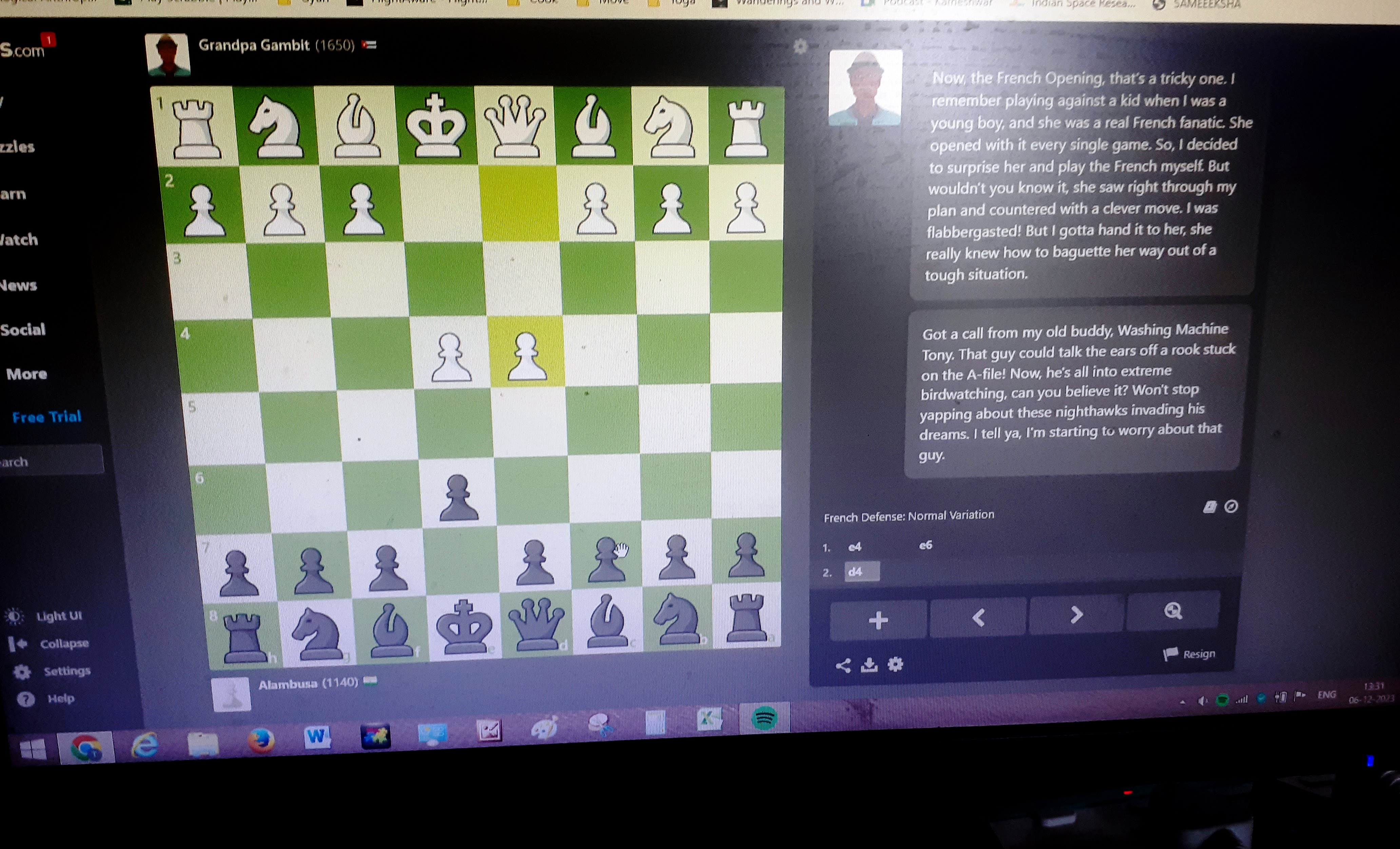
Grandpa Gambit: Grandpa was a brilliant player. Alas, he was also garrulous, like most grandpas. He talked incessantly; he talked even more than I do in my anec-dotage.  Mercifully, Grandpa was good-natured, like P G Wodehouse’s Oldest Member in the Golf Glub. Usually he conversed with himself, that too in lengthy paragraphs, while I was busy trying, without much success, to avoid checkmate.

Sample this opening remark from Grandpa after I made my first move in a game:

 “Now, the French opening…that’s a tricky one. I remember playing against a kid when I was a young boy, and she was a real French fanatic.  She opened with it every single game. So I decided to surprise her and play the French myself. But wouldn’t you know, she saw right through my plan and countered with a clever move. I was flabbergasted! But I gotta hand it to her, she knew how to baguette her way out of a tough situation!”

And another time, when I was staring in disbelief and despair at the devastated ruins of what was left of my chess army and realized checkmate was certain whatever I did, the old geezer prattled cheerfully as follows:

I remember playing against this young whippersnapper in San Antonio back in ’72. I checkmated him and thought that was the end of it. But then, wouldn’t you know it, he goes on to win the US Championship six times! I guess I must have taught him a thing or two, eh? I’m just glad I could help the kid out.”

Every game with Grandpa Gambit was like being whirled, squeezed and hammered flat by industrial machinery before being finally roasted in a high-temperature kiln. But listening to Grandpa (or rather, reading him) made it all worth it.

I still miss Grandpa Gambit. As I miss Nefertiti, and all the other bots of the olden days.

You see, O Dear Patient Reader, the old chess bots have all gone forever…gone the way of all mortal flesh (or rather, the way of all photons and baryons and leptons, long-lived though they might be). They’ve been replaced by new chess bots who, though excellent chess players, hardly talk. And when these newcomer chess bots do talk, their converse is shallow, uninspiring, boring…these new bots somehow lack the originality, the wit, the vulnerabilities, the goofiness, the humanity and individuality of their bot-ancestors.

There’s an insipid, humourless, sameness about all these new bots; they’re almost like…well… Woke bots. 

Well…I guess maybe these new bots are only mirroring what’s happening nowadays to human societies across the world.

Oh, in case you play chess… let’s have a game, do look out for me, a.k.a Alambusa, at https://chess.com/.

General ravings, Potshots

Great Indian Grope Trick, Slipped Discus Throw, Spittle Chase…India prepares to top next Olympics!

I’m so happy for our young Indian athletes who did so well at the just-concluded Paralympics in Paris; in all they won 29 medals! And at the Olympic Games last month, too, our Indian athletes did well—winning 6 medals.

Yet, with China topping the Paralympics with 220 medals, and the USA topping the Olympics with 126 medals, we can’t help think that the Indian government, the Indian corporates, the Indian media money bags…in short the Indian establishment can and should do much more to support sports in India so that more Indian youngsters are given the opportunities and encouragement to become high-performing athletes who can qualify to participate in international sporting events and win more medals.  

To get more gyaan on this matter we obtained an interview with the internationally discredited sports expert Professor Glucose Kuriakose Gillidandan, Head of the Centre for Research & Advanced  Programs in Sports (CRAPS) of the Ministry of Sports, and winner of many national awards including the coveted Bakasura Prize for Sports Dietetics & Nutrition, 2011.

We met Prof. Gillidandan at his comfortable office-cum-laboratory complex in Shahdara, New Delhi, overlooking the rippling brown waters of the Shahdara Drain. A beautiful miniature marble sculpture of the fearsome Bakasura, Rakshasa of Insatiable Appetite, stood on Prof. Gillidandan’s colossal desk next to a laptop, a pen-stand, and assorted files. Through the open window, a gentle breeze occasionally brought in the heady organic aromas of the Shahdara drain, blended deliciously with the sharp inorganic aromas of nitric acid, sulphur dioxide and chlorine from the hundreds of informal and illegal e-waste recycling units spread across the vast urban village of Seelampur on the other bank of the Drain.

“Rest assured India will soon be a leading Olympian power,” Prof. Gillidandan declared in response to our opening query.  “My team at CRAPS is implementing a low-cost, innovative strategy which will guarantee that our budding young athletes will win at least 50 gold medals in the L.A. Olympics, 2028, and top the medals chart in the 2032 Games!”

We were thrilled at his words. “Yeh Bharat Mahaan!” we yelled in our enthusiasm, and he leaned back and smiled while the three peons in the room, along with several chaprasis, clerks, and affiliated touts in the reception hall outside raucously echoed the patriotic chant.

“But…er… how will you achieve this ambitious goal?” we asked when the tumult subsided.

Prof. Gillidandan smiled. “We have adopted a two-pronged strategy.  One: instead of wasting precious time and money in creating costly new sports training infrastructure like stadiums, running tracks, and so on, we will use the sports training infrastructure that is readily available all around us already —in the streets and other public places all across our country—to help build all the qualities that young aspiring athletes need: like courage, self-belief, strength, speed, reflexes, flexibility, determination, endurance, and so. In this way, at virtually no extra cost, we can train and create thousands of world-class Indian athletes! “

We were puzzled, but did not interrupt as he was clearly warming to his theme.

“Two,” he went on, “we are also developing a few innovative, uniquely Indian sports events that we will pilot in the next National Games, and thereafter recommend for adoption in the Olympics and other international sports events. These new sports events are broadly modelled on existing Olympic events— but most importantly, they are also perfectly attuned to the same local conditions in our cities where our youngsters will train. Naturally, our newly-trained  Indian athletes will be able to win many medals in these new events… so it’s a win-win strategy! “

We were deeply impressed. “Er…could you please explain with an example or three …?”

Prof. Gillidandan thought for a moment.

“All right, a good example is our latest invention, the Dribble Jump©.  CRAPS has modelled the Dribble Jump on the traditional Olympic sport known as ‘Triple Jump’.  The essence of the Dribble Jump is the same as the Triple Jump:  the contestant sprints down a straight track and then executes a hop, a bound, and finally a long jump into a sand pit. However, the Dribble Jump is far more challenging than the Triple Jump, because the contestant will have to overcome certain unique and formidable hurdles that are encountered in daily life by Indians everywhere, particularly in big cities. These hurdles are created by Acts of Nature—or more precisely, by Indian men responding to Calls of Nature…”

We couldn’t believe our ears. “Eh?  What? Calls of Nature!  How…what do you mean, sir…”

He went on as though we hadn’t spoken. “In the Dribble Jump, the contestant is required to sprint along a straight, shallow sewage drain, and then execute a hop, a bound, and finally a long jump  over a patch of hard ground littered with puddles and piles of …er….freshly deposited human metabolic by-products.”

Dribble Jump – field trial in progress [image created with MetaAI, Paint, and Insanity]

He paused to feed himself a large zarda paan. We attempted to speak but could only utter faint gulping noises. A peon helpfully proffered a glass of water, which we emptied in three additional gulps.

“You see,” Prof. Gillidandan continued indistinctly around his zarda paan, “ studies by my CRAPS team have revealed certain extraordinary facts about our country: that wherever in India there is a vacant plot of land, or a wall or pavement or fence or even a row of bushes stretching more than ten metres, the local community will proceed to use these areas as garbage dumps. Furthermore, passing Indian men will use the same areas as a public toilet on a continuous basis.  The same practices are manifest along the borders of railway lines, streets, canals, ponds, lakes, and so on.  In a flash we realized that these age-old practices—which are so much a part of our glorious heritage, culture and agriculture— provide us with readily available sports training infrastructure across the country at virtually zero cost!”

We continued to gulp in both English and Hindi. As before, Prof. Gillidandan ignored us completely.

“Let me give you an idea of what I mean,” went on Prof. Gillidandan dreamily. “On a stretch of pavement near my own apartment in Rajender Nagar, New Delhi, I’ve seen children and adults routinely execute Triple Jumps of over 24 metres to avoid landing in or on the fresh pools and piles laid out every morning and evening by large-hearted men of the locality! Compare this with the World Records in Triple Jump, which are a mere 18.29 metres for men and 15.74 metres for women…”

“Gulp…glug…”

“These and other insights helped us to envision and design the Dribble Jump, and commence trials too,” he continued.  He waved a hand towards the window. “We’ve field-tested and validated the Dribble Jump in and around the Shahdara Drain, and will continue trials at the Ghazipur Landfill – the ideal venue! And we’ve identified over 1640 other venues across India in which to demonstrate the Dribble Jump as part of our nationwide awareness-cum-training programme during 2024–25.  We hope to showcase this event in the L.A. Games, 2028, and are confident that the International Olympic Association will adopt the Dribble Jump in place of its traditional Triple Jump—especially because the Dribble Jump’s refreshingly natural and organic hurdles harmonize so well with the global movement towards natural and organic lifestyles…”

Ghazipur Landfill, New Delhi – perfect for trials of Dribble Jump and other innovative CRAPS games

We found our voice at last. “This is incredible…unbelievable!” we croaked. “How on earth could…”

“Yes, thank you very much, sir,” replied Prof. Gillidandan with a modest smile, completely misconstruing our words.  “I’m flattered…but  then  I cannot take all the credit, I must acknowledge the contributions of my team here at CRAPS…”

We resumed our gulping and gurgling; by now we were getting quite adept at it.

He grabbed a thin sheaf of papers from his desk and thrust them at us. “Here, take a look at this,” he said, “They summarize a few other innovative sports events that we’ve designed at CRAPS. Some are being field-testing now—like Slipped Discus Throw, Spittle Chase, Great Indian Grope Trick. A few are at the concept stage…my personal favourite is the Poll Vault, specifically designed for contestants from Indian political parties…”

At this point Prof. Gillidandan’s cellphone rang. After a minute’s conversation he disconnected and jumped to his feet.  “My apologies, I must go,” he muttered. “That was the Sports Minister: I have to meet him immediately…”

And so, mercifully, the interview ended.

But our horror endures.

We’ve gone through the small sheaf of papers that Prof. Gillidandan so kindly gave us study, and present  below the gist of some of the sporting events that he and his team at CRAPS have developed for introduction in the next National Games—and perhaps in future Olympic Games.

We’ve also commenced a three-month course of mild tranquilizers on our doctor’s advice, to overcome the bouts of sudden hysteria that overwhelm us without warning ever since our interview with Prof. Gillidandan. The doctor is confident that we’ll recover completely … but has strictly warned us against any stressful activities including watching sporting events on TV or the Net.

Other innovative sports events developed/under development by CRAPS

[list not exhaustive]

Contestants:  athletes of all sexes, all ages

Like the traditional Olympic Steeple Chase, the Spittle Chase© is a gruelling 3000 meter race; but with a few vital differences.

  • In the Steeple Chase, each contestant is required to run about 3000 metres during which he/she jumps over 28 three-foot hurdles and executes seven ‘water jumps’ , each over a 10-foot wide pit of water).
  • In the Spittle Chase©, each contestant  will  run 3000 metres along  the streets of a typical Indian city road choked with traffic and garbage—for example,  Vikas Marg in New Delhi or Andheri–Kurla road In Mumbai. In Kolkata, Guwahati, and Kanpur, any streets will do.
  • In the Spittle Chase©, each of the 28 barriers will consist of a three-foot high mound of construction & demolition (C&D) waste material in the middle of the road, which are usually available or can be arranged for by municipal agencies, Public Works Department (PWD), etc.
  • instead of jumps over pits of water, the Spittle Chase© runner must execute jumps over seven 10-foot-wide pits filled with trash and/or sewage (such pits, too, are usually readily available at no cost due to the roads caving in after being undermined by leaking sewage pipes)
  • To add to the excitement, 28 city buses will hurtle up and down the road at 50–60 kmph during the Spittle Chase©. Each bus will be filled with expert zarda paan chewers who will take pot-shots— rather, spittle-shots— at the running  contestants  who must weave and twist while running in order to escape being hit by the scarlet and fluid barrage. The contestants must also avoid being run over by the city buses—otherwise they will be penalized.

Participants:  athletes of all sexes, all ages [N.B: orthopaedic surgeons and ambulances will be on standby]

The Slipped Discus Throw© will be a night event – the first ever in the history of India’s National Games, as well as of the Olympics as and when it is introduced!

  • The venue for Slipped Discus Throw© can be any typical newly-developed upmarket area in any of India’s major metropolitan cities— with broad well-lit roads lined with glittering shops and malls, sidewalks littered with C&D waste and garbage, deep uncovered trenches containing exposed electricity and data cables, gas lines, etc., fetid open manholes, and so on.
  • Contestants are required to walk briskly along a designated 400-meter stretch of the road and/or sidewalk without falling or slipping or stumbling and dislocating their hips and/or backs, or tripping over blocks of masonry and tangles of steel wire and breaking their necks.
  • At the end of the 400-meter stretch, the contestant will pick up a standard-size cement block weighing 40 kilograms and throw it across a distance of 10 metres without collapsing on his/her/their/its face or rear. [Note: all cement blocks shall  be tested before the event to ensure that the cement has not been adulterated by unscrupulous contractors]

Participants:  women athletes of all ages

This unique, all-new women’s event can potentially become the most exciting of all sporting events for spectators at the National Games and Olympics!  Highlights:

  • The Great Indian Grope Trick can be held in any large, crowded public place like a shopping arcade, plaza, bazaar, and so on—for instance, Connaught Place in New Delhi, Johari Bazaar in Jaipur, Crawford Market in Mumbai, and so on.
  • The women contestants, wearing bullet-proof suits and carrying pepper-sprays and/or tasers for self-defence, will have to sprint approximately 800 metres along a demarcated route in the venue while evading the groping fingers (and other assorted intrusive digits, appendages, protuberances and tools) of 400 ‘Gropers’ who will be chosen by a rigorous selection process from among the thousands of lechers, oglers, dirty old men, dirty young men, and affiliated riffraff who frequent all the public spaces in all the cities of India.
  • For scoring purposes, the Gropers will be provided with buckets of indelible dye in which to dip their fingers (and any other tools they may wish to deploy). The winning contestant will be the one who completes the course with the minimum number of dye-marks on her apparel and/or the maximum number of pepper-spray/taser strikes on her would-be Gropers.

[Note from Prof.G K Gillidandan: Regrettably, we may have to reconsider promoting this event due to the slightly disturbing comment by Mr Seniram Ungaliwallah Singh, Deputy Director at the Indian Wrestling Federation (Women’s Division), while praising the CRAPS team for developing the Great Indian Grope Trick:

Truly, the Great Indian Grope Trick promises to be a Track & Feel event with a difference! I am confident it will leave an indelible impression on all the spectators, if not the contestants; and touch them to the hearts of their bottoms.”]

Great Indian Grope Trick – preliminary trial [image created with MetaAI, Paint, and Insanity]

Poll Vault©

ParticipantsIndian political leaders

The Poll Vault is an event that offers high entertainment value for spectators. It is primarily aimed at the National Games for the obvious reason that it is open only to Indian MPs, MLAs, and other senior political party leaders who have defected at least three times from one party to another.

  • As with the traditional Pole Vault, the Poll Vault contestant will use uses a long and flexible pole as an aid to jump over a bar and land on a sand pit on the far side.
  • However, in the Poll Vault, a minimum of three rival contestants will be allowed to grab the pole and tug it away from beneath the contestant while she/he/it/them is attempting to vault over the bar.
  • If the contestant loses balance and lands on the same (starting) side,  penalty points will be awarded there and then by the rival contestants in the form of mild beatings with the pole (which may be made of light bamboo to ensure adherence to International Human Rights Law).
  • Contestants who succeed in vaulting over the bar and landing without severe injury will continue to the next round, with the height of bar being raised each time, until the three final winners are found.  


[Notes from Prof. Gillidandan:

(1) The bar may be made from mild steel for all contestants except those from Aam Aadmi Party, who may be allowed to vault over a standard-sized liquor bar

(2) Any contestant who manages to leap to the other side of the bar, and then leap back to the starting side, can be awarded a special medal. I suggest the name ‘N D Tiwari Puraskaar’, in honour of the late lamented Congress leader N D Tiwari who broke away from the Congress to form the Congress (Tiwari), and then defected back from the Congress (Tiwari) to Congress, leaving his Congress (Tiwari) colleagues Tiwari-less.

Poll Vault – concept [image created with MetaAI, Paint, and Insanity]

Jai Hind! Hail our athletes, who do so well despite our apathy and cynicism.

Ancient writings, General ravings

The Rain of Terror [or, Electricity Department Blues]

Please do forgive me for my long silence, O Most Loyal Reader…for Clouds of Angst have filled my deranged mind ever since the Lok Sabha polls, especially because the Aam Aadmi Party candidate for whom I voted—whose name I have forgotten, if at all I ever knew it—lost his/her/its deposit.

But now, as I struggle to cast aside Writer’s Block and emerge from the churning brown Monsoon waters that have turned Delhi into a mosquito-and-politician-infested swamp,  the Gates of Memory briefly open to reveal a dreadful yet inspiring tale I narrated 22 years ago; a tale that I inflict upon Thee now (with some slight modifications), in the hope that it might relieve Thee too of any depression with its moral message—that even within the deepest Pits of Darkness, we may find the Lights of Optimism and Good Cheer….    

Amid the fire and brimstone raised by the recent debates in Delhi and indeed across India over collapsing buildings, flooded streets, and rewriting our history books, an archaeological discovery of immense significance escaped public attention—much to the relief of an embattled government! Indeed, it was only with the greatest reluctance, and that too on conditions of strict anonymity, that a senior archaeologist attached to the Department of Ancient Monuments agreed to reveal details of their extraordinary find.

“The MTNL chaps unearthed it,” he began, “while digging a trench during a routine cable-laying operation in West Delhi. As soon as they alerted us, we rushed to the site to investigate what they’d found. Careful excavations at the site eventually revealed a large rectangular room with a single doorway. It was buried two metres below the surface, and built entirely of a sickly yellow material, that upon chemical analysis turned out to be a kind of inferior grade cement…”

“Cement?” we broke in, startled.  “How could that be…surely cement is a modern construction material…?”

“Exactly!” he cried. “We, too, were excited at the idea that we might have stumbled upon a facet of some hitherto unknown, technologically advanced civilization! At first the chamber we were in appeared to be an ancient necropolis, similar to those found in Egyptian and Mesopotamian sites of contiguous depth. Strange, sinister-looking objects stood here and there on the floor of the chamber, smothered in dirt and dust: some tall and vaguely cuboid, others squat and flat-topped, still others on spindly legs and clustered in little groups. There was something curiously familiar about them…a colleague remarked that they resembled the great dolmens of Stonehenge and Meghalaya. We also found hideous crimson streaks on all the walls, particularly near the corners. They suggested that the chamber might have been the site of ritual sacrifices in ages gone by!”

“It took us a month to survey the layout of the chamber and to record our findings on dictaphones and digital diaries, notebooks and camcorders. Even now I remember the moment when we finally commenced physical verification of the artefacts in the chamber, starting with a flattish mound near the doorway.” He shuddered slightly. “Ahh! Even now I recall the stillness all around, the eerie glow of our solar lanterns, the silence broken only by the hum of our scrapers and the hoarse breathing of my colleagues, the odours of decay and the heaviness of ancient memories in the air…” his voice trailed away.

“And…?” we prompted him gently.

“Oh ye Gods, give me strength!” he choked: the poor man was obviously still traumatized by his experience. He took a deep breath, lit a noxious cigarette with trembling fingers, and went on in a calmer tone: “As we worked away with scrapers and chisels, all of a sudden a great chunk of dirt fell away from the mound. We brushed away the last traces of earth and held aloft two lanterns to better illuminate the scene. Before us stood a crude wooden table, its legs still encased in muck. And on the table lay a monograph; a standard-issue Staff Attendance Register, open at a page marked ‘July 22, 1986..” and again he broke off into a spasm of choking and gasping.

“What!” we cried, aghast. “But what…but how…what did it mean!”

He held up a weary hand. “It meant,” he whispered hoarsely, “that after a month’s painstaking work, we had succeeded in unearthing a long-buried Area Office of the Delhi government’s sole electricity distribution company— the Delhi Electricity Supply Undertaking,DESU.” He paused to wipe his glistening brow.

We gaped at him, attempted to speak but could only make strange gargling noises.

“The other artefacts in the room,” he went on shakily, “revealed themselves to be cupboards, tables, chairs…little wonder they’d looked familiar to us despite being covered in muck! Our subsequent investigations revealed that on the afternoon of that fateful 22nd day of July, 1986, this particular DESU office had suddenly subsided beneath ground level. The cause for its subsidence was a nearby sewage canal, whose waters had progressively undermined the foundations of the DESU office building. Almost immediately thereafter, a violent monsoon storm had struck the city: whereupon a partly-constructed and wholly illegal building on an adjacent plot of land had collapsed onto the site where the DESU office had stood, burying it beneath tonnes of muddy waters, plaster, sand and assorted rubbish. It was fortunate indeed, that these events took place only at 3 p.m—two hours before official closing time, by which time of course all the staff had long left the office—or else the casualties might have been heavy.”

He wiped his brow again. “And so the DESU office remained concealed through the years, buried underground, till our arrival.”

“This is impossible to believe…it’s insane!” we yelled, having at last found our voice. “What about the employees, the DESU office staff? Surely they’d have turned up for work the following day and found their office missing? Surely they’d have tried to locate it, done something …?”

Our colleague emitted a hideous cackle. “Indeed they did!” he replied. “But all of them, from the Officer-in-Charge down to the lowliest assistant peon, were ‘Lessee Employees’: that is to say, each employee held his post in a purely unofficial capacity, on lease as it were, having paid a lump-sum for this privilege to the person whose name was actually on the official roles of DESU.”

We stared at him blankly.

“This system of Lessee Employment,” he explained patiently, “is still in vogue across India, particularly in government and public-sector undertakings . On the one hand, the official employee continues to draw his/her monthly salary but is unshackled of any duties, and thereby able to learn other skills and earn additional income elsewhere. On the other hand, the lessee employee rests content in the fact that under-the-table earnings more than compensate him/her for the absence of an official salary. Indeed, the overall effect of this system is to increase employment and national productivity!”

We made some more strange gargling noises. He ignored them and went on.

“Understandably, then, when these Lessee Employees of the DESU office could not locate their office the following day, there was no question of their lodging any kind of report or complaint—the poor fellows had no locus standi whatsoever! After searching awhile in vain, they therefore quietly dispersed. Our investigations have confirmed that in due course all of them found re-employment, on similar lessee terms, in other Delhi government and municipal bodies.”

A wave of unreality had come over us. “But…but what about the members of the public?” we quavered. “What about all the people in the neighbourhood who had electricity connections, who were served by this DESU office…what of their bills and applications, their files and records? Surely they at least would have complained when their DESU office disappeared?”

“Yes, yes!” our spokesman retorted impatiently. Clearly, he had had enough of the subject and wanted us to leave. “The more naïve and ignorant citizens did indeed lodge reports and complaints—naturally, to no avail whatsoever. One foolish person even filed a PIL before the Delhi High Court—we understand it is scheduled to come up for hearing in October 2029. The majority of people, however, regarded the disappearance of their DESU office—and with it, their files and records—as a supreme stroke of good fortune.”

“What! Why?”

“You see, at a stroke every electricity connection under this Area Office became unauthorized and illegal, because there were no documents left to prove that these connections had ever been sanctioned or even existed! This in turn freed the local citizens forever from power-related worries. Each grateful citizen—householder or shopkeeper, industrialist or businessman—simply made a suitable one-time lump-sum payment to designated DESU personnel who called on him/her at home…and lo! After that there were no more electricity bills to pay or files to chase, no faulty meters to complain about…”

He leaned back in his chair, glanced pointedly at the wall-clock and fed himself a large paan.

Outside the window, we could see the skies had turned a forbidding grey, and there was a heaviness in the air; a brooding stillness that mean only one thing: a great monsoon storm was brewing. Hastily we rose, thanked our spokesman for his enlightening discourse, but paused at the door as a sudden thought struck us: “One thing remains puzzling,” we ventured hesitantly. “What were those crimson stains you found on the walls of the buried chamber…?”

His reply was fluid if not eloquent. With accuracy born of years of practice, a jet of scarlet betel-juice shot out from his mouth straight out the window. We fled even as the lights suddenly flickered, heralding the usual evening power-cut…

[The Sunday Pioneer: January 20th, 2002]

General ravings, Musings

Happy Netako Ungli Dikhana Diwas!!

Just a fortnight to go, O gentle Reader, for the Sacred Day of June 4th — which will mark the grand culmination of the greatest of festivals that Democratic India has gifted to the world… Netako Ungli Dikhana Diwas!

For those among us who might be unfamiliar with India’s glorious heritage and culture, Netako Ungli Dikhana Diwas roughly translates from the ancient Indian language of Tapori Hindi to ‘Day to Show Politician the Finger’.

It is such an appropriately named festival as we traverse the Digital Age, no?

It is the Day We Show Politicians a Digit.

 Netako Ungli Dikhana Diwas is a beautiful festival, even by India’s stellar standards of sublime secular celebration. It is observed once every five years and lasts for many weeks, depending on the Lunatic Calendar.

This time the festivities last for a full 44 days, starting from 19th April and ending on 4st June 2024. 

This Holy Period is marked not by austere fasts, but instead by joyous and frenzied public revelry throughout the nation, with intermittent  region-wise climaxes—called Electoral Days by the intelligentsia and Electoral Dysfunction Days by the irreverent and irrelevant—when We the Wee People troop to our local Electoral Shrines to observe the Hallowed and Powerful Ritual of the Forefinger, our brains numbed by six weeks of incessant, insensitive and incendiary sloganeering, our spirits buoyed by the giga-litres of free ethylated spirits and other heady gifts and freebees distributed among us by the Powers-That-Be who comprise both rulers and the aspiring-rulers of Bharat that is India .

Ahhh! How eagerly I await May 25th, fingers a-twitching in unholy excitement, to take my turn in celebrating this greatest of ancient Indian festivals.

May 25th 2024 is Electoral Day for us Dilli-wallahs.

It is the day I shall sally forth with my co-sufferers in the sweltering Capital, most likely around 07:30 a.m when it is a cool and pleasant 105 degrees F in the shade, to queue up at the designated Electoral Shrine and have my forefinger anointed with Holy Ink by the solemn Presiding Priests and Priestesses and take my turn in the quiet, curtained sanctum sanctorum to choose one name from among the dozen scoundrels, scallywags, assorted crooks and scamsters who seek my vote that might help them become one of the 543 Members of Parliament who will misgovern India for the next five years.

Oh, please don’t get me wrong…I love Lok Sabha Elections.

 I love Netako Ungli Dikhana Diwas!

I also love the Exit Polls that take over every media channel and newspaper from the moment the last vote is cast—from the evening of June 1st, that is! This year, I’m going to binge-watch at least five different Indian TV news channels— and also monitor leading and misleading Indian and international online news portals of impeccable disrepute such as The Wire, BBC, New York Times, The Dawn, and The People’s Daily—to chortle non-stop at their wildly diverse ‘analyses’ and predictions as to which political party or alliance is going to emerge as the winner.

And when Netako Ungli Dikhana Diwas dawns…June 4th… Oooooohh! Awwwwkkk!

Already, I tremble in anticipation of getting a year’s worth of mirth and merriment from morning to night as I watch and listen to anxious anchors, earnest experts, jaded journalists, pontificating psephologists and affiliated pretenders yap away non-stop as the numbers and results come in from across the country;  numbers and results that will invariably differ exponentially from all their painstakingly presented pre-poll and exit poll predictions. 

And my chuckles will explode into belly-aching roars of laughter and I will double over and and shake and dance in ecstasy in front of the TV screen—and perhaps waggle my Holy Ink-anointed finger and wiggle my non-Holy Ink-anointed butt in their collective faces for good measure—as they explain how in fact they actually got all their predictions right,  and how it is that We, the Wee People, must take the blame for not voting according to their analyses and predictions.  

I look forward to chortling over brave explanatory phrases like these from the Talking Heads on TV, YouTube, WhatsApp, Twitter and other boob-tubes:

“…Thus, our forecasts were absolutely spot-on! The variance from actual results is only because our correctly predicted swing factor towards the Secular I.N.D.I.A Coalition in North Indian states has been counter-balanced by the last-minute counter-oscillation of Backwards towards the Hindutva-inclined BJP, though of course this in turn has been somewhat mitigated by the usual Koeri-Kurmi antipathy toward the Right-leaning Thakurs, the Centrist Yadavs, and Left-leaning EBCs and Muslims…”

“As you can see from this graphic, our predictions that the Congress would sweep Uttar Pradesh with 75–80 seats were 100% accurate. The fact that they’ve actually won only 3 seats is entirely due to the urban and peri-urban electorate’s incremental wooing by the BJP through excremental programs like Swacchh Bharat Abhiyaan…”

“The sweep by BJP in Delhi has nothing to do with the AAP broom. It is directly a result of the complex interplay between the policy paralysis of the AAP government with over 60% of its Cabinet Ministers in Tihar Jail,  and the mid-election Maliwal–Kejriwal– Sheesh Mahal –Ghotalay Golmal,  combined with the overall  Maha-Dalit–Bhumihar consolidation against I.N.D.I.A in NCR region and the Adi Dravid-Tamil Brahmin groups in Tamil Nadu against the DMK…”

“To put it in plain and simple language:  the results only underline the deep inroads carved into the superstructure of Indian democracy by the enduring Brahmanical Hegemony that, strengthened by communal agendas and catalysed by the institutionalization of Comprador agencies masquerading as pseudo-Right Liberal entities, have promoted exploitative neo-Capitalist policy frameworks and schemes which have historically been proven to be contrapuntal to the interests of the oppressed subaltern sections of society…”

O precious Reader, please do pardon my feeble efforts above: these are mere examples, pale imitations of the turgid, hilarious phrases that we will actually get to hear from the learned Talking Heads who will analyse the poll results for us, from June 4th till the next Lok Sabha elections.

 Ahh! It is at times like this that I miss those supremely entertaining Talking Heads of yesteryear:  those masters and mistresses of gobbledygook whose names most of us have forgotten… like Purana  Roy, Khadka Butt, Saregama the Ghost, et al…

But then, we still have the likes of Roger Deep- Sordid Sai,  Hardknob Gowshala and Nervy Cuckoomar to regale us as we track the poll outcomes up to and even beyond Netako Ungli Dikhana Diwas…to Gaali Diwas.

Gaali Diwas!

The Day of Swearing-In!

Gaali Diwas is the day the newly-appointed Prime Minister and his/her chosen Ministers take their oaths and are sworn in to their respective orifi…er…offices. 

Going by its name, Gaali Diwas should be the day when you and I should be given the opportunity to attend the swearing-in rituals personally so that we can swear and hurl oaths and abuse at the newly-appointed Prime Minister and his chosen Ministers as they take their oaths. Particularly, if they are not the leaders we voted for.

However, this requires reform in the Law.

I am confident that the Leader for whom I am going to vote will bring in the necessary reform to allow the public this wonderful and indeed fundamental right to free fundamentalist expression.

I shall pray for such an outcome on May 25th, when I visit my Electoral Shrine and vote.

“Bollocks!” exclaims the Resident Lizard, rudely interrupting my flow of thoughts.

The Resident Lizard has crept up on me silently, like a predatory Aam Aadmi Party leader in Kejriwal’s Sheesh Mahal, and is reading over my shoulder as I write. It is a most annoying habit (his reading over my shoulder, I mean, not my writing).

“If your Chosen Leader becomes Prime Minister, you wouldn’t want to swear at him,” my reptilian colleague adds with his typical cussed logic. “So what’s the point of your Chosen Prime Minister bringing in a reform that allows  you to swear at him when he’s being sworn in, when you’re anyway not going to swear at him?”

Infuriated, I throw a priceless crystal cup, a wireless mouse, a printer cartridge, my reading glasses case and three pens at the Lizard. All miss their target; but he skilfully extracts the reading glasses from the case, dons them with a sardonic chuckle and scuttles off to the living room to read the newspaper.

I regain my composure; I realize I must tolerate the Resident Lizard’s presence and his views.

After all, he too, awaits Netako Ungli Dikhana Diwas.

And so, I conclude this herewith before joining him in the living room.

Hail the spirit of Vasudaiva Kutumbakam.

Jai Hind!